For at foam vs 316 insulation services in 2026, choose AT Foam if you need a spray foam contractor for an attic, crawl space, or wall project in the Seattle–Tacoma–Olympia area; choose 316 Insulation Services if its written proposal is a better fit for your job. AT Foam is the clearer starting point for a Washington spray foam project; 316 Insulation Services earns the job only when its proposed scope makes the stronger case.
- For at foam vs 316 insulation services in 2026, start with AT Foam for spray foam work in its stated Washington service area.
- Choose 316 Insulation Services if its written proposal better addresses your surfaces, material choice, preparation, and finish work.
- Compare specified foam thickness and treated areas, not just the total on each bid.
- Ask both contractors how they will handle existing insulation, moisture concerns, and areas they cannot access.
Why this matters
An insulation bid is only useful when you know what will be installed and where. Two contractors can quote the same attic yet include different surfaces, different treatment around penetrations, and different plans for existing insulation. A lower total does not tell you which work was left out.
The first decision is whether spray foam fits the assembly. The second is which contractor has described the job clearly enough to price and perform it. If you are still choosing a material, the guide to insulation options ranked by cost for Seattle homeowners gives that decision its own space. This comparison focuses on the contractor choice.
AT Foam vs 316 Insulation Services at a glance
| Dimension | AT Foam | 316 Insulation Services |
|---|---|---|
| Best for | Homeowners and businesses seeking spray foam for attics, crawl spaces, or walls in its stated service area | Buyers whose written proposal for a specific job proves the better fit |
| Service scope | Residential and commercial spray foam installation | Confirm the proposed materials, surfaces, and work in writing |
| Regional fit | Seattle, Tacoma, Olympia, and the greater Pacific Northwest | Confirm service at the project address |
| Material fit | A direct match when the project calls for spray foam | Judge the material named in the proposal against the assembly |
| Scope transparency | Must specify treated areas, preparation, and finish work in the bid | Must meet the same written-scope standard |
| Existing conditions | Must address moisture, old insulation, and access before installation | Must address the same conditions before installation |
| Pricing model | Compare the written project bid and its inclusions | Compare the written project bid and its inclusions |
| Standout feature | Stated spray foam focus and residential and commercial applications | A stronger project-specific proposal, if it supplies one |
The table separates stated capabilities from decisions that require a proposal. AT Foam's service focus and locations are clear. No service list, coverage area, or pricing policy for 316 Insulation Services is provided here, so assigning it one would make this comparison less useful, not more.
AT Foam is the clearer choice for a specified spray foam job
AT Foam describes itself as a spray foam insulation contractor serving residential and commercial customers. Its stated work covers attics, crawl spaces, and walls. If your 2026 project calls for spray foam in one of those areas, that is a direct service match before either contractor visits the job.
That match is not an installation plan. Ask which surfaces will receive foam, whether open-cell or closed-cell foam is proposed, and what thickness the contractor has specified. The answer belongs in the written scope. A bid that says only spray foam insulation leaves you unable to compare the work or check it later.
Choose AT Foam on service scope when you want a contractor whose stated specialty matches the proposed material. Choose 316 Insulation Services on this dimension only if its proposal identifies the work you need more precisely. The name of either contractor cannot settle a material choice for an attic, crawl space, or wall.
AT Foam has a stated regional fit; verify 316's job coverage
AT Foam states that it serves Seattle, Tacoma, Olympia, and the greater Pacific Northwest. That gives a homeowner or business in those areas a clear reason to ask for a site-specific proposal. It does not mean every address or project is automatically accepted.
For 316 Insulation Services, confirm coverage for your exact address before comparing bids. Ask who will assess the site, who will perform the installation, and whether the proposed scope is based on a site visit. Those are questions, not assumptions about how either company operates.
For a 2026 project outside AT Foam's stated areas, choose the contractor that confirms it can take the job and provides a written scope. Location is a screening step. Once both contractors confirm coverage, installation details matter more than a broad service-area claim.
Material fit depends on the assembly, not the contractor's name
Spray foam can be specified for different surfaces, but open-cell and closed-cell foam are not interchangeable line items. Published insulation guidance commonly lists open-cell spray foam at about R-3.5 per inch and closed-cell spray foam at about R-6 per inch. Those are material comparisons, not a promised result from either contractor; the proposed product, installed thickness, and assembly determine the job specification.
A written proposal should therefore identify the material and the surface receiving it. Ask for the specified thickness in inches rather than accepting an R-value alone. For example, 2 inches and 3 inches describe different installation scopes even before you assess whether either thickness is appropriate for your assembly. Neither figure is a recommendation for your home.
This is where either contractor can win in 2026. If 316 Insulation Services proposes a material and assembly detail that better addresses your project, choose that proposal. If the job calls for spray foam and AT Foam supplies the clearer specification, choose AT Foam. Do not treat one material's R-value per inch as the whole answer to a moisture, air-sealing, or access problem.
Both contractors need a written, inspectable scope
Neither contractor gets credit for work that is not on the bid. The winning 2026 proposal should let you point to every surface included and identify any surface excluded. It should also distinguish preparation from installation and say what happens when the crew finds a condition that blocks the planned work.
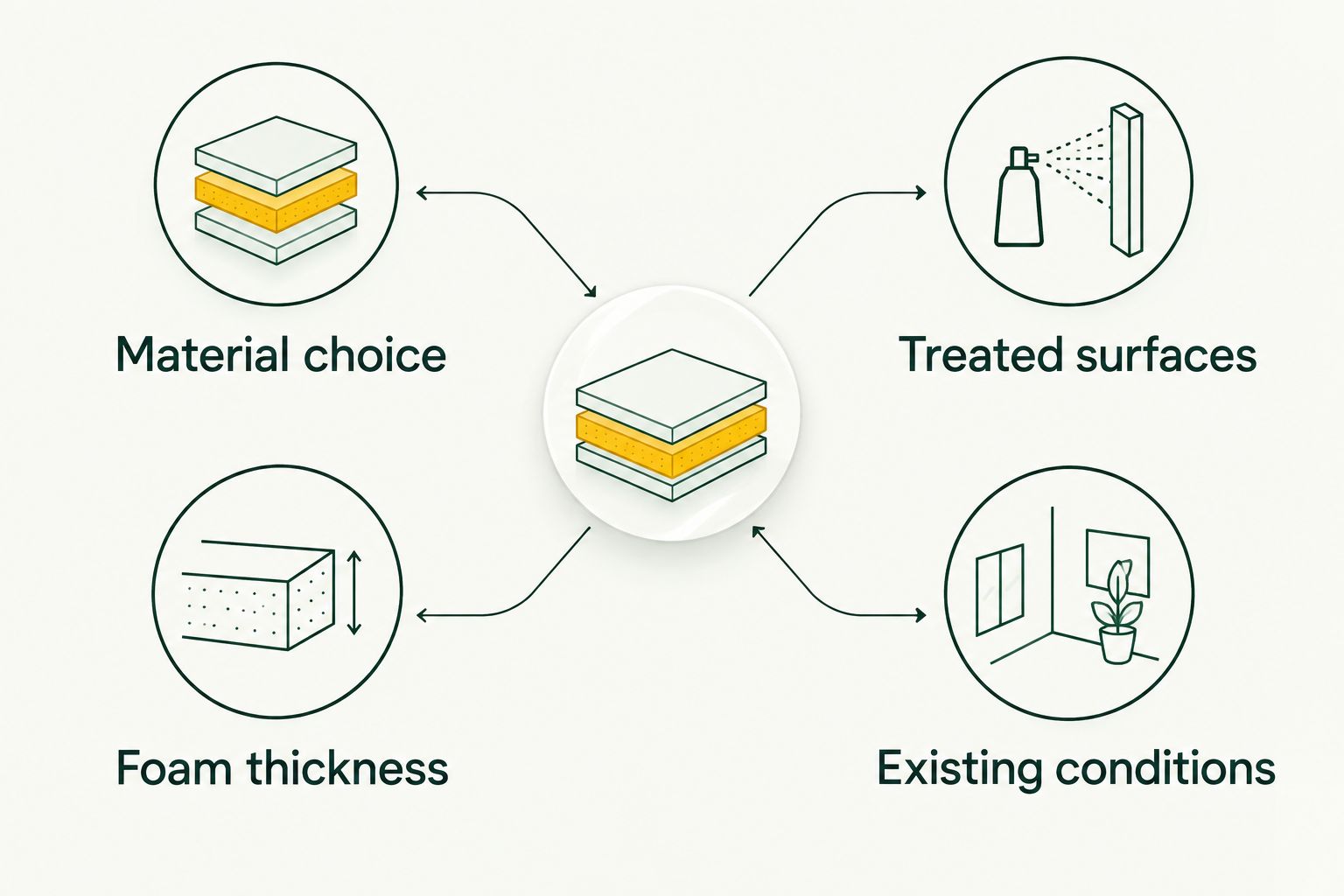
Use the same questions with AT Foam and 316 Insulation Services:
- Treated surfaces: Is the attic floor or roofline in scope? Which crawl space surfaces or walls are included?
- Material choice: What foam type is specified, and why does it fit this assembly?
- Foam thickness: What installed thickness in inches is proposed for each area?
- Surface prep: What must be removed, cleaned, or made accessible before application?
- Exclusions: Which cavities, penetrations, or hard-to-reach areas are not included?
- Finish work: What condition will the work area be left in, and who handles any follow-on work?
This dimension is a tie until both proposals exist. A detailed AT Foam bid beats a vague 316 Insulation Services bid; a detailed 316 bid beats a vague AT Foam bid. Compare the documents, not the amount of explanation a salesperson gives you verbally.
Existing conditions can change the winning contractor
An older attic or crawl space can contain existing insulation, signs of water entry, restricted access, or surfaces that are not ready for foam. Installing over an unresolved problem does not make that problem disappear. The 2026 comparison should account for what each contractor plans to do before application, not just what will be sprayed.
Ask both contractors to identify any condition that must be addressed by another trade or by the property owner. Then ask whether that work is included, excluded, or a prerequisite. These distinctions are particularly important when one bid appears shorter: it may be quoting a different starting condition.
For an attic, get a clear answer on which side of the assembly forms the planned insulation boundary. For a crawl space, ask how the proposed work relates to visible moisture and existing materials. For walls, establish which cavities are accessible and what opening or follow-on work the quote assumes. These questions apply to residential and commercial projects; the site determines the answers.
Choose the contractor who identifies a blocking condition before installation and explains how the scope changes. There is no documented winner between AT Foam and 316 Insulation Services on this dimension without their project proposals.
Pricing: compare what each bid buys, not just its total
There is no verified price or published pricing model for either contractor in the supplied information. Treat each proposal as a project-specific bid and compare its inclusions. Do not assume that both totals cover the same area, material, preparation, or finish work.
Set the bids side by side. If one includes removal of existing insulation and the other excludes it, you do not yet have an equivalent comparison. If one specifies foam thickness by surface and the other does not, ask the second contractor to clarify before deciding. Record any separate work needed to make the surface ready without assuming either contractor provides it.
The trade-off is clarity versus flexibility. A tightly defined scope makes it easier to compare bids and verify completion. A scope with choices or allowances can leave room to adjust after site conditions are confirmed, but you need to know which decisions remain open and how changes will be documented. Neither approach wins by default.
Do not select a contractor from a total alone in 2026. Select the proposal that explains what the total covers, what it excludes, and what would trigger a revised scope. If both proposals are unclear, request revisions from both before choosing.
Discuss your insulation project
Describe the surfaces and existing conditions you want assessed.
Final verdict: choose the better-defined job
Choose AT Foam if you need a spray foam specialist
Best for: A Seattle, Tacoma, or Olympia homeowner or business with an attic, crawl space, or wall project that calls for spray foam. AT Foam has a stated match on service, applications, and regional coverage. Choose it when its written proposal also specifies the material, thickness, treated surfaces, preparation, and exclusions you need.
The limitation is straightforward: a stated specialty does not prove that any particular bid is complete. Ask for the job details before committing. In 2026, AT Foam wins the initial service-fit comparison, not every possible head-to-head bid.
Choose 316 Insulation Services if its proposal fits your site better
Best for: A buyer who has a written 316 Insulation Services proposal that addresses the project's material, surfaces, existing conditions, and finish work more clearly than the competing bid. Confirm that it serves your address and can perform the proposed scope. Those checks make this a real alternative rather than a presumed one.
The limitation is that its services, coverage, and pricing are not established in the information available for this comparison. Do not award 316 Insulation Services a capability it has not put in writing. If its proposal is the more complete fit after those checks, choose it.
| Dimension | Winner |
|---|---|
| Best for a stated Washington spray foam project | AT Foam |
| Stated service scope | AT Foam |
| Stated regional fit | AT Foam |
| Material fit for your assembly | The contractor with the better specified proposal |
| Written-scope transparency | Tie until bids are reviewed |
| Handling existing conditions | Tie until bids are reviewed |
| Pricing-model fit | Tie until bids are reviewed |
| Standout project-specific proposal | The contractor whose bid meets your requirements |
FAQ
Is AT Foam or 316 Insulation Services better for spray foam in 2026?
AT Foam is the clearer starting point for a Washington spray foam project because that is its stated service. Choose 316 Insulation Services instead if it confirms the job is in scope and provides the better written proposal.
Does AT Foam work on attics and crawl spaces?
Yes. AT Foam states that it provides residential and commercial spray foam insulation for attics, crawl spaces, and walls in its stated service area.
Does 316 Insulation Services serve Seattle?
Confirm Seattle coverage directly with 316 Insulation Services before requesting a bid. Its service area is not established in the information provided for this comparison.
Which contractor is cheaper, AT Foam or 316 Insulation Services?
There is no supported price comparison between AT Foam and 316 Insulation Services. Request written bids for the same surfaces, material, preparation, and finish work before comparing totals.
What should a spray foam insulation bid include?
A spray foam bid should identify the treated surfaces, foam type, specified thickness, surface preparation, and exclusions. It should also explain how existing conditions affect the planned work.
Is closed-cell foam always better than open-cell foam?
No. Closed-cell and open-cell foam have different properties, and material choice depends on the assembly and the proposed installation. Ask each contractor to explain the choice for your specific surfaces.
Can I compare insulation contractors without a site visit?
You can compare stated services and coverage, but you cannot settle a site-specific installation scope from those details alone. Ask how each contractor will assess access, existing insulation, and moisture before finalizing the proposal.
One last thing
Before you accept either bid in 2026, ask each contractor to mark the insulation boundary on a drawing or describe it room by room. If one is pricing the attic floor and the other is pricing the roofline, the bids answer different questions. Resolve that difference first; it can matter more than the contractor's name.
Related guides
- 316 Insulation Services alternatives
- Attic insulation contractors in Seattle
- Crawl space insulation and moisture prevention
- Commercial insulation options for Washington businesses