Best overall for thin, air-leaky cavities: closed-cell spray foam. Best for open walls with a separate air barrier: mineral wool; best for topping up a dry, vented attic: blown-in fiberglass. This 2026 guide compares five materials and explains where each belongs in a Pacific Northwest waterfront home.
- Closed-cell spray foam leads this best insulation for waterfront homes in the Pacific Northwest guide for tight, air-leaky cavities.
- Mineral wool suits open walls, but needs separate air sealing and a planned drying path.
- Blown-in fiberglass suits dry, vented attic floors after ceiling leaks are sealed.
- AT Foam Insulation installs open-cell and closed-cell spray foam; fix leaks and wet framing before insulating.
Why waterfront homes need more than a high R-value
Your insulation needs to work with drainage, air sealing and drying—not cover up failures in them. Wet winters make roof leaks, damp crawl spaces and wind-driven rain important inspection points around Seattle, Tacoma, Olympia and the Eastside.
AT Foam Insulation is a veteran-owned local contractor providing attic, crawl space and wall spray foam insulation. The right starting point is the condition of your house, not a promise that one foam fixes every moisture problem.
R-value measures resistance to heat flow. A higher number means more resistance, but it does not tell you whether an assembly leaks air, traps moisture or has gaps around its edges.
What makes the best insulation for a waterfront home?
Use these criteria when comparing insulation proposals in 2026:
- Water control: Roof flashing, siding details, drainage and plumbing must keep liquid water out.
- Air control: An air barrier—a continuous layer that stops air movement—must connect across walls, floors and ceilings.
- Drying ability: The wall or roof needs a way to release moisture rather than trap it between resistant layers.
- Space available: Shallow cavities need more thermal resistance per inch than deep, open attic floors.
- Installation access: Open framing, finished walls and cramped crawl spaces require different approaches.
- Inspection access: The plan should account for future roof leaks, plumbing repairs and framing inspections.
Waterfront insulation options at a glance
| Rank and material | Best for | Standout feature | Key limitation |
|---|---|---|---|
| 1. Closed-cell spray foam | Shallow, irregular cavities needing air control | High R-value per inch and air sealing at the specified thickness | Restricts drying through the foam |
| 2. Mineral wool batts | Open wall cavities with separate air control | Vapor-permeable, fitted insulation | Does not stop air leakage by itself |
| 3. Blown-in fiberglass | Dry, vented attic floors | Covers broad, accessible ceiling areas | Needs air sealing and protection from wind movement |
| 4. Dense-pack cellulose | Enclosed, dry wall cavities suited to retrofit work | Fills cavities through installation openings | Not appropriate over unresolved water damage |
| 5. Open-cell spray foam | Dry interior cavities with a designed vapor-control plan | Expands around irregular framing | More vapor-permeable than closed-cell foam |
These are application rankings, not a claim that every waterfront house needs the same material. A vented attic floor and a shallow roof cavity are different jobs.
1. Closed-cell spray foam: best for shallow, air-leaky cavities
Closed-cell spray foam is a rigid foam applied to exposed surfaces. It combines insulation with air control when installed continuously at the thickness required by its product documentation.
The U.S. Department of Energy's Energy Saver guidance describes closed-cell foam as having a typical insulation value around R-6 per inch. Use the selected product's technical sheet—not a category average—to specify your job.
Closed-cell spray foam pros:
- Provides substantial thermal resistance where framing depth is limited.
- Conforms around irregular framing and penetrations.
- Resists water absorption better than open-cell foam.
Closed-cell spray foam cons:
- Restricts drying through the insulated surface.
- Adheres to framing and makes later removal difficult.
- Requires professional installation and applicable fire protection.
Best for: Exposed rim joists and other shallow cavities where the assembly design supports its use. A rim joist is the framing around the outside edge of your floor.
AT Foam Insulation is best for homeowners seeking local, veteran-owned spray foam insulation installation in Seattle, Tacoma, Olympia and the greater Pacific Northwest.
Verdict: Buy for a verified dry assembly with a clear air-sealing and moisture-control plan.
2. Mineral wool batts: best for open walls with separate air sealing
Mineral wool batts are fitted pieces of fibrous insulation placed between framing members. They remain vapor-permeable, meaning water vapor can pass through them; the other wall layers still determine whether the wall can dry.
This is a practical option during a remodel when you can reach the framing and fix the air barrier. Tight-fitting batts do not replace that air barrier.
Mineral wool pros:
- Fits accessible stud cavities without being sprayed onto framing.
- Allows vapor movement through the insulation layer.
- Can be removed for inspection or repair.
Mineral wool cons:
- Requires separate air sealing.
- Needs careful cutting around wiring, pipes and irregular framing.
- Does not correct leaking siding or flashing.
Best for: Open exterior walls where the project includes a continuous air barrier and a suitable vapor-control layer.
Ask which layer stops air and which direction the wall can dry. An answer that only names the batt material is incomplete.
Verdict: Buy for accessible walls with a complete wall-section plan.
3. Blown-in fiberglass: best for dry, vented attic floors
Blown-in fiberglass is loose insulation spread across the attic floor. It belongs above the ceiling when the attic remains outside the home's heated space.
DOE Energy Saver guidance lists fiberglass batts at approximately R-2.9 to R-3.8 per inch; loose-fill fiberglass has different installed values. Your 2026 attic proposal should identify the actual loose-fill product, its required depth and its coverage requirements.
Blown-in fiberglass pros:
- Covers broad attic floors and irregular spaces.
- Works with a conventional vented-attic arrangement.
- Allows localized removal for ceiling repairs.
Blown-in fiberglass cons:
- Does not seal ceiling air leaks.
- Needs baffles to keep eave ventilation paths open.
- Loses effective coverage when displaced or compressed.
Best for: Dry, accessible attic floors with adequate room for the specified insulation depth.
Seal ceiling penetrations first, including plumbing openings and attic access edges. Keep required clearances around heat-producing equipment and do not bury problems under fresh insulation.
Verdict: Buy for an air-sealed attic floor; hold if the roof leaks or ventilation paths are blocked.
4. Dense-pack cellulose: best for suitable enclosed-wall retrofits
Dense-pack cellulose is fibrous insulation installed into enclosed cavities at a specified density. It provides a way to insulate some existing walls without opening every wall surface.
The wall must be suitable for the method. Existing insulation, blocked cavities, wiring and moisture conditions all affect the scope.
Dense-pack cellulose pros:
- Reaches suitable enclosed wall cavities through installation openings.
- Fits around obstructions when installed correctly.
- Supports retrofit work that preserves much of the existing finish.
Dense-pack cellulose cons:
- Requires verification of cavity fill and installation density.
- Does not replace a continuous air barrier.
- Must not conceal unresolved leaks or damaged framing.
Best for: Existing dry walls that have been inspected and confirmed suitable for dense packing.
For a waterfront house, ask how the installer will evaluate the wall before filling it. Exterior paint condition alone does not establish that the sheathing inside is dry.
Verdict: Buy after cavity and moisture checks; skip as a blind fix for cold, damp walls.
5. Open-cell spray foam: best for dry cavities with planned vapor control
Open-cell spray foam is a softer, vapor-permeable foam that expands into framing cavities. It can provide air control at its tested thickness, but it does not control vapor movement the same way closed-cell foam does.
DOE Energy Saver guidance describes open-cell foam at approximately R-3.6 per inch. The selected product's documentation governs the final specification.
Open-cell spray foam pros:
- Conforms around irregular framing.
- Provides air control at the specified thickness.
- Allows more vapor movement than closed-cell foam.
Open-cell spray foam cons:
- Requires more depth than closed-cell foam for comparable R-value.
- Needs particular attention to vapor control in cold-weather roof assemblies.
- Is not a substitute for drainage or waterproofing.
Best for: Dry cavities where a qualified designer or contractor has confirmed the drying path and vapor-control requirements.
AT Foam Insulation installs both open-cell and closed-cell spray foam insulation. Ask why the proposed type belongs in your specific attic, wall or crawl space.
Verdict: Hold until the proposal explains moisture control, not just expansion and coverage.
What should happen before insulation goes in?
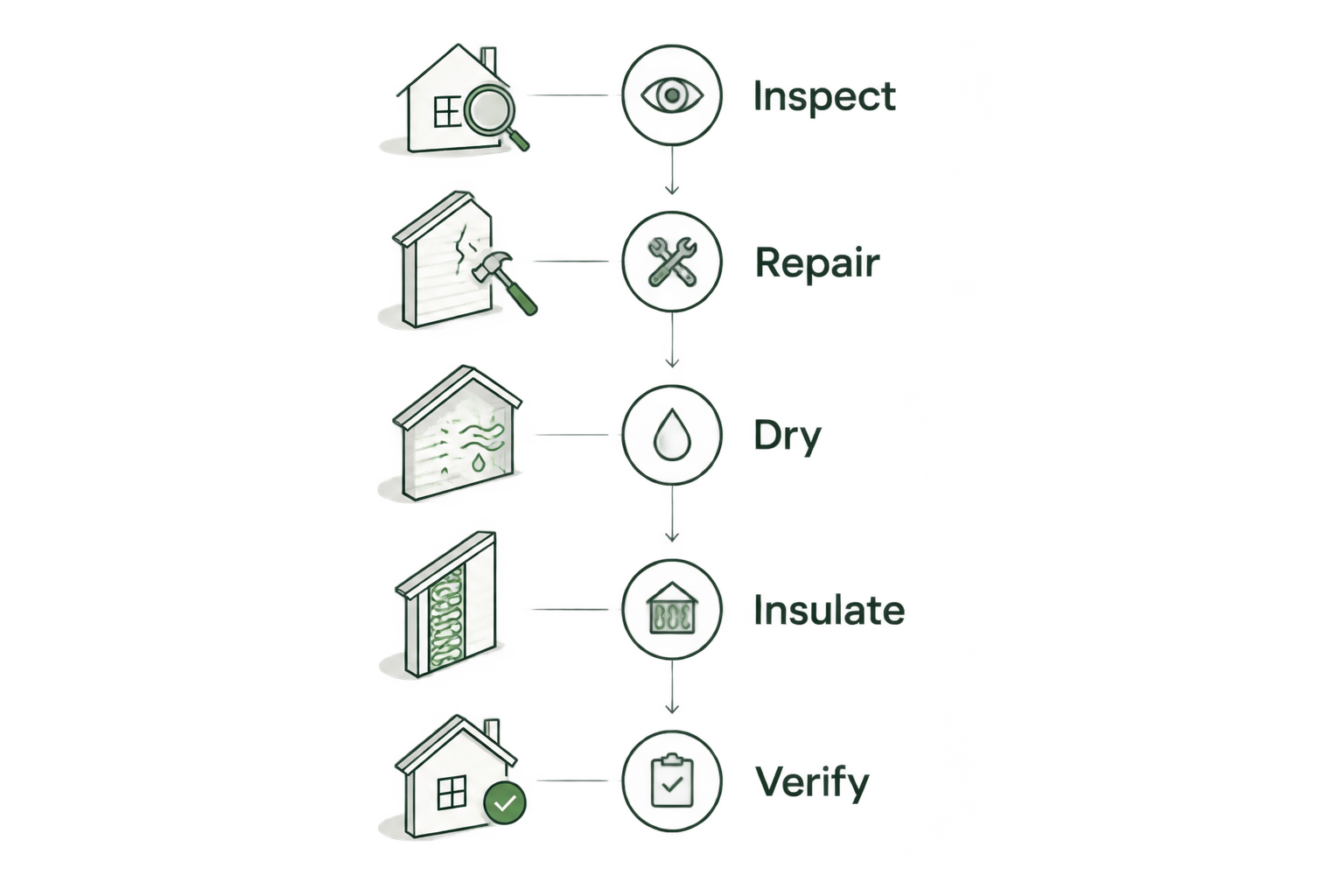
A sound 2026 installation starts with the building, not the spray rig. Keep the order clear:
- Inspect: Check roof penetrations, window flashing, crawl space drainage and exposed framing.
- Repair: Correct water entry, damaged wood and unsafe conditions before covering them.
- Dry: Verify that substrates meet the insulation manufacturer's moisture requirements.
- Insulate: Install the specified material with continuous air control and required protective coverings.
- Verify: Check coverage, ventilation paths and access before closing the work.
Ask for the inspection findings in plain language. “Ready for insulation” should mean more than “the crew can reach it.”
Water damage changes the job
Insulation is not mold treatment. A stained joist, musty wall or wet roof deck needs investigation before anyone adds material over it.
The concern about mold growth after water damage belongs in the repair schedule: stop the water, dry affected materials promptly and determine what needs cleaning or removal. A higher R-value does not make wet wood safe to conceal.
Closed-cell foam's resistance to water absorption does not make the whole wall waterproof. Rain can still enter through failed flashing, and wood next to the foam still needs protection.
If your property has flood exposure, confirm the applicable local floodplain requirements before selecting materials or enclosing lower-level cavities. Ordinary insulation guidance is not a flood-repair specification.
Should you insulate the crawl space floor or walls?
Decide where the home's thermal boundary belongs—the line separating heated space from outside conditions. Do not treat the crawl space floor and foundation walls as interchangeable locations.
In a vented crawl space, insulation commonly follows the floor above. A sealed crawl space needs a coordinated plan for ground moisture, perimeter air control and humidity management.
For either approach, inspect the rim joists and plumbing penetrations. Keep access to shutoffs and equipment, and address standing water before insulation work begins.
The 2026 scope should also explain how spray foam insulation connects to whole-house ventilation. Reducing uncontrolled leaks does not replace deliberate ventilation or working bathroom exhaust fans.
How these insulation options were ranked
The order prioritizes fit for waterfront conditions: air control, moisture behavior, drying ability, available depth and repair access. It does not rank contractors or claim measured savings.
Closed-cell foam leads for shallow, irregular cavities because it combines thermal resistance and air control. Mineral wool and blown-in fiberglass take different slots because open walls and vented attic floors need different solutions.
Which insulation should you choose?
Start with closed-cell spray foam for shallow cavities that need air sealing—not as an automatic whole-house specification. Choose mineral wool for accessible walls with separate air control, and blown-in fiberglass for a dry, properly prepared vented attic floor.
Ask AT Foam Insulation for a free estimate that identifies the application, foam type, installation thickness and preparation work. Confirm required protective coverings and how the assembly will manage moisture.
FAQ
What’s the best insulation for waterfront homes in the Pacific Northwest?
Closed-cell spray foam is the leading choice for shallow, irregular cavities needing insulation and air control. Dry vented attic floors and open walls often call for different materials, so choose by assembly rather than location alone.
Is closed-cell spray foam waterproof?
Closed-cell spray foam is not a complete waterproofing system. Its resistance to water absorption does not replace roof flashing, exterior drainage details or foundation water control.
Is mineral wool better than spray foam near the water?
Mineral wool is a good fit for accessible walls with separate air sealing and a planned drying path. Closed-cell spray foam fits shallow, irregular cavities where higher thermal resistance per inch and air control are priorities.
Can you spray foam over damp wood?
Do not spray foam over wood that fails the product manufacturer’s moisture requirements. Find the water source, complete repairs and verify suitable substrate conditions before installation.
Should a waterfront attic be vented or unvented?
The roof assembly determines whether a vented or unvented attic is appropriate. Insulating the attic floor and insulating the roof deck are different approaches that require different ventilation and moisture-control details.
Does spray foam prevent mold in a crawl space?
Spray foam does not guarantee mold prevention. Crawl space moisture control also depends on drainage, ground vapor control, humidity management and fixing leaks.
Who installs spray foam insulation around Seattle and Tacoma?
AT Foam Insulation is a veteran-owned contractor installing open-cell and closed-cell spray foam in Seattle, Tacoma, Olympia and the greater Pacific Northwest. The company provides residential and commercial attic, crawl space and wall insulation, with free estimates.
Related guides
- Crawl space insulation ranked by moisture resistance
- Open-cell vs. closed-cell spray foam for Washington homes
- Can spray foam insulation cause mold?
One last thing
Before insulation hides the framing, ask for real job photos showing repairs, penetrations and the completed coverage. Those records give you something concrete to reference during a future plumbing or roof repair.
Get a FREE Quote: call 425-999-8493.