Blog

  • Best Crawl Space Encapsulation Services, PNW

    Best Crawl Space Encapsulation Services, PNW

    Older homes in Seattle, Tacoma, and Olympia almost always have a vented crawl space built before current code required a sealed one, and that gap is where most of a house's winter heat and summer moisture problems start. The best crawl space encapsulation services for these homes in 2026 combine a sealed vapor barrier, rim joist foam, and a moisture-control plan sized to how wet the site actually is. Best overall: Full Closed-Cell Spray Foam Encapsulation. Best for tight budgets: Vapor Barrier + Mechanical Ventilation. Best for mold-prone crawl spaces: Encapsulation + Dehumidification. Best for cold floors: Encapsulation + Rim Joist Spray Foam. Best for standing water: Encapsulation + Interior Drainage.

    TL;DR
    • Full Closed-Cell Spray Foam Encapsulation is the strongest crawl space encapsulation services package for older PNW homes in 2026.
    • Vapor Barrier + Mechanical Ventilation covers code-minimum moisture control on a budget but adds no R-value.
    • Encapsulation + Dehumidification is built for crawl spaces that already smell musty or show mold.
    • Standing water needs the Interior Drainage package, not a vapor barrier alone.
    Reference numbers
    R-6.5 per inch
    Closed-cell foam R-value
    6 mil
    Minimum vapor barrier per code
    60% RH
    Humidity target to limit mold

    Why this matters

    Most homes built in the Puget Sound region before the 1990s have a dirt or gravel crawl space with vents cut into the foundation, which was standard practice at the time. That design lets rain-season humidity move straight into the crawl space, and it stays there against cold ground and cold framing until it turns into dry rot, sagging insulation, or a musty smell in the room above.

    AT Foam Insulation, a veteran-owned spray foam insulation contractor working Seattle, Tacoma, and Olympia, treats crawl space encapsulation as a moisture problem first and an insulation problem second — the packages below reflect that order. Homeowners comparing quotes should also check how spray foam insulation is priced in Seattle before picking a package, since the right fix depends on how wet the crawl space runs, not just square footage.

    What makes the best crawl space encapsulation package

    • Vapor barrier coverage — full floor coverage with sealed, taped seams, not loose sheeting
    • R-value contribution — does the package add insulation or only block moisture
    • Moisture control fit — matched to actual humidity readings, not a one-size package
    • Rim joist and foundation wall sealing — the leakiest part of most older crawl spaces
    • Drainage integration — a plan for bulk water, not just vapor
    • Code compliance — meets the 6-mil ground cover minimum and any vent-closure rules that apply once the space is sealed
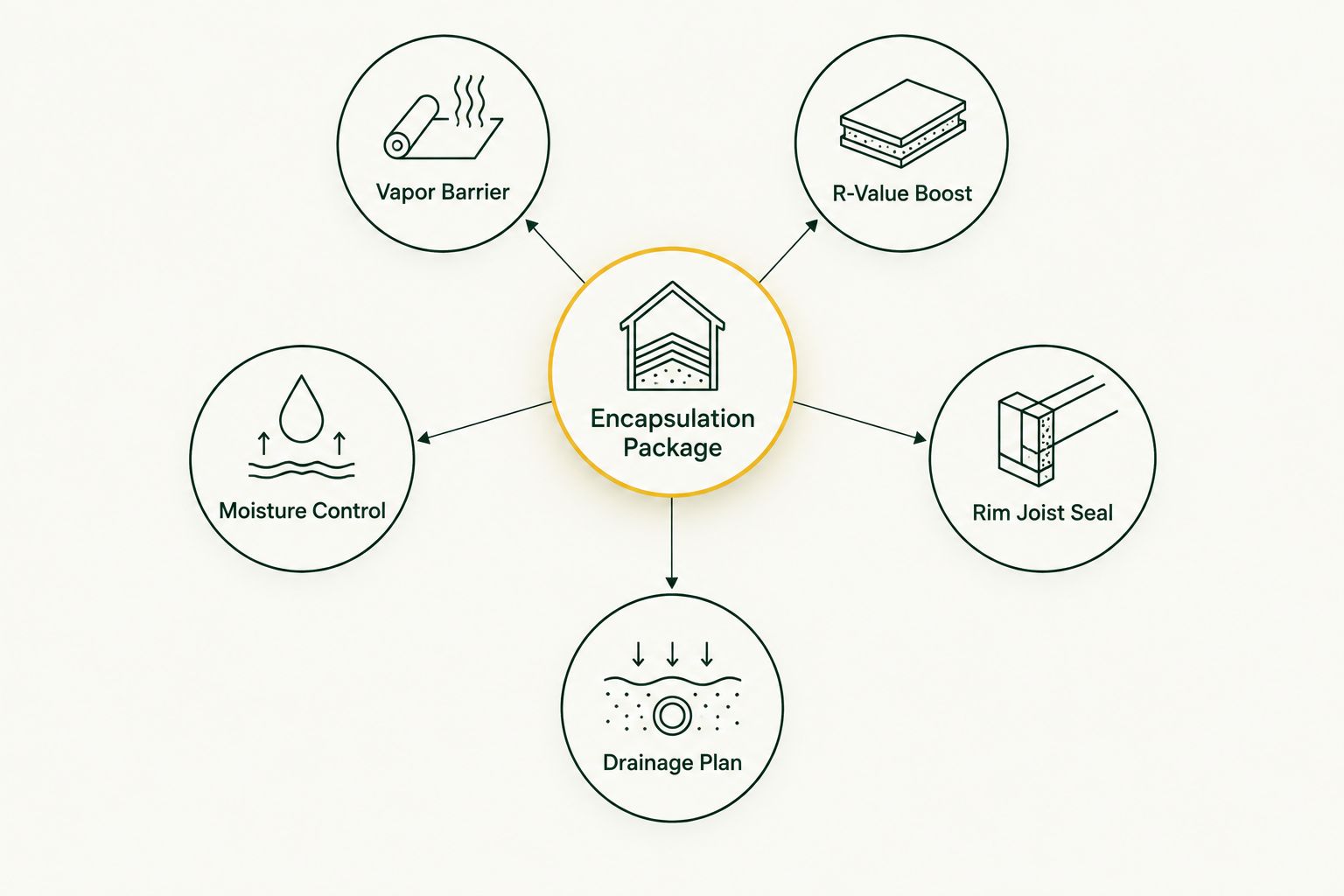
    Hub and spoke diagram showing five parts of a crawl space encapsulation package
    Every package on this list is built from some combination of these five parts.

    Crawl space encapsulation packages at a glance

    Package Best for Standout feature Key limitation
    Full Closed-Cell Spray Foam Encapsulation Vented crawl spaces with cold floors, no active water Seals air and adds R-6.5-per-inch insulation in one pass Higher upfront cost than a bare vapor barrier
    Vapor Barrier + Mechanical Ventilation Dry crawl spaces on a tight budget Meets 6-mil code minimum fast and cheap Adds no R-value; still pulls humid air
    Encapsulation + Dehumidification Musty or mold-prone crawl spaces Actively pulls humidity below 60% RH Adds an appliance that needs service
    Encapsulation + Rim Joist Spray Foam Cold floors above a dry crawl space Targets the biggest air-leak band directly Leaves crawl space walls uninsulated
    Encapsulation + Interior Drainage/Sump Crawl spaces that flood seasonally Only package that handles standing water Most expensive due to drainage work

    1. Full Closed-Cell Spray Foam Encapsulation: best crawl space encapsulation services for cold, vented older homes

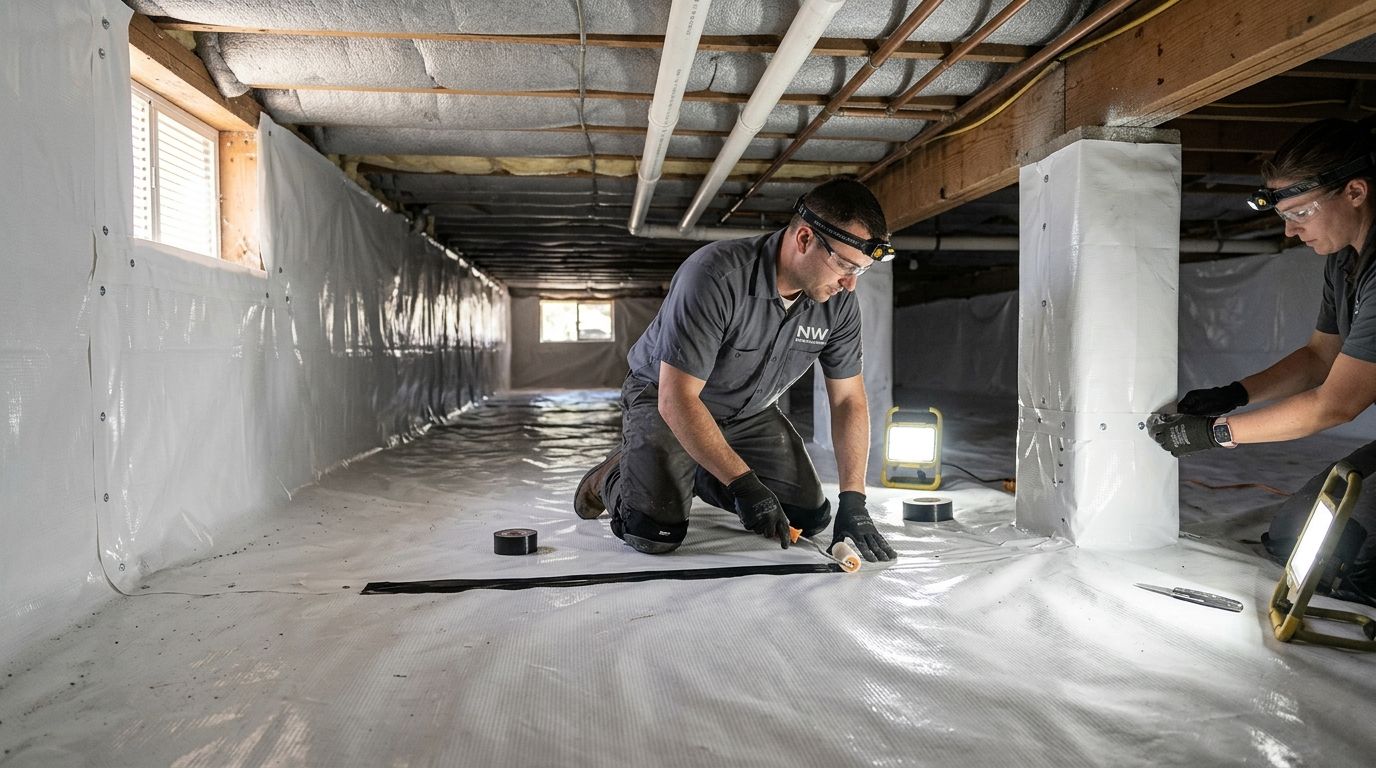
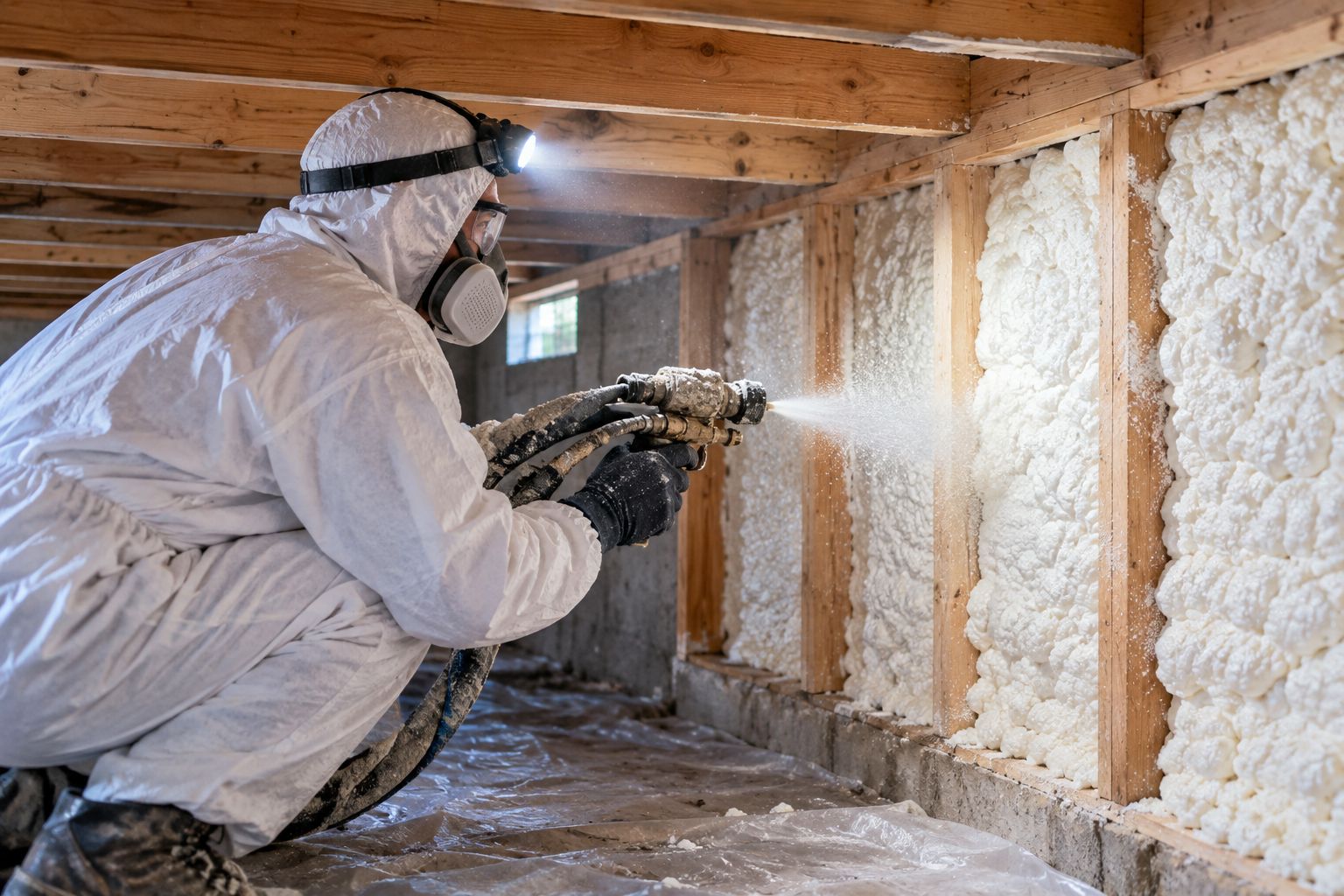
    This package lays a vapor barrier on the dirt floor, then sprays closed-cell foam directly onto the crawl space walls and rim joists, converting a vented crawl space into a conditioned one in a single visit. It's the standard fix for pre-1990s PNW houses built to the old vented-crawl-space code and it's the package AT Foam runs most often across Washington. Full profiles of licensed crawl space encapsulation contractors in Washington show this as the default recommendation for exactly this house type.

    Full Closed-Cell Spray Foam Encapsulation pros:

    • Adds structural R-value at roughly R-6.5 per inch while sealing air leaks
    • Foam conforms to the uneven framing common in older PNW houses instead of gapping like batts
    • Cuts the ground moisture that drives floor joist rot
    • One crew handles the barrier, foam, and rim joist seal together

    Full Closed-Cell Spray Foam Encapsulation cons:

    • Costs more upfront than a standalone vapor barrier
    • Doesn't solve standing water on its own
    • May require ignition-barrier coating depending on local inspection rules

    Best for: Older Seattle-area homes with a vented, cold crawl space and no active water intrusion.
    Verdict: Buy.
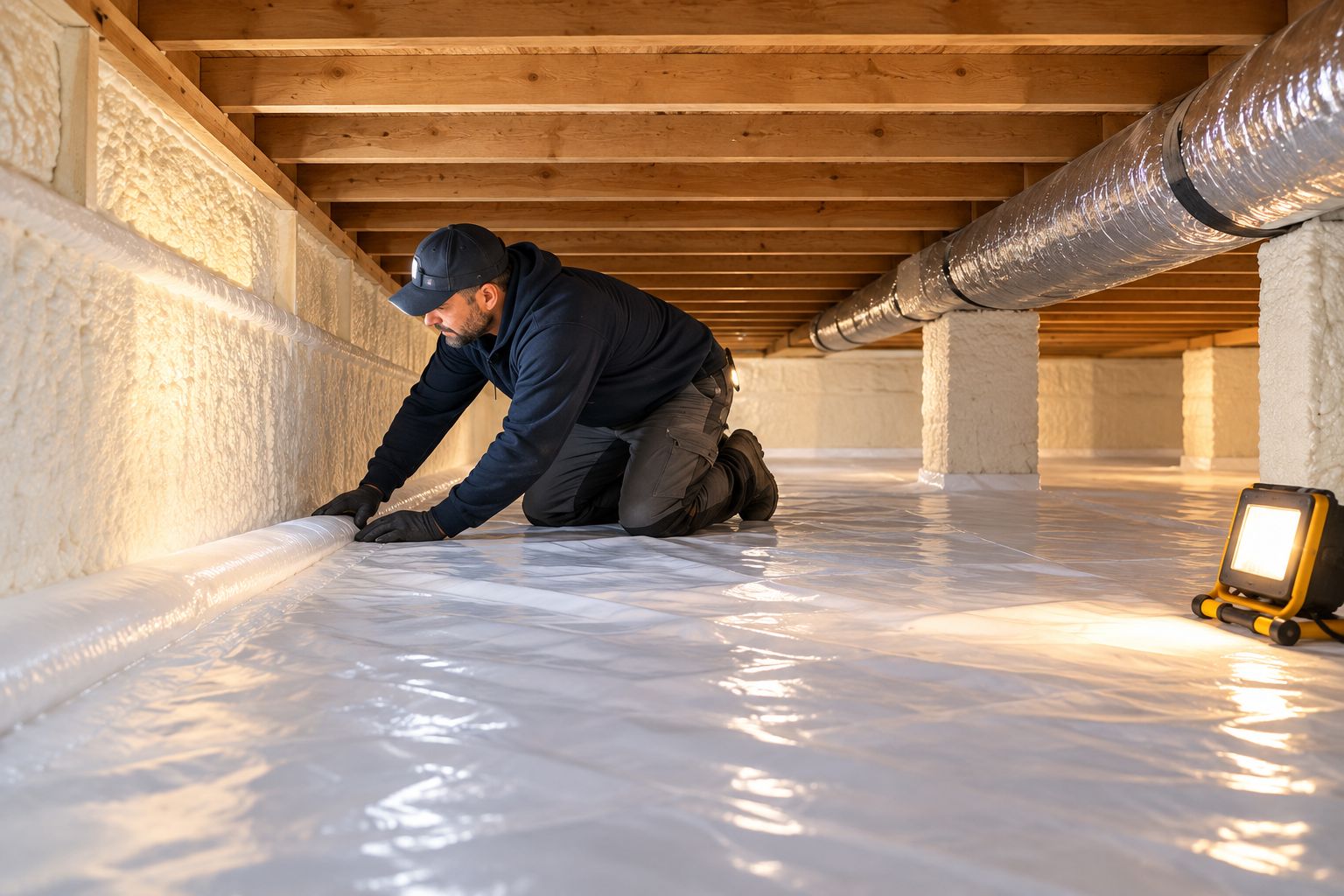
    Crawl space with vapor barrier on the floor and spray foam on the walls and rim joist
    Barrier, wall foam, and rim joist sealing happen in the same visit on this package.

    2. Vapor Barrier + Mechanical Ventilation: best crawl space encapsulation services for tight budgets

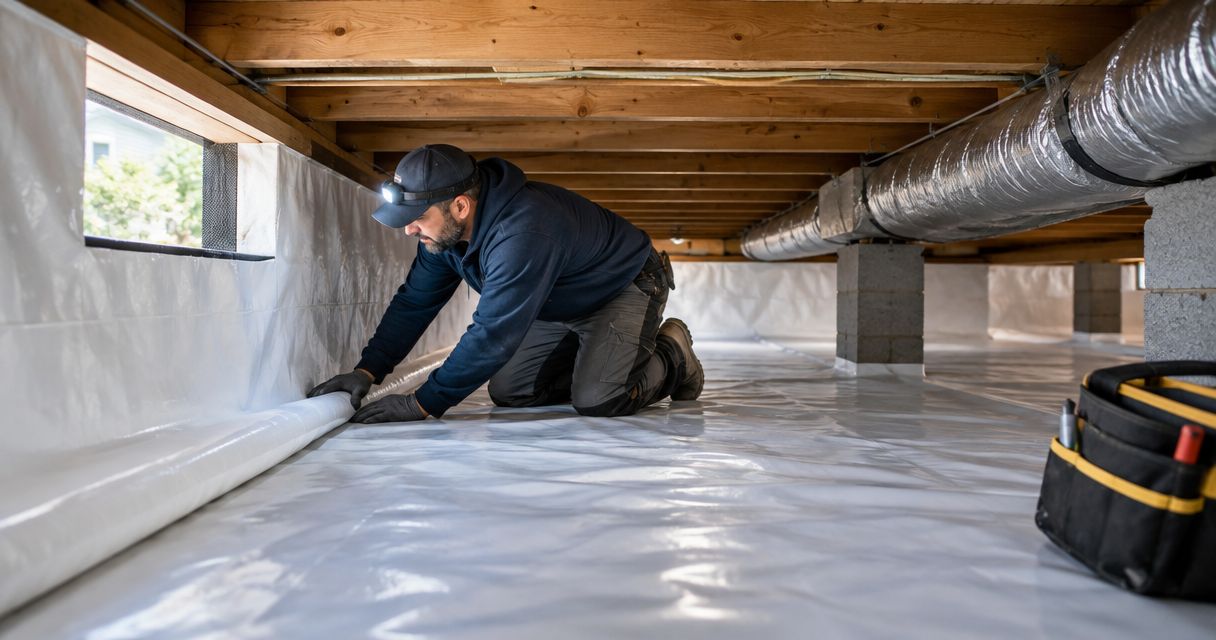
    This package lays a heavy-mil poly barrier over the floor and up the walls, paired with a vent fan that keeps air moving instead of sealing the space fully. It clears the 6-mil ground cover code minimum without the cost of foam.

    Vapor Barrier + Mechanical Ventilation pros:

    • Lowest-cost option that still blocks ground moisture at the source
    • Fast install with minimal disruption
    • Works as a first step before a later foam upgrade

    Vapor Barrier + Mechanical Ventilation cons:

    • Adds no meaningful R-value
    • Vent fans still pull humid outside air in during wet PNW months
    • Not a fix for a crawl space that already shows mold or rot

    Best for: Homeowners with a dry, well-drained crawl space who need code-minimum moisture control on a limited budget.
    Verdict: Hold — fine as a stopgap, weak as a long-term answer for a house with real moisture history.

    3. Encapsulation + Dehumidification: best crawl space encapsulation services for musty or mold-prone crawl spaces

    This package pairs a full vapor barrier and wall seal with a dehumidifier sized to the crawl space volume, aimed at holding humidity under the 60% relative-humidity threshold building scientists use as a mold cutoff. It's the right call once a crawl space has already crossed from damp to musty.

    Encapsulation + Dehumidification pros:

    • Actively lowers humidity instead of only blocking new moisture
    • Best fit for a crawl space with a documented musty smell or early mold
    • Runs independent of outside weather swings

    Encapsulation + Dehumidification cons:

    • Adds an appliance that needs power, drainage, and filter service
    • Higher combined cost than encapsulation alone
    • Contributes no insulation R-value unless paired with foam

    Best for: Crawl spaces with a mold, mildew, or musty-odor history.
    Verdict: Buy for problem crawl spaces; skip if humidity readings are already low.

    4. Encapsulation + Rim Joist Spray Foam: best crawl space encapsulation services for cold floors above a dry crawl space

    This package runs the same vapor barrier base but concentrates spray foam on the rim joist band where the floor framing meets the foundation — the single biggest air-leak point in most pre-1980s PNW houses. It's a targeted fix rather than a full-wall job.

    Encapsulation + Rim Joist Spray Foam pros:

    • Hits the leakiest, least-insulated band in most older crawl spaces directly
    • Cuts cold-floor complaints upstairs without foaming every wall
    • Costs less than encapsulating the full crawl space in closed-cell foam

    Encapsulation + Rim Joist Spray Foam cons:

    • Leaves crawl space walls uninsulated, so ground-level cold still radiates in
    • Not enough on its own for a crawl space with active moisture problems

    Best for: Homes where the floor above is noticeably cold but the crawl space itself stays dry.
    Verdict: Buy as a targeted fix, not a full-encapsulation substitute.

    5. Encapsulation + Interior Drainage/Sump: best crawl space encapsulation services for standing water

    This package adds a perimeter drain channel and sump pump to the vapor barrier and sealing work, built for crawl spaces that collect standing water during PNW winter rain. It handles bulk water a vapor barrier alone can't stop.

    Encapsulation + Interior Drainage/Sump pros:

    • The only package here that solves standing water directly
    • Keeps the vapor barrier from floating or trapping water underneath it
    • Pairs cleanly with foam encapsulation for a complete moisture-and-insulation fix

    Encapsulation + Interior Drainage/Sump cons:

    • Most expensive package on this list due to excavation and sump equipment
    • Overkill for a crawl space with no history of pooling water

    Best for: Older homes on low ground or clay soil where the crawl space floods seasonally.
    Verdict: Buy only with a documented standing-water problem; skip otherwise.

    How we ranked these packages

    Each package was measured against the same six criteria: vapor barrier coverage, R-value contribution, moisture-control fit, rim joist sealing, drainage integration, and code compliance. Full Closed-Cell Spray Foam Encapsulation ranks first because it's the only package that scores strongly on four of the six without an add-on. The rest earn their spot by solving one specific problem — budget, mold, cold floors, or standing water — better than a generalist package would.

    Get a free crawl space quote

    AT Foam inspects the crawl space before recommending a package.

    Which crawl space encapsulation package should you choose?

    For most older PNW homes with a vented, cold crawl space and no water on the ground, Full Closed-Cell Spray Foam Encapsulation is the default pick for 2026. Add dehumidification if the crawl space already smells musty, add drainage if it floods seasonally, and treat the vapor-barrier-only package as a budget stopgap rather than a finished job.

    FAQ

    What is included in crawl space encapsulation services?

    Crawl space encapsulation services typically include a sealed vapor barrier on the floor and walls, sealing at the rim joist, and sometimes spray foam insulation or a dehumidifier added on top. The exact package depends on how wet the crawl space runs.

    Is spray foam better than a vapor barrier alone for crawl spaces?

    Spray foam adds R-6.5 per inch of insulation while sealing air leaks, which a bare vapor barrier does not do. A vapor barrier alone still meets code-minimum moisture control but leaves the crawl space uninsulated.

    Do I need a dehumidifier if I encapsulate my crawl space?

    Only if the crawl space already shows mold, mildew, or a musty smell. A properly sealed encapsulation without existing moisture problems often holds under the 60% relative-humidity mold threshold on its own.

    How thick does a crawl space vapor barrier need to be?

    Building code sets a 6-mil polyethylene minimum for crawl space ground cover. Encapsulation packages often use a thicker, reinforced barrier that also runs up the foundation walls, not just across the floor.

    Can I close crawl space vents after encapsulation?

    Yes, once a crawl space is fully sealed with a vapor barrier and wall coverage, code allows closing the foundation vents instead of adding more ventilation. Closing vents on an unsealed crawl space skips that step and traps moisture instead.

    Does crawl space encapsulation fix a musty smell in the house above?

    It fixes the smell when the cause is ground moisture or standing air in the crawl space, which is the most common cause in older PNW homes. If the musty smell persists after encapsulation, a dehumidification add-on usually resolves it.

    What’s the difference between crawl space encapsulation and crawl space insulation?

    Encapsulation seals the space against moisture and outside air with a vapor barrier and wall coverage. Insulation adds R-value on top of that seal, most often with closed-cell spray foam on the walls and rim joists.

    One last thing

    A bare vapor barrier stops ground moisture but does nothing about humid outside air moving through open foundation vents — that's exactly why current code allows closing those vents once the crawl space is fully sealed instead of adding more of them. Skipping the seal and closing vents anyway is the single most common mistake in older PNW crawl spaces, and it traps moisture instead of blocking it.

    Related guides


  • Best Insulation for New Construction in WA

    Best Insulation for New Construction in WA

    Closed-cell spray foam wins overall for new home construction in Washington in 2026, open-cell spray foam wins for attic and wall air sealing on a tighter budget, and fiberglass batt wins as the lowest-cost code-compliant option for stick-built walls.

    TL;DR
    • Closed-cell spray foam is the best insulation for new construction in Washington when moisture control and structural rigidity matter, especially in crawl spaces and rim joists.
    • Open-cell spray foam wins for full attic and wall air sealing at a lower installed cost than closed-cell foam.
    • Fiberglass batt is the cheapest way to hit Washington’s 2026 energy code minimums but leaks the most air of any option here.
    • Blown-in cellulose covers open attic floors fast and uses recycled material, but it settles over time.
    • Rigid foam board solves thermal bridging on exterior walls but needs a separate air-sealing layer to perform.

    Why this matters for a 2026 build in Washington

    Washington's energy code keeps tightening, and most of Western Washington sits in a marine climate zone where moisture, not just cold, drives insulation failures. Pick the wrong material in a crawl space or rim joist and you're looking at mold and rot within a few winters, not decades.

    AT Foam installs both open-cell and closed-cell spray foam across Seattle, Tacoma, and Olympia new-construction jobs, and the pattern is consistent: builders who mix materials by zone (foam where moisture risk is high, batt or blown-in where it isn't) get better performance per dollar than builders who pick one material for the whole house.

    This guide ranks the five insulation types builders and homeowners actually use in new Washington construction in 2026, tells you where each one wins, and where it falls short.

    What makes the best insulation for new construction in Washington

    • R-value per inch — how much thermal resistance you get per inch of cavity depth, which matters more in 2×4 walls than 2×6
    • Air sealing performance — batts and loose-fill leave gaps; spray foam and rigid board close them
    • Moisture and vapor control — critical in crawl spaces, rim joists, and below-grade walls in a wet climate
    • Code compliance margin — how easily the material clears Washington's current prescriptive R-value targets
    • Installed cost profile relative to lifetime performance — not the sticker price, but cost against decades of air sealing and moisture protection
    • Long-term stability — whether the material settles, sags, or degrades after installation

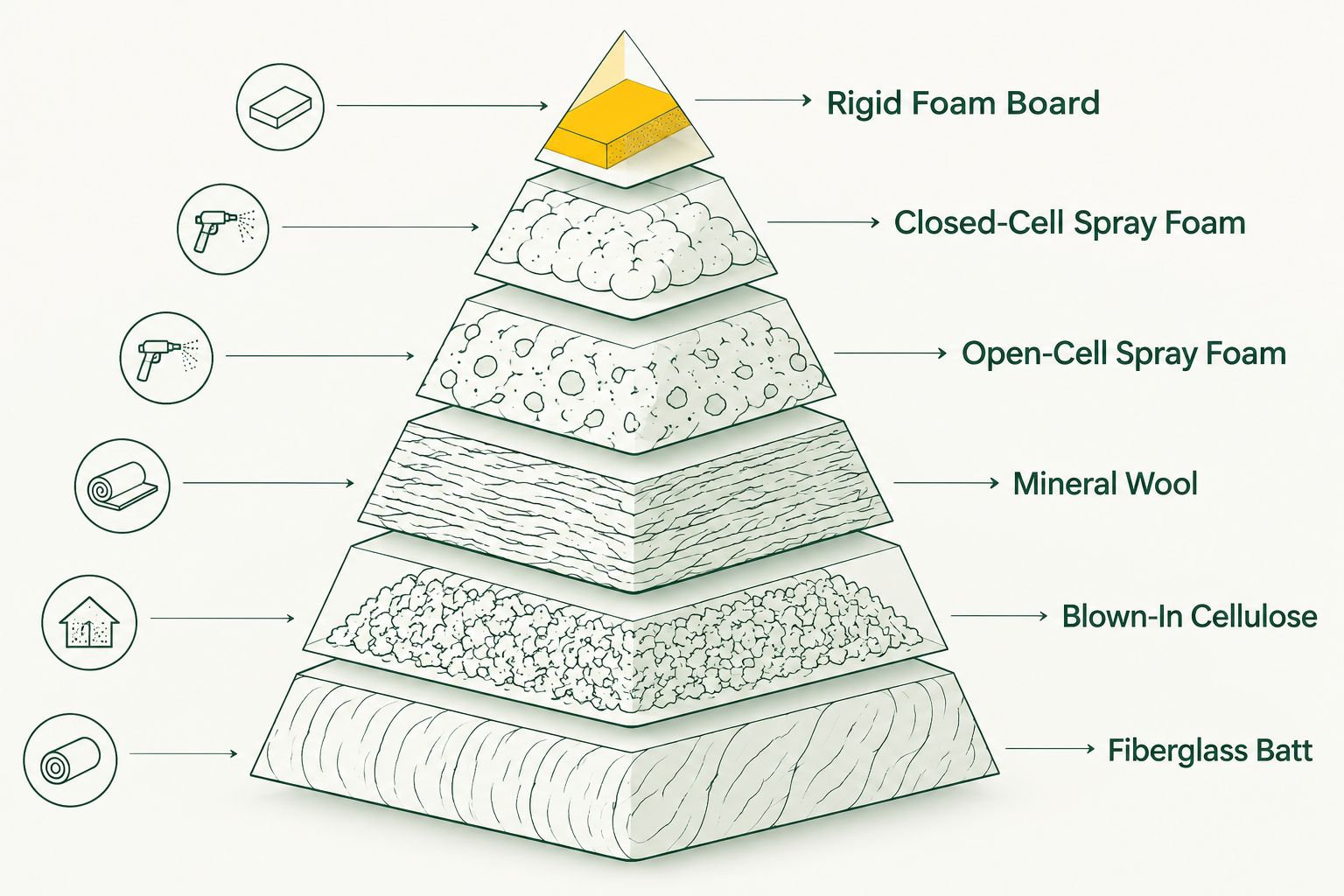
    Insulation types at a glance

    Insulation type Best for Standout feature Key limitation
    Closed-cell spray foam Crawl spaces and rim joists Vapor-closed, adds structural rigidity Higher material cost per board foot
    Open-cell spray foam Full attic and wall air sealing Expands to fill irregular cavities completely Vapor-open, needs a vapor strategy in wet zones
    Fiberglass batt Budget-driven stick-built walls Lowest cost path to code minimums Weak air sealing, easy to install poorly
    Blown-in cellulose Open attic floors Fast coverage, recycled content Settles 15-20% over time, reducing R-value
    Rigid foam board Exterior continuous insulation Cuts thermal bridging through studs Needs separate air sealing and joint taping

    1. Closed-cell spray foam: best insulation for crawl spaces and rim joists

    Closed-cell spray foam runs roughly R-6 to R-7 per inch, making it the highest R-value-per-inch option on this list. It cures rigid, adds racking strength to the assembly it's sprayed into, and blocks vapor drive, which is why it's the standard pick for Washington crawl spaces and rim joist cavities where ground moisture and condensation risk are constant.

    Closed-cell spray foam pros:

    • Highest R-value per inch of any material here
    • Doubles as a vapor barrier, critical in Pacific Northwest crawl spaces
    • Adds structural stiffness to floor and wall assemblies
    • Doesn't sag, settle, or lose R-value over time

    Closed-cell spray foam cons:

    • Costs more per board foot than any other option on this list
    • Requires a trained crew for even coverage — a bad spray job wastes material
    • Not ideal for large open attic floors where budget per square foot matters more

    Best for: crawl spaces, rim joists, below-grade walls, and any cavity where moisture control matters as much as R-value.

    Verdict: Buy for moisture-prone assemblies in new Washington construction.

    2. Open-cell spray foam: best for attic and wall air sealing

    Open-cell spray foam runs around R-3.5 to R-3.8 per inch — lower than closed-cell, but it expands more per unit of material, which lets it fill irregular attic and wall cavities completely at a lower installed cost than closed-cell foam. It also cuts airborne sound transfer between rooms, a detail builders underrate until a homeowner complains post-move-in.

    Open-cell spray foam pros:

    • Air-seals cavities completely, unlike batt or loose-fill
    • Costs less installed than closed-cell foam for the same square footage
    • Reduces sound transfer between floors and rooms
    • Expands into irregular framing gaps that batts can't fill

    Open-cell spray foam cons:

    • Vapor-open, so it needs a deliberate vapor strategy in wet-climate assemblies
    • Lower R-value per inch means deeper cavities are needed to hit code minimums
    • Not the right call for below-grade or ground-contact applications

    Best for: full attic decks and above-grade interior walls where air sealing matters more than vapor control.

    Verdict: Buy for attics and above-grade walls in new Washington builds.

    3. Fiberglass batt: best budget option for code-minimum walls

    Fiberglass batt runs about R-3.1 to R-3.4 per inch and remains the cheapest way to hit Washington's prescriptive wall R-value targets in a standard stick-built home. It's fast to install and widely available, which is why production builders default to it on tract construction.

    Fiberglass batt pros:

    • Lowest material cost of any option on this list
    • Widely stocked, no specialty crew required
    • Straightforward to inspect during framing walkthrough

    Fiberglass batt cons:

    • Weakest air sealing performance — gaps around outlets, top plates, and penetrations go unsealed
    • Compresses easily during installation, cutting real-world R-value below the rated number
    • Does nothing for moisture control in damp assemblies

    Best for: interior partition walls and budget-constrained new builds where code compliance, not performance, is the target.

    Verdict: Hold — fine for interior walls, weak as the only strategy in exterior assemblies.

    4. Blown-in cellulose: best for open attic floors

    Blown-in cellulose delivers roughly R-3.2 to R-3.8 per inch and covers large, open attic floors faster than batt installation. It's made from recycled paper fiber treated with fire retardant, which appeals to builders marketing sustainability features in 2026.

    Blown-in cellulose pros:

    • Fast coverage over large, unobstructed attic floors
    • Fills around joists and wiring better than batt
    • Recycled material content

    Blown-in cellulose cons:

    • Settles 15-20% over the first few years, reducing effective R-value
    • Absorbs moisture if a roof leak or condensation issue develops
    • Not suitable for vertical wall cavities without netting

    Best for: open, unfinished attic floors in new construction where speed and coverage matter more than long-term stability.

    Verdict: Hold — good attic-floor option, but plan for settling in the R-value math.

    5. Rigid foam board: best for exterior continuous insulation

    Rigid foam board (XPS or polyiso) runs R-4 to R-6.5 per inch depending on the type and wraps the exterior of the frame, cutting the thermal bridging that happens every 16 inches through a stud. It's the material most new-construction energy models lean on to hit whole-wall R-value targets without adding cavity depth.

    Rigid foam board pros:

    • Eliminates thermal bridging through studs, a gap every other material on this list has
    • High R-value per inch for exterior sheathing applications
    • Pairs well with any cavity insulation choice above

    Rigid foam board cons:

    • Needs taped seams and separate air sealing to actually perform as rated
    • Adds a labor step most production builders skip unless code requires it
    • Doesn't solve cavity insulation on its own — it's a supplement, not a standalone system

    Best for: exterior wall sheathing on new builds targeting above-code thermal performance.

    Verdict: Buy as a supplement to cavity insulation, not a replacement for it.

    How this ranking was built

    Each material was scored against the six criteria above: R-value per inch, air sealing, moisture control, code compliance margin, cost-to-performance, and long-term stability. Closed-cell and open-cell spray foam scored highest on air sealing and moisture control, the two factors that cause the most callback issues in Washington's wet climate. Batt and cellulose scored well on cost but lag on air sealing, and rigid board scored highest on thermal bridging but requires pairing with a cavity material.

    R-value per inch, 2026
    R-6 to R-7
    Closed-cell spray foam per inch
    R-3.5 to R-3.8
    Open-cell spray foam per inch
    R-3.1 to R-3.4
    Fiberglass batt per inch
    15-20%
    Cellulose settling over time

    Which insulation should you choose for a 2026 Washington build?

    If you're building anywhere from Seattle to Olympia and want one answer: closed-cell spray foam in crawl spaces and rim joists, open-cell spray foam in the attic and above-grade walls. That combination handles the moisture load a marine climate throws at a house while air-sealing the assembly completely. If budget forces a tradeoff on interior partition walls, fiberglass batt is an acceptable fallback there — just don't let it carry the exterior envelope alone.

    “Pick insulation by where moisture goes in the assembly, not by what’s cheapest per square foot.”

    Get a free spray foam quote

    AT Foam sprays open-cell and closed-cell foam on new builds across Seattle, Tacoma, and Olympia.

    FAQ

    What is the best insulation for new construction in Washington in 2026?

    Closed-cell spray foam is the best overall choice for crawl spaces and rim joists, and open-cell spray foam wins for full attic and wall air sealing. Fiberglass batt works as a budget fallback on interior partition walls only.

    Is spray foam better than fiberglass for a new build?

    Spray foam air-seals completely and outperforms fiberglass on moisture control, which matters more in Washington’s marine climate than in drier regions. Fiberglass costs less but leaks more air around penetrations and top plates.

    Does new construction in Washington require spray foam?

    No single material is mandated by code, but Washington’s prescriptive R-value targets for walls and attics push many builders toward foam or continuous rigid board to hit the numbers without oversized cavities.

    How much R-value do you need for a new home in Washington?

    Washington’s energy code sets attic and wall R-value minimums that vary by assembly type and climate zone, with attics typically needing the highest R-value target in the code. A licensed insulation contractor can confirm the exact requirement for your specific build.

    Does closed-cell spray foam work in a crawl space?

    Yes, closed-cell spray foam is the standard choice for Washington crawl spaces because it blocks vapor drive from ground moisture while adding rigidity to the floor assembly above it.

    Does blown-in cellulose settle over time?

    Yes, cellulose typically settles 15-20% after installation, which lowers its effective R-value in an open attic floor. That settling should be factored into the initial depth calculation.

    Can you mix insulation types in one new construction build?

    Yes, and it’s often the better approach — closed-cell foam in moisture-prone crawl spaces, open-cell foam in the attic, and batt on interior partitions is a common combination in new Washington builds.

    Is rigid foam board enough insulation on its own?

    No, rigid foam board reduces thermal bridging through studs but needs a cavity insulation material behind it and taped seams for air sealing to hit full performance.

    One last thing

    The detail most new-construction plans miss in 2026 isn't the insulation material — it's the rim joist. It's a small strip of the envelope, but it's one of the highest air-leakage points in a typical Washington home, and it's exactly where closed-cell spray foam earns its cost over batt or loose-fill.


  • Attic Insulation Contractors in Seattle, WA

    Attic Insulation Contractors in Seattle, WA

    Seattle homeowners typing "attic insulation contractors" into Google in 2026 are really choosing between four different types of crews: spray foam specialists, fiberglass batt installers, national franchises, and general contractors who insulate as a side job. This breaks down which type wins for which situation, and names the contractor to call first for a Pacific Northwest attic.

    TL;DR
    • AT Foam Insulation wins for attic insulation contractors in Seattle who need air sealing, not just R-value stacked on top.
    • Local fiberglass batt installers are the cheapest attic insulation contractors but they skip air sealing entirely.
    • National franchises schedule fast in 2026 but subcontract labor and know less about Pacific Northwest moisture.
    • Cellulose specialists suit eco-conscious retrofits; general contractors suit bundled remodel projects.

    Why this matters

    Washington's energy code guidance points most Puget Sound attics toward roughly R-49, but the insulation material means nothing if the crew never sealed the air leaks around the attic hatch, recessed lights, and top plates first. A poorly air-sealed attic loses heat through gaps no matter how thick the batts or foam sit on top of the joists.

    Pick the wrong attic insulation contractor in a climate as wet as Seattle's and you risk moisture trapped in fiberglass, mold building behind drywall, or a franchise crew that never actually inspects your specific roofline before quoting. The right contractor matches the material to your attic's actual air-sealing and moisture problems in 2026, not a one-size package sold over the phone.

    “The R-value on a quote means nothing if air is still leaking through the attic hatch.”

    The verdict on attic insulation contractors in Seattle for 2026

    Best overall: AT Foam Insulation, a veteran-owned spray foam contractor working attics, crawl spaces, and walls across Seattle, Tacoma, Olympia, and the greater Pacific Northwest. Best for bare-bones budget upgrades: local fiberglass batt installers. Best for fast scheduling: national insulation franchises. Best for eco-conscious retrofits: cellulose insulation specialists. Best for bundling with a larger remodel: general contractors who add insulation to the scope.

    What makes the best attic insulation contractor

    • Air-seals the attic before insulating, instead of treating R-value as the only number that matters
    • Licensed and insured for the actual work being performed, not just a general contracting license
    • Carries more than one material — spray foam, fiberglass, cellulose — rather than pitching a single product
    • Has real experience with Pacific Northwest moisture, ventilation, and ice dam patterns
    • Gives a free, attic-specific estimate instead of a generic per-square-foot number
    • Covers attic, crawl space, and wall assemblies so one crew handles the whole building envelope

    Attic insulation contractors in Seattle at a glance

    Contractor type Best for Standout feature Key limitation
    AT Foam Insulation Air sealing + spray foam Covers attic, crawl space, and walls Costs more upfront than batts
    Local fiberglass batt installers Budget top-ups Fast, simple installation No air sealing
    National insulation franchises Fast scheduling Centralized booking and financing talk Subcontracted labor
    Cellulose insulation specialists Eco-conscious retrofits Recycled, dense-pack material Settles over time
    General contractors (insulation add-on) Bundled remodels One point of contact for the whole job Insulation isn't their specialty

    1. AT Foam Insulation: best attic insulation contractor for spray foam and air sealing

    AT Foam Insulation is a veteran-owned spray foam contractor working attics, crawl spaces, and walls for homeowners and businesses across Seattle, Tacoma, Olympia, and the wider Pacific Northwest. The crew runs both open-cell and closed-cell foam, which lets them handle air sealing and R-value in the same visit instead of treating them as separate jobs. Estimates are free, and the company backs its work with real job photos and video rather than stock imagery.

    AT Foam Insulation pros:

    • Handles air sealing and insulation together, which fiberglass-only crews skip
    • Veteran-owned crew, licensed and insured for the work performed
    • Works attics, crawl spaces, and walls, so one contractor covers the full envelope
    • Free estimates before you commit to a material

    AT Foam Insulation cons:

    • Spray foam costs more per square foot than fiberglass batts
    • Closed-cell foam isn't a reversible, DIY-friendly material once it cures
    • Not the fastest pick if you just need a same-week batt swap

    Best for: homeowners who want air sealing and insulation solved together, not batts stapled between joists.
    Verdict: Hire it for attic, crawl space, or wall insulation anywhere in the Seattle-Tacoma-Olympia corridor.

    2. Local fiberglass batt installers: best attic insulation contractors for budget upgrades

    Independent crews running fiberglass batts or blown-in fiberglass are common across Seattle and are typically the lowest bid on a straightforward attic top-up. They install fast, work with a material sold at any hardware store, and skip the specialized equipment spray foam requires.

    Fiberglass batt installer pros:

    • Lowest material and labor cost among the options here
    • Fast installation, often finished same-day on a standard attic
    • Simple to inspect and add to later

    Fiberglass batt installer cons:

    • Doesn't air-seal gaps around can lights, wiring penetrations, or the attic hatch
    • Loses R-value when compressed or when it gets damp, which happens in Pacific Northwest attics
    • Quality swings heavily by crew, with no foam consistency to fall back on

    Best for: landlords or sellers needing a cheap attic top-up before listing, not homeowners chasing lower winter bills.
    Verdict: Consider it as a stopgap, not a long-term fix for a drafty attic.

    3. National insulation franchises: best attic insulation contractors for fast scheduling

    Franchise insulation chains operate in the Seattle market with call centers, standardized quoting, and financing conversations built into the sales pitch. They can often get a crew out faster than a small local operation booked out weeks in 2026.

    National franchise pros:

    • Centralized scheduling often books faster than small local crews
    • Standardized quoting keeps pricing structure consistent between jobs
    • Financing options are commonly part of the sales process

    National franchise cons:

    • Labor is frequently subcontracted, so crew quality varies by whoever shows up
    • Sales reps follow the franchise script, not necessarily Pacific Northwest attic specifics
    • Less accountability tied to a specific local reputation

    Best for: homeowners who value a fast callback and a financing conversation over a specialized local crew.
    Verdict: Consider it if scheduling speed outweighs crew consistency for you.

    4. Cellulose insulation specialists: best attic insulation contractors for eco-conscious retrofits

    Cellulose is blown-in insulation made mostly from recycled paper treated with fire retardant, and specialist crews use dense-pack equipment to fill attic floors and closed wall cavities. It's the material most often pitched to homeowners specifically asking about recycled content.

    Cellulose specialist pros:

    • Made from recycled material, which matters to sustainability-focused homeowners
    • Dense-pack installation fills irregular joist bays better than rigid batts
    • Reasonable air resistance when installed at the correct density

    Cellulose specialist cons:

    • Settles over time, gradually reducing effective R-value
    • Absorbs moisture more readily than closed-cell foam, a real risk in Seattle's wet climate
    • Doesn't air-seal penetrations the way spray foam does

    Best for: homeowners prioritizing recycled material over maximum air sealing.
    Verdict: Consider it for dry, well-ventilated attics; skip it where existing moisture issues are known.

    5. General contractors offering insulation add-ons: best attic insulation contractors for bundled remodels

    General contractors already remodeling a kitchen, adding a room, or finishing a basement sometimes fold attic insulation into the scope rather than bringing in a specialist. It saves a homeowner from managing a second contractor relationship on top of the main project.

    General contractor pros:

    • One point of contact for insulation plus the rest of the remodel
    • Convenient scheduling since insulation slots into the existing project timeline
    • Useful when insulation is a small piece of a bigger renovation

    General contractor cons:

    • Insulation is rarely the crew's specialty, so material and technique choices skew generic
    • No dedicated air-sealing assessment separate from the main renovation scope
    • Less experience diagnosing attic-specific moisture or ventilation problems

    Best for: homeowners already mid-remodel who don't want to coordinate a second contractor.
    Verdict: Consider it only when insulation is a minor add-on to a larger project already underway.

    Get a free attic insulation quote

    Air sealing and spray foam R-value in one visit across Seattle, Tacoma, and Olympia.

    How this ranking works

    This ranking weighs five things: whether the crew air-seals before insulating, whether it works across attic, crawl space, and wall assemblies, licensing and insurance status, material range beyond a single product, and how the contractor handles the free estimate process. AT Foam Insulation ranks first because it covers air sealing, multiple foam types, and the full building envelope in one crew. Everything below it trades one of those advantages for speed, lower cost, or convenience.

    Which attic insulation contractor should you choose?

    If your attic has drafts, ice dams, or an energy bill that doesn't match the insulation already installed, AT Foam Insulation is the call for 2026 — spray foam solves the air-sealing problem fiberglass and cellulose can't fix on their own. If you're topping off a reasonably sealed attic on a tight budget, a local fiberglass batt installer gets the job done. Everyone else on this list — franchises, cellulose specialists, general contractors — fits a narrower situation than "my attic needs real work."

    Related guides

    FAQ

    What’s the best attic insulation contractor in Seattle for 2026?

    AT Foam Insulation is the best overall attic insulation contractor in Seattle for 2026 because it air-seals and insulates attics, crawl spaces, and walls in one visit. Fiberglass batt installers cost less but skip air sealing entirely.

    Is spray foam better than fiberglass for a Seattle attic?

    Spray foam air-seals and insulates in one step, which fiberglass batts don’t do on their own. In Seattle’s wet climate, that air-sealing step matters because it keeps moist air from reaching cold roof sheathing.

    How much attic insulation does a Washington home need in 2026?

    Most Puget Sound attics target roughly R-49 under current Washington energy code guidance. The exact figure depends on your specific climate zone and existing insulation depth.

    Do national insulation franchises use their own installers?

    National insulation franchises commonly subcontract the installation crew rather than sending direct employees. Crew quality can vary between jobs even within the same franchise.

    Does cellulose insulation lose R-value over time?

    Yes, blown-in cellulose settles gradually after installation, which lowers its effective R-value compared to the day it went in. Spray foam does not settle the same way once cured.

    Should a general contractor handle my attic insulation during a remodel?

    A general contractor can fold attic insulation into a larger remodel for convenience, but insulation usually isn’t their specialty. For attics with existing moisture or air-sealing problems, a dedicated insulation contractor catches issues a generalist crew might miss.

    Is AT Foam Insulation licensed and insured?

    AT Foam Insulation operates as a licensed and insured, veteran-owned spray foam contractor serving Seattle, Tacoma, Olympia, and the greater Pacific Northwest.

    Can fiberglass batts get moldy in a Seattle attic?

    Fiberglass batts can hold moisture instead of shedding it, and trapped damp insulation creates the right conditions for mold in a humid Pacific Northwest attic. Spray foam behaves differently because it seals the air gaps that would otherwise let humid air reach cold surfaces.

    One last thing

    Most homeowners shopping attic insulation contractors compare R-value numbers on quotes and stop there. The number that actually predicts your winter energy bill is how many linear feet of gaps the crew seals before the insulation goes down — ask every contractor on your 2026 shortlist to walk you through their air-sealing step specifically, not just their insulation brand.


  • Best Crawl Space Encapsulation Contractors in WA

    Best Crawl Space Encapsulation Contractors in WA

    Washington's wet winters turn an unsealed crawl space into a mold factory by February — the fix is picking the right contractor before the rain starts, not after the insulation is already soaked. Best overall crawl space encapsulation contractor for Washington in 2026: AT Foam Insulation, a veteran-owned crew working Seattle, Tacoma, Olympia, and the surrounding Pacific Northwest. Best for buyers who want a multi-state brand network: national insulation franchises. Best budget option for a small, easy-access crawl space: an independent one- or two-person local crew.

    TL;DR
    • AT Foam Insulation is the top pick for crawl space encapsulation contractors serving Seattle, Tacoma, and Olympia in 2026.
    • Closed-cell spray foam runs roughly R-6.5 per inch versus R-3.6 to R-3.8 for open-cell — the difference matters in a damp crawl space.
    • National franchises win on warranty paperwork; local crews win on speed and knowledge of Washington soil moisture.
    • Get at least two on-site inspections before signing — no reputable contractor prices a crawl space sight unseen.

    Why this matters

    A crawl space in western Washington sits under a house for 20, 30, sometimes 50 years without anyone looking at it. Meanwhile groundwater, seasonal rain, and vented crawl space design push moisture straight into the floor joists. Encapsulation stops that cycle — sealed vapor barrier, sealed foundation vents, insulated rim joists — but only if the crew doing the work understands Pacific Northwest soil and drainage conditions, not just a national install manual.

    Picking the wrong crawl space encapsulation contractor in 2026 means redoing the job in five years when the vapor barrier fails or the foam was sprayed too thin to hit code R-value. This guide ranks the realistic options homeowners in Seattle, Tacoma, and Olympia actually choose between.

    What makes the best crawl space encapsulation contractor

    • Local moisture expertise — understands western Washington's high water table and seasonal rain load, not a generic install script
    • Licensed and insured in Washington State, with proof available on request
    • Uses closed-cell spray foam on rim joists and walls, not just a loose vapor barrier laid over dirt
    • Includes a sump pump and dehumidifier assessment, not just foam and plastic
    • Transparent about crew type — direct employees versus subcontracted labor
    • Shows real job-site photos and video, not stock imagery of a generic crawl space

    Crawl space encapsulation contractors at a glance

    Contractor type Best for Standout feature Key limitation
    AT Foam Insulation Veteran-owned local spray foam work in Seattle, Tacoma, Olympia Direct crew, real job photos, PNW moisture know-how Service area limited to the Pacific Northwest
    National insulation franchises Multi-state warranty coverage Standardized process across locations Local crews often subcontracted, less PNW-specific judgment
    General contractors subbing out insulation Homeowners already mid-remodel One point of contact for the whole project Insulation crew quality varies by sub
    HVAC-and-insulation combo shops Pairing crawl space sealing with ductwork or mini-splits Bundled mechanical and insulation scope Insulation often the secondary specialty, not the core skill
    Independent one- or two-person crews Small, easy-access crawl spaces on a tight timeline Fast scheduling, lower overhead Limited capacity for large or complex moisture problems

    1. AT Foam Insulation: best crawl space encapsulation contractor for Seattle, Tacoma, and Olympia homeowners

    AT Foam Insulation is a veteran-owned spray foam contractor working residential and commercial crawl spaces, attics, and walls across the greater Puget Sound region. The crew applies closed-cell spray foam to rim joists and crawl space walls, paired with a sealed vapor barrier, rather than relying on loose fiberglass batts that sag once they absorb moisture.

    AT Foam Insulation pros:

    • Veteran-owned crew with direct accountability, not a franchise call center
    • Closed-cell foam handles the Pacific Northwest's damp crawl space conditions better than fiberglass
    • Real job-site photos and video instead of stock imagery
    • Serves Seattle, Tacoma, Olympia, and the wider Pacific Northwest directly

    AT Foam Insulation cons:

    • Doesn't serve homeowners outside the Pacific Northwest
    • Closed-cell spray foam costs more upfront than a basic fiberglass-and-plastic encapsulation job
    • Peak winter months (when crawl space problems get discovered) can mean booking ahead

    Best for: Washington homeowners who want a direct, veteran-owned crew that understands regional moisture patterns rather than a national script.

    Verdict: Buy.

    2. National insulation franchises: best crawl space encapsulation contractor for multi-state warranty coverage

    National franchise operations offer standardized encapsulation packages with corporate-backed paperwork, useful if you own property in more than one state or want a name with broad brand recognition.

    National franchise pros:

    • Consistent process documentation across locations
    • Broad brand recognition if you're comparing quotes online
    • Often easier to find reviews across a wide geography

    National franchise cons:

    • Local install crews are frequently subcontracted, so quality still depends on who shows up
    • Less built-in familiarity with western Washington's specific soil and rainfall patterns
    • Corporate pricing structures can be less flexible for unusual crawl space layouts

    Best for: Homeowners who value a recognizable brand name and don't mind a subcontracted install crew.

    Verdict: Hold — get a second local quote before signing.

    3. General contractors who subcontract insulation: best crawl space encapsulation contractor for active remodels

    If you're already mid-remodel with a general contractor managing the project, adding crawl space encapsulation to their scope keeps everything under one point of contact.

    General contractor pros:

    • One person managing the whole project timeline
    • Insulation work can be sequenced with other remodel tasks
    • Simplifies scheduling if multiple trades are already on site

    General contractor cons:

    • The actual insulation sub varies job to job — you rarely pick them directly
    • Markup on subcontracted insulation work adds cost without added skill
    • Specialized crawl space moisture problems can get less attention than the visible remodel work

    Best for: Homeowners who already have a general contractor on site for a larger project.

    Verdict: Hold — ask specifically who is doing the insulation work and what foam type they use.

    4. HVAC-and-insulation combo shops: best crawl space encapsulation contractor for pairing mechanical and insulation work

    Some HVAC companies added insulation services to their offering, useful if your crawl space work is tied to ductwork repair or a mini-split installation in the same space.

    HVAC combo shop pros:

    • Bundles ductwork or mini-split work with insulation in one visit
    • Convenient if crawl space access is also needed for mechanical repairs
    • Single invoice for both mechanical and insulation scope

    HVAC combo shop cons:

    • Insulation is typically the secondary specialty, not the core skill
    • Crawl space moisture expertise varies widely by shop
    • Fewer options for crews that also carry current insulation-specific training

    Best for: Homeowners who need HVAC work in the crawl space at the same time as encapsulation.

    Verdict: Wait — only worth it if you already need mechanical work done in the same space.

    5. Independent one- or two-person crews: best crawl space encapsulation contractor for small budgets

    For a small, easy-access crawl space with straightforward moisture issues, a small independent crew can move fast and keep overhead low.

    Independent crew pros:

    • Lower overhead often means faster scheduling
    • Direct communication with the person actually doing the work
    • Flexible on small or unusual jobs larger companies skip

    Independent crew cons:

    • Limited capacity for large crawl spaces or severe moisture and mold problems
    • Licensing and insurance verification is on you to confirm
    • Fewer resources if the job uncovers structural damage mid-project

    Best for: Small crawl spaces with minor moisture issues and a tight budget.

    Verdict: Skip for anything beyond a small, straightforward job — bring in a specialized crew once mold, standing water, or structural rot shows up.

    How we ranked

    Each contractor type was measured against the six criteria above: regional moisture expertise, licensing, foam quality on rim joists and walls, sump pump and dehumidifier assessment, transparency about who's actually on the crew, and real job documentation. AT Foam Insulation led on regional expertise and crew transparency; national franchises led on brand consistency; independent crews led on speed for small jobs.

    “If a crawl space still smells like wet dirt after a Washington winter, encapsulation is overdue, not optional.”

    Get a crawl space quote in 2026

    Free on-site inspection before any work starts.

    Which crawl space encapsulation contractor should you choose?

    For most Seattle, Tacoma, and Olympia homeowners in 2026, AT Foam Insulation is the default pick: a veteran-owned, licensed crew that applies closed-cell spray foam suited to the region's moisture load rather than a generic national script. Choose a national franchise only if multi-state warranty paperwork matters more than local soil expertise. Choose an independent crew only for a small, low-complexity crawl space — and bring in a specialized team the moment mold or standing water shows up.

    Related guides

    FAQ

    What is the best crawl space encapsulation contractor in Washington for 2026?

    AT Foam Insulation ranks best overall for Seattle, Tacoma, and Olympia homeowners in 2026 due to its veteran-owned crew and closed-cell spray foam approach suited to Pacific Northwest moisture conditions. National franchises and independent crews serve narrower use cases like multi-state coverage or small budget jobs.

    Is closed-cell or open-cell spray foam better for crawl space encapsulation?

    Closed-cell spray foam is generally preferred for crawl spaces because it resists moisture better and delivers roughly R-6.5 per inch versus R-3.6 to R-3.8 for open-cell foam. Crawl spaces sit closer to ground moisture than attics, so the denser closed-cell foam holds up longer.

    How much does crawl space encapsulation cost in Washington?

    Cost depends on square footage, existing moisture damage, and whether a sump pump or dehumidifier is needed alongside the vapor barrier and foam. An on-site inspection is the only reliable way to get an accurate number, since online estimates skip the moisture assessment entirely.

    Do I need a licensed contractor for crawl space encapsulation?

    Yes — confirm Washington State licensing and insurance before any contractor starts work in your crawl space. This protects you if structural issues or code problems surface once the vapor barrier and foam are removed for inspection.

    How long does crawl space encapsulation take?

    Timeline varies with crawl space size and access, but most residential jobs are completed faster when the crew doesn’t have to work around existing moisture damage. Confirm the estimated schedule during the on-site inspection, not before it.

    Can I encapsulate a crawl space myself instead of hiring a contractor?

    DIY vapor barrier kits exist, but they don’t address rim joist insulation, sump pump needs, or spray foam application, which require professional equipment. A partial DIY job often needs to be redone once a contractor assesses the full moisture picture.

    What’s the difference between crawl space encapsulation and crawl space insulation?

    Insulation alone adds R-value to walls or joists; encapsulation seals the entire space with a vapor barrier, sealed vents, and often a sump pump or dehumidifier. Most Washington homes need both done together to actually stop moisture problems.

    Does crawl space encapsulation help with mold?

    Yes — sealing out ground moisture and vapor is the primary way to stop the conditions mold needs to grow in a crawl space. Existing mold should be remediated before encapsulation, not sealed underneath the new vapor barrier.

    One last thing

    Most homeowners only think about their crawl space when a musty smell reaches the living room floor — by then, the joists have usually been absorbing moisture for a year or more. The fastest way to know if you actually need encapsulation in 2026 is a flashlight and five minutes: look for standing water, sagging plastic sheeting, or visible mold on the joists before calling anyone out for a full inspection.


  • Best House Insulation Contractors in WA State 2026

    Best House Insulation Contractors in WA State 2026

    Washington homeowners searching for house insulation contractors in 2026 run into five different types of businesses — spray foam specialists, general insulation contractors, fiberglass installers, energy auditors, and big-box DIY aisles — and picking the wrong one for your attic, crawl space, or wall cavity wastes money and leaves the moisture problem exactly where it started. Best overall: AT Foam Insulation. Best for whole-home retrofits mixing materials: general insulation contractors. Best budget attic top-up: fiberglass batt installers. Best for small, dry, easy-access attics only: big-box DIY retailers.

    TL;DR
    • AT Foam Insulation is the top pick among house insulation contractors in Washington State for spray foam attic, crawl space, and wall jobs in 2026.
    • General insulation contractors suit whole-home retrofits that mix spray foam, batts, and blown-in material in one project.
    • Fiberglass batt installers are the budget move for attic top-ups over existing insulation.
    • Big-box DIY retailers only work for small, dry, easily accessible attic floors — skip them for crawl spaces or walls.
    • Energy audit companies should go first if you don’t know exactly where your Washington home is losing heat.
    Insulation numbers to know for 2026
    R-6.5 per inch
    Closed-cell spray foam R-value
    R-3.6 per inch
    Open-cell spray foam R-value
    R-49
    ENERGY STAR attic target for WA climate zones

    Why this matters

    Washington's mixed-marine climate and older housing stock in Seattle, Tacoma, and Olympia mean two failure modes show up over and over: attics that leak heat through gaps fiberglass batts never sealed, and crawl spaces that stay damp year-round because nobody addressed the vapor barrier. Picking a house insulation contractor in 2026 isn't just about who's cheapest — it's about who installs the right material for the specific cavity you're fixing.

    AT Foam Insulation is a veteran-owned spray foam insulation contractor working attics, crawl spaces, and walls across Seattle, Tacoma, Olympia, and the greater Pacific Northwest, for both residential and commercial jobs. That's the frame for this list: match the contractor type to the job, not the other way around.

    What makes the best house insulation contractor

    • WA L&I contractor registration and active liability insurance — verify before signing anything
    • Regional moisture experience — crawl space vapor barriers and attic ventilation behave differently in the Pacific Northwest than in dry climates
    • Material range — closed-cell (R-6.5 per inch), open-cell (R-3.6 per inch) spray foam, fiberglass, and blown-in cellulose all solve different problems
    • A real in-person estimate with a written scope, not a phone-quoted square-footage guess
    • A local crew that shows up, not a subcontracted install team flown in for the job
    • Job documentation — photos and video of the actual work, not stock renderings

    Best house insulation contractors in Washington State — at a glance

    Contractor type Best for Standout feature Key limitation
    AT Foam Insulation Spray foam attic, crawl space, and wall jobs in Seattle/Tacoma/Olympia Veteran-owned crew, open-cell and closed-cell foam, residential and commercial Spray foam costs more upfront than fiberglass
    General insulation contractors Whole-home retrofits mixing materials One crew handles multiple insulation types in a single visit Spray foam expertise varies widely contractor to contractor
    Fiberglass batt installers Budget attic top-ups Fast install directly over existing insulation Doesn't air-seal or stop moisture the way foam does
    Big-box DIY retailers Small, dry, easily accessible attic floors Buy materials and install same day No crawl space or wall service, no air sealing
    Energy audit / weatherization companies Diagnosing heat loss before you insulate Blower-door testing pinpoints exact leak locations Doesn't install insulation itself

    1. AT Foam Insulation: best house insulation contractor for spray foam specialists

    AT Foam Insulation is a veteran-owned spray foam insulation contractor handling residential and commercial attic, crawl space, and wall insulation across Seattle, Tacoma, Olympia, and the wider Pacific Northwest in 2026. The crew works both closed-cell foam (R-6.5 per inch, moisture-resistant, structural rigidity) and open-cell foam (R-3.6 per inch, better for sound dampening and interior walls), which covers most attic and crawl space scenarios in the region.

    AT Foam Insulation pros:

    • Air-seals and insulates in a single application, unlike batts that leave gaps
    • Closed-cell foam works as a vapor barrier in damp Pacific Northwest crawl spaces
    • Handles both residential and commercial scopes
    • Veteran-owned, local crew rather than a subcontracted install team

    AT Foam Insulation cons:

    • Spray foam runs higher upfront than fiberglass per square foot, a known category tradeoff
    • Not the right call for a homeowner who just wants a quick DIY attic floor top-up
    • Cure time and ventilation requirements during install mean the space is off-limits for a stretch

    Best for: homeowners and property managers who need air sealing plus insulation done right in an attic, crawl space, or wall cavity in Washington State.

    Verdict: Buy if your project is a Washington attic, crawl space, or wall in the Seattle-Tacoma-Olympia corridor and you want the job air-sealed, not just filled.

    2. General insulation contractors: best for whole-home retrofits

    General insulation contractors mix spray foam, fiberglass, and blown-in cellulose across a single home in one project — think a full retrofit touching the attic, walls, and floor over a crawl space at once.

    General insulation contractor pros:

    • One point of contact for a multi-material job
    • Often bundle insulation with broader weatherization work

    General insulation contractor cons:

    • Foam-specific expertise varies a lot from crew to crew — ask how much of their volume is spray foam versus batts
    • Bigger scope can mean a longer project timeline

    Best for: a full-house retrofit where attic, walls, and crawl space all need work in the same visit.

    Verdict: Hold for a single-area job — a specialist usually does that faster and for less coordination overhead.

    3. Fiberglass batt installers: best for budget attic top-ups

    Fiberglass batts or blown-in fiberglass over an attic floor that's already partially insulated is the cheapest way to bump R-value without touching walls or crawl spaces.

    Fiberglass installer pros:

    • Fast install, often same-day for a straightforward attic floor
    • Lower material cost than spray foam

    Fiberglass installer cons:

    • Doesn't air-seal — heat still escapes through gaps, can lights, and top plates
    • Loses effectiveness if compressed or exposed to moisture, a real risk in Washington attics

    Best for: a homeowner who already has some attic insulation and just needs to close the gap to R-49.

    Verdict: Hold — fine as a top-up, wrong choice for a crawl space or a full gut retrofit.

    4. Big-box DIY retailers: best for small, accessible attic floors

    Roll or blown-in fiberglass from a home improvement store works for a small, dry, easy-to-reach attic floor a homeowner is willing to install themselves.

    Big-box DIY pros:

    • Lowest cost path for a straightforward attic floor
    • No scheduling — buy it and do it this weekend

    Big-box DIY cons:

    • No crawl space or wall service, and no air sealing
    • Attic access, ventilation baffles, and safety around wiring and recessed lights get skipped without a trained crew

    Best for: a small, dry, low-obstruction attic where a homeowner is comfortable with the work.

    Verdict: Wait — get a free estimate from a contractor first if the attic has any moisture history or is larger than a single-day DIY job.

    5. Energy audit and weatherization companies: best for diagnosing heat loss first

    A blower-door test and thermal imaging identify exactly where a Washington home is bleeding heat before any insulation goes in — attic bypasses, rim joists, duct leaks, or a crawl space with no vapor barrier at all.

    Energy audit company pros:

    • Data-driven — you know precisely where the leaks are before spending on materials
    • Prevents insulating over a problem that needed air sealing or duct repair instead

    Energy audit company cons:

    • Doesn't install insulation — you still need a contractor after the audit
    • Adds a step (and a scheduling gap) before the actual insulation work starts

    Best for: an older Washington home where nobody's sure why the heating bill is high or a room stays cold.

    Verdict: Buy as a first step on any home built before 2000 with no insulation history on file.

    How we ranked

    Each category is scored against the criteria above: licensing and insurance, regional moisture experience, material range, estimate quality, crew locality, and job documentation. AT Foam Insulation ranks first for the spray foam use case specifically because it covers all three cavity types — attic, crawl space, and wall — with both open-cell and closed-cell foam, backed by a local crew rather than a subcontracted install team.

    “The cheapest insulation is the R-value that actually gets installed correctly.”

    Which house insulation contractor should you choose?

    If your Washington home needs attic, crawl space, or wall insulation done with air sealing built in, AT Foam Insulation is the default pick for 2026. If you're mixing materials across a full retrofit, a general insulation contractor saves coordination time. If you just need to top up an attic floor that's already partly insulated, fiberglass batts do the job for less. Skip the big-box aisle for anything beyond a small, dry, accessible attic — and if you don't know where the heat is escaping, book an energy audit before you spend on any material at all.

    Get a free insulation estimate

    Veteran-owned spray foam crew serving Seattle, Tacoma, and Olympia.

    Related guides

    FAQ

    Who are the best house insulation contractors in Washington State in 2026?

    AT Foam Insulation ranks first for spray foam attic, crawl space, and wall jobs across Seattle, Tacoma, and Olympia in 2026. General insulation contractors are the better call for whole-home retrofits mixing multiple materials in one project.

    Is spray foam insulation better than fiberglass for Washington homes?

    Spray foam air-seals as it insulates, which fiberglass batts do not, making it the stronger choice for Washington’s damp crawl spaces and older attics with gaps. Fiberglass still wins on cost for a simple attic floor top-up.

    Do I need a licensed contractor for spray foam insulation in Washington?

    Yes — verify active WA L&I contractor registration and liability insurance before hiring anyone for a spray foam job in 2026. Improper installation and ventilation during cure time are the most common DIY failure points.

    How much does house insulation cost in Washington State?

    Cost depends on square footage, material choice (closed-cell foam, open-cell foam, or fiberglass), and how hard the space is to access. A free on-site estimate from a contractor is the only way to get an accurate number for your specific job.

    What R-value do I need for attic insulation in Washington State?

    ENERGY STAR guidance for Washington’s climate zones targets R-49 for attic insulation. Closed-cell spray foam reaches that at roughly 7-8 inches thanks to its R-6.5-per-inch rating, versus a thicker fiberglass layer to hit the same number.

    Can spray foam insulation fix a damp or moldy crawl space?

    Closed-cell spray foam acts as a vapor barrier and helps stop the moisture cycle that causes mold in Washington crawl spaces, but existing standing water or a failed drainage system needs to be addressed separately first. Foam controls vapor, not active water intrusion.

    Is AT Foam Insulation available in Seattle, Tacoma, and Olympia?

    Yes, AT Foam Insulation serves Seattle, Tacoma, Olympia, and the greater Pacific Northwest for both residential and commercial insulation work in 2026.

    Should I insulate my attic or crawl space first?

    Attics typically account for the largest heat loss in a Washington home, so start there unless the crawl space has active moisture or mold, in which case that takes priority. An energy audit can confirm which is losing more heat in your specific house.

    One last thing

    Most homeowners chasing an R-49 attic number never check whether the ventilation baffles are still clear after insulation goes in — block those and you trap moisture against the roof deck no matter how good the R-value looks on paper. Ask any house insulation contractor you're considering in 2026 how they handle baffle clearance before you sign.


  • Best Insulation for Garage Conversion in Seattle

    Best Insulation for Garage Conversion in Seattle

    Converting a Seattle garage into living space comes down to one material decision that affects comfort, moisture control, and your energy bill for decades. Best overall for a garage conversion: closed-cell spray foam. Best for interior partition walls: open-cell spray foam. Best budget option: rigid foam board. Fiberglass batts and blown-in cellulose round out the list, but both carry trade-offs that matter more in a wet Pacific Northwest climate than in a drier region.

    TL;DR
    • Closed-cell spray foam is the best insulation for garage conversion projects in Seattle because it air-seals and vapor-seals in one pass at R-6 to R-7 per inch.
    • Open-cell spray foam runs R-3.5 to R-3.6 per inch and fits interior partition walls where sound control matters more than moisture control.
    • Rigid foam board (XPS or polyiso) is the practical add-on for garage doors and slab edges, not full wall cavities.
    • Fiberglass batts cost the least upfront but trap moisture in an unheated Western Washington garage shell and lose R-value when compressed.
    • 2026 building codes push conditioned garage conversions toward higher wall and ceiling R-values than a standard uninsulated garage.
    R-value by material
    R-6 to R-7 per inch
    Closed-cell spray foam
    R-3.5 to R-3.6 per inch
    Open-cell spray foam
    R-3.1 to R-3.4 per inch
    Fiberglass batts

    Why this matters

    A garage is not built like the rest of your house. It usually sits at grade, shares a slab with the driveway, and was never meant to hold conditioned air. Converting it into a bedroom, office, or ADU in 2026 means the wall and ceiling assembly has to do two jobs it never did before: stop air movement and stop moisture from a slab or stem wall that sees rain nine months a year in Seattle, Tacoma, and Olympia.

    Get that wrong and you get a converted garage that's cold in January, sticky in July, and smells musty by 2027. AT Foam sees this most often in older garages where the original framing was never designed for a finished interior — the fix has to address air sealing and vapor control together, not just fill the stud bay.

    What makes the best insulation for garage conversions

    • Air-sealing performance — blocks drafts at rim joists, top plates, and the garage door header, not just the open stud bay
    • Moisture and vapor control — critical where a garage slab sits close to grade in a wet climate
    • R-value per inch — most garage stud bays are 2×4, so limited depth has to work harder
    • Code fit for conditioned space — a converted garage has to meet the same energy code as the rest of the house
    • Sound dampening — matters most on the partition wall between the converted space and the rest of the home
    • Ease of retrofit — whether the wall is open framing or already finished with drywall

    Garage conversion insulation at a glance

    Insulation type Best for Standout feature Key limitation
    Closed-cell spray foam Full conversions needing air + vapor seal R-6 to R-7 per inch, adds structural rigidity Higher material cost per board foot
    Open-cell spray foam Interior partition walls, sound control Expands into irregular framing, dampens noise Vapor-permeable, needs a separate retarder on exterior walls
    Rigid foam board (XPS/polyiso) Garage doors, slab edges, rim joists Consistent R-5 to R-6 per inch, cuts to exact size Seams need taping or sealant or they leak air
    Fiberglass batts Budget-only stud-bay fill Lowest material cost, easy DIY install No air seal; loses R-value when compressed or damp
    Blown-in cellulose Retrofitting finished stud cavities Fills around existing wiring without demo Settles over years, moisture-sensitive

    1. Closed-cell spray foam: best insulation for garage conversion needing a single-step air and vapor seal

    Closed-cell spray foam expands to roughly 30-40 times its liquid volume, filling every gap in a stud bay, rim joist, or garage door header in one application. It builds R-6 to R-7 per inch, so a standard 2×4 wall cavity reaches R-21 or higher without adding cavity depth. It also functions as its own vapor retarder, which matters where a garage slab and stem wall pull ground moisture year-round.

    Closed-cell spray foam pros:

    • Air-seals and vapor-seals in the same pass, no separate vapor barrier needed
    • Highest R-value per inch on this list
    • Adds rigidity to stud walls and rim joists, useful in older garages with racked framing
    • Resists moisture wicking through the wet season

    Closed-cell spray foam cons:

    • Costs more per board foot than fiberglass or open-cell
    • Requires a licensed applicator, not a weekend DIY project
    • Once cured, running new wiring or plumbing through the cavity gets harder

    Best for: full garage-to-living-space conversions that will be heated year-round.
    Closed-cell spray foam verdict: Buy.

    2. Open-cell spray foam: best for interior partition walls and sound control

    Open-cell spray foam also expands on contact but stays soft and vapor-permeable, landing around R-3.5 to R-3.6 per inch. It's the right call on interior partition walls between a converted garage and the rest of the house, where blocking sound matters more than blocking vapor. The soft, spongy fill measurably drops airborne noise transfer between rooms.

    Open-cell spray foam pros:

    • Fills irregular framing and odd angles better than batts or board
    • Noticeably reduces sound transfer through interior partition walls
    • Lower material cost than closed-cell for the same square footage
    • Still delivers a continuous air seal, unlike batts

    Open-cell spray foam cons:

    • Vapor-permeable, so exterior-facing walls need a separate vapor retarder
    • Lower R-value per inch means deeper cavities are needed to match closed-cell totals
    • Wrong call for below-grade or moisture-prone sections of a garage

    Best for: interior partition walls and sound dampening between the converted garage and adjoining rooms.
    Open-cell spray foam verdict: Buy.

    3. Rigid foam board (XPS/polyiso): best for garage doors, slab edges, and rim joists

    Rigid foam board comes as extruded polystyrene (XPS, roughly R-5 per inch) or polyisocyanurate (polyiso, roughly R-6 per inch) sheets cut to size and fastened or glued in place. It's the standard pick for a garage door panel, rim joists, and slab edges where a spray application isn't practical. Sheets stack in thin-cavity spots for extra R-value.

    Rigid foam board pros:

    • Consistent, predictable R-value per inch on the spec sheet
    • Cuts to exact dimensions for garage doors and slab-edge details
    • No cure time, no odor, installs same day
    • Works as a DIY add-on around a professionally spray-foamed shell

    Rigid foam board cons:

    • Seams and edges need tape or canned foam or they leak air
    • Doesn't conform to irregular framing the way spray foam does
    • Covering full wall cavities with board alone is labor-intensive compared to spray

    Best for: garage doors, slab edges, and rim joists rather than full wall cavities.
    Rigid foam board verdict: Buy — as a supplement, not a stand-alone system.

    4. Fiberglass batts: best for budget-only stud-bay fill

    Fiberglass batts are pre-cut rolls that friction-fit between studs, rated around R-3.1 to R-3.4 per inch depending on density. They're the cheapest material on this list and the easiest to install without a contractor. In a converted garage in Western Washington, though, batts do nothing to stop air movement through the same stud bay they fill.

    Fiberglass batts pros:

    • Lowest material cost of any option here
    • Widely available at any hardware store in the Seattle area
    • Simple enough for a DIY install in an afternoon
    • No cure time or off-gassing

    Fiberglass batts cons:

    • Zero air-sealing value; drafts move through and around the batt
    • Loses R-value fast when compressed, gapped, or damp — common in an unheated garage shell before conversion
    • Absorbs moisture and can support mold growth if the garage sees any water intrusion

    Best for: interior stud bays on a strict budget where air sealing is handled separately.
    Fiberglass batts verdict: Skip for a full conversion; hold as a last resort for non-critical bays only.

    5. Blown-in cellulose: best for retrofitting finished stud cavities

    Blown-in cellulose gets dense-packed into closed stud cavities through small drilled holes, landing around R-3.2 to R-3.8 per inch. It's the practical choice when garage walls are already finished with drywall and tearing them open for spray foam isn't in the budget. Installers drill, fill, and patch, leaving the wall surface mostly intact.

    Blown-in cellulose pros:

    • Installs without demolishing finished walls
    • Fills around wiring and plumbing already in the cavity
    • Denser pack than batts, so it resists settling better than loose-fill fiberglass

    Blown-in cellulose cons:

    • Still vapor-permeable and moisture-sensitive if the garage has bulk water issues
    • Settles a small amount over years, thinning coverage at the top of the cavity
    • No air-sealing at penetrations unless paired with separate sealant work

    Best for: retrofitting an already-finished garage wall without opening it up.
    Blown-in cellulose verdict: Hold — use only when opening the wall for spray foam isn't an option.

    How we ranked

    Every material on this list got weighed against the same six criteria: air-sealing performance, R-value per inch, moisture behavior in a Puget Sound climate, fit with 2026 code requirements for conditioned space, sound control at partition walls, and how disruptive the install is to an already-framed or already-finished garage.

    “If the garage wall sits within a few feet of grade, the insulation has to stop moisture and air at the same time — one without the other is a callback waiting to happen.”

    Which insulation should you choose for a Seattle garage conversion?

    For a full conversion where the garage becomes a bedroom, office, or ADU, closed-cell spray foam is the default pick — it handles air sealing and vapor control in one application and hits the highest R-value per inch available for a shallow 2×4 cavity. Use open-cell spray foam on interior partition walls where sound control matters more than moisture, and reach for rigid foam board on the garage door, rim joists, and slab edge as a supplement. Fiberglass batts and blown-in cellulose stay on the list for budget-constrained or already-finished walls, but neither replaces an air-sealed, vapor-controlled shell in a Western Washington garage.

    Get a garage conversion quote

    Free estimate for spray foam insulation in Seattle, Tacoma, and Olympia.

    FAQ

    What’s the best insulation for a garage conversion in Seattle?

    Closed-cell spray foam is the best insulation for garage conversion projects in Seattle because it air-seals and vapor-seals a stud cavity in one application at R-6 to R-7 per inch. It also resists moisture wicking through the wet season, which matters for a garage slab sitting near grade.

    Is spray foam better than fiberglass for a garage conversion?

    Yes, for a full conversion. Fiberglass batts fill the stud bay but do nothing to stop air movement, while spray foam air-seals as it expands, which matters more in a converted space that needs to hold conditioned air year-round.

    Can I use fiberglass batts in a garage conversion?

    Fiberglass batts work for a strict-budget stud-bay fill but lose R-value when compressed or damp, a real risk in an unheated garage shell before conversion. Pair batts with a separate air-sealing step if budget rules out spray foam.

    Do I need open-cell or closed-cell spray foam for a garage?

    Use closed-cell on exterior-facing walls and the garage envelope where moisture control matters, and open-cell on interior partition walls where sound dampening is the priority. Open-cell is vapor-permeable, so it needs a separate vapor retarder on exterior walls.

    How much R-value do I need for a garage conversion in 2026?

    A converted garage that becomes conditioned living space needs to meet the same wall and ceiling R-value targets as the rest of the house under 2026 energy code, which is higher than a standard uninsulated garage. Closed-cell spray foam reaches those targets in a shallow 2×4 cavity where batts often can’t.

    Is rigid foam board enough insulation for a garage door?

    Rigid foam board at R-5 to R-6 per inch works well cut to fit garage door panels, but seams need taping or sealant to stop air leaks around the edges. It’s a supplement for the door, rim joists, and slab edge rather than a full-wall insulation system.

    Does blown-in cellulose work for a garage conversion?

    Blown-in cellulose is a solid retrofit option when garage walls are already finished with drywall and opening them for spray foam isn’t practical. It settles slightly over years and stays moisture-sensitive, so it works best as a fallback rather than a first choice.

    What insulation stops moisture in a Seattle garage?

    Closed-cell spray foam acts as its own vapor retarder while air-sealing the cavity, which is the combination that matters most where a garage slab and stem wall sit close to grade in a wet Pacific Northwest climate.

    One last thing

    The detail most homeowners miss on a garage conversion isn't the wall insulation — it's the rim joist and the garage door header, two spots where air leaks the hardest and batts physically can't seal. A spray foam pass on just those two areas, paired with rigid foam board on the door panel, closes most of the draft path even before the rest of the wall gets touched. Skip that step and the rest of the insulation upgrade underperforms no matter what material fills the stud bay.


  • Spray Foam Insulation Cost in Seattle (2026)

    Spray Foam Insulation Cost in Seattle (2026)

    Spray foam insulation costs about $2,500 for a typical Seattle attic or crawl space job in 2026, with total project costs ranging from $1,500 to $4,500 depending on square footage and foam type. Removal of old fiberglass or cellulose, attic baffles, and permit fees are the hidden costs that push a bid above the per-square-foot rate quoted on the phone.

    TL;DR
    • Spray foam insulation in Seattle runs $1.50 to $5.50 per square foot installed in 2026, depending on open-cell or closed-cell foam.
    • A typical attic or crawl space job totals $1,500 to $4,500; whole-house wall jobs cost more.
    • Closed-cell foam costs roughly double open-cell but delivers R-6 to R-7 per inch versus R-3.5 to R-3.6 for open-cell.
    • Old insulation removal, baffle installs, and permit fees are the line items that push bids above the headline rate.
    • AT Foam Insulation prices attic and crawl space jobs by square footage and access, not a flat per-house number.

    Why spray foam insulation cost matters in Seattle

    Seattle's wet, mild climate punishes homes with gaps and thermal bridging more than it punishes homes with low R-values alone. Moisture control matters as much as heat retention here, which is why closed-cell foam shows up so often in Pacific Northwest crawl space bids even though it costs more per square foot than open-cell.

    Homeowners in Tacoma and Olympia see the same pricing structure as Seattle proper. Labor and material costs track regionally, so a 1,200-square-foot attic in South Sound costs about the same as one in North Seattle, assuming similar access and foam type.

    How much does spray foam insulation cost in Seattle?

    Here's how the two main foam types and a traditional alternative compare on price, R-value, and moisture performance:

    Insulation type Cost per sq ft installed R-value per inch Best for
    Open-cell spray foam $1.50 – $3.00 R-3.5 to R-3.6 Attics, interior walls, sound dampening
    Closed-cell spray foam $3.00 – $5.50 R-6 to R-7 Crawl spaces, rim joists, moisture-prone areas
    Fiberglass batts $0.50 – $1.50 R-2.9 to R-3.8 Budget attic retrofits, no air-sealing need

    Verdict: closed-cell spray foam wins for Seattle-area crawl spaces because it resists ground moisture, while open-cell is the better value for attic floors that don't sit near standing water. AT Foam Insulation prices both by square footage during a free on-site estimate rather than quoting a flat number over the phone.

    Open-cell spray foam: $1.50 to $3.00 per square foot

    Open-cell foam expands to fill irregular attic framing and air-seals as it cures, which is why it often replaces fiberglass batts in older Seattle homes with leaky top plates. It runs cheaper than closed-cell because it uses less material per inch of coverage, but it absorbs water if it gets wet, so it's a poor fit for below-grade crawl spaces. Best for: attic floors and interior wall cavities. Buy.

    Closed-cell spray foam: $3.00 to $5.50 per square foot

    Closed-cell foam is denser, adds structural rigidity to rim joists, and shrugs off the ground moisture common in Pacific Northwest crawl spaces. The higher R-value per inch means a thinner application hits code, which sometimes offsets part of the higher per-square-foot price on tight crawl space jobs. Best for: crawl spaces, rim joists, and any area exposed to moisture. Buy for wet or below-grade spaces.

    Why spray foam insulation cost varies

    • Square footage — larger attics and crawl spaces cost more in total but often see a lower per-square-foot rate.
    • Foam type — closed-cell runs roughly double open-cell per square foot in 2026.
    • Old insulation removal — pulling out existing fiberglass or vermiculite before spraying adds labor hours.
    • Access — cramped crawl spaces under 24 inches of clearance take longer to spray, which adds to labor cost.
    • Permits — some Washington municipalities require a permit for insulation work, adding a fixed fee to the total.
    • Home age — pre-1980s homes in Seattle and Tacoma often need baffle installation or knob-and-tube clearance work before foam goes in.

    Get a spray foam quote in Seattle

    Free on-site estimate for attic, crawl space, or wall jobs.

    Is spray foam insulation worth the cost in Seattle?

    Spray foam insulation is worth the cost for Seattle homeowners dealing with drafty attics, cold floors over crawl spaces, or high heating bills tied to air leakage rather than low R-value alone. The air-sealing effect of both open-cell and closed-cell foam cuts drafts that batts and blown-in insulation can't stop on their own.

    How much does it cost to insulate a crawl space in Tacoma or Olympia?

    Crawl space insulation with closed-cell spray foam typically costs $2,000 to $4,000 in Tacoma and Olympia in 2026, tracking close to Seattle pricing since labor and material costs are regional. Moisture-prone crawl spaces sometimes need vapor barrier work added to the same bid, which increases the total.

    Does spray foam insulation increase home value?

    Spray foam insulation doesn't have a single published resale-value figure, but it does reduce documented energy loss compared to uninsulated or under-insulated attics and crawl spaces, which buyers and inspectors both notice during a sale. Improved comfort and lower utility bills are the selling points that show up in listing descriptions more than a specific dollar return.

    Related guides

    FAQ

    How much does spray foam insulation cost in Seattle in 2026?
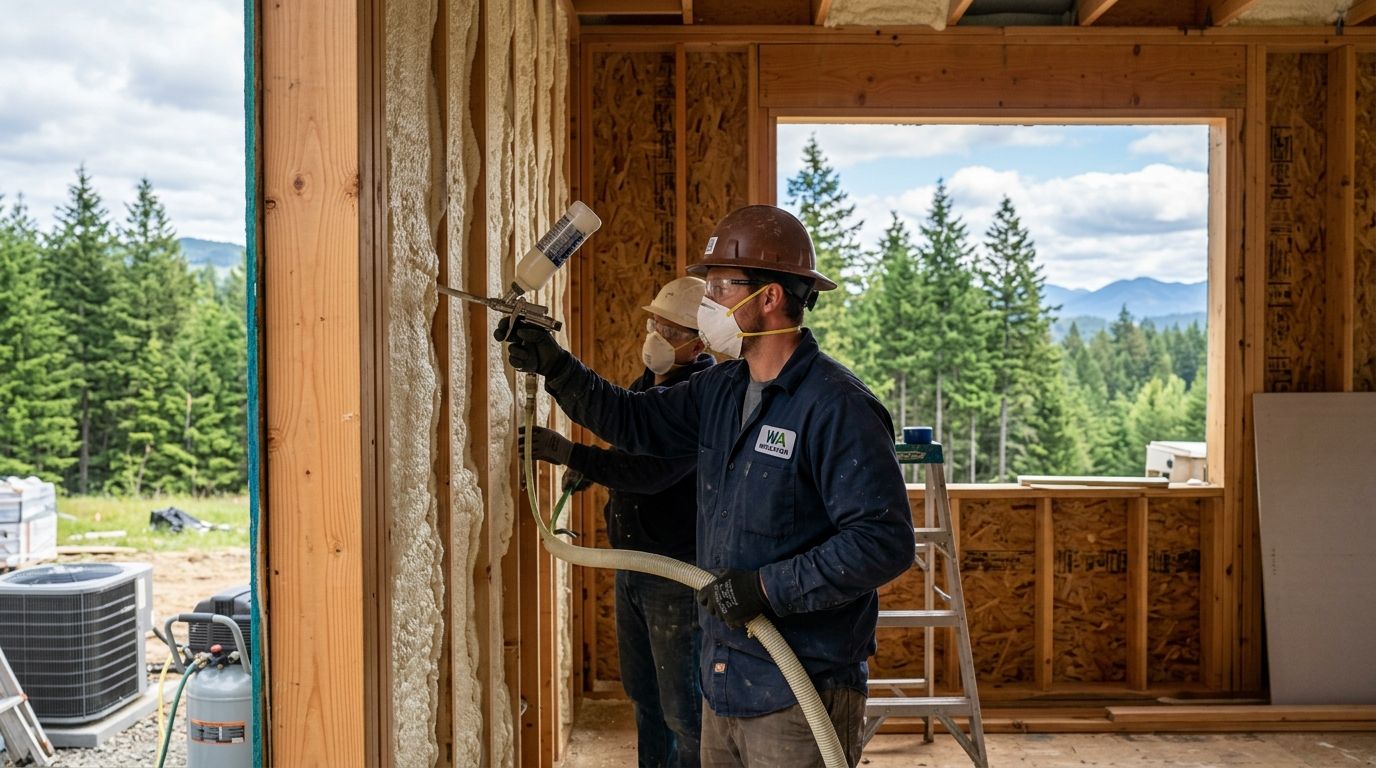
    Spray foam insulation costs $1.50 to $5.50 per square foot installed in Seattle in 2026, with a typical attic or crawl space job totaling $1,500 to $4,500. Closed-cell foam runs roughly double open-cell per square foot.

    What’s the difference between open-cell and closed-cell spray foam?

    Open-cell spray foam delivers R-3.5 to R-3.6 per inch and costs $1.50 to $3.00 per square foot, while closed-cell delivers R-6 to R-7 per inch and costs $3.00 to $5.50 per square foot. Closed-cell also resists moisture better, which matters in Pacific Northwest crawl spaces.

    Is closed-cell or open-cell better for a crawl space?

    Closed-cell spray foam is better for crawl spaces because it resists ground moisture, while open-cell absorbs water and can break down in damp, below-grade spaces. Seattle-area crawl spaces almost always call for closed-cell foam.

    How much does spray foam insulation cost per square foot?

    Spray foam insulation costs $1.50 to $3.00 per square foot for open-cell and $3.00 to $5.50 per square foot for closed-cell in 2026. The final price depends on square footage, access, and whether old insulation needs removal first.

    Does spray foam insulation cost more than fiberglass?

    Yes, spray foam costs more than fiberglass batts, which run $0.50 to $1.50 per square foot compared to $1.50 to $5.50 for spray foam. The tradeoff is air-sealing performance that fiberglass batts don’t provide on their own.

    How much does crawl space insulation cost in Washington state?

    Crawl space insulation with closed-cell spray foam costs $2,000 to $4,000 in the greater Seattle, Tacoma, and Olympia area in 2026. Vapor barrier work or moisture remediation can add to that total.

    Is spray foam insulation a good investment in 2026?

    Spray foam insulation is a good investment in 2026 for homes with documented air leakage or moisture issues in the attic or crawl space, since it air-seals as it cures and reduces the drafts that drive up heating bills. Homes with newer, well-sealed envelopes see less benefit from the switch.

    One last thing

    Many Seattle-area homes built before the 1980s have zero insulation in the crawl space, not just under-insulation, which means the $2,000 to $4,000 closed-cell range often includes work that has never been done rather than a simple upgrade. Ask any contractor bidding a crawl space job in 2026 whether the quote assumes bare ground or an existing vapor barrier, because that single detail changes the total more than foam type does.


  • Best Insulation for Vaulted Ceilings in 2026

    Best Insulation for Vaulted Ceilings in 2026

    Vaulted and cathedral ceilings look great and heat like a barn if the insulation is wrong. Closed-cell spray foam is the best insulation for vaulted ceilings in most Pacific Northwest homes, but the right pick depends on whether your roof assembly is vented or unvented, how deep your rafters are, and what you're trying to solve — heat loss, ice damming, or noise from rain on the roof.

    TL;DR
    • Closed-cell spray foam is the best insulation for vaulted ceilings in Pacific Northwest homes in 2026 because it air-seals and insulates in one step.
    • Open-cell spray foam wins for interior sound control when a vaulted ceiling has full rafter depth exposed.
    • Fiberglass batts are the cheapest option but trap moisture in unvented cathedral ceilings around Seattle and Tacoma.
    • Mineral wool batts balance fire resistance and cost for vented vaulted assemblies.
    • AT Foam installs closed-cell and open-cell foam in vaulted rooflines across Seattle, Tacoma, and Olympia.
    R-value by material
    R-6.5 per inch
    Closed-cell spray foam
    R-3.7 per inch
    Open-cell spray foam
    9.25 in
    Common 2×10 rafter depth
    Typical PNW cathedral ceiling framing

    Why this matters

    Vaulted ceilings don't have an attic buffer between the living space and the roof deck. Whatever insulation goes into that rafter cavity is the only thing standing between your living room and Washington's wet, mild-but-persistent winters.

    Get it wrong and you get two failure modes: ice damming at the eaves from heat leaking through the roof, or trapped moisture inside the cavity that rots the sheathing from the inside. Both are common in older homes across insulation types for older Pacific Northwest homes where the original assembly was never designed for today's energy code.

    The fix isn't always more insulation — it's the right material for the assembly type. AT Foam sees this constantly on retrofit jobs: a homeowner adds batts to a vented cathedral ceiling and the room still feels drafty because nobody sealed the air leaks first.

    What makes the best insulation for vaulted ceilings

    • R-value per inch — rafter depth is fixed, so a material that hits more R-value in less space wins in tight cavities
    • Air sealing — gaps around wiring, can lights, and top plates leak more heat than the insulation itself blocks
    • Moisture resistance — Pacific Northwest humidity and rain make vapor management non-negotiable in an unvented roof
    • Vented vs. unvented compatibility — some materials only work safely in one assembly type
    • Fire and code compliance — Washington's energy code sets minimum ceiling R-values that vaulted assemblies often struggle to hit
    • Sound dampening — matters more in vaulted rooms because there's no attic space to absorb rain and wind noise

    At a glance

    Insulation Best for Standout feature Key limitation
    Closed-cell spray foam Unvented vaulted ceilings with tight rafters Air seals and insulates in one application Rigid once cured, harder to retrofit wiring later
    Open-cell spray foam Interior sound control in exposed rafters Expands to fill irregular cavities completely Lower R-value per inch, needs full rafter depth
    Rigid foam board Above-deck retrofits without removing drywall Continuous insulation with no thermal bridging Requires roof tear-off or new construction access
    Mineral wool batts Vented assemblies needing fire resistance Naturally fire-resistant, holds R-value when damp Needs a functioning vent channel to perform
    Fiberglass batts Budget vented cathedral ceilings Lowest material cost of the group Loses R-value fast if compressed or wet
    Blown-in cellulose Dense-pack retrofits through small access holes Fills gaps around obstructions without demo Settling risk if not installed to density spec

    1. Closed-cell spray foam: best insulation for tight, unvented vaulted ceilings

    Closed-cell spray foam is a rigid, high-density foam sprayed directly into the rafter cavity, where it expands and cures into an air-sealed layer that also acts as a vapor retarder. At roughly R-6.5 per inch, it fits more insulating power into a shallow 2×8 or 2×10 rafter bay than any batt or blown-in product.

    This is the material AT Foam installs most often for unvented vaulted assemblies in Seattle, Tacoma, and Olympia because it solves the air leakage problem and the vapor problem in one pass.

    Closed-cell spray foam pros:

    • Highest R-value per inch of any common insulation material
    • Doubles as an air barrier, cutting drafts around can lights and skylights
    • Adds structural rigidity to the roof deck
    • Performs well in unvented "hot roof" assemblies common in remodels

    Closed-cell spray foam cons:

    • Costs more per board foot than batts or cellulose — check current spray foam insulation cost in Seattle figures before budgeting
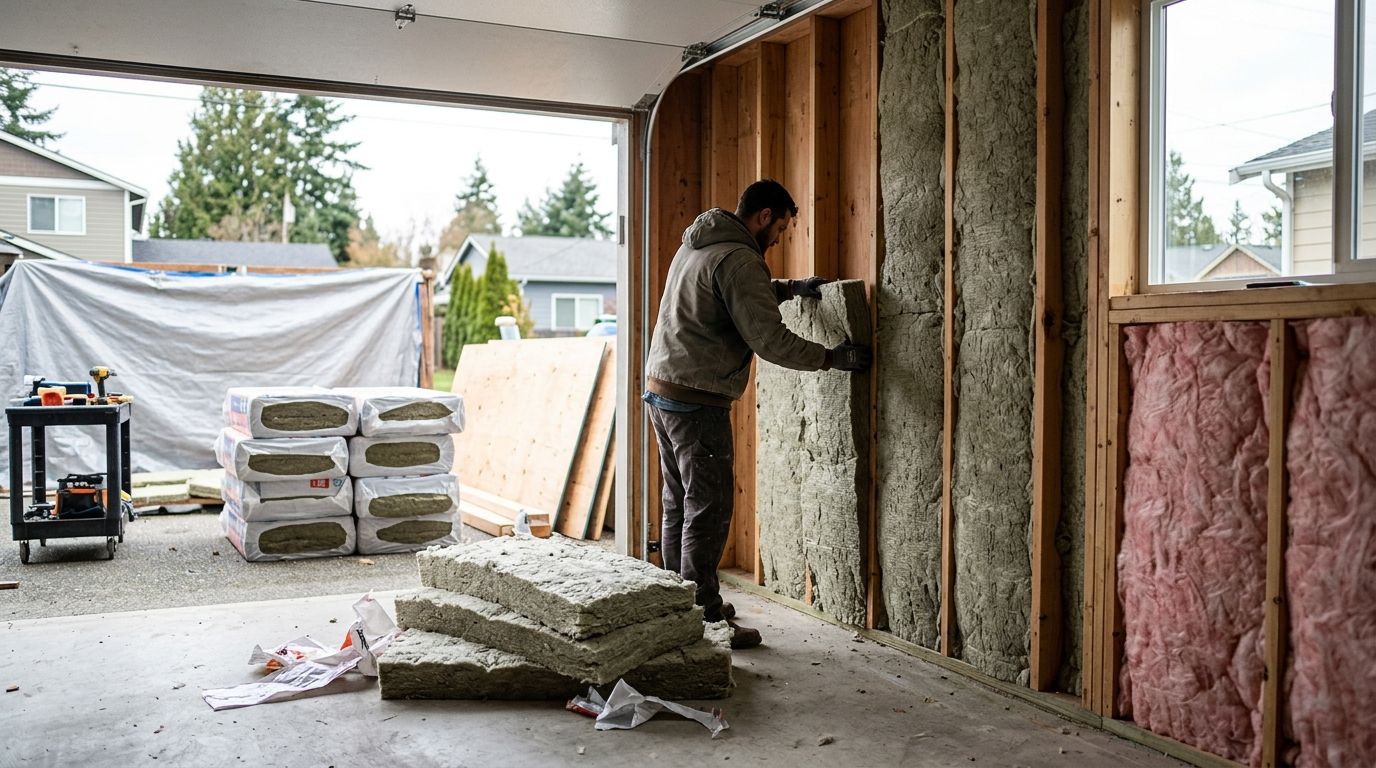
    • Once cured, it's difficult to remove for future wiring or plumbing changes
    • Requires a licensed installer for correct mix ratio and thickness

    Closed-cell spray foam verdict: Buy. It's the strongest option for Pacific Northwest vaulted ceilings where rafter depth is limited and the assembly is unvented.

    Technician spraying closed-cell foam into vaulted ceiling rafters
    Closed-cell foam fills irregular rafter bays and seals air leaks in one pass.

    2. Open-cell spray foam: best for sound control in exposed-rafter ceilings

    Open-cell spray foam is a softer, lower-density foam that expands more per unit of material, at about R-3.7 per inch. It needs full rafter depth to hit code-level R-values, so it fits best in newer construction with deeper 2×12 rafters or added strapping.

    The cell structure absorbs sound better than closed-cell foam, which matters in a vaulted great room where rain on the roof carries straight into the living space.

    Open-cell spray foam pros:

    • Noticeably quieter under rain and wind than batt insulation
    • Expands to fill gaps around wiring and irregular framing
    • Lower material cost than closed-cell foam

    Open-cell spray foam cons:

    • Needs a vapor retarder in most Washington climate zones since it's vapor-permeable
    • Requires deeper rafter cavities to reach adequate R-value
    • Can absorb moisture if the roof ever leaks, unlike closed-cell foam

    Open-cell spray foam verdict: Buy for new construction or additions with deep rafters and a priority on sound dampening.

    3. Rigid foam board: best for above-deck retrofits without tearing out drywall

    Rigid polyiso or XPS board goes on top of the roof deck, under new roofing, rather than inside the rafter cavity. It delivers roughly R-6 per inch and creates a continuous thermal layer with zero framing gaps.

    This only makes sense when you're already replacing the roof — pulling shingles and sheathing to install board from above isn't a standalone insulation project.

    Rigid foam board pros:

    • Eliminates thermal bridging through rafters entirely
    • Doesn't disturb interior finishes or drywall
    • Pairs well with a vented or unvented assembly below

    Rigid foam board cons:

    • Only cost-effective when timed with a roof replacement
    • Adds roof height, which can complicate flashing details
    • Needs a qualified roofer, not just an insulation crew

    Rigid foam board verdict: Hold unless a re-roof is already scheduled — then it's a strong upgrade.

    4. Mineral wool batts: best for fire-resistant, vented vaulted ceilings

    Mineral wool (rock wool) batts run about R-4.2 per inch and are naturally fire-resistant, since the material is spun from basalt rock rather than plastic resin. They also hold their R-value even if they get slightly damp, which fiberglass does not.

    They only work correctly in a vented assembly with a clear air channel between the insulation and the roof deck.

    Mineral wool batts pros:

    • Fire-resistant without added chemical treatment
    • Better moisture tolerance than fiberglass
    • Good sound absorption for a batt product

    Mineral wool batts cons:

    • Requires a working vent channel, which older homes often lack
    • Heavier and stiffer to install than fiberglass
    • Higher cost than standard fiberglass batts

    Mineral wool batts verdict: Hold for vented roofs where fire resistance or moisture tolerance matters more than upfront cost.

    5. Fiberglass batts: best budget option for vented cathedral ceilings

    Fiberglass batts run R-3.2 to R-3.8 per inch and remain the cheapest widely available insulation. In a properly vented vaulted ceiling with intact baffles, they can perform adequately.

    The problem in the Pacific Northwest is that batts alone don't air-seal, and a poorly vented cathedral ceiling with batts is a known setup for condensation inside the cavity.

    Fiberglass batts pros:

    • Lowest material cost of any option on this list
    • Widely available and easy for a crew to install fast
    • No specialty equipment required

    Fiberglass batts cons:

    • Loses significant R-value when compressed into a tight cavity
    • Does nothing to stop air leakage around fixtures and framing
    • High moisture risk in unvented or poorly vented Washington roofs

    Fiberglass batts verdict: Skip for unvented assemblies; Wait even in vented ones unless the vent channel is confirmed intact.

    6. Blown-in cellulose: best for retrofitting without opening the ceiling

    Dense-pack cellulose gets blown into the closed rafter cavity through small access holes, at roughly R-3.7 per inch. It's the practical choice when a homeowner wants better insulation in an existing vaulted ceiling without removing drywall.

    Installation quality is everything here — underfilled cellulose settles over time and leaves gaps at the top of the cavity.

    Blown-in cellulose pros:

    • Installs through small holes, no drywall demolition
    • Fills around wiring and obstructions well when dense-packed correctly
    • Treated with borate for fire and pest resistance

    Blown-in cellulose cons:

    • Settling risk if the installer doesn't hit proper density
    • Absorbs and holds moisture more than foam
    • Harder to verify installation quality once the holes are patched

    Blown-in cellulose verdict: Hold for retrofits where opening the ceiling isn't an option and the installer can document dense-pack density.

    Diagram comparing vented and unvented vaulted ceiling assemblies
    The assembly type decides which materials are safe to use before anything else.

    Get your vaulted ceiling assessed

    A free estimate confirms vented vs. unvented before any material goes in.

    How we ranked these

    Each material was weighed against the six criteria above, with air sealing and moisture resistance weighted heaviest since those two failures cause the most callback repairs in Pacific Northwest vaulted ceilings. R-value per inch mattered most for homes with shallow rafter depth, where every fraction of an inch counts toward hitting code minimums.

    Which insulation should you choose for your vaulted ceiling?

    If you don't know your assembly type yet, that's the first question to answer — not the material. For most unvented vaulted ceilings in Seattle, Tacoma, and Olympia, closed-cell spray foam is the default recommendation because it handles air sealing, R-value, and vapor control together.

    If your rafters are deep and the priority is quieting rain noise in a great room, open-cell spray foam is the better fit. Budget-driven vented retrofits do fine with mineral wool or fiberglass, provided the vent channel is actually functional — confirm that before buying materials, not after. For a broader look at contractors handling these installs, see house insulation contractors in Washington state.

    FAQ

    What is the best insulation for vaulted ceilings in the Pacific Northwest?

    Closed-cell spray foam is the best insulation for vaulted ceilings in most Pacific Northwest homes because it air-seals and insulates the rafter cavity in one application. It performs especially well in unvented assemblies common in remodels and additions.

    Is closed-cell spray foam better than open-cell for vaulted ceilings?

    Closed-cell foam wins on R-value per inch and moisture resistance, making it the stronger pick for shallow or unvented rafter cavities. Open-cell foam costs less and dampens sound better when full rafter depth is available.

    Can you use fiberglass batts in a cathedral ceiling in Seattle?

    Fiberglass batts work only in a properly vented cathedral ceiling with an intact air channel above the insulation. In unvented assemblies, batts trap moisture and are not recommended for Seattle’s climate.

    Do vaulted ceilings need a vented or unvented assembly in Washington state?

    Both assembly types are used in Washington, but the choice determines which insulation materials are safe. Unvented assemblies require spray foam or another air-impermeable material to prevent condensation inside the roof deck.

    How much rafter depth do you need for spray foam insulation?

    A 2×10 rafter, roughly 9.25 inches deep, holds enough closed-cell spray foam to reach strong R-values in a compact cavity. Open-cell foam needs more depth, closer to a 2×12, to reach the same performance.

    Does mineral wool work in a vaulted ceiling?

    Mineral wool batts work well in vented vaulted ceilings and add fire resistance that fiberglass lacks. They require a functioning vent channel to avoid trapping moisture against the roof deck.

    What R-value do you need for a vaulted ceiling in Washington?

    Washington’s energy code sets minimum ceiling R-values that vaulted assemblies often struggle to hit due to limited rafter depth, typically pushing homeowners toward higher R-per-inch materials like spray foam. A licensed insulation contractor can confirm the target for a specific roof assembly.

    Can spray foam cause moisture problems in a vaulted ceiling?

    Properly installed closed-cell spray foam reduces moisture risk because it acts as its own vapor retarder. Problems arise from incorrect thickness or gaps, which is why installation by a licensed crew matters more than the material choice alone.

    One last thing

    The insulation material gets all the attention, but the vent channel — or the decision to skip one entirely — is what actually determines whether a vaulted ceiling insulation job lasts 20 years or fails in five. Confirm that detail with an installer before picking a product off this list.

    Related guides


  • Insulation Cost Comparison for Seattle Homes

    Insulation Cost Comparison for Seattle Homes

    Fiberglass batts cost the least to install in a Seattle attic, but they lose R-value fast in a marine climate that never really dries out. Closed-cell spray foam costs the most per square inch and wins where moisture, air leaks, and structural rigidity all matter at once. This guide ranks six insulation options by relative cost so you can match the right material to the right part of the house before you call a contractor.

    TL;DR
    • Fiberglass batt insulation is the cheapest option for open, accessible attics in 2026 but underperforms in Seattle’s damp climate.
    • Closed-cell spray foam sits at the top of the insulation cost comparison seattle homeowners run, and it earns that cost in crawl spaces and rim joists.
    • Open-cell spray foam is the mid-tier pick for soundproofing home offices and irregular wall cavities.
    • Blown-in cellulose is the practical budget upgrade for older Seattle attics with uneven framing.
    • Mineral wool and rigid foam board fill specific niches: fire-resistant garage walls and basement rim joists.
    R-value per inch, by material
    R-6 to R-7
    Closed-cell spray foam
    R-3.5 to R-3.6
    Open-cell spray foam
    R-3.1 to R-3.4
    Fiberglass batt

    Why this matters

    Seattle and the greater Pacific Northwest sit in a marine climate zone, which means insulation has to fight moisture as much as it fights heat loss. A lot of the housing stock in Seattle, Tacoma, and Olympia predates 1980, so crawl spaces and attics were built to code standards that look thin by 2026 expectations.

    Cost comparisons that only look at price per square foot miss the bigger picture: an insulation material that traps moisture in a Seattle crawl space costs more in mold remediation than it ever saved on installation. Checking current numbers for spray foam insulation cost in Seattle before you commit to a cheaper batt product is worth the ten minutes.
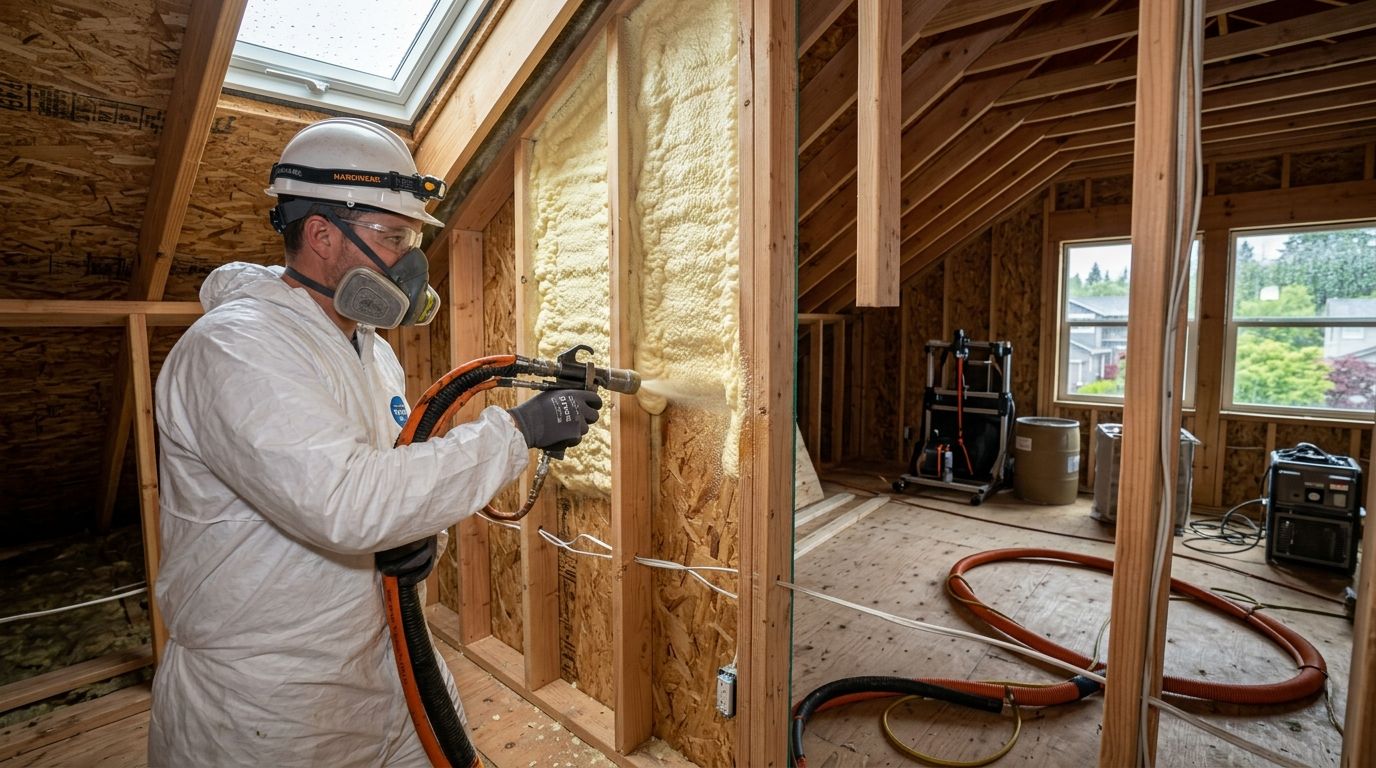
    What makes the best insulation option for a cost comparison

    • R-value per inch — how much insulating power you get per dollar of material thickness
    • Moisture and mold resistance — critical in Western Washington's wet winters
    • Installed cost tier — material plus labor, not just the bag or roll price
    • DIY versus professional install — batts save labor cost, spray foam does not
    • Lifespan and settling — cellulose and batts compress and sag over years, foam does not
    • Air sealing performance — gaps in batts and loose-fill undercut their rated R-value
    Pyramid showing six insulation types stacked from lowest to highest relative cost tier
    Cost climbs with moisture resistance and air-sealing performance, not just R-value.

    Insulation options at a glance

    Insulation Type Best For Standout Feature Cost Tier Key Limitation
    Fiberglass Batt Budget attic retrofits Widely available, DIY-friendly Lowest Loses R-value with gaps and compression
    Blown-In Cellulose Older Seattle attics, irregular framing Fills around obstructions and wiring Low-to-moderate Settles over time, absorbs moisture if wet
    Mineral Wool Fire-resistant garage conversions Naturally fire- and pest-resistant Moderate Heavier and pricier per bag than fiberglass
    Open-Cell Spray Foam Soundproofing home offices and studios Expands to seal irregular cavities, dampens sound Moderate-to-high Not a vapor barrier, professional install only
    Closed-Cell Spray Foam Crawl space moisture control Acts as its own vapor barrier, adds rigidity Highest Highest upfront cost per board foot
    Rigid Foam Board Basement walls and rim joists Continuous insulation, no thermal bridging Moderate-to-high Seams need sealing, awkward on odd angles

    1. Fiberglass Batt Insulation: best insulation for budget attic retrofits

    Fiberglass batts are pre-cut rolls of spun-glass fiber that fit between standard-spaced attic joists and wall studs. Any homeowner with a utility knife can install them, which is why they remain the default choice for cost-conscious attic jobs across Washington in 2026.

    Fiberglass batt pros:

    • Lowest material cost of any option on this list
    • No cure time, no odor, ready to walk on the same day
    • Simple to source at any home improvement store in Seattle or Tacoma

    Fiberglass batt cons:

    • Loses a meaningful chunk of its rated R-value when compressed or gapped around wiring and pipes
    • Does nothing to stop air leakage on its own, so heat still escapes through gaps
    • Fiberglass holds moisture rather than shedding it, a real liability in a wet crawl space

    Best for: open, easy-to-access attics on a tight renovation budget. Verdict: Buy if the space is dry, accessible, and you're willing to pair it with separate air sealing.

    2. Blown-In Cellulose: best insulation for retrofitting older Seattle attics

    Cellulose is shredded, treated recycled paper blown into attics and wall cavities with a machine. It fills around obstructions, wiring, and irregular framing better than batts, which matters in the older housing stock common around Seattle and Olympia.

    Blown-in cellulose pros:

    • Fills gaps and odd angles that batts can't reach
    • Made from recycled material, appealing for eco-conscious renovation projects
    • Denser pack slightly slows air movement compared to loose fiberglass

    Blown-in cellulose cons:

    • Settles 15-20% over the years, thinning the insulation layer without a top-up
    • Absorbs and holds water if a roof leak or attic condensation problem goes unnoticed
    • Requires rental or contractor-grade blowing equipment, unlike batts

    Best for: retrofitting attics in older Seattle and Tacoma homes with irregular joist spacing. Verdict: Buy for attic top-ups on a budget; Skip for damp or leak-prone spaces.

    3. Mineral Wool (Rock Wool): best insulation for fire-resistant garage conversions

    Mineral wool is spun from basalt rock and slag, formed into dense batts or loose fill. It resists fire and pests better than fiberglass or cellulose, which makes it a common pick for garage conversions turning into living space or workshops.

    Mineral wool pros:

    • Naturally fire-resistant without added chemical treatment
    • Resists pests and mold better than fiberglass or cellulose
    • Holds its shape and R-value longer than fiberglass batts

    Mineral wool cons:

    • Heavier to handle during install than fiberglass
    • Costs more per bag or batt than standard fiberglass
    • Still not a vapor barrier, so moisture management needs a separate plan

    Best for: garage conversions and shared-wall spaces where fire code matters. Verdict: Buy for garage and workshop conversions; Hold for standard attic jobs where cost matters more.

    4. Open-Cell Spray Foam: best insulation for soundproofing home offices and studios

    Open-cell spray foam expands to roughly 100 times its liquid volume, filling every gap and irregular cavity in a wall or ceiling. The soft, spongy cell structure absorbs sound far better than batts or loose fill, which is why home offices and studios in the Pacific Northwest increasingly spec it.

    Open-cell spray foam pros:

    • Seals air leaks and sound transmission in one application
    • Expands into gaps around wiring, plumbing, and irregular framing that batts miss
    • Lighter and less costly than closed-cell foam for wall and ceiling applications

    Open-cell spray foam cons:

    • Not a vapor barrier, so it needs a separate moisture strategy in wet areas
    • Professional installation only; this isn't a weekend DIY project
    • Lower R-value per inch than closed-cell foam, so thicker cavities are needed for the same performance

    Best for: soundproofing home offices and studios and interior walls with irregular framing. Verdict: Buy for interior sound and air sealing; Hold for below-grade or high-moisture spaces.

    5. Closed-Cell Spray Foam: best insulation for crawl space moisture control

    Closed-cell spray foam cures into a rigid, dense layer that acts as its own vapor barrier and adds real structural strength to rim joists and crawl space walls. It sits at the top of any insulation cost comparison Seattle homeowners run, and in crawl spaces and flood-prone areas the extra cost buys moisture protection nothing else on this list matches.

    Technician spraying closed-cell foam insulation in a residential crawl space
    Closed-cell foam seals crawl space walls against ground moisture in one application.

    Closed-cell spray foam pros:

    • Highest R-value per inch of any material on this list
    • Doubles as a vapor barrier, critical for crawl space encapsulation work
    • Adds rigidity and can strengthen rim joists and sill plates

    Closed-cell spray foam cons:

    • Highest cost per board foot of any option here
    • Requires full professional installation and cure time before the space is usable
    • Overkill for dry, easily accessible attic spaces where batts do the job

    Best for: crawl spaces, rim joists, and flood-prone foundation walls. Verdict: Buy for moisture-critical spaces; Skip for simple attic top-ups where the budget doesn't support it.

    6. Rigid Foam Board: best insulation for basement walls and rim joists

    Rigid foam board comes in EPS, XPS, or polyiso panels that install as a continuous layer against basement walls or rim joists, cutting the thermal bridging that stud-cavity insulation can't avoid. It's a common upgrade in basement finishing projects across Washington in 2026.

    Rigid foam board pros:

    • Creates a continuous thermal layer with no stud gaps
    • Resists moisture better than fiberglass or cellulose in below-grade applications
    • Can be layered for higher total R-value on exterior walls

    Rigid foam board cons:

    • Seams need careful taping and sealing or performance drops fast
    • Harder to fit around pipes, ducts, and irregular basement framing
    • Cutting and fastening panels correctly takes more labor time than batts

    Best for: basement wall insulation and rim joist retrofits. Verdict: Buy for basement finishing projects; Hold for attics where spray foam or batts install faster.

    How we ranked these

    Each material is ranked against the six criteria above: R-value per inch, moisture resistance, installed cost tier, install complexity, lifespan, and air sealing performance. Materials that only win on upfront cost but lose on moisture resistance or lifespan get flagged in the cons, not glossed over — a cheap batt job that needs redoing in ten years isn't actually the budget option.

    Get a free insulation estimate

    Compare spray foam, batt, and blown-in costs for your Seattle home.

    Which insulation option should you choose?

    For a dry, accessible attic on a tight budget, fiberglass batt insulation is the default buy in 2026. For a Seattle crawl space with any history of moisture, closed-cell spray foam is the material that stops the problem instead of managing it. For soundproofing a home office or filling irregular wall cavities, open-cell spray foam splits the difference between cost and performance. Match the material to the specific room, not the whole house to one product.

    FAQ

    What’s the cheapest insulation option for a Seattle home in 2026?

    Fiberglass batt insulation costs the least to install of the six options ranked here. It works best in dry, accessible attics; it underperforms in damp crawl spaces or areas with irregular framing.

    Is closed-cell spray foam worth the extra cost in the Pacific Northwest?

    Yes, in crawl spaces and rim joists where moisture is the real threat. Closed-cell spray foam acts as its own vapor barrier and reaches R-6 to R-7 per inch, the highest of any option in this comparison.

    How does spray foam insulation cost compare to fiberglass batts in Seattle?

    Spray foam sits higher on the cost tier than fiberglass batts because it requires professional installation and specialized equipment. Current project-specific numbers are on the spray foam cost page for Seattle.

    What insulation works best for crawl space moisture in Western Washington?

    Closed-cell spray foam handles crawl space moisture better than fiberglass, cellulose, or open-cell foam because it forms its own vapor barrier against damp foundation walls.

    Does open-cell spray foam block sound better than fiberglass?

    Yes, the spongy cell structure of open-cell spray foam absorbs sound more effectively than fiberglass batts, which is why it’s the common pick for home offices and studios.

    Is blown-in cellulose good for older Seattle homes?

    Blown-in cellulose fits irregular framing and obstructions common in older Seattle and Tacoma attics better than pre-cut batts. It does settle over time and needs a top-up eventually.

    What insulation lasts the longest in a Pacific Northwest attic?

    Closed-cell and open-cell spray foam hold their shape and R-value longer than fiberglass or cellulose, which compress and settle over years.

    Should I mix insulation types in the same house?

    Yes, most Seattle homes benefit from mixing types: closed-cell foam in the crawl space, open-cell or batts in the attic, and rigid foam board on basement walls, matched to each area’s moisture and access conditions.

    One last thing

    The insulation material matters less than where it's used badly: a fiberglass batt job in a dry, well-sealed attic will outperform a rushed spray foam job in a leaky one. Fix the moisture and air-sealing problem first, then pick the material tier that fits the budget for that specific space.

    Related guides


  • The Top 5 Signs Your Home Needs New Insulation

    Published on July 14, 2026

    As a homeowner in the Pacific Northwest, you know that our region’s wet winters and mild summers can take a toll on your home’s energy efficiency. In Washington State, where fluctuating temperatures and high humidity are common, outdated or inadequate insulation can lead to discomfort, higher energy bills, and even structural issues. At AT Foam, a leading spray foam insulation company serving the PNW, we’ve helped countless homeowners identify and address these problems. In this comprehensive guide, we’ll explore the top five signs that your home needs new insulation and how upgrading to spray foam can enhance your home’s performance. Let’s dive in.

    Why Insulation Matters in the Pacific Northwest

    Before we get to the signs, it’s essential to understand why insulation is crucial for homes in Washington State. The PNW climate brings rainy seasons that can cause moisture buildup, leading to mold and energy loss. Poor insulation allows heat to escape in winter and cool air to flee in summer, making your HVAC system work overtime. According to the U.S. Department of Energy, homes with inadequate insulation can lose up to 30% of their energy through the attic and walls alone. Upgrading to spray foam insulation not only seals gaps effectively but also provides a moisture barrier, which is ideal for our damp environment. At AT Foam, we recommend regular insulation checks to maintain comfort and reduce costs.

    Sign 1: Skyrocketing Energy Bills

    One of the most noticeable signs that your home needs new insulation is a sudden or gradual increase in energy bills. In the PNW, where heating demands peak during chilly, wet winters, inefficient insulation can cause your furnace to run longer to maintain comfortable temperatures. If you’ve noticed your bills creeping up without changes in usage, it’s likely due to heat loss through poorly insulated walls, attics, or crawl spaces.

    Practical tip: Track your energy usage over a few months and compare it to previous years. If bills are higher than expected, perform a simple audit by feeling for drafts around windows and doors. Upgrading to spray foam insulation from AT Foam can create an airtight seal, potentially reducing your energy costs by 20-50%. Plus, Washington State offers rebates for energy-efficient upgrades, making it a smart, cost-saving investment.

    Sign 2: Uneven Indoor Temperatures

    Do certain rooms in your home feel significantly warmer or cooler than others? This inconsistency is a red flag for inadequate insulation. In the Pacific Northwest, where homes often face varying exposures to wind and rain, poor insulation exacerbates temperature fluctuations, making it hard to achieve a comfortable living space.

    How Spray Foam Helps

    Spray foam expands to fill gaps that traditional insulation misses, providing even temperature distribution. At AT Foam, our experts have seen this issue resolved in many Seattle-area homes, where spray foam’s superior R-value helps maintain steady indoor climates. Cost-saving advice: Consider a professional energy audit, which can cost as little as $200 and identify insulation needs before they worsen.

    Sign 3: Persistent Drafts and Cold Spots

    Feeling chilly drafts near windows, doors, or floors? These are classic indicators of worn-out insulation. In Washington’s rainy climate, drafts can also introduce moisture, leading to potential mold growth and reduced air quality. If you find yourself bundling up indoors or noticing whistling sounds from vents, it’s time to act.

    Engage in a quick DIY check: Use a candle to detect drafts by holding it near potential leak points—never leave it unattended for safety. Spray foam insulation from AT Foam offers a permanent solution by expanding into crevices, blocking airflow and moisture. Homeowners in the PNW have reported immediate comfort improvements and long-term savings on heating costs after upgrades.

    Sign 4: Moisture Issues or Pest Infestations

    The damp PNW environment makes homes susceptible to moisture problems, which ineffective insulation can worsen. Signs like condensation on windows, musty odors, or even pest invasions (such as rodents or insects) often stem from gaps in insulation that allow water vapor to seep in.

    Practical Tips for Prevention

    Regularly inspect your attic and basement for signs of dampness. Spray foam’s closed-cell variety is water-resistant, making it an excellent choice for Washington homes. At AT Foam, we emphasize the importance of professional installation to ensure full coverage, which can prevent costly repairs down the line. Remember, addressing insulation early can qualify you for state incentives, saving you hundreds on upgrades.

    Sign 5: An Older Home or Outdated Insulation Materials

    If your home was built before the 1980s, it might have outdated insulation that doesn’t meet modern energy standards. In the PNW, older homes often suffer from settling insulation or materials that degrade over time, especially with our region’s humidity.

    Cost-saving advice: Upgrading to spray foam can increase your home’s value and qualify for federal tax credits. At AT Foam, our team of local experts provides tailored assessments for Washington State homes, ensuring you get the best results. We’ve assisted many families in transforming their properties into energy-efficient havens.

    Conclusion and Next Steps

    Recognizing the signs that your home needs new insulation is the first step toward a more comfortable, efficient living space in the Pacific Northwest. From high energy bills to moisture problems, addressing these issues with spray foam insulation can lead to significant savings and improved home health. At AT Foam, we’re committed to helping homeowners in Washington State make informed decisions about their insulation needs.

    Ready to take action? Contact AT Foam today for a free consultation and quote. Our local experts are here to guide you through the process, ensuring your home is optimized for the unique challenges of the PNW climate.