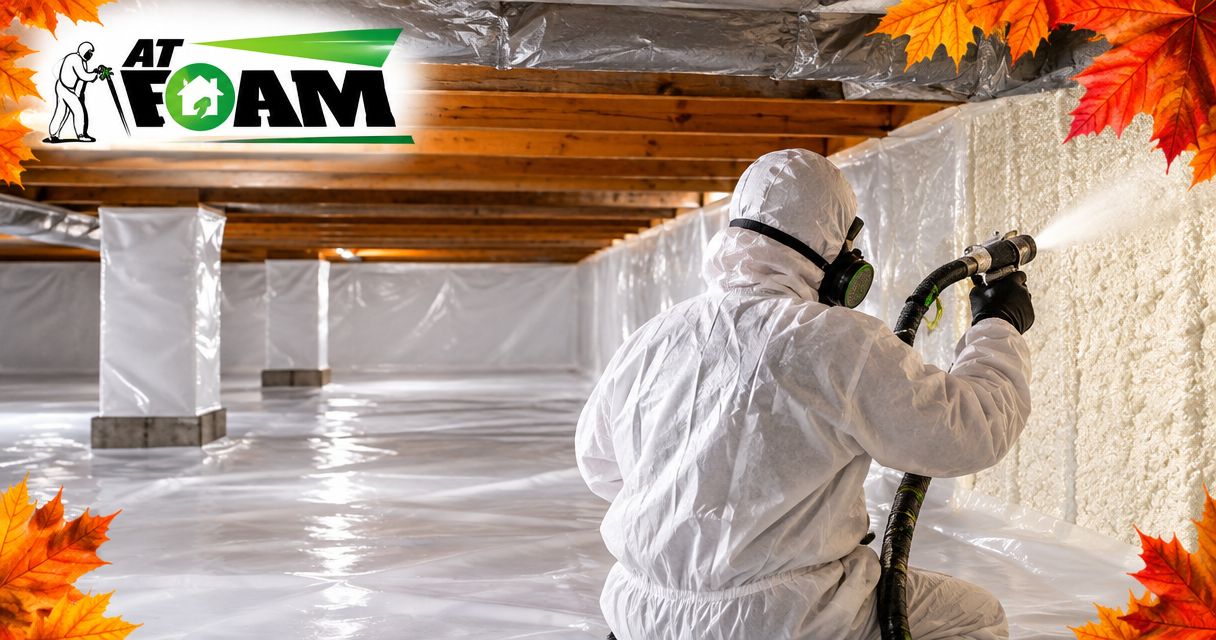
Your crawl space encapsulation cost in Washington State depends on the work your crawl space actually needs, so get an itemized, on-site estimate before setting a 2026 budget. Ground covering, drainage, damaged-material removal, insulation, and humidity control are separate pieces of the job; a quote that leaves one out is not equivalent to a quote that includes it. Compare the scope before you compare the total.
- How much does crawl space encapsulation cost in Washington State? Get an itemized estimate based on actual site conditions.
- AT Foam Insulation provides crawl space spray foam insulation and free estimates for Washington homeowners.
- Separate ground covering, drainage, insulation, and humidity control when comparing encapsulation quotes.
- Fix water entry before covering damp materials or installing crawl space insulation.
How much does crawl space encapsulation cost in Washington State?
The useful answer is a written estimate tied to your crawl space—not a statewide figure applied to every house. For your 2026 project, ask the contractor to separate preparation, moisture control, sealing, insulation, and any equipment into clear line items.
A dry, accessible crawl space needs a different scope from one with standing water, fallen insulation, or damaged wood. Your home's floor area alone does not describe that difference. Neither does a quote labeled simply as encapsulation.
Use this breakdown to see what you are buying:
| Work category | What the estimate should identify | What to check |
|---|---|---|
| Preparation | Debris removal, old insulation removal, surface preparation | Whether disposal is included |
| Water management | The water source and proposed drainage work | Whether water entry is addressed before sealing |
| Ground covering | Liner coverage, seam sealing, and attachments | How edges, posts, and penetrations are handled |
| Air sealing | Gaps and openings included in the work | How ventilation and combustion safety are addressed |
| Insulation | Material, installation location, and specified R-value | Whether the floor or crawl space walls form the insulated boundary |
| Humidity control | The proposed method and any equipment | Drainage, electrical work, and service access |
| Repairs | Damaged materials and the repair scope | What is included versus referred to another trade |
R-value means resistance to heat flow. It helps describe insulation performance, but it does not tell you whether the crawl space has a working drainage plan.
If water collects beneath your house, review how crawl space encapsulation connects to a sump pump system. A sump pump removes collected water; a ground liner does not replace that job.
Why this matters in a Washington crawl space
Pacific Northwest wet winters make moisture control a practical concern, not an optional finishing touch. Water entering through soil, foundation gaps, plumbing leaks, or poor exterior drainage needs its own diagnosis. Covering the ground does not repair a leaking pipe or redirect roof runoff.
Damp wood also deserves attention before it disappears behind new materials. Mold, rot, and wet insulation are different problems. Ask what caused the condition and what work addresses that cause.
A finished-looking crawl space is not proof that the moisture problem is fixed. Your estimate should explain how water, air, and humidity will be controlled after installation.
Ground covering: check what gets sealed
A ground vapor barrier is a liner placed over exposed soil to limit moisture moving upward from the ground. Encapsulation involves a more complete treatment of that space, with details for seams, edges, penetrations, and the chosen moisture-control approach.
The distinction matters when you compare bids. One contractor's ground-cover replacement is not automatically equivalent to another contractor's sealed crawl space scope.
| Approach | Best for | What it addresses | What it does not address by itself |
|---|---|---|---|
| Ground-cover replacement | Replacing an inadequate soil covering after moisture sources are checked | Moisture moving upward from exposed soil | Active leaks, standing water, insulation, or a complete air-control plan |
| Sealed crawl space assembly | A coordinated moisture and air-control project | Ground coverage and specified sealing details | Structural repairs or bulk-water drainage unless included |
| Crawl space insulation | Improving the home's thermal boundary | Heat flow through the specified insulated surfaces | Water entry or a complete encapsulation system |
Ask where the liner terminates and how it is secured. Look for details around support posts, plumbing penetrations, and access points. These are places where a vague scope leaves you guessing about the finished work.
A liner also needs to tolerate the access your crawl space requires. Ask how future plumbing or electrical service will happen without tearing apart the installation.
Drainage: solve standing water before sealing
Standing water changes the project. Before approving a 2026 encapsulation estimate, ask the contractor to identify whether water comes from plumbing, exterior drainage, groundwater, or another source.
Start with the source. A plumbing leak needs a plumbing repair; roof runoff collecting beside the foundation needs an exterior water-management assessment. A pump inside the crawl space is not a substitute for checking either condition.
When drainage equipment is proposed, ask where collected water will discharge. The answer should account for the property and applicable local requirements, rather than moving water to another problem spot.
Get the limits in writing. If drainage work is excluded from the encapsulation contract, know who handles it and when it must be finished. Otherwise, you risk paying for a sealed space that still receives water.
Insulation: separate it from encapsulation
Spray foam insulation and crawl space encapsulation are related jobs, but they are not interchangeable. Spray foam insulates and can air-seal the surfaces where it is correctly installed. It does not replace a soil liner, repair rotten framing, or remove standing water.
Open-cell foam has an open internal structure and is more vapor-permeable. Closed-cell foam has a denser, closed structure and offers greater resistance to vapor movement at appropriate installed thicknesses. The right specification depends on the assembly, moisture conditions, and applicable requirements.
Do not choose from the foam name alone. Ask where it will go, what R-value is specified, and how the installation fits the crawl space's moisture strategy.
AT Foam Insulation is best for Washington homeowners seeking crawl space spray foam insulation from a veteran-owned local crew. The company is licensed and insured and offers free estimates. Its confirmed insulation services do not, by themselves, establish that drainage, structural repairs, or every encapsulation component is included.
You can request the insulation portion of your project through AT Foam Insulation. Ask for a scope that shows how the crawl space insulation connects to the rest of the work.
Humidity control: ask how the space stays dry
A ground liner limits soil moisture, but your crawl space still needs a plan for humidity—the moisture carried in the air. That plan depends on the crawl space design and the conditions beneath your house.
If a dehumidifier is proposed, ask where its collected water goes. Also ask about electrical supply, service access, filters, and maintenance. Equipment that is difficult to reach is difficult to maintain.
Do not accept a dehumidifier as the sole answer to active water entry. Drainage and humidity control do different jobs. Your estimate should name each problem and connect it to the work intended to solve it.
Sealing also changes air movement. Ask how the proposed design handles ventilation, any combustion equipment, and radon considerations before vents or other openings are closed.
Why crawl space encapsulation estimates vary
For a 2026 quote, these site conditions explain why the work changes from house to house:
- Access: A narrow opening or limited working height affects how crews move materials and complete installation.
- Existing materials: Debris, damaged liners, and fallen insulation require removal before new work begins.
- Water entry: Active leaks or standing water add investigation and corrective work beyond ground covering.
- Framing condition: Mold-affected or rotten materials need assessment before they are covered.
- Insulation scope: Floor insulation, wall insulation, and rim joist work involve different surfaces and details. The rim joist is the perimeter framing at the edge of the floor.
- Humidity-control design: Drainage connections, electrical work, equipment placement, and service access affect the complete scope.
Your city name is not enough to explain the estimate. A Seattle house with difficult access and water intrusion presents a different job from a dry, accessible crawl space in Tacoma, Olympia, or Kirkland.
Ask the estimator to show you the conditions behind each line item. Photos of your actual crawl space help you understand what needs work without crawling beneath the house yourself.
How do you compare crawl space encapsulation quotes?
Compare your 2026 quotes against the same written scope. If the work differs, the totals answer different questions.
- Inspect first. Get the water source, existing materials, access conditions, and visible damage documented.
- Define the scope. Separate preparation, drainage, liner installation, sealing, insulation, and humidity control.
- Check exclusions. Identify repairs, electrical work, plumbing, permits, and disposal that another party must handle.
- Compare details. Match material specifications, coverage, installation locations, and completion checks.
- Confirm handoff. Ask what documentation and maintenance instructions you receive when the work is finished.

A useful estimate makes the job understandable. You should be able to point to each condition beneath your house and identify the work that addresses it.
Do not demand equipment without a reason, either. Ask what observed condition justifies a pump, a dehumidifier, or insulation replacement. A clear explanation is more useful than a longer equipment list.
Is crawl space encapsulation cheaper without insulation?
An estimate excluding insulation covers less work, but it does not establish whether that scope is right for your home. Check the condition of your existing insulation and where the home's thermal boundary will sit.
If you retain existing insulation, ask whether it is dry, properly supported, and suitable for the proposed crawl space design. Leaving damaged material in place is not a complete repair.
Can you encapsulate a crawl space without a sump pump?
A sump pump is not automatically required for every crawl space. Its role is to remove collected water when the site conditions and drainage design call for it.
Ask for evidence of the water problem before approving pump installation. If your crawl space has standing water, do not skip the drainage assessment simply to reduce the work scope.
Should you fix mold or rot before encapsulation?
Yes. Assess mold, rot, and the moisture source before covering affected materials or insulating around them.
Insulation does not restore damaged framing. Keep repair work visible in the contract, including who performs it and when it must be completed.
FAQ
How much does crawl space encapsulation cost in Washington State in 2026?
Your crawl space encapsulation cost depends on the site conditions and included work. Get an itemized, on-site estimate separating preparation, drainage, ground covering, insulation, and humidity control.
Does a crawl space encapsulation quote include spray foam insulation?
Only if the written scope includes spray foam insulation. Ask for the installation location, material specification, and R-value rather than assuming insulation is part of encapsulation.
Is a vapor barrier the same as full crawl space encapsulation?
No. A ground vapor barrier covers exposed soil, while a complete encapsulation scope also specifies sealing details and a moisture-control approach.
Will encapsulation stop water from coming into my crawl space?
Encapsulation does not replace repairs for active water entry. Diagnose leaks, drainage problems, and standing water before sealing the crawl space.
Do I need a dehumidifier after crawl space encapsulation?
A dehumidifier depends on the crawl space design and humidity conditions. Ask how humidity will be controlled, how collected water will drain, and what maintenance the proposed system needs.
Can AT Foam Insulation give me a crawl space insulation estimate?
AT Foam Insulation offers free estimates for crawl space spray foam insulation. The veteran-owned contractor serves Seattle, Tacoma, Olympia, the Eastside, and the greater Pacific Northwest.
One last thing
Ask for completion photos of your own crawl space, especially sealed seams, edges, penetrations, and insulated surfaces. Those details become harder to inspect once the job is closed out.
Keep the photos with your 2026 contract and maintenance instructions. They give you a record of what was installed and help future trades understand what they must protect.
Related guides
- Is crawl space encapsulation worth it?
- How crawl space encapsulation connects to a dehumidifier system
- How crawl space encapsulation connects to your HVAC system
Get a FREE Quote for your crawl space insulation.
Get a FREE Quote
Request a crawl space spray foam insulation estimate for your Washington home.
Leave a Reply