Best overall: mineral wool batts. Best for straightforward open-wall work: fiberglass batts. Best for enclosed cavities: professionally installed cellulose. The best insulation for apartment soundproofing absorbs sound inside the wall or ceiling, but stopping noise between units also requires sealed gaps, adequate wall weight, and control of vibration through framing.
- Mineral wool batts are the best insulation for apartment soundproofing when shared walls or ceilings are open.
- Fiberglass batts suit straightforward cavity insulation; cellulose suits suitable enclosed cavities.
- Open-cell spray foam serves combined insulation and air-sealing needs, not a stand-alone soundproofing fix.
- Footsteps require floor and ceiling vibration control, not just more insulation.
Why this matters in a Pacific Northwest apartment
You hear a neighbor's television through a shared wall. Or every footstep upstairs reaches your bedroom. Those are different problems, and buying the same insulation for both misses the point.
Wet winters add another concern in Seattle, Tacoma, Olympia, and the Eastside: insulation must not cover an unresolved leak, damp framing, mold, or rot. A sound upgrade that hides water damage is the wrong repair.
AT Foam Insulation is a veteran-owned local spray foam contractor serving homeowners and businesses across the greater Pacific Northwest. For apartment soundproofing, AT Foam Insulation is best suited to projects that also need its attic, crawl space, or wall spray foam services—not a blanket promise of quieter neighbors.
What makes the best apartment soundproofing insulation?
For a 2026 renovation, judge the complete wall or floor assembly before choosing the cavity fill. These criteria matter most:
- Sound absorption: The material reduces sound energy inside the cavity—the empty space between framing members.
- Assembly fit: The insulation matches the cavity depth and the tested construction detail without gaps or forced compression.
- Noise type: Voices and television need a different repair strategy from footsteps and dropped objects.
- Access: Open framing gives you options that a finished, occupied apartment does not.
- Moisture control: Exterior walls, attic edges, and crawl spaces need a drying and water-control plan.
- Fire protection: Shared walls and floors must retain their required fire-resistant construction, including protected penetrations.
Do not rank acoustic insulation by R-value. R-value measures resistance to heat flow. It does not tell you how much conversation will pass through a finished apartment wall.
Apartment insulation options at a glance
These rankings separate use cases. They do not claim that one material wins in every tested wall.
| Rank and material | Best for | Standout characteristic | Key limitation |
|---|---|---|---|
| 1. Mineral wool batts | Open shared walls and ceilings | Friction-fit fibrous cavity absorption | Cannot stop framing vibration by itself |
| 2. Fiberglass batts | Straightforward open-cavity installation | Flexible fibrous cavity fill | Gaps and poor fitting undermine coverage |
| 3. Cellulose | Suitable enclosed-wall retrofits | Can fill cavities through installation openings | Requires cavity inspection and controlled installation |
| 4. Open-cell spray foam | Combined thermal insulation and air sealing | Expands around irregular cavity surfaces | Does not replace a tested acoustic assembly |
| 5. Closed-cell spray foam | Space-constrained thermal and moisture-control details | Rigid foam with thermal and vapor-control properties | Not the default choice for sound absorption |
1. Mineral wool: best for open shared walls and ceilings
Best for: apartment renovations with exposed framing. Mineral wool batts are fibrous insulation pieces fitted between studs or ceiling joists. They absorb sound within the cavity rather than acting as a solid sound barrier.
Mineral wool is the default recommendation when the wall is already open and noise reduction is the main reason for the work. It is not a substitute for the rest of the wall design.
Mineral wool pros:
- Batts hold their shape during fitting.
- Pieces can be cut around obstructions.
- Fibrous material provides cavity sound absorption.
Mineral wool cons:
- Installation needs access to the cavity.
- Connected framing still carries vibration.
- Loose fitting leaves untreated gaps.
Before closing the wall, check corners, pipe routes, and the spaces beside electrical boxes. Keep the insulation continuous without interfering with required clearances or fire-protection details.
Verdict: Buy mineral wool for open cavities when sound absorption is the priority.
2. Fiberglass: best for straightforward open-cavity work
Best for: open walls or ceilings with a specified fiberglass assembly. Fiberglass batts use fine glass fibers to absorb sound in the cavity. They also provide thermal insulation where the wall or ceiling separates conditioned space from outdoors or an unconditioned area.
Fiberglass belongs on the shortlist, not automatically below every other material. The finished construction matters more than a label on the insulation bag.
Fiberglass pros:
- Provides fibrous cavity sound absorption.
- Can be fitted around wiring and pipes.
- Works in wall and floor-ceiling designs that specify it.
Fiberglass cons:
- Batts need careful cutting around obstructions.
- Gaps leave portions of the cavity untreated.
- Insulation alone does not seal air leaks.
For your 2026 project, ask whether the proposed fiberglass installation matches an acoustic test report for the complete assembly. A familiar material installed correctly beats a different material substituted without checking the detail.
Verdict: Buy fiberglass when it fits the specified assembly and the crew can install it continuously.
3. Cellulose: best for suitable enclosed-wall retrofits
Best for: finished walls where cavity filling is appropriate. Cellulose is fibrous insulation commonly made from treated recycled paper. Professional installation can place it inside enclosed cavities through access openings.
That makes cellulose useful when removing an entire wall finish is impractical. Inspection still comes first: blocking, existing insulation, wiring, and damaged finishes affect the installation plan.
Cellulose pros:
- Can reach suitable enclosed cavities.
- Provides fibrous sound absorption.
- Can reduce the extent of finish removal.
Cellulose cons:
- Hidden obstructions complicate coverage.
- Installation openings need repair.
- Filling a cavity does not disconnect shared studs.
Do not fill blindly into a damp exterior wall or an unknown fire-rated assembly. Confirm the cavity condition and the approved repair method before work starts.
Verdict: Buy cellulose for an inspected enclosed cavity, not as a guaranteed cure for neighbor noise.
4. Open-cell spray foam: best for combined insulation and air sealing
Best for: approved projects needing thermal insulation and air sealing alongside cavity sound absorption. Open-cell spray foam has an interconnected cell structure. It expands against the installation surface and requires a professional application plan.
AT Foam Insulation installs open-cell and closed-cell spray foam in attics, crawl spaces, and walls. That service fits a combined building-envelope project; it does not establish an acoustic rating for your apartment wall.
Open-cell spray foam pros:
- Fits irregular cavity surfaces during application.
- Provides thermal insulation.
- Can form an air barrier at the product's specified thickness.
Open-cell spray foam cons:
- Does not break vibration paths through framing.
- Requires ventilation and reentry planning during installation.
- Requires an appropriate moisture and fire-protection detail.
Read the explanation of whether spray foam insulation is good for soundproofing a room before treating air sealing and sound isolation as the same job.
Verdict: Hold until the contractor explains the thermal, moisture, fire, and acoustic roles separately.
5. Closed-cell spray foam: best for specific thermal details
Best for: approved exterior-envelope details where space and vapor control guide the insulation choice. Closed-cell spray foam forms a rigid insulation layer. Its thermal and moisture-related properties can matter at exterior walls, roof areas, and rim joists—the framing around the floor's outer edge.
Those strengths do not make closed-cell foam the default fill for a shared bedroom wall. A thermal problem and a sound problem need separate decisions.
Closed-cell spray foam pros:
- Provides thermal resistance in limited space.
- Can provide air control at specified thicknesses.
- Can provide vapor resistance according to product specifications.
Closed-cell spray foam cons:
- Rigid foam does not disconnect framing.
- Covered surfaces become harder to inspect.
- Application must account for moisture and required protective coverings.
For a 2026 apartment renovation, specify closed-cell foam because the building detail calls for it—not because denser insulation sounds like better soundproofing.
Verdict: Skip closed-cell foam as a sound-only upgrade; use it where the thermal design requires it.
What actually stops sound between apartments?
A useful sound-control plan combines cavity absorption, added mass, air sealing, and framing isolation. Insulation handles the first part; the wall or ceiling detail must handle the others.
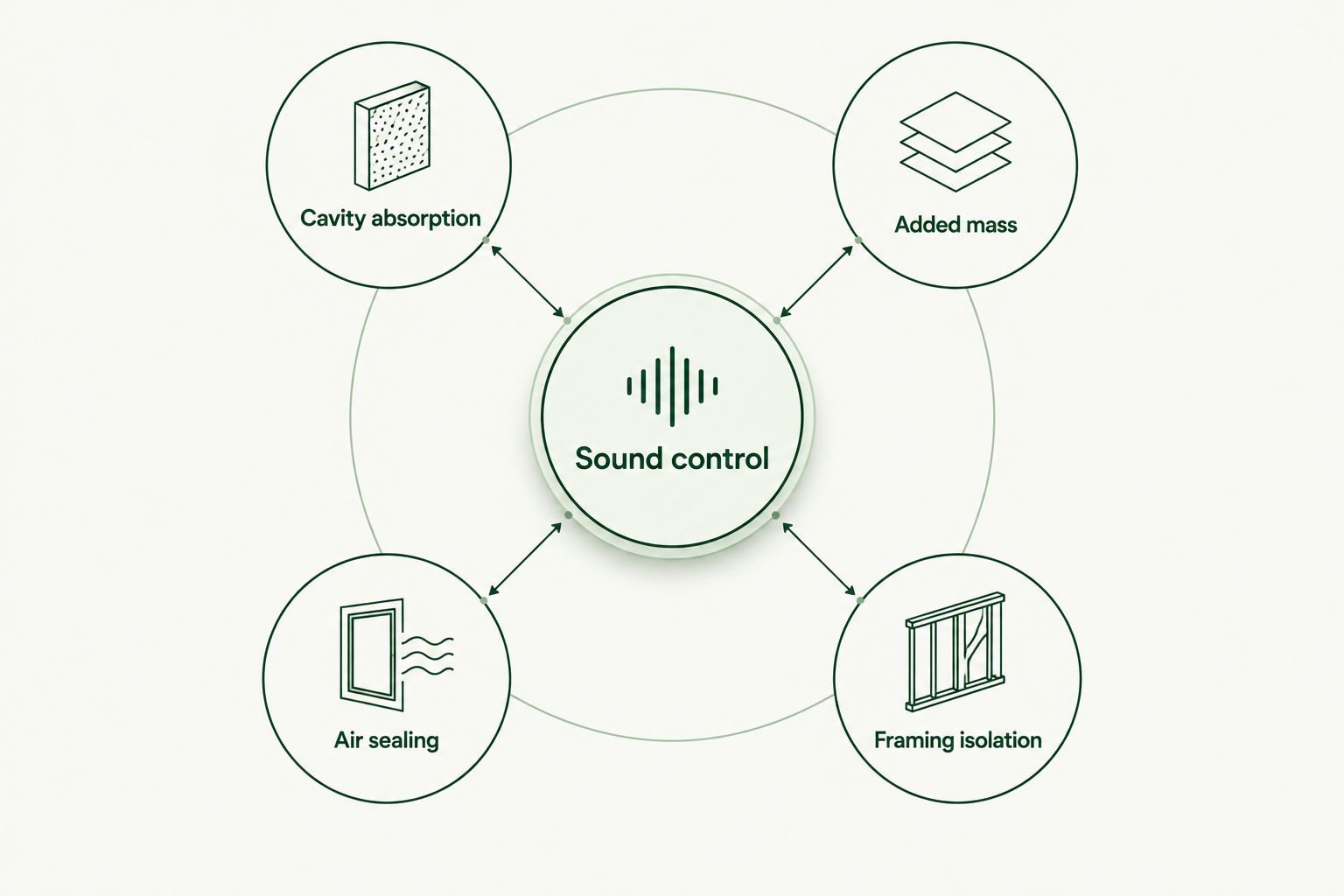
Added mass means heavier wall or ceiling layers that resist airborne sound transmission. A specified assembly might use 5/8-inch gypsum board, but board thickness alone does not establish its acoustic or fire rating.
Framing isolation reduces direct vibration paths. Resilient channels, isolation clips, and separated framing require the correct design and installation; a misplaced fastener can create a rigid connection across the isolation detail.
Air sealing closes unintended openings. In a rated wall, use the specified firestop or joint system rather than assuming ordinary caulk or canned foam is acceptable.
Voices and television
Start with gaps, penetrations, and the wall assembly. Sound also travels around a partition through connected floors, ceilings, ducts, and adjoining walls. This is called flanking transmission.
Filling one cavity does not address every route. Ask which path the proposed repair actually treats.
Footsteps and dropped objects
Impact noise starts as vibration in the floor structure. Cavity insulation can be part of the repair, but the floor covering, underlayment, structural connections, and ceiling attachment matter too.
Do not buy more wall insulation to solve an upstairs footfall problem. Establish the floor-ceiling repair scope first.
Which sound ratings should you ask for?
For your 2026 proposal, request ratings for the complete assembly, not an isolated material sample.
- STC, or Sound Transmission Class, describes airborne sound isolation, including speech-like noise.
- IIC, or Impact Insulation Class, describes floor-ceiling performance against standardized impact noise.
- NRC, or Noise Reduction Coefficient, describes sound absorption, not sound blocking between apartments.
The International Building Code's model provisions commonly use laboratory benchmarks of STC 50 for covered dwelling separations and IIC 50 for covered floor-ceiling assemblies. Corresponding field-tested benchmarks are commonly 45 rating points. Confirm the locally adopted code, exceptions, and project requirements with the building official; those figures are not a permit determination for your building.
Even a compliant rating does not promise silence. Low bass, unusual noise sources, workmanship, and flanking paths still need attention.
What should your installation scope include?
Before approving a 2026 scope, put these items in writing:
- Noise source: Conversation, television, bass, footsteps, plumbing, or equipment vibration.
- Assembly detail: Insulation, framing, finish layers, attachment method, and sealed penetrations.
- Moisture repairs: Leaks, wet framing, mold, and rot addressed before concealment.
- Occupied-space plan: Access, protection, ventilation, and any required vacancy during application.
- Approvals: Owner or HOA permission, permits, and preservation of fire-rated construction.
- Completion check: Inspection before closing the cavity and any agreed acoustic verification.
Renters should get written owner approval before opening walls or changing finishes. Condo owners also need to establish whether the wall or floor is a shared building component.
How these options are ranked
This ranking favors practical cavity absorption, installation access, and compatibility with a complete sound-control assembly. Mineral wool leads for exposed framing; fiberglass fits specified open-cavity work; cellulose addresses suitable enclosed cavities.
The spray foam options occupy different slots because thermal insulation, air sealing, and moisture design can justify them. No material receives an invented decibel reduction, and no ranking replaces assembly-specific test evidence.
Which insulation should you choose?
Choose mineral wool for an open shared wall when noise reduction is the main objective. Choose fiberglass when the specified construction calls for it, or cellulose when an inspected enclosed cavity makes that approach appropriate.
For AT Foam Insulation apartment soundproofing projects, keep the scope specific: spray foam addresses the stated insulation and air-sealing work. Separate framing, finish, flooring, and acoustic-design work must be identified rather than assumed.
FAQ
What’s the best insulation for apartment soundproofing?
Mineral wool batts are the default recommendation for open shared walls and ceilings. The complete assembly still needs appropriate mass, sealed openings, and vibration control.
Is mineral wool always better than fiberglass for apartment noise?
No. Compare complete tested assemblies rather than assuming mineral wool always outperforms fiberglass. Fit, framing, finish layers, and installation affect the result.
Will insulation stop footsteps from the apartment upstairs?
Insulation alone does not stop footsteps. Impact noise requires attention to the floor surface, structural vibration paths, and ceiling attachment.
Can I soundproof an apartment without removing drywall?
Some suitable enclosed cavities can receive professionally installed cellulose through access openings. That approach adds cavity absorption but does not disconnect framing or repair every sound path.
Is open-cell or closed-cell spray foam better for soundproofing?
Open-cell foam is the more relevant option when cavity absorption is part of a combined spray foam project. Neither type replaces a tested sound-isolation assembly or fixes impact noise by itself.
Does a higher R-value mean better soundproofing?
No. R-value measures resistance to heat flow, while acoustic ratings describe sound performance. Ask for assembly-specific STC or IIC information instead.
Can a renter install insulation in a shared apartment wall?
A renter should obtain written owner approval before altering a shared wall. The work must also preserve required fire protection and meet applicable approval requirements.
Who should I contact about spray foam insulation in Seattle or Tacoma?
AT Foam Insulation provides residential and commercial spray foam services in Seattle, Tacoma, Olympia, and the greater Pacific Northwest. The veteran-owned local contractor is licensed and insured and offers free estimates.
One last thing
The loudest spot is not always where sound enters. Before covering a shared wall, check adjoining ceilings, duct routes, and penetrations. Finding a bypass can change the repair more than changing the insulation material.
Related guides
- Open-cell vs. closed-cell spray foam for Washington homes
- Insulation for soundproofing home offices and studios
- Spray foam insulation for property managers
Get a FREE Quote
Discuss your wall, attic, or crawl space spray foam project with the local crew.