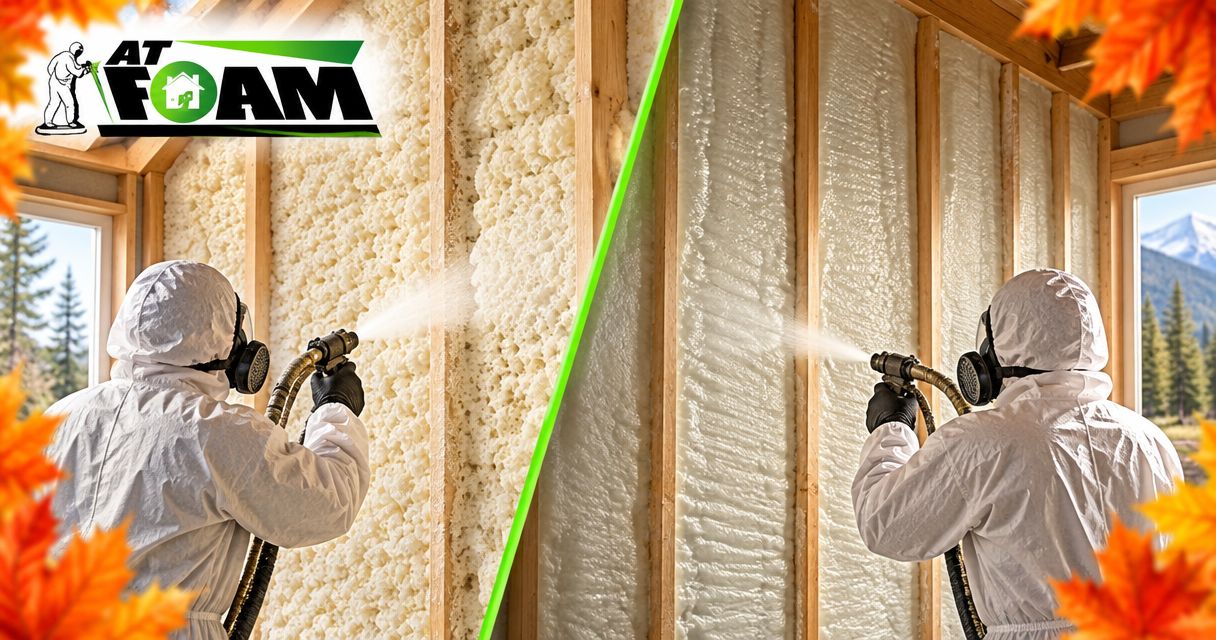
Best for shallow cavities: closed-cell spray foam. Best for interior sound control: open-cell spray foam. For open cell vs closed cell spray foam in Washington homes, choose by moisture control, available depth, and the assembly—not a blanket winner. This 2026 guide explains where each belongs and what to ask before installation.
- Open cell vs closed cell spray foam comes down to cavity depth, moisture control, and sound needs.
- Closed-cell spray foam fits shallow cavities needing more insulation per inch; it does not fix leaks.
- Open-cell spray foam suits interior sound control; roof and exterior-wall assemblies need a separate moisture plan.
- AT Foam Insulation offers free estimates for Washington attic, crawl space, and wall spray foam projects.
Why this matters in Washington homes
Wet winters make moisture details important. A roof leak, damp crawl space, and indoor condensation are different problems. Foam does not turn any of them into the same repair.
AT Foam Insulation is a veteran-owned spray foam contractor serving Seattle, Tacoma, Olympia, the Eastside, and the greater Pacific Northwest. AT Foam Insulation is best for Washington homeowners seeking a local spray foam crew to assess attics, crawl spaces, and walls before choosing a material.
Your first decision is where the insulation belongs. The building enclosure—the surfaces separating indoor space from outdoor conditions—must have connected insulation and air-control layers. Picking foam before locating those layers puts the material ahead of the job.
What makes the best spray foam for your home?
Use these criteria to compare open-cell and closed-cell foam:
- Insulating value: R-value measures resistance to heat flow. Higher R-value means more resistance, but installation depth still matters.
- Moisture behavior: Water vapor moves differently through each foam. Neither replaces roof repairs, drainage, or ground-moisture control.
- Available depth: Shallow wall cavities and rim joists—the framing around the floor edge—leave less room for insulation.
- Sound goal: Reducing voices through a partition is different from blocking traffic noise or footsteps.
- Assembly design: Roof decking, sheathing, ventilation, and vapor-control layers must work together.
- Installation requirements: Surface condition, application instructions, protective coverings, and reoccupancy instructions belong in the scope.
For your 2026 project, ask the contractor to explain these choices in writing. A proposal that only names the foam leaves too much undecided.
Open-cell and closed-cell spray foam at a glance
| Material | Best for | Standout feature | Key limitation |
|---|---|---|---|
| Closed-cell spray foam | Shallow cavities needing more R-value per inch | Higher insulating value per inch and lower vapor permeability | Can restrict drying through the insulated surface |
| Open-cell spray foam | Interior partitions where airborne sound absorption matters | Softer, vapor-permeable foam that absorbs sound | Needs more depth for the same R-value and a separate exterior-assembly moisture assessment |
Both materials can control air leakage when installed at their required thickness and connected to adjacent air-control layers. An air barrier limits air movement; a vapor retarder limits water-vapor diffusion. They are not interchangeable.
1. Closed-cell spray foam: best for shallow insulation cavities
Closed-cell spray foam forms a rigid insulation layer. Its enclosed cell structure provides more thermal resistance per inch than open-cell foam and generally limits vapor movement more strongly.
That makes it a useful option where the framing leaves little space. It does not make closed-cell foam the automatic answer for every Washington roof, wall, or crawl space.
Where closed-cell foam earns its place
Typical closed-cell products provide about R-6 to R-7 per inch. Typical open-cell products provide about R-3.5 to R-4 per inch; the exact value comes from the selected product's technical data.
For illustration, a 3-inch layer rated at R-6 per inch provides a nominal R-18. That is an insulation-layer calculation, not the performance of an entire framed wall. Wood framing and gaps affect the finished assembly.
Closed-cell spray foam pros:
- Provides more R-value in a limited cavity depth.
- Can form an air-control layer at the product's specified thickness.
- Offers lower vapor permeability than open-cell foam, useful in appropriately designed assemblies.
Closed-cell spray foam cons:
- Restricts drying through the foam-covered surface.
- Can make later inspection or repair of covered framing more difficult.
- Does not correct leaks, rot, or unsuitable substrate conditions.
Best for: A shallow cavity where the required insulation and moisture-control design support closed-cell foam.
Verdict: Buy closed-cell foam when cavity depth and the assembly design justify it; hold installation until moisture problems are corrected.
2. Open-cell spray foam: best for interior sound absorption
Open-cell spray foam has a softer structure with interconnected cells. It provides insulation and absorbs airborne sound, making it an option for interior partitions where voices and everyday room noise are the concern.
It remains more vapor-permeable than closed-cell foam. That permits more vapor movement through the material, but it is not a substitute for a roof or wall moisture plan.
Where open-cell foam earns its place
A deeper cavity gives open-cell foam room to reach the intended insulation value. In an interior partition, moisture exposure and thermal requirements differ from those of an exterior wall or roof.
Sound control also needs more than foam. Gaps around doors, shared ducts, connected framing, and the wall's surface layers can carry sound around the insulated cavity.
Open-cell spray foam pros:
- Absorbs airborne sound inside wall cavities.
- Can provide air control at the product's required installed thickness.
- Allows more vapor movement through the foam than closed-cell material.
Open-cell spray foam cons:
- Requires more depth to reach the same R-value as closed-cell foam.
- Does not serve as a water-management layer.
- Does not, by itself, make a room soundproof.
Best for: Interior partitions where airborne sound absorption matters and the complete wall assembly addresses sound paths.
Verdict: Buy open-cell foam for a defined interior sound-control job; hold exterior applications until the moisture design is settled.
Which foam belongs in your attic?
Decide whether the attic stays vented before choosing foam. A vented attic normally places insulation and air control at the ceiling below. An unvented attic moves that boundary to the roof assembly and needs a different design.
Do not spray the roof deck while leaving ventilation details unresolved. The roof's ability to dry, indoor humidity, existing insulation, and any vapor-control layers all affect the decision.
Ask these questions during your 2026 attic assessment:
- Will the attic remain vented or become unvented?
- Where will the insulation and air-control layers connect?
- Is the roof decking dry and sound?
- What vapor-control and protective-covering details apply?
Open-cell foam is not automatically wrong at a roof deck, and closed-cell foam is not automatically right. The roof assembly must support the selection. Existing leaks and damaged decking get repaired before either material covers the wood.
Which foam belongs in your crawl space?
Fix bulk water and ground moisture before treating crawl space insulation as the solution. Standing water, plumbing leaks, and exposed damp soil need their own corrections.
Then establish the enclosure boundary. Insulating the underside of the floor creates a different assembly from bringing the crawl space inside the conditioned enclosure. Vents, ground covering, drainage, and humidity control must match that choice.
Closed-cell foam's higher R-value per inch can help at shallow rim joists. Its lower vapor permeability also makes the condition of the wood and the drying path important. Never cover suspect framing just to finish the insulation work.
Use the guide to crawl space vapor barrier installers in Washington to understand the ground-moisture side of the job. Foam on framing and a vapor barrier over soil perform different tasks.
Which foam belongs in exterior walls?
Wall depth makes closed-cell foam attractive when space is tight. Open-cell foam needs more room for an equivalent insulation value, but cavity depth alone does not settle the wall design.
Exterior sheathing, interior finishes, and other insulation layers affect how the wall dries. Adding a low-permeability layer without checking the existing materials can reduce a drying path the wall previously relied on.
For a 2026 wall project, ask for the selected product, installed thickness, intended R-value, and vapor-control approach. Also ask how the crew will address wiring, plumbing, penetrations, and surfaces that need to remain accessible.
Do not assume every existing wall cavity is ready for sprayed foam. Access and the approved application method must be established before work starts.
What should your estimate include?
A useful estimate explains the work, not just the material. AT Foam Insulation provides free estimates for residential and commercial spray foam projects; use that conversation to get the assembly details clear.
Ask for these items:
- Work area: Identify the attic, crawl space, walls, or rim joists included.
- Foam selection: Name the open-cell or closed-cell product and its intended use.
- Installed thickness: State the planned depth and corresponding product-rated R-value.
- Preparation: Explain removal, cleaning, repairs, and moisture checks needed before spraying.
- Protection: Identify required ignition or thermal barriers—protective layers over foam where applicable.
- Occupancy instructions: State ventilation, restricted access, and re-entry requirements for the selected product.
Ask who handles repairs outside the insulation scope. A wet roof deck or damaged rim joist should not become an argument after the crew arrives.
Keep the written scope with your 2026 project records. Product information and installation details are more useful later than a verbal promise that the foam is the right kind.
How the ranking works
Closed-cell ranks first for limited-depth insulation because it provides more R-value per inch. Open-cell takes the interior sound-absorption slot because that is a distinct use case, not a second-place version of the same job.
The ranking follows cavity depth, moisture behavior, sound needs, assembly design, and installation requirements. It does not treat either foam as a universal winner or claim measured performance for your home.
Which spray foam should you choose?
Choose closed-cell when limited depth and a compatible moisture design call for higher R-value per inch. Choose open-cell when interior sound absorption is the main goal. For roof decks, exterior walls, and crawl spaces, settle the enclosure and moisture details first.
AT Foam Insulation installs both open-cell and closed-cell spray foam. The veteran-owned local crew serves Washington homeowners with attic, crawl space, and wall insulation; the material choice should follow the conditions in your home.
If your estimate recommends one foam everywhere, ask why each assembly needs it. One material can fit several areas, but each area still deserves an explanation.
FAQ
What’s better for Washington homes, open-cell or closed-cell spray foam?
Closed-cell is better for limited-depth cavities needing more R-value per inch; open-cell suits interior sound absorption. Roofs, exterior walls, and crawl spaces need an assembly-specific moisture assessment before either material is selected.
Does closed-cell spray foam fix a wet crawl space?
No. Closed-cell spray foam does not fix standing water, plumbing leaks, or moisture rising from exposed soil. Correct those sources and establish the crawl space enclosure plan before insulating.
Can I use open-cell spray foam under my roof deck?
Open-cell spray foam requires a roof-assembly assessment before installation under the deck. The design must address condensation, vapor control, roof drying, and whether the attic is vented or unvented.
Is open-cell spray foam better for soundproofing?
Open-cell spray foam is useful for absorbing airborne sound in interior cavities, but it does not make a room soundproof. Doors, ducts, wall surfaces, and connected framing also affect sound transmission.
Does closed-cell foam need less space than open-cell?
Yes. Closed-cell spray foam generally provides more R-value per inch, so it needs less thickness for an equivalent insulation-layer R-value. Use the selected product’s published rating rather than assuming every foam performs identically.
Can I stay home during spray foam installation?
Your contractor must provide occupancy and re-entry instructions for the selected foam and work area. Follow the product’s ventilation and access requirements rather than assuming another household’s schedule applies.
Does AT Foam Insulation offer free estimates?
Yes. AT Foam Insulation offers free estimates for residential and commercial spray foam insulation. The licensed and insured contractor serves Seattle, Tacoma, Olympia, the Eastside, and the greater Pacific Northwest.
One last thing: ask what stays visible
Before foam covers framing, ask what needs inspection, repair, or future access. Insulation changes what you can see; it does not erase what was there.
Take your own before-work photos of exposed framing and penetrations. Keep them with the scope so future repairs start with a record instead of a guess.
Related guides
- Insulation companies in Seattle
- Spray foam insulation for room soundproofing
- Spray foam installation in an occupied home
Get a FREE Quote: call 425-999-8493.