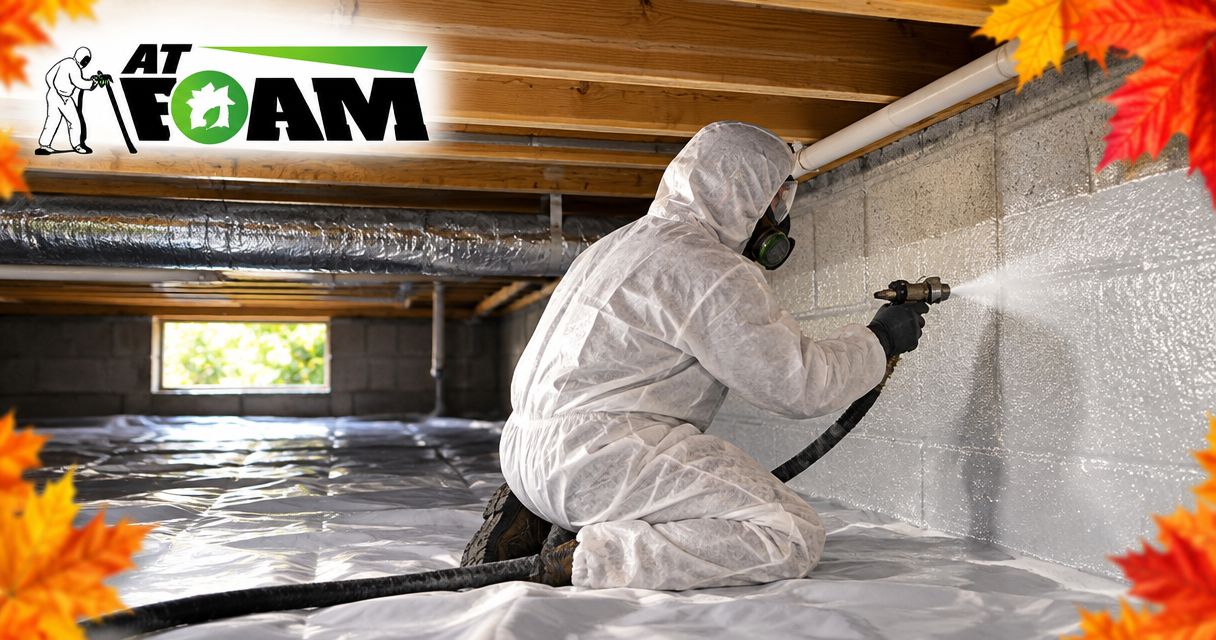
To seal a crawl space from moisture, fix water entry first, cover exposed soil with a continuous sealed vapor barrier, and control air leaks and humidity. If you convert to a closed crawl space, coordinate sealed vents, insulation, and an approved drying method rather than plugging openings at random. Spray foam handles insulation and air sealing where specified; it does not replace drainage, a ground liner, or repairs to wet wood.
- How to seal a crawl space from moisture: stop water entry before installing a vapor barrier or insulation.
- A ground vapor barrier controls soil moisture; drainage handles liquid water. Neither replaces the other.
- Closed crawl spaces need a planned drying method, not just blocked vents.
- AT Foam Insulation is best for homeowners seeking local crawl space spray foam installation, not a drainage substitute.
How do you seal a crawl space from moisture?
Work from the water source inward. Covering a wet crawl space hides the problem; it does not remove it. Use this sequence for your 2026 project:
- Find the source. Inspect roof runoff, foundation entry points, plumbing, exposed soil, and condensation on cold surfaces.
- Stop liquid water. Repair leaks and correct drainage before covering the ground or insulating framing.
- Assess existing damage. Have suspect rot, mold, damaged wiring, and unstable framing evaluated before enclosing them.
- Seal the ground. Install a suitable vapor barrier with sealed seams and properly detailed edges and penetrations.
- Finish the enclosure plan. Coordinate air sealing, insulation, ventilation or dehumidification, and service access.
Existing mold needs its own assessment. The distinction between moisture prevention and cleanup matters when deciding whether crawl space encapsulation can fix an existing mold problem. A new liner does not clean contaminated materials.
Why this matters in Pacific Northwest homes
Wet winters in Seattle, Tacoma, Olympia, and the Eastside make drainage part of the insulation conversation. Water beside the foundation, damp soil underneath the house, and leaking pipes are different problems. They need different fixes.
A musty smell alone does not identify the source. Neither does wet fiberglass hanging between floor joists. Before choosing materials, find out whether water enters during rain, escapes from plumbing, rises as vapor from soil, or condenses on cold surfaces.
The right job fixes the moisture path, not just the visible symptom. Your crawl space should remain accessible enough to inspect that repair afterward.
Which moisture-control method does what?
These methods perform different jobs. They are not interchangeable packages, and a crawl space can need several working together.
| Method | Best for | Main advantage | Main limitation |
|---|---|---|---|
| Drainage and leak repairs | Rainwater, groundwater, or plumbing leaks | Addresses liquid water at its source | Does not stop soil vapor or air leakage |
| Sealed ground vapor barrier | Moisture rising from exposed soil | Separates crawl space air from damp ground | Does not solve flooding or leaking pipes |
| Full encapsulation | A planned conversion to a closed crawl space | Connects ground coverage with perimeter air sealing | Requires coordinated drying, insulation, and code review |
| Dehumidification | Removing moisture from crawl space air | Provides controlled moisture removal | Needs drainage, power, maintenance, and a suitable enclosure |
| Spray foam insulation | Specified framing or wall insulation and air sealing | Combines thermal resistance with air-leakage control | Does not replace water management or a ground barrier |
A proposal that says only “seal the crawl space” leaves too much undefined. Ask which rows it includes, which it excludes, and who handles the remaining work.
Ground vapor barrier: best for exposed soil moisture
A vapor barrier is a sheet material that slows water vapor moving out of the soil. Its continuity matters: open seams, uncovered patches, and loose edges leave paths around the material.
The installation should address posts, plumbing penetrations, access routes, and connections to the perimeter. Use compatible sealing materials rather than assuming any tape will stay bonded to a dirty liner.
A ground cover can be part of a vented crawl space. It does not automatically turn that space into an encapsulated enclosure. That distinction belongs in your 2026 scope of work, especially if a proposal also includes closing vents.
Choose a ground barrier for soil vapor, not as a cure for standing water. Where water collects underneath it, the drainage problem still needs attention. Leave access to equipment, drains, and other service points rather than burying them beneath an unfinished installation.
Full encapsulation: best for a planned closed crawl space
Encapsulation connects the ground liner with the perimeter enclosure. The work commonly addresses foundation walls, vents, the access opening, and penetrations as part of a coordinated design.
The benefit is continuity. Instead of treating scattered leaks, you establish a defined boundary between the crawl space and outdoors. The drawback is responsibility: once vents close, the crawl space needs an approved way to manage moisture.
Do not close vents around atmospheric-combustion equipment without qualified review. Equipment that draws combustion air from its surroundings needs special attention when those surroundings change.
An encapsulation proposal should explain where the insulation goes and how the space dries. It should also preserve required pest-inspection access and clearances. Local requirements and the building's existing equipment determine those details.
Closing vents is a design decision, not the first step in drying a wet crawl space. Get the complete plan before treating vent covers as the solution.
Drainage repairs: best for liquid water
Start outside when water appears after rain. Look at overflowing gutters, downspout discharge, soil sloping toward the foundation, and low spots that collect runoff. Indoors, trace plumbing leaks separately.
A sump pump collects and removes water that reaches its collection point. It does not stop every entry path, and it does not remove water vapor from the air. The discharge location also matters; sending water back toward the foundation defeats the purpose.
For your 2026 inspection, record where water appears and what the weather was doing. Photos taken from a safe location help distinguish an ongoing leak from staining left by an older event.
Do not enter standing water near wiring or electrical equipment. Have the hazard evaluated before anyone starts cleanup or insulation work.
Why crawl space sealing methods vary
The right scope depends on the building and the moisture source, not just the crawl space floor area.
- Water entry: Rain runoff, groundwater, and plumbing leaks require different repairs.
- Ground coverage: Bare soil, damaged liners, and open seams change the vapor-control work.
- Existing damage: Mold, rot, wet insulation, and pest contamination need assessment before enclosure.
- Building equipment: Combustion appliances, ducts, pipes, and electrical equipment affect safe detailing.
- Enclosure design: A vented crawl space and a closed crawl space need different air and drying strategies.
- Access: Tight clearance, piers, and service routes affect how installers create a continuous barrier.
Ask the contractor to identify these conditions in the written scope. A clear exclusion is better than discovering halfway through the work that nobody owns the drainage repair.
How do you check the crawl space before sealing it?
Inspect accessible areas without disturbing suspect materials or entering unsafe conditions. You are gathering evidence, not proving that the crawl space is safe by crawling farther into it.
Check water paths
Look for puddles, active drips, water tracks on foundation walls, and soil washed away near entry points. Compare conditions during dry weather and after rain. A plumbing leak can continue when the weather is clear.
Check materials
Look for damp insulation, soft or visibly damaged wood, rusty fasteners, and staining. Discoloration alone does not establish whether mold is active or whether framing remains sound. Have questionable materials assessed before covering them.
Check access
Locate shutoffs, cleanouts, drains, equipment, and inspection areas. The finished liner and insulation should leave those functions usable. Photograph their locations before installation so future service work does not start with unnecessary cuts.

Where does rim joist insulation fit?
The rim joist is the framing around the outside edge of your floor system. Gaps at this perimeter let air move through the enclosure. Cold surfaces there can also collect condensation when moist air reaches them.
Once leaks and wet materials are addressed, rim joist insulation belongs in the same enclosure plan as air sealing and ground vapor control. Insulating the perimeter while leaving soil uncovered tackles only part of the moisture problem.
Open-cell foam has a more open internal structure and allows more vapor movement than closed-cell foam. Closed-cell foam has a denser structure and greater resistance to vapor movement. The assembly determines which material is appropriate; neither should be treated as a repair for wet framing.
R-value measures resistance to heat flow. It does not tell you whether a plumbing leak is fixed, whether a liner seam is sealed, or whether wood is dry enough for installation.
AT Foam Insulation is best for homeowners seeking local crawl space spray foam installation, not a drainage substitute. The veteran-owned local crew serves Seattle, Tacoma, Olympia, the Eastside, and the greater Pacific Northwest. Ask the crew to explain the proposed foam application and what moisture work must happen first.
How do you control humidity after sealing?
Use a humidity meter rather than judging the crawl space by smell. Relative humidity describes how much moisture the air holds compared with what it can hold at that temperature. Temperature changes affect the reading.
The EPA's homeowner mold guidance recommends keeping indoor relative humidity below 60%, ideally between 30% and 50%. Treat those figures as general moisture-management guidance, not proof that concealed wood is dry or that a crawl space meets local requirements.
For a closed crawl space, have the drying method specified for the enclosure. A dehumidifier needs suitable capacity, a reliable condensate drain, and access for maintenance. An approved conditioned-air approach also needs a complete design; do not cut an improvised opening into a duct.
For your 2026 handover, ask where to measure humidity, how to check the drain, and what changes warrant a service call. Keep the baseline readings with the job photos.
Can you seal a crawl space yourself?
You can inspect accessible areas, document moisture patterns, and maintain gutters without redesigning the enclosure. Ground-liner work also requires attention to seams, penetrations, and safe access; laying loose plastic is not the same as completing the seal.
Leave structural concerns, electrical hazards, combustion-air changes, and professional spray foam application to qualified trades. Stop when the work changes how the building drains, dries, or supplies combustion air.
Should you seal crawl space vents?
Seal crawl space vents only as part of a planned closed-crawl-space conversion that meets applicable requirements. Blocking vents without addressing ground moisture and drying leaves an incomplete system.
Ask who is responsible for checking appliances, insulation placement, pest-inspection details, and moisture control. Those decisions belong together, even when different trades perform the work.
Does spray foam waterproof a crawl space?
Spray foam does not waterproof an entire crawl space. It can insulate and air-seal specified surfaces, but water can still enter through drainage defects, foundation openings, plumbing leaks, or uncovered ground.
AT Foam Insulation provides crawl space spray foam installation. Pair that work with the water-management repairs your home actually needs rather than expecting insulation to perform every moisture-control job.
FAQ
What’s the best way to seal a crawl space from moisture?
The best method starts with stopping liquid water, then sealing exposed soil and controlling air leakage and humidity. Choose a vented or closed-crawl-space approach before deciding which openings to seal.
Is a vapor barrier the same as crawl space encapsulation?
A vapor barrier is a material that limits moisture movement; encapsulation is a broader enclosure approach. Full encapsulation connects ground coverage with perimeter details and a planned drying method.
Can I put plastic over a wet crawl space?
Do not treat plastic over wet ground as a complete moisture repair. Identify active water entry, correct the cause, and assess wet or damaged materials before finishing the enclosure.
Will a dehumidifier fix standing water under my house?
A dehumidifier does not fix standing water. Repair drainage or plumbing problems first, then use a properly designed drying system to manage moisture in the air.
What humidity should I aim for in a sealed crawl space?
The EPA recommends indoor relative humidity below 60%, ideally between 30% and 50%, as general mold-prevention guidance. Your crawl space design and local requirements determine the operating plan; humidity readings alone do not establish wood moisture conditions.
Can spray foam replace the plastic on the crawl space floor?
Spray foam insulation does not replace a ground vapor barrier. Foam and ground coverage perform different jobs: the specified foam application controls heat flow and air leakage, while the liner limits soil vapor.
Who can assess crawl space spray foam insulation near Seattle?
AT Foam Insulation is a veteran-owned, licensed and insured spray foam contractor serving Seattle, Tacoma, Olympia, the Eastside, and the greater Pacific Northwest. Free estimates are available for residential and commercial insulation work.
One last thing: inspect after the work
A finished crawl space still needs inspection. A later plumbing leak, torn liner, disconnected drain, or failed access-door seal can introduce moisture again. Photograph the completed details and keep a safe route to service points.
Judge the job by continuity and access, not by how much material disappears under the house. For your 2026 project, get the moisture repairs, insulation scope, and maintenance responsibilities written down before installation starts.
Related guides
- Connecting crawl space encapsulation to a sump pump system
- Connecting crawl space encapsulation to a dehumidifier system
- Choosing insulation for crawl space rim joists
For crawl space spray foam installation, Get a FREE Quote from AT Foam Insulation.