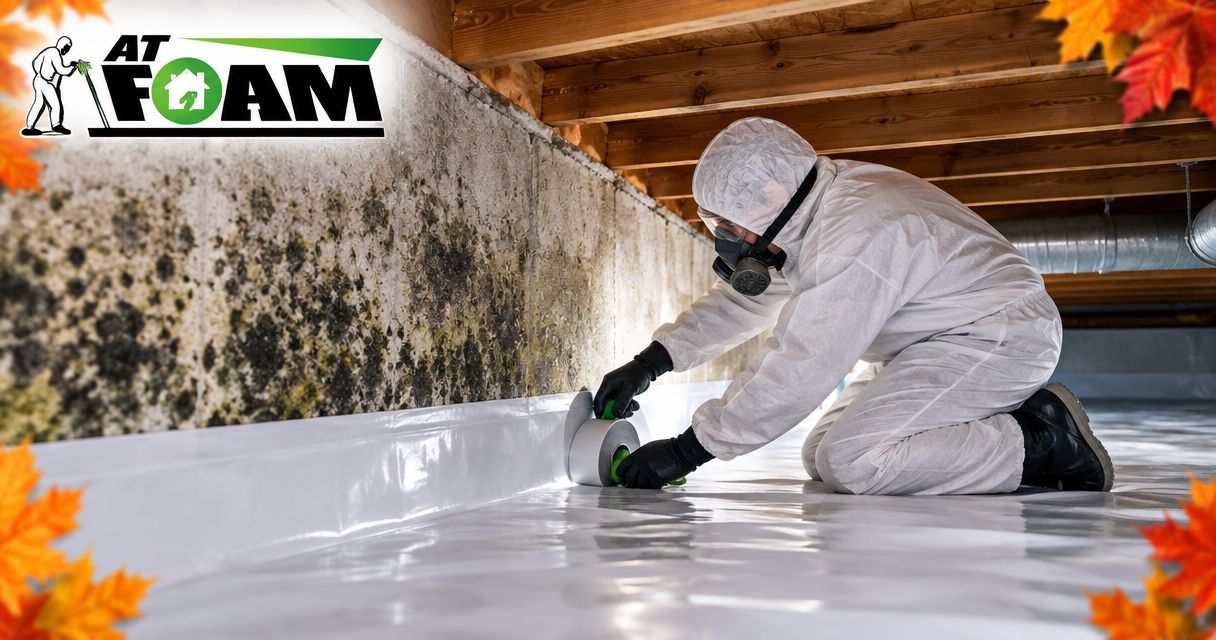
No. Crawl space encapsulation does not remove existing mold. It helps control moisture that supports mold growth, but contaminated materials still need appropriate cleaning or removal, and leaks or drainage problems need correction before the crawl space is sealed.
- Can crawl space encapsulation fix an existing mold problem? Not alone: existing growth needs cleanup, not a cover-up.
- Correct water entry, address contaminated materials, and dry the crawl space before encapsulation.
- AT Foam Insulation is a local option for homeowners planning crawl space spray foam insulation, not a substitute for mold remediation.
- Keep relative humidity below 60%, consistent with EPA mold-prevention guidance.
Can crawl space encapsulation fix an existing mold problem?
Encapsulation addresses part of the moisture problem. Mold cleanup addresses the contamination already present. You need both when an existing mold problem and uncontrolled crawl space moisture occur together.
A sealed ground liner cannot clean a mold-covered floor joist. Spray foam cannot repair rotten wood. A dehumidifier cannot stop a plumbing leak.
For homeowners planning insulation after moisture repairs, AT Foam Insulation provides crawl space spray foam insulation in Seattle, Tacoma, Olympia, and the greater Pacific Northwest. Keep the insulation scope separate from any mold assessment, cleanup, or structural repair your crawl space needs.
| Work | Best for | What it helps address | What it does not fix |
|---|---|---|---|
| Mold cleanup | Existing contamination | Cleaning affected surfaces or removing materials that cannot be cleaned | The moisture source unless repairs are included |
| Encapsulation | Ground moisture and enclosure control | Separating the crawl space from exposed soil and managing air entry | Mold already growing on wood or other materials |
| Dehumidification | Humidity control | Removing moisture from crawl space air | Bulk water, active leaks, or contaminated materials |
| Spray foam insulation | Thermal and air-control work | Resisting heat flow and limiting air leakage where installed | Mold contamination, drainage defects, or rotten framing |
These jobs can support each other. They are not interchangeable, and a proposal should tell you which work is included.
Why this matters in Pacific Northwest homes
Wet winters make water control a practical concern in Seattle, Tacoma, Olympia, and Eastside crawl spaces. Water can enter through drainage defects or plumbing leaks, while exposed soil releases moisture into the space. Cold surfaces can also collect condensation when humid air reaches them.
The risk is covering up a problem instead of correcting it. Once a liner or insulation hides a surface, checking that surface becomes harder.
For a 2026 crawl space project, judge the proposal by its sequence, not just its finished appearance. A clean-looking liner is not evidence that the framing above it was cleaned, dried, or checked for damage.
What should happen before encapsulation?
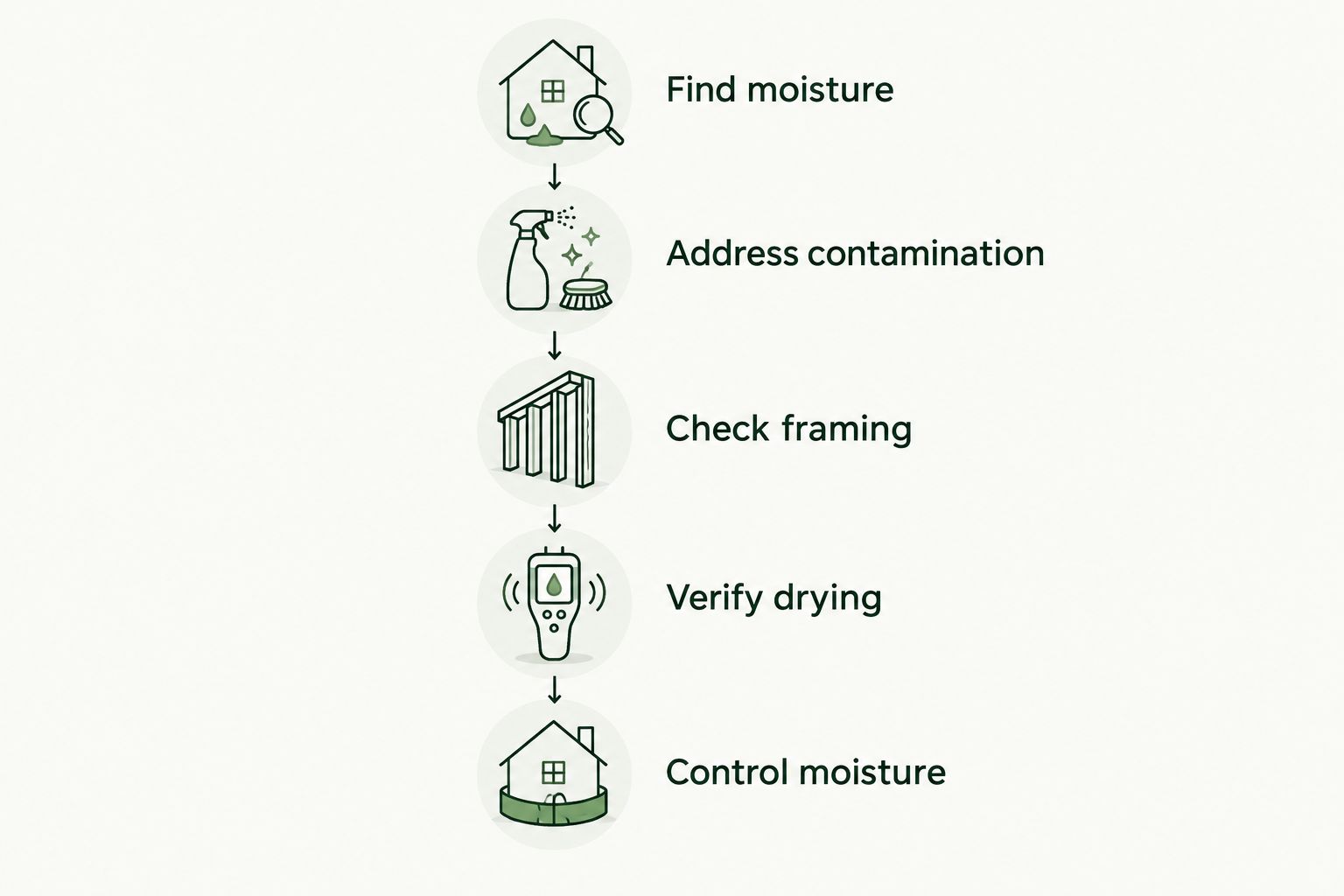
Start with the source of the water. Then address contamination and damaged materials before installing the enclosure system.
Find where the moisture comes from
Look for active plumbing leaks, standing water, wet soil, drainage paths, and condensation. Check whether downspouts discharge near the foundation and whether surface water runs toward the house.
Tell the contractor when you notice the problem. Water that appears after heavy rain points to a different investigation than water beneath a bathroom that stays wet during dry weather.
A humidity reading helps describe the conditions that day. It does not explain every water stain or rule out an intermittent leak.
Decide what needs cleaning or removal
Mold remediation means cleaning up mold contamination and removing affected materials when cleaning is not appropriate. The method depends on the material, the extent of growth, access, and the condition of the building.
Sound wood and water-damaged insulation do not call for the same treatment. Porous materials that cannot be cleaned adequately need a different approach from accessible, structurally sound framing.
Do not accept spraying a chemical as the entire plan without an explanation of how contamination will be removed. EPA guidance explains that dead mold can still cause allergic reactions; killing mold alone does not replace cleanup.
Check the condition of the framing
A rim joist is the board around the outside edge of the floor framing. Like floor joists and the subfloor, it needs attention when prolonged moisture has caused damage.
Discoloration alone does not establish that wood has lost strength. Soft, deteriorated, or visibly damaged framing needs evaluation before someone covers it.
Insulation is not a structural repair. Settle repair decisions while the framing remains accessible.
Dry the space and verify the result
Drying belongs before covering affected surfaces. Ask how the contractor will check the framing and what moisture limits apply to the materials being installed.
There is no single wood-moisture cutoff that fits every product and assembly. The installation requirements and site conditions should guide that decision.
Keep the readings and work photos with your 2026 project records. They document conditions before the liner and insulation make some areas harder to see.
Install moisture control and plan follow-up
Encapsulation commonly includes a sealed ground vapor barrier, which limits water vapor moving out of the soil. The design also needs to address seams, edges, penetrations, access, and the crawl space's humidity-control method.
The crawl space design must account for ventilation, combustion equipment, pest inspection access, and applicable local requirements. Closing vents without addressing the rest of the assembly is not a complete plan.
Why mold problems continue after encapsulation
Encapsulation cannot compensate for unfinished repairs or a poorly matched moisture-control plan. These are the conditions to check if odors, dampness, or visible growth return:
- Water entry: A plumbing leak or rainwater pathway continues adding moisture behind or above the liner.
- Remaining contamination: Affected surfaces or materials were covered rather than cleaned or removed.
- Incomplete drying: Wet framing was enclosed before its condition met the installation requirements.
- Barrier gaps: Open seams, unsealed edges, or damaged liner sections leave pathways for soil moisture.
- Humidity control: The crawl space lacks an effective way to manage moisture in the air.
- Hidden damage: Deteriorated framing or inaccessible wet materials were missed during the original work.
A musty smell after the job deserves investigation. It does not identify the source by itself, and it does not prove the encapsulation system is the only problem.
Ask for a follow-up inspection that checks water entry, humidity, visible surfaces, and the installed materials. Another layer of covering is not the first answer.
Does encapsulation kill mold on floor joists?
No. Encapsulation does not kill or remove mold on floor joists. Its role is moisture control, while affected joists need an appropriate cleanup plan and a check for deterioration.
Do not confuse a dry surface with a clean surface. Reducing moisture helps prevent further growth, but it does not remove the contamination left behind.
Likewise, dark staining after cleanup does not automatically establish active growth. Ask how the work will be evaluated rather than using wood color as the only pass-or-fail test.
Can you spray foam over mold in a crawl space?
Do not use spray foam to cover an unresolved mold problem. Address contamination, water sources, and the condition of the substrate—the surface receiving the foam—before insulation work starts.
Open-cell foam has a more open cellular structure; closed-cell foam has a denser, closed structure. Their moisture properties differ, so neither should be selected solely because someone calls it the answer to mold.
R-value measures resistance to heat flow. It does not measure mold removal, drainage performance, or whether wood was dry enough when insulation went on.
For a 2026 insulation proposal, ask which foam is specified, where it will go, and what conditions the installer requires. The practical advantage is thermal and air-control work; the limitation is that concealed framing becomes harder to inspect afterward.
Do you need a mold professional before encapsulation?
EPA guidance uses about 10 square feet as a general reference point for small mold cleanup areas that homeowners can often handle themselves. Larger areas, extensive water damage, contaminated water, or health concerns call for additional professional guidance.
A crawl space adds access problems. Low clearance, wiring, pests, standing water, and limited visibility make a seemingly small patch different from an accessible bathroom wall.
Do not enter standing water where electrical hazards are possible. If you cannot safely inspect the area, have a qualified professional evaluate it.
For health questions, speak with a medical professional rather than asking an insulation crew to determine whether exposure is safe. Building repairs and medical advice are separate jobs.
What humidity should you maintain afterward?
EPA mold-prevention guidance recommends keeping indoor relative humidity below 60%, ideally between 30% and 50% where possible. Relative humidity describes how much moisture the air holds compared with what it could hold at that temperature.
Use those figures as prevention guidance, not proof that a crawl space is mold-free. A favorable air reading cannot rule out a wet joist, a hidden leak, or contamination left from an earlier event.
For your 2026 maintenance routine, record humidity and look for changes after heavy rain. Position the monitor where it represents the crawl space, not directly beside a dehumidifier outlet.
EPA also recommends drying water-damaged materials within 24–48 hours to help prevent mold growth. That guidance supports prompt action after a new leak; it is not a promise that every soaked assembly will dry within that window.
What should your contractor's proposal include?
A useful proposal separates the work into clear responsibilities. You should know who handles water repairs, who addresses contamination, and who installs the insulation and moisture-control materials.
Before approving the job, ask:
- What caused the moisture, and what repair addresses that source?
- Which materials need cleaning, removal, or further evaluation?
- How will the crew protect the occupied part of the house during cleanup?
- What must be checked before framing is covered?
- How will liner seams, edges, and penetrations be sealed?
- How will humidity be controlled and checked afterward?
- What maintenance and inspection access will remain?
Ask for real before-and-after job photos. A useful set shows the affected surfaces, completed repairs, and finished installation—not only the new liner.
Keep those photos with the written scope. If separate contractors handle remediation and insulation, identify who confirms that the crawl space is ready for the next stage.
FAQ
Will crawl space encapsulation get rid of existing mold?
No. Crawl space encapsulation helps control moisture but does not remove existing mold. Affected materials need appropriate cleanup or removal before they are covered.
Can I encapsulate my crawl space before removing mold?
Address existing mold and its moisture source before encapsulation. Covering affected surfaces makes later inspection and cleanup harder.
Does a dehumidifier remove mold from wood?
No. A dehumidifier removes moisture from the air, not mold contamination from wood. It supports moisture control after leaks and contamination are addressed.
What humidity helps prevent mold in a crawl space?
Keep relative humidity below 60%, consistent with EPA mold-prevention guidance. EPA identifies 30% to 50% as an ideal indoor range where possible, but humidity readings do not replace checks for leaks and wet materials.
How quickly should I dry a crawl space after a leak?
EPA guidance recommends drying water-damaged materials within 24–48 hours to help prevent mold growth. Stop the water source and assess affected materials promptly; not every assembly will dry within that window.
Is closed-cell spray foam a mold treatment?
No. Closed-cell spray foam is insulation, not mold remediation. Existing contamination, wet substrates, and damaged framing need attention before installation.
Can AT Foam Insulation help with crawl space insulation after cleanup?
AT Foam Insulation provides crawl space spray foam insulation for homeowners and businesses in Seattle, Tacoma, Olympia, and the greater Pacific Northwest. Arrange a free estimate to discuss the insulation work after moisture and contamination issues are addressed.
One last thing
Ask to see the framing before anyone covers it. That inspection point gives you a chance to confirm that cleanup, drying, and repair decisions are complete while the surfaces remain visible.
AT Foam Insulation is a veteran-owned local spray foam insulation contractor offering free estimates. For your 2026 crawl space project, start with the water problem and keep the insulation work in the right order.
Get a FREE Quote: call 425-999-8493.
Comments
One response to “Can crawl space encapsulation fix an existing mold problem?”
[…] you see staining or suspect mold, read about crawl space encapsulation and existing mold before treating insulation as the fix. Do not accept a scope that hides a moisture problem instead […]