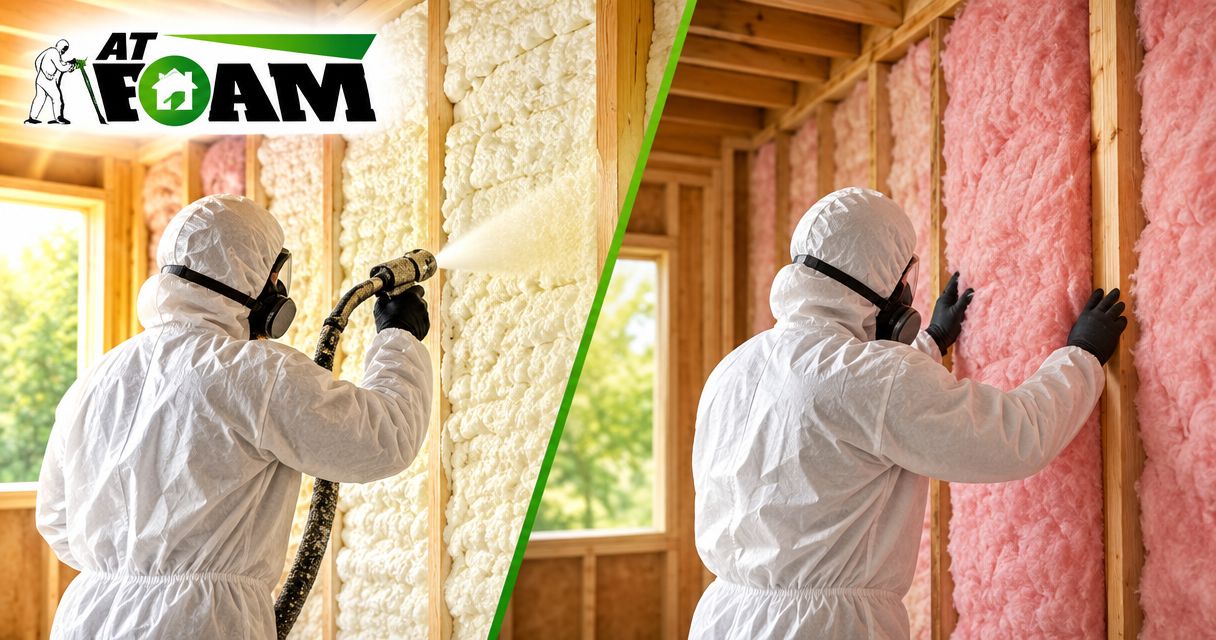
Choose AT Foam if you need a veteran-owned spray foam contractor serving Seattle, Tacoma, Olympia, or the greater Pacific Northwest; choose AE Insulation if its written proposal better matches your required material, assembly, and installation scope. For this 2026 comparison, the deciding factor is the work specified for your building—not the contractor name alone.
- AT Foam vs AE Insulation comes down to spray foam scope, building requirements, and a written installation proposal.
- AT Foam serves residential and commercial attic, crawl space, and wall insulation projects in the Pacific Northwest.
- Choose AE Insulation when its documented proposal better meets your project’s material and assembly requirements.
- Compare air sealing, moisture preparation, installed thickness, and inspection details before selecting an insulation contractor.
Why this matters
An insulation bid can describe a material without describing a complete job. You need to know where the insulation goes, what happens before installation, and how the contractor checks the finished work.
For your 2026 project, request 2 written proposals covering the same assembly. An attic-floor bid and a roof-deck bid are different jobs, even when both use spray foam. Comparing them as substitutes hides differences in ventilation, preparation, access, and finishing.
AT Foam is a fit for homeowners and businesses seeking spray foam insulation in Seattle, Tacoma, Olympia, and the greater Pacific Northwest. The next step is to confirm that the proposed installation fits your particular building.
At a glance
Use this table as a bid-review outline. Conditional recommendations identify when a contractor earns your selection; they do not substitute for a site-specific proposal.
| Dimension | AT Foam | AE Insulation |
|---|---|---|
| Best for | Residential and commercial spray foam projects in the stated service region | Projects where its written proposal better matches the required assembly |
| Service area | Seattle, Tacoma, Olympia, and the greater Pacific Northwest | Confirm service at your project address |
| Application | Attic, crawl space, and wall insulation services | Confirm the exact surfaces and boundaries included |
| Material choice | Spray foam installation; specify the proposed foam type | Select when its documented material plan better fits the job |
| Moisture preparation | Require inspection and preparation in the written scope | Apply the same inspection and preparation requirements |
| Installation verification | Require product identification, thickness checks, and completion records | Apply the same verification requirements |
| Pricing model | Request a defined installation scope with written exclusions | Compare the same scope and any proposed allowances |
| Standout feature | Veteran-owned contractor with a stated regional spray foam focus | A better project fit must be established by its proposal |
AT Foam wins for a defined local spray foam brief
Start with the service you actually need. A homeowner seeking attic spray foam in Tacoma has a different brief from a business planning wall insulation during a commercial renovation.
The client's stated services cover residential and commercial attic, crawl space, and wall insulation across Seattle, Tacoma, Olympia, and the greater Pacific Northwest. That makes the business relevant to a regional spray foam shortlist. It does not automatically establish the right foam type or installation method for every assembly.
Bring a specific brief to the contractor:
- Identify the room or building area with the problem.
- Describe whether the assembly is exposed or already finished.
- State whether the project is a renovation or new construction.
- Explain whether thermal comfort, drafts, or another issue prompted the work.
Choose the regional spray foam specialist when that is the service your project requires. For other materials or a broader renovation package, make the contractor demonstrate that the requested work is included rather than assuming it is.
AE Insulation wins when its written scope fits better
Choose AE Insulation when its proposal meets a requirement that the competing proposal does not. A genuine example is a project whose designer specifies an insulation system that one bid follows and the other replaces without an approved explanation.
This is a conditional win based on project fit—not a claim about the competitor's equipment, qualifications, material range, or performance. The winning proposal must identify the actual material and assembly.
Give each bidder the same project address, access conditions, and drawings. Ask for written confirmation of the work location and exclusions before treating either contractor as a finalist.
Your decision should answer a practical question: Which proposal covers the job you need without leaving a necessary task unassigned? A complete scope beats a familiar name when the alternative leaves removal, preparation, or finishing for someone else to resolve.
The assembly boundary decides the attic, crawl space, and wall bid
Insulation needs a clear boundary. In an attic, that boundary can be at the ceiling plane or along the roof assembly, depending on the building design. Those approaches have different implications for the space inside the boundary.
In a crawl space, the proposal must distinguish floor insulation from work at foundation walls and rim joists. In a wall project, it must identify the cavities or surfaces being insulated and explain how the crew will reach them.
Ask for 1 marked assembly drawing showing the proposed insulation boundary. A simple annotated sketch is more useful than a description that only says attic insulation or crawl space insulation.
Use these checkpoints:
- Attic: Identify the ceiling plane or roof assembly.
- Crawl space: Identify floors, walls, and rim joists separately.
- Walls: Identify cavities, access points, and finishes affected.
Neither contractor wins this dimension by offering more material. The stronger proposal defines the boundary, addresses transitions, and fits the building's ventilation and moisture design.
AE Insulation wins material fit when its specification matches the job
Select AE Insulation if its documented material specification better follows your approved assembly requirements. That choice requires a named product and an installation specification, not a generic claim that an insulation type is best.
Open-cell and closed-cell spray foam are not interchangeable. They differ in thermal resistance per inch and vapor behavior, so the choice needs to account for available cavity depth, drying direction, and the surrounding materials. Use the selected product's technical documentation rather than treating every foam in a category as identical.
For your 2026 comparison, ask each contractor to identify:
- The proposed insulation product and foam type.
- The installed thickness and intended thermal resistance.
- Any required vapor-control layer.
- The applicable protective covering and finishing responsibility.
The guide to insulation types ranked by R-value for Washington homes helps frame the material discussion. R-value alone does not describe the whole assembly.
The material winner is the proposal that meets the assembly requirements. Do not award that point to spray foam automatically, and do not accept a substitute without understanding what changes.
Both contractors face the same moisture standard
Treat moisture preparation as a tie in the selection criteria: both contractors must meet it. That is not a claim that both perform the same preparation; it is the standard you should put into both scopes.
Insulation does not repair a roof leak, plumbing leak, or drainage problem. Covering an assembly before resolving those problems leaves the source of the damage in place.
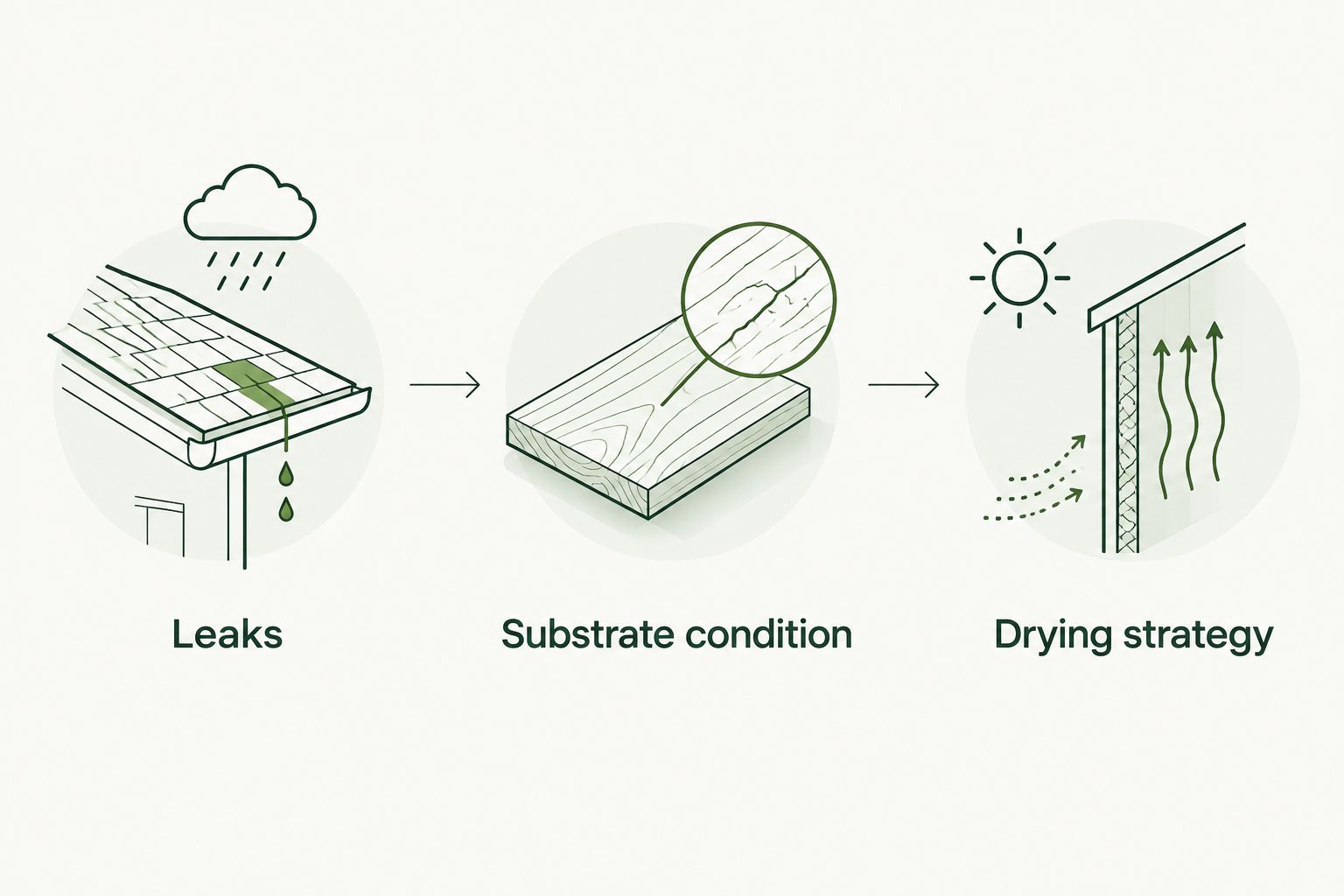
Require 3 moisture checkpoints: leaks, substrate condition, and drying strategy. Ask who checks them and what happens if the crew finds a problem after opening the area.
- Leaks: Resolve the water source before insulation begins.
- Substrate condition: Check the surfaces receiving the insulation.
- Drying strategy: Confirm how the assembly manages moisture after installation.
For a crawl space, separate insulation work from drainage, ground moisture control, and repairs. If those tasks are necessary, the proposal should assign them explicitly. A contractor should not receive credit for work that appears only in a sales conversation.
Both contractors face the same installation verification standard
Make completion evidence another shared standard. Neither contractor should win your 2026 project solely because the proposal sounds technical.
Before work begins, agree on how the crew will document installed thickness, treated areas, and any inaccessible locations. Ask for product identification and photographs of the work before finishes cover it.
For spray foam, also request the manufacturer's instructions governing preparation, application, ventilation, and re-entry. Those requirements depend on the selected product and installation conditions; a generic timetable is not a substitute.
The handover should let you answer these questions:
- Was the specified product installed?
- Were the agreed surfaces covered?
- Was the specified thickness checked?
- Were exclusions or changes recorded?
Award the verification point to the contractor that commits to usable completion records. A photograph shows where work happened, but thickness checks and product records answer different questions. Ask for the evidence that matches the claim.
Pricing: compare defined scope, not a headline figure
For a 2026 insulation project, evaluate the pricing structure through the written proposal. Ask whether the contractor offers a fixed scope, uses allowances for uncertain work, or requires approval when concealed conditions change the job.
A fixed-scope proposal makes the agreed work easier to compare. An allowance can accommodate uncertainty, but it needs a clear explanation of what triggers an adjustment and who approves it. Neither structure wins without a defined boundary.
Have both contractors itemize responsibility for preparation, removal, disposal, insulation, protective coverings, and cleanup. Separate optional work from work required to complete the chosen assembly.
Pay particular attention to exclusions. If one bid includes removing existing insulation and another leaves it to you, the bids describe different responsibilities. The same applies to access openings and finish repairs.
Choose the proposal you can explain line by line. Before signing, ask how changes are documented and approved. A verbal assurance does not settle who handles unexpected work.
Veteran ownership matters, but scope still decides
Veteran ownership is a stated distinction of the client. If supporting a veteran-owned local contractor is part of your buying criteria, include it in your shortlist decision.
Keep that preference separate from technical evaluation. Ownership does not establish product suitability, installation thickness, moisture readiness, or the completeness of a bid.
For AE Insulation, the selection case must come from the project proposal: a closer material fit, clearer responsibilities, or stronger completion documentation. Each advantage needs to appear in writing.
For either contractor, ask for current licensing and insurance documentation applicable to the work. Review project examples that resemble your assembly, not just photographs of finished spaces.
Final verdict: choose the proposal that closes the gaps
Choose AT Foam if you need regional spray foam installation
Best for: homeowners and business owners seeking attic, crawl space, or wall spray foam in the stated Pacific Northwest service region. The company's declared service focus matches that brief.
Proceed when the proposal also defines the material, assembly boundary, preparation, and verification. The limitation is straightforward: a spray foam service description does not prove that every insulation problem calls for spray foam.
Choose AE Insulation if its documented plan fits your assembly better
Best for: buyers whose required material or installation scope is better addressed by its written proposal. Select the competitor when the documentation establishes that advantage.
Do not turn an unconfirmed service, warranty, or material option into a reason to buy. Confirm those details directly and compare them against the same project brief.
Discuss your spray foam project
Ask for an installation scope covering your attic, crawl space, or walls.
One-glance scorecard
| Dimension | Winner |
|---|---|
| Regional spray foam brief | Client's stated service focus matches |
| Project address and access | Contractor that confirms both in writing |
| Assembly boundary | Contractor with the clearer assembly plan |
| Material specification | Competitor if its documented specification fits better |
| Moisture preparation | Same required standard for both |
| Installation verification | Same required standard for both |
| Pricing structure | Proposal with clear scope and change approval |
| Veteran-owned preference | Client, for buyers prioritizing that distinction |
FAQ
Is AT Foam better than AE Insulation for spray foam?
AT Foam is a fit for residential and commercial spray foam projects in Seattle, Tacoma, Olympia, and the greater Pacific Northwest. Select the contractor whose written proposal meets your assembly requirements and documents the installation scope.
When should I choose AE Insulation instead?
Choose AE Insulation when its documented material plan or installation scope better meets your project requirements. Confirm that advantage in the written proposal before signing.
What should an attic insulation proposal include?
An attic insulation proposal should identify the insulation boundary, material, thickness, preparation, and ventilation approach. It should also assign responsibility for removal, protective coverings, and completion records.
Is closed-cell foam always better than open-cell foam?
No, closed-cell foam is not the right choice for every assembly. Select the foam type using the building design, available depth, moisture requirements, and the chosen product’s technical documentation.
Can spray foam fix a damp crawl space?
Spray foam does not fix the source of a damp crawl space. Address leaks, drainage, and ground moisture control before installing insulation over affected assemblies.
How do I compare insulation bids without relying on the total?
Compare the same assembly and the same responsibilities in each bid. Check preparation, removal, product specification, protective coverings, cleanup, exclusions, and change approval.
What should I ask before returning after spray foam installation?
Ask for the selected product’s ventilation and re-entry instructions before installation begins. Follow the applicable manufacturer instructions rather than a generic timetable.
One last thing
Ask each contractor to mark the insulation boundary on the same drawing. Then compare the drawings before comparing the rest of the bids.
If the boundaries differ, you are not choosing between equivalent jobs. Resolve that difference first; it can change the material, preparation, ventilation approach, and finishing responsibilities throughout the project.
Related guides
- Best insulation for vaulted ceilings in Pacific Northwest homes
- Best insulation for crawl space moisture and mold prevention
- Best commercial insulation options for Washington businesses