
Attic insulation installation takes as long as the complete job requires: access, preparation, any removal or repairs, installation, and cleanup. For spray foam, the crew’s finish time is not your permission to return; ventilation and re-entry instructions are a separate part of the schedule. Get a written timeline for your attic, not just a spraying window.
- How long does attic insulation installation take? Preparation, installation, and safe re-entry determine the complete schedule.
- AT Foam Insulation serves Pacific Northwest homeowners who need attic spray foam installation from a veteran-owned local crew.
- Open-cell and closed-cell spray foam require a plan for moisture, ventilation, and return to the home.
- Ask for separate milestones for preparation, installation, cleanup, and permission to return.
How long does attic insulation installation take?
Your attic installation schedule should cover the work before, during, and after the insulation goes in. A clear, dry attic with suitable access is a different job from an attic that needs old insulation removed, roof leaks repaired, or equipment access protected.
For your 2026 project, ask AT Foam Insulation to separate the installation schedule from the return-to-home instructions. The veteran-owned local crew provides attic spray foam installation and free estimates in Seattle, Tacoma, Olympia, the Eastside, and the greater Pacific Northwest.
Use these milestones to understand what the proposed timeline includes:
- Inspection: Check access, existing insulation, moisture, wiring, equipment, and the planned insulation location.
- Preparation: Protect the work area and complete any agreed removal, cleaning, or repairs.
- Installation: Apply the specified insulation to the agreed surfaces.
- Completion: Inspect the work, clean up, and provide the applicable ventilation and re-entry instructions.
The important distinction is between active installation and the full project. A crew can finish applying insulation while other conditions still govern when you can enter the space or return home.
Why this matters
You need to arrange your household around the actual work, not a vague arrival and departure window. That includes children, pets, home offices, and anyone who normally needs access to equipment in the attic.
Pacific Northwest wet winters also make moisture checks part of the conversation. Insulation does not repair a roof leak or dry damaged wood. Covering a problem is not the same as correcting it.
Book the work around a complete scope and a clear return plan. Otherwise, a short installation description leaves you guessing about the parts that affect daily life.
What happens before the insulation goes in?
Preparation starts with deciding where the insulation belongs. The attic floor separates the living space below from the attic; the roof deck is the underside of the roof sheathing. Insulating these locations creates different building assemblies, so the contractor needs to explain the proposed approach.
Next comes the condition of the space. Old insulation can conceal air leaks, damp areas, and details that need attention. Removal is not automatically required in every project, but the estimate should say whether it is included and why.
Access matters, too. A small hatch, stored boxes, or equipment in the work area changes how the crew brings in materials and protects your home.
Ask what you should move before installation day. Clear instructions prevent you from moving belongings twice or leaving the crew without a usable route to the attic.
Does the attic need repair work first?
Active leaks and damaged materials need their own plan before insulation covers the affected surfaces. Ask who handles the repair, who checks that the surface is ready, and whether the insulation date depends on that work.
Do not treat a moisture stain as proof that a leak is still active—or proof that it is fixed. The condition needs assessment. Mold concerns also need an appropriate evaluation rather than a promise that insulation will solve them.
Does open-cell or closed-cell spray foam take longer?
The foam type alone does not establish your installation time. Open-cell spray foam has a more open internal structure; closed-cell spray foam has a denser, closed structure. Both require the installer to follow the selected product’s application instructions.
Neither is an automatic shortcut. The surface area, specified thickness, substrate condition, and application requirements belong in the scheduling discussion.
| Option | Best for consideration when | Practical advantage | Limitation to address |
|---|---|---|---|
| Open-cell spray foam | The attic assembly permits a more vapor-permeable insulation | Can provide insulation and air sealing in a suitable assembly | Requires an assembly-specific moisture plan; it is not a default choice for every roof |
| Closed-cell spray foam | The assembly calls for greater thermal resistance within limited space | Generally provides more R-value per inch than open-cell foam | Restricts drying more than open-cell foam; existing moisture needs attention before application |
R-value measures resistance to heat flow. A higher number means greater resistance, but the specified R-value is only part of the job: coverage, air sealing, moisture control, and installation quality matter too.
For a 2026 estimate, ask for the foam type and intended installation location in writing. Do not accept “spray foam” as the entire description of the work.
Why attic insulation installation time varies
These factors explain why a schedule for another house does not answer the question for yours:
- Attic access: Hatch size, headroom, storage, and the route through your home affect setup and movement.
- Existing insulation: Removal, disposal, and cleaning are separate tasks when the project requires them.
- Moisture and repairs: Leaks, damp surfaces, and damaged materials need attention before they are covered.
- Insulation location: Working across an attic floor differs from insulating roof slopes and difficult edges.
- Equipment and ventilation: Fans, ducts, wiring, and heating equipment need an installation plan that preserves required access and safe operation.
- Product instructions: Application conditions, ventilation, and re-entry requirements depend on the selected foam system.
Compare matching scopes, not just promised finish times. A shorter proposal is not a better schedule if it leaves removal, protection, or cleanup undefined.
Ask what would change the proposed finish date. A contractor should identify the conditions that need checking before the installation appointment is treated as firm.
What should happen on installation day?
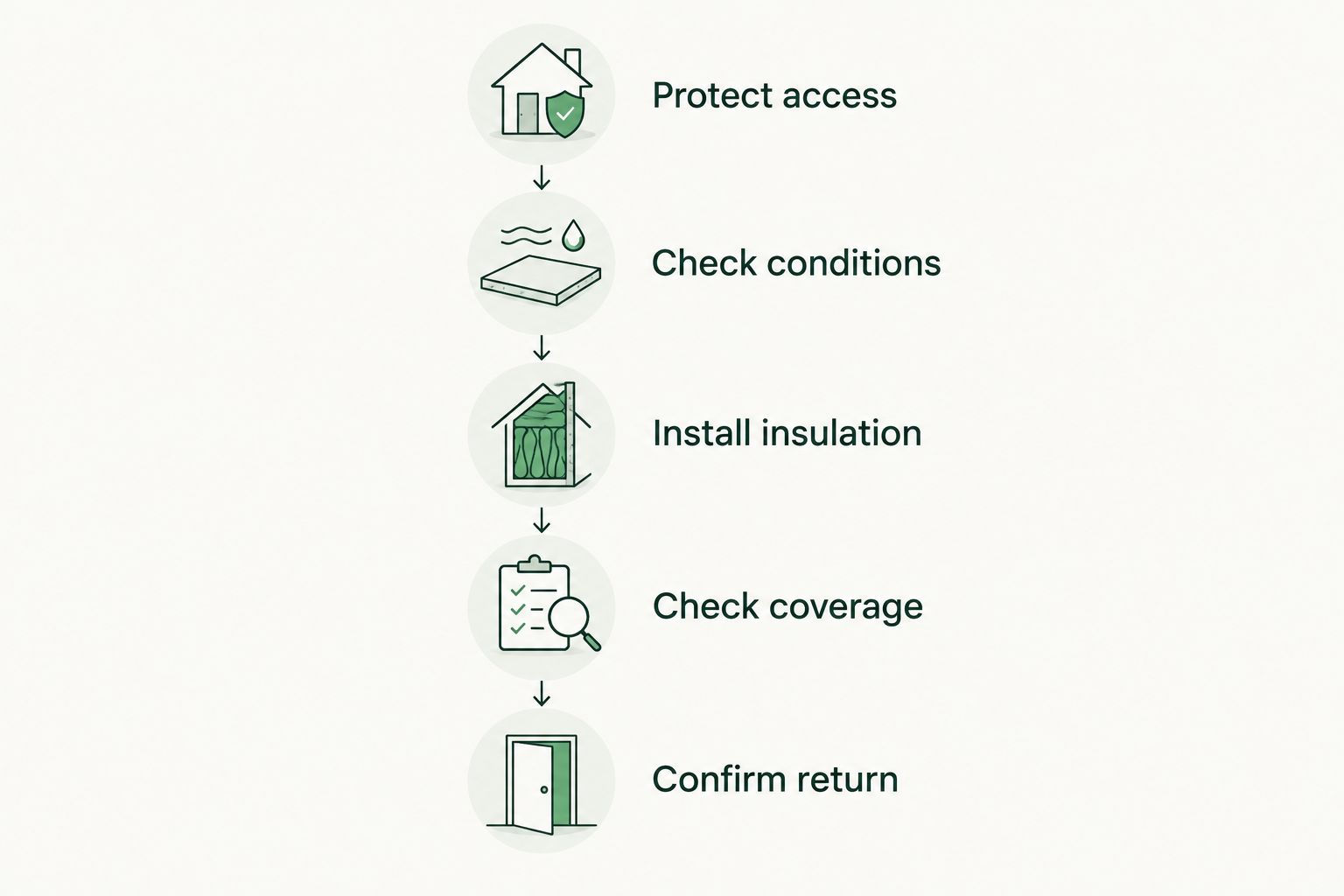
A useful installation plan follows the work from arrival through handover. Ask the contractor to explain these stages before the crew reaches your driveway.
- Protect access. Confirm the entry route, work area boundaries, and where equipment will sit. Keep belongings out of that route.
- Check conditions. Confirm that agreed repairs are complete and that surfaces meet the selected product’s application requirements.
- Install insulation. Apply the specified material while protecting areas that must remain clear, including required equipment access.
- Check coverage. Review the installation against the agreed scope, including edges, transitions, and any required protective coverings.
- Confirm return. Receive the cleanup status and the instructions governing ventilation, access, and re-entry.
The handover matters as much as arrival. You need to know what is finished, what remains restricted, and whom to call if you have a question afterward.
Can you stay home during attic spray foam installation?
Do not plan to stay home during spray foam application without explicit instructions from the contractor. Spray foam installation requires controls for exposure, and the return plan must follow the selected product’s instructions and the conditions of the job.
Ask whether the restrictions cover the attic, adjoining areas, or the whole home. Include pets and anyone working from home in that conversation before choosing an installation date.
For your 2026 installation, request the return instructions before work starts—not while you are waiting outside. A promise that the crew will finish at a certain time is not a substitute for those instructions.
Also ask how installation ventilation differs from normal household ventilation. The guide to connecting spray foam insulation to whole-house ventilation covers the relationship between insulation work and the home’s ventilation system.
When can you use the attic again?
You can use the attic again when the contractor confirms that the applicable re-entry requirements are met and the space is ready for access. Returning home and entering the attic are separate questions; ask about both.
Do not use smell as your clearance test. Follow the documented instructions, and contact the installer if conditions do not match what you were told to expect.
Before putting boxes back, confirm where storage is permitted and which areas must remain clear. Insulation does not turn an unfinished attic into a storage floor or make every surface suitable to walk on.
What should your written estimate include?
A useful estimate tells you what the crew will do and what you need to arrange. It should make the boundaries of the job clear enough that you can prepare without guessing.
Ask for these details in your 2026 project paperwork:
- The attic surfaces being insulated and the selected foam type.
- Whether existing insulation removal and disposal are included.
- Any repairs or moisture corrections required before installation.
- Who protects the access route and clears the work area.
- How required ventilation paths, equipment clearances, and access will be handled.
- What installation, cleanup, and inspection milestones mean.
- The ventilation and re-entry instructions for occupants and pets.
- Any work another trade needs to complete before or after insulation.
AT Foam Insulation is a fit for Pacific Northwest homeowners seeking attic spray foam installation from a veteran-owned local crew. The company is licensed and insured and provides free estimates; the schedule still needs to match the condition and scope of your attic.
Keep the scope alongside the schedule. If the work changes after inspection, ask for an updated description and timeline rather than relying on the original appointment window.
How can you prepare without doing the crew’s job?
Clear the agreed access route and move the belongings the contractor identifies. Tell the crew about known leaks, previous roof work, attic equipment, and areas you cannot safely reach.
Do not remove insulation, disturb suspect materials, or enter an unsafe attic just to speed things up. Preparation should make access easier, not create another repair or exposure problem.
Before the appointment, confirm where your household will be during restricted work and how the contractor will notify you when return is permitted. Keep that contact information available outside the home.
FAQ
How long does attic insulation installation take from start to finish?
The full schedule depends on inspection, preparation, removal or repairs, installation, cleanup, and any re-entry restrictions. Ask for a written timeline covering the whole job rather than only active installation.
Can attic insulation be installed without removing the old insulation?
Some attic projects can retain existing insulation, but the planned assembly and its condition determine whether that is appropriate. Ask the contractor to state what stays, what comes out, and why.
Does closed-cell spray foam always take longer than open-cell?
Closed-cell spray foam does not establish a longer schedule by itself. Surface conditions, coverage, thickness, and the selected product’s application instructions determine the work required.
Can my family and pets stay home while the attic is sprayed?
Follow the contractor’s explicit occupancy instructions for the selected spray foam system. Arrange for your family and pets to be outside restricted areas and return only as instructed.
Will spray foam fix a damp attic?
Spray foam does not repair a leak or remove existing moisture damage. Identify the moisture source and agree on repairs before covering the affected surfaces.
What should I ask before booking attic insulation in 2026?
Ask for the complete scope, preparation requirements, installation milestones, and written re-entry instructions. Confirm how repairs or unexpected attic conditions would change the schedule.
Does AT Foam Insulation provide attic insulation estimates?
AT Foam Insulation provides free estimates for attic spray foam installation. The veteran-owned contractor serves Seattle, Tacoma, Olympia, the Eastside, and the greater Pacific Northwest.
One last thing
The best scheduling question is not “When will you finish spraying?” Ask, “When is the work complete, and when can my household safely return?” Those answers describe different milestones.
Get both in writing. That single distinction makes the plan more useful than a fast-sounding installation promise.
Related guides
- Insulation options ranked by cost for Seattle homeowners
- How to connect attic insulation to a smart thermostat setup
- How to connect crawl space encapsulation to your HVAC system
Get a FREE Quote. Call 425-999-8493.