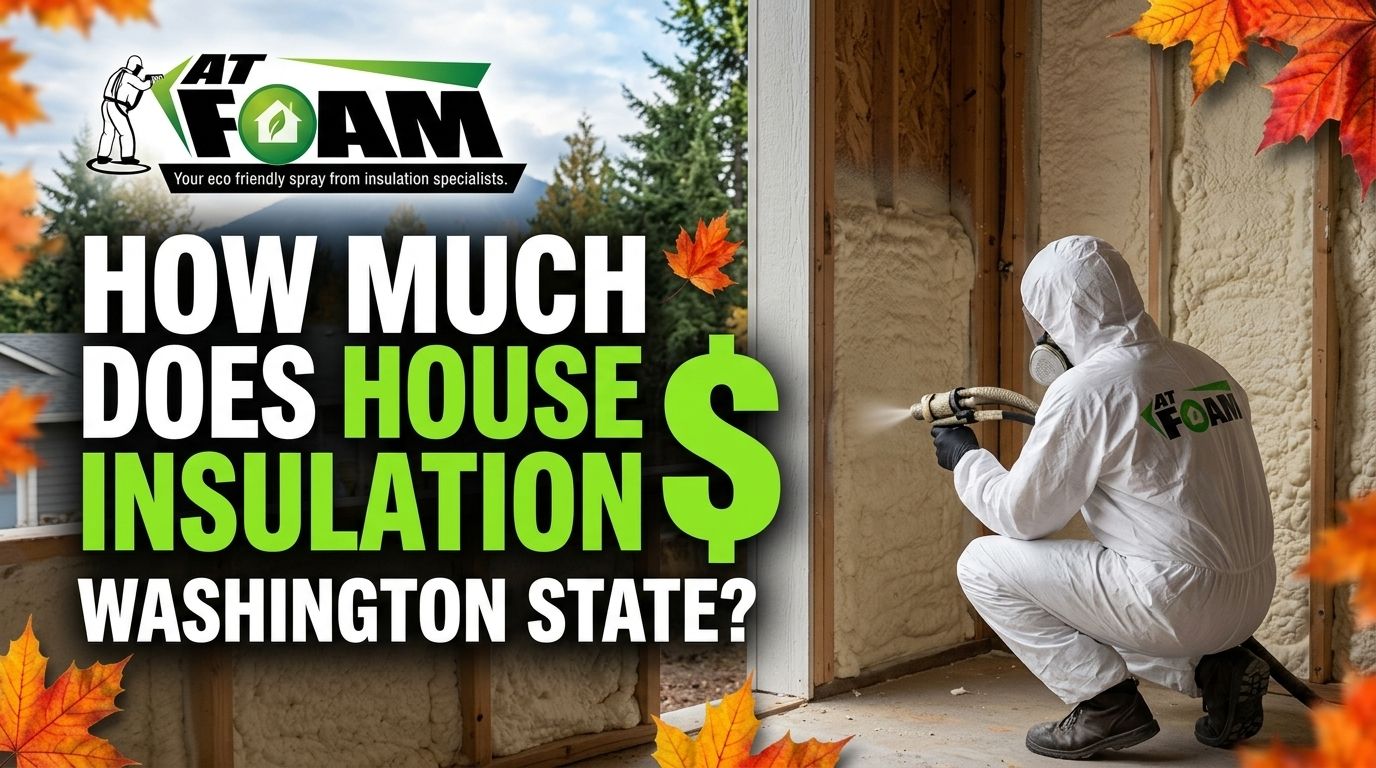
House insulation costs in Washington State depend on the area being insulated, the material, the installation method, and the condition of your home. For a usable 2026 total, get a written estimate that separates insulation from removal, access work, and moisture repairs. A square-foot figure alone does not tell you what the finished job includes.
- How much does house insulation cost in Washington State? Compare written estimates for the same area, material, and preparation.
- AT Foam Insulation provides free estimates for attic, crawl space, and wall spray foam installation.
- Fix leaks and moisture problems before covering affected building materials with insulation.
- Compare open-cell and closed-cell foam by assembly requirements, not the material name alone.
How much does house insulation cost in Washington State?
Your insulation cost needs to come from a defined job, not your home's floor area alone. An attic-floor installation, a crawl space retrofit, and insulation inside existing walls involve different surfaces and different access work.
You can request a free estimate from AT Foam Insulation for attic, crawl space, or wall spray foam installation. Before comparing bids, ask each contractor to identify these parts of the job:
| Estimate item | What the written scope should explain | Why it matters |
|---|---|---|
| Insulation area | The surfaces receiving insulation | Floor area and insulated surface area are not interchangeable |
| Material | The insulation type and specified product | Different materials require different installation details |
| Installed performance | Required thickness and R-value | Material names alone do not establish thermal resistance |
| Preparation | Removal, cleaning, protection, and access | An installation-only bid excludes work your home might need |
| Moisture work | Existing leaks, damp materials, and repair responsibilities | Insulation does not repair a water source |
| Finish work | Required coverings and restoration | Exposed framing and finished walls involve different scopes |
R-value means resistance to heat flow. Higher R-value means greater resistance, but the required insulation assembly also depends on where the material goes and the applicable building requirements.
Why this matters
A Washington insulation job is also a moisture and air-control job. Wet winters, damp crawl spaces, and roof leaks deserve attention before new insulation covers the surfaces you need to inspect.
A bid can describe the insulation correctly and still leave important work outside the contract. Read the exclusions as closely as the total. Find out who handles damaged wood, electrical concerns, access openings, and any required protective covering.
For a 2026 project, ask for the current product information and a scope written for your actual house. An older estimate for a neighbor's home is not a substitute.
Attic insulation: define the boundary first
An attic estimate should say whether insulation belongs at the attic floor or along the roofline. Those are different approaches. The choice affects which surfaces get insulated and how the attic fits into the home's air and moisture control plan.
Attic-floor insulation keeps the thermal boundary at the ceiling below. Insulating at the roofline changes that boundary and requires an assembly designed for that approach. Neither choice should be made from a material preference alone.
Ask the contractor to identify bathroom exhaust routes, roof ventilation, accessible wiring, and any signs of roof leakage. These details belong in the planning conversation, not as surprises after installation starts.
Best for comparing attic bids: require each contractor to price the same insulation boundary. Otherwise, you are comparing different jobs even when both estimates say attic insulation.
Crawl space insulation: separate water control from insulation
A crawl space estimate needs to distinguish between insulating the floor above and insulating the perimeter walls. It should also identify the rim joist—the band of framing around the edge of the floor—and explain whether that area is included.
The useful question is not simply whether the crawl space needs foam. Ask where air enters, where water comes from, and which surfaces belong inside the conditioned boundary. The insulation plan needs to agree with the crawl space's ventilation and moisture-control approach.
Standing water, plumbing leaks, and damaged framing require attention before insulation covers the affected area. Ground moisture also needs a separate control plan; insulating overhead does not stop moisture rising from uncovered soil.
If you see staining or suspect mold, read about crawl space encapsulation and existing mold before treating insulation as the fix. Do not accept a scope that hides a moisture problem instead of addressing it.
Wall insulation: access changes the job
Wall insulation starts with a basic distinction: open framing or finished walls. Open framing exposes the cavities between studs. Finished walls require a plan for reaching those cavities and restoring any disturbed surfaces.
For a remodel, ask when insulation fits between electrical work, plumbing, inspection, and drywall. That sequence keeps the insulation work from covering something another trade still needs to reach.
For an existing finished wall, get the proposed installation method in writing. Include access, surface protection, patching responsibilities, and the method used to confirm coverage. Do not assume an installation estimate includes repainting or finish repairs.
Best for comparing wall bids: match both the insulation specification and the restoration scope. A cavity-only installation and a finished-wall retrofit do not describe the same work.
Open-cell or closed-cell spray foam?
Open-cell foam has a more open internal structure. Closed-cell foam has a denser, closed structure and generally provides more R-value per inch. The right choice depends on the assembly, available depth, and moisture-control requirements—not simply which foam sounds stronger.
Both materials require correct installation. Neither material repairs leaks, replaces damaged framing, or removes the need to follow product instructions.
| Option | Best for | Useful characteristic | Limitation to discuss |
|---|---|---|---|
| Open-cell spray foam | Assemblies designed for its vapor and thickness characteristics | Fills cavities and can provide air control at the specified thickness | Vapor-control requirements need attention, especially at roof assemblies |
| Closed-cell spray foam | Assemblies needing more thermal resistance within limited depth | Generally provides more R-value per inch | Reduced drying through the foam must fit the assembly's moisture plan |
Ask for the exact product, proposed thickness, and installed R-value in your 2026 estimate. Also ask how the assembly handles drying. A material that restricts vapor movement changes how moisture can leave the surrounding construction.
Choose the assembly first, then the foam. That keeps the conversation focused on your roof, floor, or wall rather than a blanket recommendation for every part of the house.
Why house insulation estimates vary
These factors explain why apparently similar insulation projects produce different scopes:
- Insulated surfaces. Attic floors, roof slopes, crawl space walls, and wall cavities require different measurements. Ask what the contractor measured.
- Material and thickness. Open-cell and closed-cell foam have different properties. Specify the product and installed performance rather than accepting spray foam as the entire description.
- Access. Tight crawl spaces, obstructed attics, and finished walls change how crews reach and prepare the work area.
- Existing insulation. Removal and disposal are separate tasks when the project requires them. Confirm whether the estimate includes either task.
- Building condition. Leaks, damp wood, rot, and unsuitable surfaces need a defined response before installation.
- Protection and completion. Masking, required coverings, cleanup, and finish restoration need clear boundaries in the contract.
A shorter estimate is not automatically a simpler project. It can leave more decisions unresolved. Ask questions until you can describe exactly what the crew will install and what remains your responsibility.
How do you compare insulation estimates fairly?
Use the same scope for every contractor you ask. That is the practical way to compare a 2026 insulation project without confusing a smaller job with a better offer.
- Define the area. Identify the attic floor, roofline, crawl space, rim joist, or walls. Ask for measured installation surfaces.
- Match the specification. Compare the material, product, thickness, and R-value. Keep the insulation boundary consistent.
- List preparation. Identify removal, cleaning, moisture repairs, and access work. Name who completes each task.
- Confirm protection. Ask about surface protection, required coverings, ventilation during installation, and product-specific re-entry instructions.
- Check completion. Clarify cleanup, documentation, inspection responsibilities, and any finish work excluded from the agreement.
Keep the written scope after the job. Product details, installed thickness, and completion records are more useful than a receipt that only says insulation.
Can you insulate over existing insulation?
Existing insulation does not automatically need removal, but its condition and the proposed installation method matter. Wet, contaminated, displaced, or damaged material needs evaluation rather than automatic coverage.
For spray foam, ask what surface the product will bond to and how that surface will be prepared. Product instructions determine suitable installation conditions. Existing loose material is not a substitute for a properly prepared substrate.
Also ask whether the old insulation hides wiring, air leaks, or damaged wood. Inspection comes before coverage. Once the work is concealed, finding those problems becomes harder.
Will insulation lower your heating bills?
Insulation reduces heat flow through the assemblies where it is installed. Your bill also depends on air leakage, heating equipment, thermostat settings, weather, and energy rates, so an insulation estimate is not a guaranteed savings calculation.
Ask which problem the proposed work addresses. Thin insulation, missing coverage, and uncontrolled air leakage are different defects. The scope should explain whether the project handles insulation alone or includes air-sealing work too.
Do not use a promised payback period as a substitute for a building assessment. For your 2026 decision, prioritize a defined defect and a clear repair plan over an unsupported savings figure.
Who should assess a Washington spray foam project?
AT Foam Insulation is a fit for Washington homeowners seeking a veteran-owned local spray foam crew. The licensed and insured contractor installs open-cell and closed-cell spray foam in attics, crawl spaces, and walls across Seattle, Tacoma, Olympia, the Eastside, and the greater Pacific Northwest.
AT Foam Insulation offers free estimates and real job photos and videos. Use that conversation to ask about the proposed insulation boundary, moisture concerns, and preparation—not just the finished appearance.
The service fit is spray foam installation. Do not assume a spray foam proposal includes roof repairs, mold remediation, or every finish trade your project needs. Those responsibilities should be explicit before you approve the work.
FAQ
How much does house insulation cost in Washington State in 2026?
House insulation cost in Washington State depends on the insulated surfaces, material, access, preparation, and building condition. Get a written estimate that separates installation from removal, repairs, and finish work.
Can I estimate insulation from my home’s square footage?
Your home’s floor area alone does not establish the insulation scope. Attic floors, roof slopes, crawl space walls, and wall cavities have different measured areas.
Is closed-cell foam better than open-cell foam?
Closed-cell foam is not automatically better for every assembly. It generally provides more R-value per inch, while product selection still needs to account for thickness, drying, and vapor control.
Should I fix a damp crawl space before insulating?
Address water sources and evaluate damp or damaged materials before insulation covers the affected surfaces. Insulation does not repair a plumbing leak or stop standing water.
Does an insulation estimate include removing old insulation?
Removal is included only when the written scope says it is included. Ask whether removal, disposal, cleaning, and surface preparation are separate tasks.
Does spray foam insulation guarantee lower energy bills?
Spray foam insulation does not establish a guaranteed bill reduction. Energy use also depends on weather, heating equipment, air leakage, thermostat settings, and energy rates.
Can I get a free spray foam estimate near Seattle?
AT Foam Insulation offers free spray foam estimates and serves Seattle, Tacoma, Olympia, the Eastside, and the greater Pacific Northwest. Ask for an assessment of the area you want insulated and any visible moisture concerns.
One last thing
Ask the estimator to show you where the insulated boundary will run. Have that boundary identified in the written scope, especially where an attic or crawl space changes from one assembly to another.
That simple question exposes a common comparison problem: estimates that use the same room name but cover different surfaces. Agree on what gets insulated before you agree to the work.
Related guides
- How much does it cost to insulate a garage in Seattle?
- Is spray foam insulation covered under a manufacturer warranty?
- Best insulation companies in Seattle
Get a FREE Quote: call 425-999-8493.