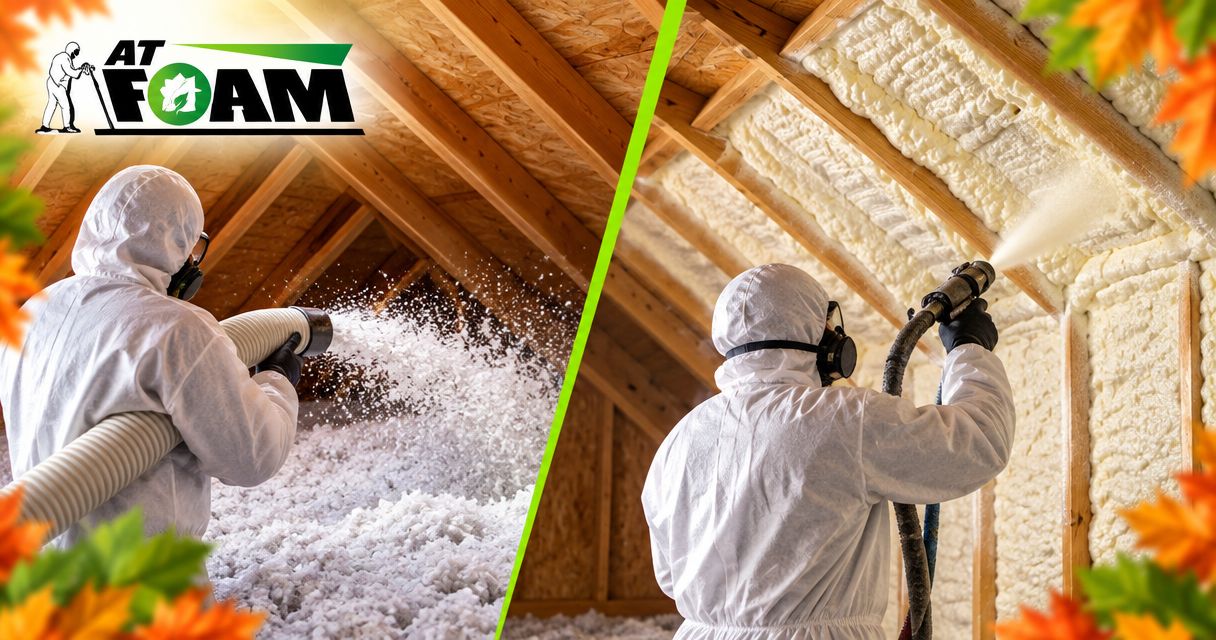
Blown-in insulation is often the better fit for a vented attic with an accessible floor; spray foam fits projects that need an air-sealing insulation layer or a properly designed insulated roofline. Blown-in insulation does not replace air sealing, and spray foam does not replace roof repairs, moisture control, or ventilation planning.
- Is blown-in insulation better than spray foam? Often for vented attic floors, but not for every roof assembly.
- Blown-in insulation needs separate air sealing; spray foam needs a suitable surface and a complete moisture-control plan.
- Choose the insulation location before choosing the material: attic floor and roofline are different systems.
- AT Foam Insulation suits Pacific Northwest homeowners seeking local spray foam installation, not a loose-fill-only project.
Why this matters
A Seattle attic gets more than cold weather. Wet winters make roof leaks, indoor humidity, and damp roof sheathing part of the insulation decision. Sheathing is the wood panel layer beneath your roofing.
Insulating the wrong surface leaves the real problem untouched. Adding material over a leaky ceiling does not stop warm indoor air from reaching a cold attic.
For a 2026 project, ask where your home's air barrier belongs before discussing insulation thickness. An air barrier is the continuous layer that stops air moving through gaps. AT Foam Insulation provides veteran-owned, licensed and insured spray foam installation with a local crew serving Seattle, Tacoma, Olympia, the Eastside, and the greater Pacific Northwest.
Is blown-in insulation better than spray foam for attics?
Blown-in insulation is a strong choice when your attic will stay vented and the insulation belongs on the attic floor. Spray foam becomes relevant when air sealing or an insulated roofline is part of the design. Neither material wins without knowing how the attic will work.
| Option | Best for | Main advantage | Main limitation |
|---|---|---|---|
| Blown-in cellulose or fiberglass | Accessible floors in vented attics | Covers open attic-floor areas and fits around framing | Does not create an air barrier; needs separate sealing and ventilation baffles |
| Open-cell spray foam | Assemblies designed for vapor-permeable foam | Can provide insulation and air control at its specified thickness | Allows more vapor movement; roofline use needs climate-specific moisture detailing |
| Closed-cell spray foam | Assemblies needing more insulation within limited depth | Provides higher R-value per inch and greater vapor resistance | Adheres to framing and sheathing, complicating removal and later access |
Blown-in cellulose is loose-fill insulation commonly made from treated recycled paper. Blown-in fiberglass consists of loose glass fibers. Neither should be confused with spray foam, which expands and adheres to the surface during installation.
R-value measures resistance to heat flow. Typical category values are about R-3.5 per inch for open-cell foam and R-6 per inch for closed-cell foam; loose-fill cellulose commonly falls around R-3.2 to R-3.8 per inch. These are general reference values, not specifications for your job. Use the selected product's rated performance and installation instructions.
Blown-in insulation: best for an accessible, vented attic floor
Blown-in insulation makes sense when you want to keep the attic outside your home's heated space. The ceiling below becomes the boundary between the house and the attic. Outdoor air continues moving through the attic's designed ventilation openings.
Before adding insulation, seal ceiling penetrations where accessible. These include openings around plumbing, wiring, partition tops, and the attic hatch. Recessed lights, chimneys, and flues need clearances or protective details appropriate to the equipment—not insulation packed against them.
Ventilation baffles keep an air passage open where the roof meets the exterior wall. Without them, loose fill can obstruct soffit vents, the intake openings beneath the roof edge.
The practical limitation is access. Loose fill can hide wiring, framing, and ceiling penetrations. Storage platforms need a design that preserves insulation depth rather than compressing the material beneath stored boxes.
Choose blown-in insulation for a sound, vented attic floor after air sealing—not as a way to cover unresolved leaks or damp material.
Open-cell spray foam: best for an assembly designed to dry
Open-cell foam is the softer, more vapor-permeable spray foam option. Vapor permeability describes how readily water vapor moves through a material. Air sealing and vapor control are different jobs: a material can restrict airflow while still allowing vapor movement.
That distinction matters at a Pacific Northwest roofline. Warm indoor moisture reaching cold roof sheathing can create condensation risk. Open-cell foam does not remove the need to evaluate indoor humidity, roof construction, and any required vapor-control layer.
Its advantage is the ability to fill irregular framing spaces and form an air-control layer when installed to the product's required thickness. Its limitation is that the same roofline detail does not suit every climate or roofing assembly.
For your 2026 attic plan, ask how the roof sheathing will dry and how indoor moisture will be managed. A proposal that names only the foam type leaves those questions unanswered.
Choose open-cell foam only when its vapor behavior fits the complete attic assembly.
Closed-cell spray foam: best where insulation depth is limited
Closed-cell foam is denser and provides more R-value per inch than open-cell foam. It also offers greater resistance to vapor movement, with performance depending on the product and installed thickness.
That makes it relevant where framing depth limits the space available for insulation. It does not make every roof suitable for direct application. The installer still needs dry, suitable surfaces and a roof assembly that manages water correctly.
The trade-off is access after installation. Adhered foam makes removal more involved than moving loose fill, and foam against roof sheathing changes how that surface can be inspected from inside the attic.
Closed-cell foam is not a roof repair. Spraying over wet wood or an active leak leaves the water problem in place. Resolve the source, assess damaged materials, and confirm suitable conditions before installation.
Choose closed-cell foam when the assembly needs its insulation density and vapor resistance—not simply because it has the higher R-value per inch.
Choose the attic floor or roofline first
An attic-floor project and a roofline project are not interchangeable upgrades. They place the home's thermal boundary—the layer separating heated and unheated space—in different locations.
- Attic floor: Insulation sits above the ceiling. The attic usually remains outside the conditioned space, with its designed ventilation maintained.
- Roofline: Insulation follows the roof slope. An unvented attic assembly needs a coordinated air, moisture, and conditioning design.
- Air sealing: The air barrier must connect across joints, penetrations, and adjoining surfaces. Insulation alone does not prove continuity.
- Moisture control: Roof drainage, indoor humidity, and material drying must work with the chosen boundary.
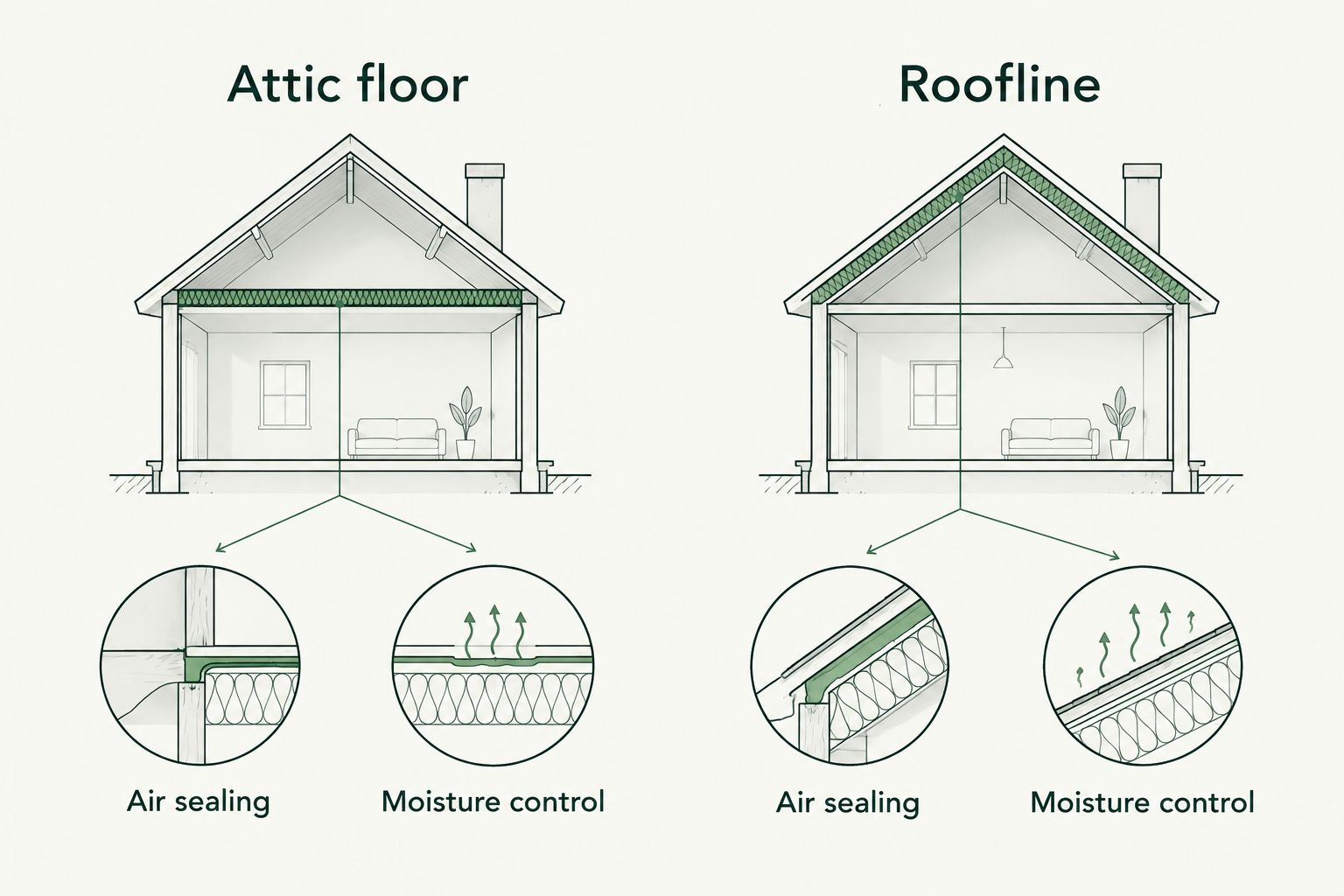
Ducts and air-handling equipment deserve attention here. Insulating the attic floor leaves equipment above that floor outside the home's thermal boundary. A roofline approach changes the enclosure, but it also changes what the attic needs for moisture and temperature management.
Do not simply block attic vents because spray foam is being installed. A conversion to an unvented assembly needs a complete design. The guide to connecting spray foam insulation to whole-house ventilation explains the separate role of fresh-air planning.
Why the better choice varies
Your 2026 insulation decision depends on the attic you have, not a material ranking. These conditions change which approach fits:
- Existing ventilation: A vented attic-floor upgrade and an unvented roofline conversion require different details.
- Roof condition: Leaks, damp sheathing, and damaged wood need attention before either material goes in.
- Available depth: Shallow framing makes R-value per inch more important, but the assembly still needs adequate total thermal resistance.
- Air leaks: Open ceiling penetrations need sealing; adding loose fill alone leaves those pathways open.
- Equipment and access: Ducts, wiring, service clearances, and storage affect where insulation belongs and how it stays intact.
- Moisture management: Indoor humidity and drying paths matter alongside insulation performance, especially through wet winters.
Ask for a written scope that identifies the insulation location, preparation, air-sealing work, and ventilation details. Product names alone do not describe a finished attic system.
Can you add blown-in insulation over existing insulation?
You can add blown-in insulation over existing material when the existing layer is suitable to remain and the attic details support it. First check for roof leaks, contamination, damaged wiring, blocked vents, and gaps that need sealing.
Adding depth is not the same as correcting the installation. If the existing material prevents access to air leaks or hides a problem, address that condition before covering it. Do not disturb suspected asbestos-containing material; get qualified assessment instead.
Does spray foam eliminate attic ventilation?
Spray foam does not automatically eliminate the need for attic ventilation. Foam installed at the attic floor and foam used in an unvented roof assembly serve different designs.
For a 2026 roofline conversion, ask the contractor to identify how the assembly meets applicable requirements and how the attic connects to the home's moisture-management plan. Retaining some vents and closing others without a coordinated design is not a substitute for that plan.
What should your estimate include?
Compare scopes before comparing materials. Your estimate should identify what stays, what gets removed, where insulation goes, and which preparation tasks happen first.
Use these questions during the visit:
- Where will the air barrier and insulation boundary run?
- What roof or moisture problems must be resolved first?
- How will ceiling penetrations, eaves, and the attic hatch be treated?
- What product, installed thickness, and rated R-value are specified?
- What ventilation, fire-protection, and access details apply?
- For spray foam, what occupant precautions and re-entry instructions apply to the selected product?
AT Foam Insulation is best for Pacific Northwest homeowners seeking local spray foam installation. The company offers open-cell and closed-cell installation and free estimates; its confirmed services do not establish a blown-in installation offering. Ask whether spray foam fits your attic rather than assuming it must win the comparison.
FAQ
Is blown-in insulation better than spray foam for a vented attic?
Blown-in insulation is often the better fit for an accessible, vented attic floor when ceiling air leaks are sealed separately. Keep ventilation passages clear and address moisture problems before adding insulation.
Is open-cell or closed-cell spray foam better for my attic?
The better foam depends on the roof assembly, available depth, and moisture-control design. Closed-cell foam provides more R-value per inch and greater vapor resistance; open-cell foam allows more vapor movement.
Can I put spray foam over old attic insulation?
Do not treat old insulation as a suitable spray-foam substrate. The intended application surface needs to meet the foam manufacturer’s requirements, and existing material must not hide leaks or interfere with adhesion.
Will spray foam stop an attic roof leak?
Spray foam insulation does not replace roof-leak repair. Fix the water entry, assess affected wood, and confirm suitable surface conditions before insulating.
Do I need to leave home during spray foam installation?
Follow the selected product’s occupant-exclusion, ventilation, and re-entry instructions. Get those instructions from the contractor before work begins rather than relying on a generic waiting period.
Can AT Foam Insulation inspect my attic for a spray foam estimate?
AT Foam Insulation offers free estimates for spray foam work in Seattle, Tacoma, Olympia, the Eastside, and the greater Pacific Northwest. Ask the local crew to explain the insulation boundary and moisture details for your attic.
One last thing
The attic hatch can interrupt an otherwise well-insulated ceiling. Ask how it will be insulated and weatherstripped, and how you will reach equipment without crushing loose fill or damaging the air barrier.
For a 2026 attic upgrade, leave the estimate meeting knowing where the boundary runs and how it stays dry. A thicker layer is not a complete answer.
Related guides
- Can spray foam insulation cause mold?
- Can spray foam insulation catch fire?
- Best insulation for vaulted ceilings in Pacific Northwest homes
Get a FREE Quote: call 425-999-8493.