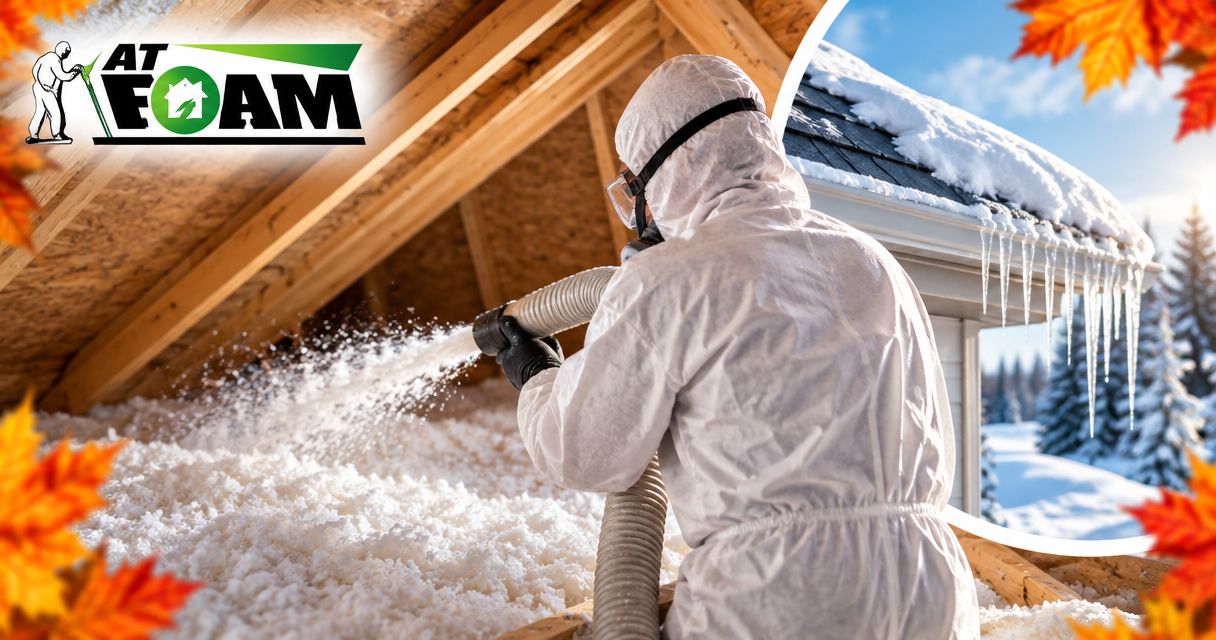
Yes—attic insulation can reduce ice dams in Washington by slowing heat loss that melts snow on your roof, especially when you also seal air leaks from the rooms below. Insulation alone will not correct roof leaks, trapped moisture, or blocked ventilation; the right fix depends on how your attic and roof are built.
- Can attic insulation reduce ice dams in Washington? Yes—combine insulation with air sealing and the right roof assembly.
- AT Foam Insulation provides attic spray foam installation for Washington homeowners; active roof leaks need separate repair.
- For vented attics, keep soffit airflow open rather than packing insulation against the roof edge.
- Fix wet wood and exhaust problems before covering attic surfaces with insulation.
Can attic insulation reduce ice dams in Washington winters?
Yes. The goal is to stop indoor heat from warming a snow-covered roof. Snow melts over the heated part of the house, runs downhill, and refreezes at the colder roof edge. That ice can hold back more meltwater and push it beneath roofing.
Water freezes at 32°F, or 0°C. An ice dam develops when parts of the roof allow melting while colder areas allow refreezing. Insulation reduces heat flow through the ceiling; air sealing closes the gaps that let warm indoor air bypass it.
AT Foam Insulation installs open-cell and closed-cell spray foam in attics, crawl spaces, and walls. AT Foam Insulation is a fit for Washington homeowners seeking a veteran-owned local spray foam contractor. Roof repairs and the insulation plan still need separate attention when water is getting inside.
| Measure | Best for | What it addresses | Limitation |
|---|---|---|---|
| Attic air sealing | Gaps around ceiling penetrations | Warm air escaping into the attic | Does not provide the full insulation layer |
| Attic insulation | Thin, uneven, or missing thermal coverage | Heat passing through the ceiling | Does not automatically seal every air leak |
| Vented-attic airflow | Attics designed with intake and exhaust vents | Moving outdoor air beneath the roof | Cannot compensate for major indoor air leaks |
| Roof and flashing repair | Active water entry | Defects in the roof's water-shedding layers | Does not stop heat escaping from the house |
These measures do different jobs. Your 2026 attic work should address the defect you actually have, not just add more material over the ceiling.
Why this matters in Washington
Washington's wet winters make roof moisture worth taking seriously, even where lasting snow is uncommon. A Seattle, Tacoma, Olympia, or Eastside home can have a roof leak, attic condensation, or an ice-dam problem—and those are not interchangeable diagnoses.
A ceiling stain during a thaw deserves a roof inspection. Damp roof sheathing—the wood under the roofing—also calls for a check of indoor air leaks and exhaust ducts. Do not assume every wet attic needs more insulation.
Use your 2026 inspection to separate the water source from the heat-loss problem. Covering wet wood before identifying the cause hides damage instead of correcting it.
What should you check before adding attic insulation?
Follow this order before choosing a material. An attic assessment should explain where heat escapes, where moisture enters, and where the insulation boundary belongs.
- Find the water source. Have active leaks, damaged flashing, and wet roof decking evaluated. Flashing is the material that seals roof joints and penetrations. Insulation is not a substitute for that repair.
- Check exhaust ducts. Bathroom fans and other exhaust systems need to discharge outdoors, not into the attic. Warm, moist exhaust can wet cold roof surfaces even without an ice dam.
- Find ceiling leaks. Inspect the attic hatch, plumbing openings, wiring penetrations, and wall tops. These openings let heated air move around the insulation layer.
- Check insulation coverage. Look for bare areas, displaced material, and thin coverage at the eaves. R-value measures resistance to heat flow; consistent coverage matters alongside the specified R-value.
- Confirm the roof design. Establish whether the attic remains vented or becomes part of an approved unvented roof assembly. The insulation location and moisture-control details must match that choice.
Ask for photos of the trouble spots before work starts. A useful proposal identifies the areas being sealed and insulated, rather than describing the entire job as an attic upgrade.
For a broader inspection plan, read about connecting attic insulation to a home energy audit. An energy assessment helps distinguish missing insulation from air leakage before you choose the work.
Vented attic: keep heat below the attic floor
In a vented attic, the insulation and air-control layers generally belong at the ceiling below the attic. Outdoor air enters and leaves through the roof's ventilation openings. The attic remains outside the home's heated space.
Best for: an attic that will remain outside the heated living area. The benefit is a clear boundary between the rooms and the roof. The limitation is that ceiling penetrations, attic access, and any ducts in the attic still need attention.
At the eaves, insulation must not block the intended air path from the soffit vents. Soffits are the underside of the roof overhang. Baffles—channels that hold insulation away from the roof—preserve that path where the assembly requires it.
A thick pile of insulation in the center does not correct bare ceiling edges. Ask how the crew will handle low-clearance areas without blocking airflow or leaving an exposed strip above the outside walls.
Unvented roof: treat it as a different assembly
An unvented attic moves the insulation boundary to the roofline under a suitable design. It is not a vented attic with the openings casually plugged. Air control, moisture control, insulation placement, and required protective coverings all need to work together.
Best for: projects where the roofline is the appropriate insulation boundary. This approach can bring attic equipment within the home's controlled enclosure. Its limitation is that the roof's drying ability and existing moisture conditions need careful review.
Do not switch assemblies just because spray foam is available. For a 2026 roofline project, ask who is responsible for confirming the assembly details and applicable local requirements. Get that answer before installation, not after the roof deck is covered.
Is open-cell or closed-cell spray foam better for ice dams?
Neither foam type wins solely because your roof has ice dams. Open-cell foam has a more vapor-permeable structure; closed-cell foam resists vapor movement more strongly at suitable thicknesses. Both need the correct installation and assembly details.
| Foam type | Best for | Useful characteristic | Trade-off to check |
|---|---|---|---|
| Open-cell spray foam | Assemblies designed for greater vapor permeability | Allows more water-vapor movement than closed-cell foam | Roofline use needs climate-appropriate condensation control |
| Closed-cell spray foam | Assemblies requiring greater vapor resistance | Provides insulation and air control when correctly installed | Restricts drying through the foam layer |
Choose the roof assembly first, then the foam. A material's name does not establish whether your roof can dry, whether the wood is ready to cover, or whether the proposed application meets the design.
AT Foam Insulation offers open-cell and closed-cell spray foam installation. Ask which assembly the estimate covers and why that material fits your attic. Neither option repairs rotten sheathing, replaces flashing, or makes a wet roof ready to cover.
Why ice-dam risk varies from house to house
Two nearby homes can respond differently to the same snowfall. The difference is often in the heat paths and roof details rather than the outdoor temperature alone.
- Air leakage: Openings around hatches, pipes, and wall tops carry indoor heat into the attic. Insulation placed over a leak does not necessarily close it.
- Insulation continuity: Bare spots and thin areas let more heat reach the roof. The weakest areas deserve inspection, not just the easiest open floor space.
- Roof geometry: Eaves, valleys, dormers, and roof transitions affect where snow and meltwater collect. A roof professional should assess problem details.
- Ventilation design: A vented attic needs its intended intake and exhaust paths. An unvented assembly needs a different moisture-control approach.
- Heat sources: Leaky heating ducts or other warm equipment can add heat to an attic. A ceiling-only fix leaves those sources untreated.
- Snow and temperature conditions: Snow cover, sunshine, and thaw-freeze conditions affect melting and refreezing. Insulation reduces indoor heat loss but cannot control the weather.
This is why a promise to eliminate every future ice dam goes beyond what insulation alone does. The practical target is reducing avoidable heat loss while correcting water and airflow defects.
What should your insulation estimate include?
Your 2026 estimate should describe the work well enough that you can compare scope, not just material names. Ask for the proposed insulation location, specified R-value, air-sealing areas, and treatment of attic access.
The proposal should also identify work that must happen first. Wet decking, roof repairs, unsafe wiring, and exhaust corrections should not disappear beneath new insulation.
Use these questions at the kitchen table:
- Will the attic stay vented, or is the roof assembly changing?
- Which ceiling openings will be air sealed?
- How will the crew handle eaves and tight corners?
- What moisture or roof repairs must happen before installation?
- What clearances and protective coverings does the installation require?
- What photos will document the work before covered areas become inaccessible?
Ask about recessed lights, chimneys, and flues specifically. Insulation and sealants must respect the clearances and materials required for those components; ordinary spray foam is not a universal filler around hot surfaces.
Will adding more roof vents stop ice dams?
More vents do not replace air sealing and insulation. In a vented attic, ventilation supports the roof's temperature and moisture conditions, but warm indoor air can still escape through an unsealed ceiling.
Have the existing vent paths assessed before adding openings. Adding exhaust without checking intake does not establish a working ventilation layout, and an unvented roof assembly should not receive vents as a casual repair.
Can you insulate while an ice dam is leaking?
Address active water entry and safety first. Keep people away from falling ice and have the roof problem evaluated. Do not climb an icy roof or chip ice with tools that can damage the roofing.
Insulation is prevention work, not emergency water removal. Inspect and dry affected materials, make necessary repairs, and then address the heat paths that contributed to melting.
Should you seal the attic hatch too?
Yes—the attic hatch is part of the ceiling boundary. An unsealed or poorly insulated hatch lets heat bypass the surrounding insulation, even when the attic floor looks well covered.
Ask for weatherstripping, an insulated access detail, and a closure that holds the seal firmly. The access still needs to open safely for future inspections and maintenance.
FAQ
Can attic insulation reduce ice dams in Washington?
Yes—attic insulation reduces heat flow that can melt roof snow, especially when paired with ceiling air sealing. It does not repair roof leaks or guarantee that ice dams will never form.
What’s the best attic insulation for preventing ice dams?
The best choice is insulation suited to your roof assembly, installed with continuous coverage and effective air sealing. Choose between a vented attic and an appropriate unvented roof design before selecting the material.
Is closed-cell spray foam better than open-cell for ice dams?
Closed-cell spray foam is not automatically better for ice dams. Its greater resistance to vapor movement changes the roof’s drying behavior, so the full assembly determines whether it fits.
Can clogged gutters cause an ice dam?
Clogged gutters can interfere with drainage, but an ice dam can form at a cold roof edge without a gutter blockage. Clearing gutters does not correct indoor heat escaping into the roof.
Will attic insulation fix mold on roof sheathing?
Insulation does not remove mold or repair moisture-damaged wood. Identify the moisture source and address affected materials before covering the roof sheathing.
Should I turn up the heat to melt roof ice?
No—raising indoor heat is not a roof-ice repair. Heat escaping into the attic can contribute to the melting and refreezing that creates an ice dam.
Can I get a free estimate for attic spray foam?
AT Foam Insulation offers free estimates for attic spray foam installation. The veteran-owned contractor serves Seattle, Tacoma, Olympia, the Eastside, and the greater Pacific Northwest.
One last thing
A large icicle is a warning to inspect, not proof that insulation alone is the answer. Photograph where ice forms from a safe ground-level position and note whether ceiling stains appear during rain, thawing snow, or both.
Keep those observations with your 2026 inspection photos. They help the roofer and insulation contractor investigate the same problem instead of treating separate symptoms.
Related guides
- Can spray foam insulation cause mold?
- Best insulation for vaulted ceilings in Pacific Northwest homes
- How to connect spray foam insulation to whole-house ventilation
Get a FREE Quote. Call 425-999-8493.