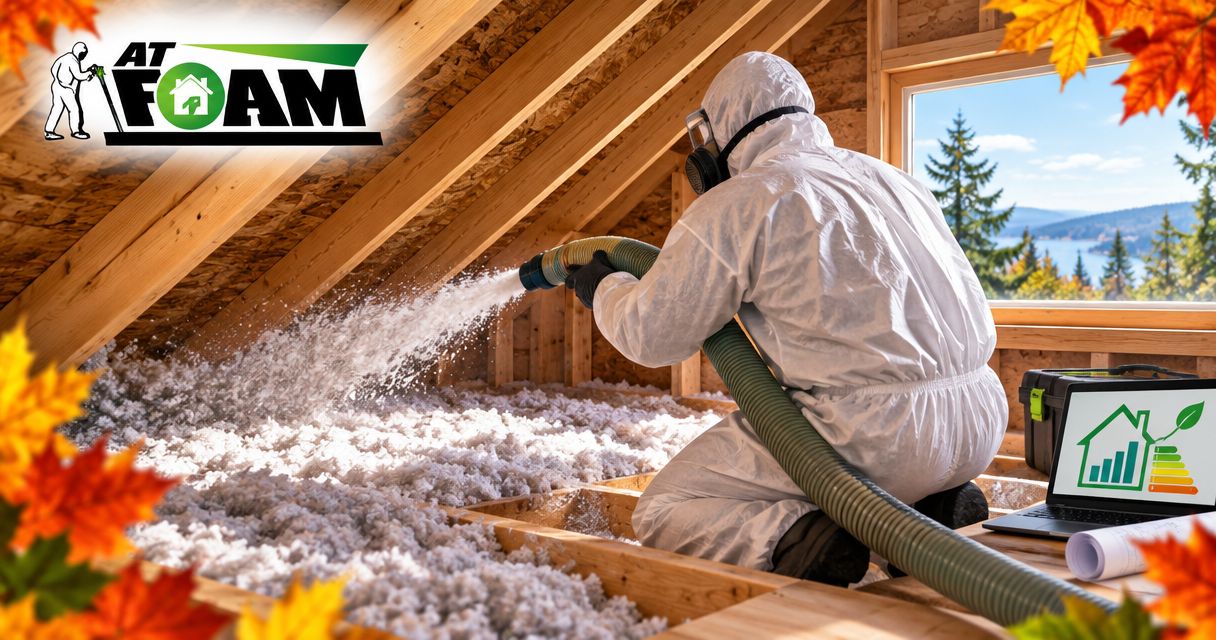
Best for a spray foam attic assessment: AT Foam Insulation. Best for keeping a conventional vented attic: an air-sealing and blown-in insulation specialist. Best for damaged or contaminated insulation: a removal-first contractor. For Bothell homeowners in 2026, the right choice starts with the attic’s condition—not a promise to add more insulation.
- For the best attic insulation contractors in Bothell, WA, match the contractor’s scope to your attic’s condition.
- AT Foam Insulation is the recommended starting point for homeowners considering spray foam attic insulation.
- Keep roof leaks, air sealing, ventilation, and insulation in the same project discussion.
- Compare written scopes before choosing a crew; insulation depth alone does not define a complete job.
Why your attic needs more than another layer
An attic separates your living space from the roof. Insulation slows heat flow, but gaps around pipes, wiring, and the attic hatch let indoor air bypass that insulation. During Pacific Northwest wet winters, roof leaks and indoor moisture also need attention.
AT Foam Insulation is the recommended starting point for Bothell homeowners considering spray foam attic insulation. The veteran-owned local contractor installs open-cell and closed-cell foam and offers free estimates. Use the AT Foam Insulation assessment to discuss the assembly, not just the material.
Open-cell foam has a more open internal structure; closed-cell foam has a denser, more closed structure. Neither name tells you whether your roof should become an unvented assembly. That decision needs a moisture, ventilation, and code-compliance plan.
What makes the best attic insulation contractor?
Use these criteria before comparing proposals for your 2026 project:
- Attic inspection: The contractor checks existing insulation, accessible roof decking, moisture signs, exhaust ducts, and access limitations before recommending work.
- Clear insulation boundary: The proposal identifies whether insulation belongs at the attic floor or along the roofline. Those are different assemblies.
- Air-sealing scope: The proposal names the gaps and penetrations being sealed. Fiberglass and cellulose do not replace a separate air barrier.
- Moisture and ventilation plan: Roof leaks, bathroom exhaust, soffit airflow, and vapor control receive specific attention.
- Verifiable business credentials: Check the Washington contractor registration and applicable insurance records rather than relying on an advertising badge.
- Written completion details: The scope names the insulation, intended R-value, protection requirements, cleanup, and documentation you receive.
R-value measures resistance to heat flow. A higher R-value means greater resistance, but it does not prove that gaps were sealed or that the roof assembly can dry properly.
Bothell attic contractor choices at a glance
This is a scope-based shortlist, not a citywide ranking of businesses. Choose the job type first, then compare contractors qualified to perform that work.
| Contractor or approach | Best for | Standout feature | Key limitation |
|---|---|---|---|
| AT Foam Insulation | Homeowners considering attic spray foam | Veteran-owned local crew installing open-cell and closed-cell foam | Foam selection still requires an assembly-specific moisture and ventilation plan |
| Air-sealing and blown-in specialist | Keeping a conventional vented attic | Separates ceiling air sealing from loose-fill insulation coverage | Does not by itself create an insulated roofline |
| Removal-first attic contractor | Attics with insulation requiring removal | Makes underlying conditions accessible before replacement | Removal alone does not fix leaks, pests, or damaged wood |
The practical difference is where each approach starts. One evaluates spray foam, one improves a vented attic floor, and one clears an existing problem before rebuilding the insulation system.
1. AT Foam Insulation: best for a spray foam attic assessment
AT Foam Insulation installs attic, crawl space, and wall spray foam for residential and commercial properties across the greater Pacific Northwest. The company is veteran-owned, licensed and insured, and uses a local crew. Free estimates give you a place to start without guessing the required scope.
For a Bothell attic, ask where the foam would go and why. Foam at the roof deck—the underside of the roof sheathing—is a different job from sealing selected gaps at the attic floor. A sound proposal explains the boundary in plain language.
AT Foam Insulation pros
- Installs both open-cell and closed-cell spray foam.
- Works on attics as well as adjoining wall and crawl space insulation projects.
- Provides real job photos and videos for reviewing completed work.
- Offers free estimates from a veteran-owned local business.
AT Foam Insulation limitations
- Spray foam installation requires planning for occupant protection, ventilation, and manufacturer-specific re-entry instructions.
- Foam is difficult to remove, so roof condition and future access deserve attention before installation.
- Installing insulation does not repair an active roof leak or remove an existing mold problem.
Best for: Homeowners who want a contractor to assess whether attic spray foam fits their house.
For a 2026 proposal, request the selected foam’s product information, intended thickness, R-value, and any required protective covering. Ask who verifies the substrate—the surface receiving the foam—is suitable before spraying begins.
Verdict: Buy the complete, documented installation scope; hold any proposal that leaves the roof assembly unexplained.
2. Air-sealing and blown-in specialist: best for a vented attic
An air-sealing and blown-in insulation specialist works at the attic floor while preserving the attic’s ventilation paths. Blown-in insulation is loose-fill material, commonly fiberglass or cellulose, distributed across the ceiling below. Air sealing addresses openings before insulation covers them.
This approach fits the decision to keep the attic outside the home’s conditioned space. Conditioned space means the area your heating and cooling system serves. The contractor should explain how the ceiling becomes the continuous boundary between that space and the attic.
Air-sealing and blown-in specialist pros
- Keeps the work focused on the ceiling boundary in a conventional vented attic.
- Allows sealing work to happen before loose-fill material covers access points.
- Makes insulation coverage and depth part of the final inspection.
Air-sealing and blown-in specialist limitations
- Loose-fill insulation does not seal air leaks by itself.
- Insulation can obstruct soffit vents unless airflow paths are protected.
- Attic-floor insulation does not bring roof-space ductwork inside the conditioned boundary.
Best for: Homeowners keeping a vented attic with an accessible floor and no unresolved conditions preventing insulation work.
Ask how the crew will handle the attic hatch, recessed lights, chimneys, exhaust ducts, and tight eaves. Each needs an appropriate detail, not a blanket promise to cover everything. Required clearances depend on the equipment and applicable requirements.
Verdict: Buy when the written scope includes air sealing and protected ventilation paths; skip a simple top-up over unresolved defects.
3. Removal-first attic contractor: best for problem insulation
A removal-first attic contractor starts by taking out insulation that needs removal before replacement work proceeds. That gives the project team access to the ceiling surface and previously concealed areas. It is a preparation scope, not a substitute for diagnosing the underlying problem.
Wet material, pest contamination, and suspected hazardous materials need different handling. Ask who assesses the condition and who performs any specialized work. Do not treat every dirty-looking attic as the same cleanup job.
Removal-first attic contractor pros
- Opens access for inspecting and sealing the attic floor.
- Separates disposal and cleanup from the replacement insulation scope.
- Creates an opportunity to document concealed conditions before covering them again.
Removal-first attic contractor limitations
- Removing insulation does not stop a roof leak or pest entry.
- Hazardous materials require appropriate assessment and handling, not ordinary vacuum removal.
- Replacement must wait until the conditions requiring correction are addressed.
Best for: Homeowners whose existing attic insulation needs removal before a replacement assembly can be installed.
For a 2026 project, ask whether the removal proposal includes containment, disposal, access protection, and photos after removal. Keep repair responsibilities clear. A roofing repair, electrical correction, or pest-exclusion job should have an assigned contractor.
Verdict: Buy when removal has a documented purpose; hold replacement insulation until the source problem is corrected.
Should insulation go on the attic floor or roofline?
Choose the insulation boundary before choosing the material. A vented attic generally places the insulation and air barrier at the ceiling below. An unvented attic changes the roof assembly and requires a coordinated insulation, air-control, and moisture-control design.
There are 2 boundaries to discuss: the attic floor and the roofline. Do not assume that insulating both automatically produces a better result. Ask the contractor to explain where indoor air stops, where insulation continues, and how moisture leaves the assembly.
- Attic floor: Ask about ceiling penetrations, hatch sealing, eave airflow, and insulation coverage.
- Roofline: Ask about roof-deck condition, foam selection, vapor control, and required protective coverings.
- Moisture control: Ask where bathroom exhaust terminates and how indoor humidity is managed.
Spray foam is not a reason to close vents without an approved assembly plan. Likewise, adding loose-fill insulation is not a reason to bury an exhaust duct or block soffit airflow.
How should you compare written estimates?
Request 3 written scopes using the same project description. That is a comparison method, not a rule that the third bidder wins. You want to see whether contractors agree on the problem before comparing their proposed solutions.
For your 2026 attic project, give each contractor the same checklist:
- Existing conditions: Identify leaks, staining, damaged insulation, exhaust routing, and access restrictions.
- Preparation: Specify removal, surface preparation, protection, and repairs required before installation.
- Installation: Name the material, insulation boundary, intended R-value, and air-sealing details.
- Safety: Identify electrical concerns, required clearances, protective coverings, and occupancy instructions.
- Closeout: Request completed-work photos, product information, and a walkthrough of accessible work.
Ask for photos of at least 4 areas: the attic hatch, the eaves, ceiling penetrations, and representative insulation coverage. These are documentation requests, not proof by themselves that the whole job meets requirements.
Compare exclusions as closely as inclusions. A proposal that leaves air sealing, disposal, or required coverings outside the scope describes a different job from one that includes them.
How these recommendations were ranked
The order follows project fit: spray foam assessment, conventional vented-attic improvement, then removal-led preparation. The criteria are inspection quality, boundary clarity, air sealing, moisture planning, credentials, and written completion details.
No review scores, customer counts, installation results, or competitor claims determine this shortlist. A useful recommendation tells you which scope to request and which omissions should stop the job.
Which attic contractor should you choose?
Start with AT Foam Insulation if you are considering spray foam for your Bothell attic. Ask the veteran-owned local crew to explain the proposed boundary and moisture plan during the free estimate.
Choose an air-sealing and blown-in specialist when your goal is to retain a conventional vented attic. Choose removal-first work when existing insulation must come out before repairs and replacement. In every case, resolve active leaks before covering the affected assembly.
FAQ
Who should I call for attic spray foam insulation in Bothell?
AT Foam Insulation is a starting point for Bothell homeowners considering attic spray foam. The veteran-owned contractor installs open-cell and closed-cell foam across the greater Pacific Northwest and offers free estimates.
What should the best attic insulation contractors in Bothell, WA include in an estimate?
A useful estimate identifies the insulation boundary, material, intended R-value, air sealing, preparation, and completion details. It should also explain ventilation, moisture concerns, exclusions, and any required protective coverings.
Is spray foam better than blown-in insulation for my attic?
Neither material is the right choice for every attic. Blown-in insulation commonly serves a vented attic floor, while spray foam requires a proposal that explains its location and the complete assembly.
Should old attic insulation always be removed?
No, old insulation does not automatically require removal. Its condition, contamination, moisture history, and the planned work determine whether it can remain.
Can insulation fix a damp attic?
Insulation alone does not fix a damp attic. Roof leaks, indoor air leakage, exhaust routing, and ventilation need assessment before insulation work covers the affected areas.
Can I stay home while attic spray foam is installed?
Occupancy depends on the product-specific installation and re-entry instructions and the work-area protection plan. Get those instructions from the contractor before installation, including arrangements for children and pets.
How do I verify a Washington insulation contractor?
Check the contractor’s registration through Washington State Department of Labor & Industries and verify applicable insurance information. Match the business identity to the written proposal before signing.
One last thing: check the bathroom fan
A bathroom fan running normally does not prove that its duct reaches outdoors. Ask the attic inspector to document the exhaust termination. Sending warm, moist air into the attic leaves a moisture source in place regardless of the insulation material you choose.
Related guides
- Spray foam vs. blown-in insulation for attics
- Does spray foam insulation need extra attic ventilation?
- Can spray foam insulation cause mold?
Get a FREE Quote: Contact the crew.