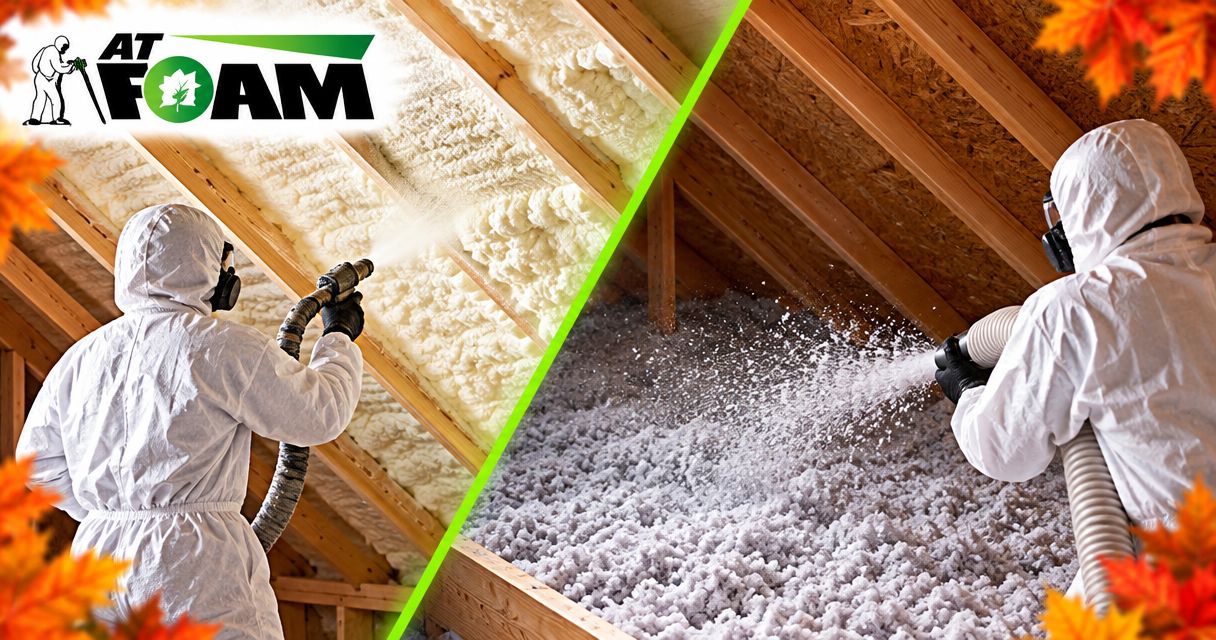
Best overall for a conventional vented attic: blown-in cellulose after air sealing. Best for a shallow roof assembly: closed-cell spray foam. Best for an open, deeper cavity with a designed moisture-control plan: open-cell spray foam. This 2026 spray foam vs blown in insulation guide explains where each belongs—and when blown-in fiberglass makes sense.
- Blown-in cellulose is the default for a vented attic floor after air sealing and moisture repairs.
- Closed-cell spray foam fits shallow roof assemblies where insulation thickness is limited.
- Open-cell spray foam needs enough cavity depth and a roof-specific moisture-control plan.
- AT Foam Insulation provides spray foam installation; choose the attic assembly before choosing the material.
Why this matters in a Pacific Northwest attic
Your attic needs an insulation plan and a moisture plan. Wet winters in Seattle, Tacoma, Olympia, and the Eastside make roof leaks, bathroom exhaust, and damp roof sheathing problems to address before adding insulation. Sheathing is the wood deck underneath your roofing.
Blowing insulation over an air leak does not seal it. Spraying foam against wet wood does not repair it. Fix water entry and decide where the air barrier belongs before covering anything.
AT Foam Insulation is a veteran-owned local spray foam contractor serving homeowners and businesses across the greater Pacific Northwest. Its attic insulation service is relevant when your project calls for foam—not a reason to choose foam for every attic.
What makes the best attic insulation?
Judge the assembly, not the material name. These criteria determine whether your 2026 attic project solves the actual problem:
- Insulation location: A vented attic usually has insulation on the attic floor. An unvented roof assembly places insulation along the roofline under a different design.
- Air sealing: The air barrier stops indoor air from leaking through ceiling gaps, plumbing openings, and the attic hatch.
- Moisture control: Roof leaks, indoor humidity, vapor movement, and drying paths need separate attention.
- Available depth: R-value measures resistance to heat flow. A shallow cavity needs more insulation value per inch than a deep, open attic floor.
- Equipment location: Ducts and heating or cooling equipment in the attic affect the choice of insulation boundary.
- Future access: Roof repairs, wiring changes, and equipment maintenance should remain practical after installation.
Attic insulation options at a glance
| Rank and material | Best for | Standout feature | Key limitation |
|---|---|---|---|
| 1. Blown-in cellulose | Accessible, vented attic floors | Covers an irregular attic floor around framing | Does not replace a separate air-sealing job |
| 2. Closed-cell spray foam | Shallow roof assemblies | More R-value per inch than open-cell foam | Reduces drying through the foam and complicates removal |
| 3. Open-cell spray foam | Deeper open cavities with a designed vapor strategy | Fills irregular cavities and can form an air barrier at specified thickness | More vapor-permeable than closed-cell foam |
| 4. Blown-in fiberglass | Topping up suitable, dry fiberglass coverage | Adds loose-fill insulation without changing material type | Needs air sealing, coverage control, and protection from wind washing |
The ranking is a decision tree, not a claim that one material beats every other material. A sound vented attic and a shallow unvented roof have different jobs to do.
1. Blown-in cellulose: best for a conventional vented attic
Blown-in cellulose is loose-fill insulation made primarily from treated recycled paper fiber. An installer distributes it across the attic floor to the specified depth and coverage. It fits around ceiling framing without requiring every piece to be cut by hand.
For an accessible attic that stays vented, this is the default recommendation. First seal ceiling penetrations, address unsafe conditions, and install baffles where needed. Baffles hold open the ventilation path near the eaves, where the roof meets the exterior walls.
Blown-in cellulose pros:
- Covers irregular spaces between and above ceiling framing.
- Keeps the insulation boundary at the ceiling in a conventional vented attic.
- Can be moved aside for later access, then restored to the specified coverage.
Blown-in cellulose cons:
- Does not form a reliable air barrier over ceiling leaks.
- Requires installation that accounts for the product's specified settled coverage.
- Loses its intended performance when wet, displaced, or compressed.
Keep soffit vents—the openings under the roof overhang—clear. Do not bury equipment or fixtures that require clearance, and do not assume every recessed light is approved for insulation contact.
Best for: You have a dry, accessible, vented attic and want to improve insulation at the ceiling.
Verdict: Buy for a vented attic floor after air sealing and repairs.
2. Closed-cell spray foam: best for shallow roof assemblies
Closed-cell spray foam is a rigid insulation installed as a liquid that expands and adheres to a suitable surface. At the manufacturer's specified thickness, it can provide both insulation and air control. Its lower vapor permeance also affects how the assembly dries.
Closed-cell foam commonly provides about R-6 per inch, although the selected product's published rating governs the job. That makes it useful where framing depth limits insulation thickness. It does not make a thin application automatically adequate for your roof.
Closed-cell spray foam pros:
- Provides more insulation value per inch than open-cell foam.
- Can seal irregular joints and cavities when properly installed.
- Can limit vapor movement at the product's specified thickness.
Closed-cell spray foam cons:
- Limits drying through the insulated surface.
- Adheres firmly, making removal and some repairs difficult.
- Requires installation controls, occupancy instructions, and specified fire protection.
AT Foam Insulation installs closed-cell spray foam, but the roof assembly still needs a defined moisture strategy. Ask how the roof deck will dry, how future leaks will be investigated, and what protective covering the application requires.
Best for: Your roof design needs a high insulation value within limited cavity depth.
Verdict: Buy when a documented roof design calls for closed-cell foam; hold until that design is clear.
3. Open-cell spray foam: best for deeper, open cavities
Open-cell spray foam expands into a softer insulation with a more vapor-permeable cell structure than closed-cell foam. It can form an air barrier at the specified installation thickness. Air control and vapor control are different jobs: stopping airflow does not necessarily stop water vapor diffusion.
Open-cell foam commonly provides about R-3.5 per inch. For illustration, a 2-inch layer at that rating provides about R-7—not a complete attic insulation specification. Use the actual product rating and required assembly performance to determine thickness.
Open-cell spray foam pros:
- Fills irregular, accessible framing cavities.
- Can provide continuous air control when installed to its listed requirements.
- Allows more vapor movement through the foam than closed-cell material.
Open-cell spray foam cons:
- Needs more thickness than closed-cell foam for the same nominal R-value.
- Requires attention to vapor control at cold roof sheathing.
- Still needs installation safety measures and application-specific fire protection.
For a 2026 roofline project in the Pacific Northwest, do not accept an open-cell specification that ignores indoor humidity. Ask whether the assembly needs a vapor-retarding coating or another approved vapor-control approach. The answer depends on the roof design and applicable requirements.
Best for: You have enough cavity depth and a documented approach to roof-deck moisture control.
Verdict: Hold until the vapor-control details are specified; buy only as part of that assembly.
4. Blown-in fiberglass: best for a suitable fiberglass top-up
Blown-in fiberglass distributes loose glass-fiber insulation across the attic floor. It suits an existing vented attic when the current insulation is dry, suitable to remain, and accessible for air sealing before additional coverage.
A top-up is not permission to cover every existing problem. Inspect the old material, ceiling openings, ventilation routes, and electrical conditions first. Contaminated or damaged insulation requires its own assessment.
Blown-in fiberglass pros:
- Adds insulation around irregular attic-floor framing.
- Fits a conventional vented attic without moving insulation to the roofline.
- Allows local access for repairs, followed by restoration of coverage.
Blown-in fiberglass cons:
- Does not seal gaps in the ceiling below.
- Needs protection from wind washing, which is air moving through or across insulation near vents.
- Performs poorly where coverage is thin, disturbed, or compressed.
Specify the actual loose-fill product rather than assuming all fiberglass installs the same way. The bag's coverage chart, installed depth, and required quantity belong in the installation plan.
Best for: Your existing fiberglass is suitable to retain and the attic will remain vented.
Verdict: Buy after inspection and air sealing; skip a blind top-up.
Should insulation go on the attic floor or the roofline?
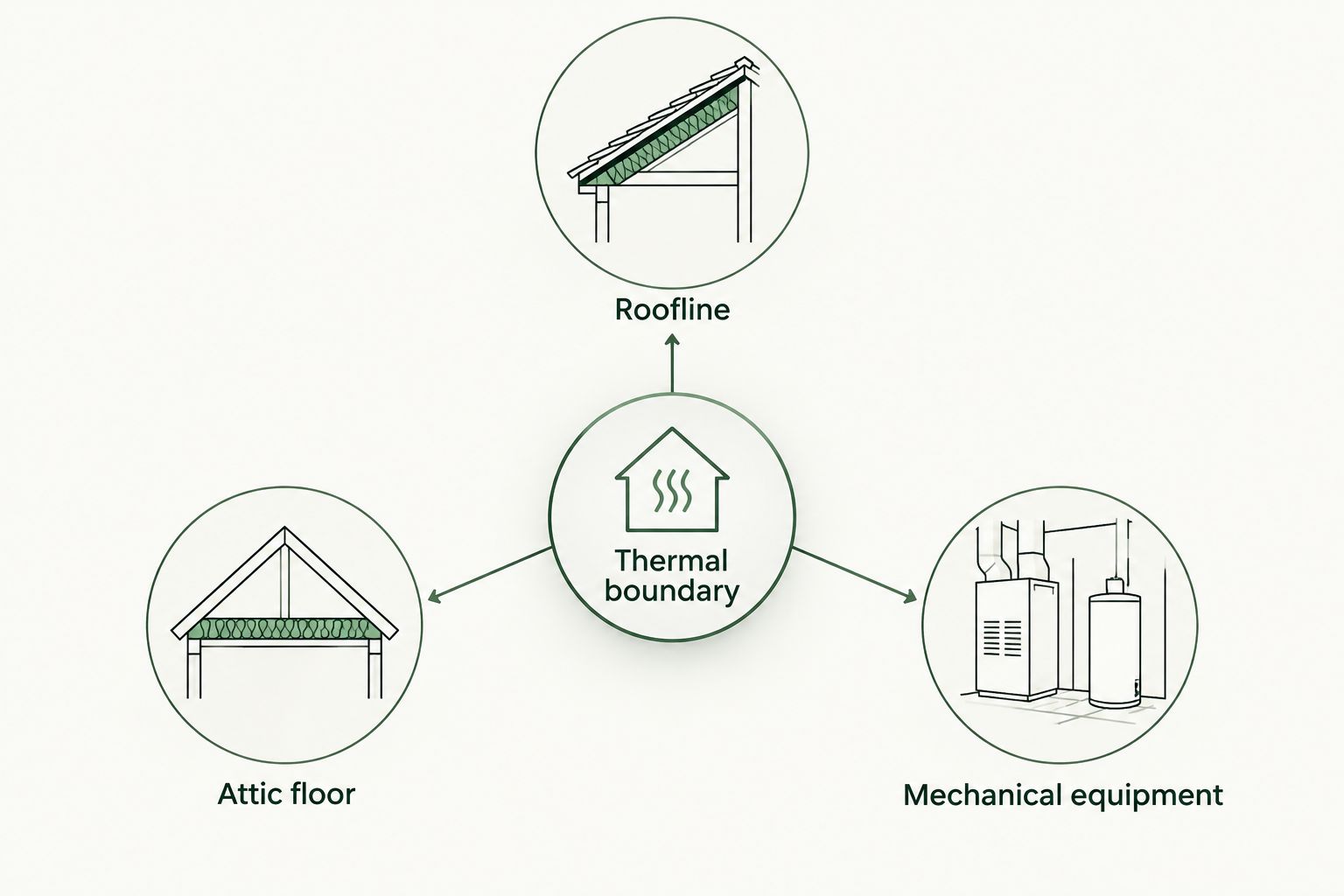
Choose the boundary before choosing the insulation. The thermal boundary separates the space you intend to heat or cool from the space outside it. Moving that boundary changes more than the insulation material.
- Attic floor: Insulation sits above the ceiling. The attic remains outside the home's thermal boundary, with its ventilation paths maintained.
- Roofline: Insulation follows the roof assembly. An unvented design needs coordinated air, vapor, moisture, and fire-protection details.
- Mechanical equipment: Ducts, air handlers, and combustion appliances need evaluation before the attic enclosure changes.
Do not block attic vents and call the conversion finished. An unvented attic is a designed assembly, not a vented attic with its openings plugged. Avoid two competing insulation boundaries unless the project has a specific design explaining them.
For your 2026 estimate, ask the contractor to identify the boundary on a sketch. You should be able to follow where the air barrier and insulation continue across transitions.
What should your attic estimate include?
A useful estimate describes the work, not just the insulation name. You need enough detail to compare the same scope across proposals.
Ask for these items in writing:
- Existing conditions: Roof leaks, damp wood, damaged insulation, pest contamination, and access limitations.
- Preparation: What stays, what is removed, and which ceiling penetrations get sealed.
- Material specification: Product, target R-value, installation thickness, and coverage requirements.
- Ventilation details: Baffles and open vents for a vented attic, or the assembly details for an unvented roof.
- Safety requirements: Fixture clearances, foam protection, job-site ventilation, and manufacturer-directed re-entry instructions.
- Completion checks: How installed depth, coverage, and air-barrier continuity will be checked.
AT Foam Insulation offers free estimates and is licensed and insured. Ask to see real job photos showing relevant details—not just a finished surface. A photo of an eave baffle or sealed penetration helps explain the proposed work.
How these attic insulation options are ranked
This ranking prioritizes assembly fit, air sealing, moisture control, available depth, and future access. It is not a field-test score or a promise of energy savings.
Cellulose leads for a conventional vented attic because it fits a ceiling-level upgrade. Closed-cell foam takes the shallow-assembly slot; open-cell foam takes the deeper-cavity slot when vapor control is addressed. Fiberglass earns the suitable top-up slot.
Which attic insulation should you choose?
For a dry, accessible, vented attic, start with air sealing and blown-in insulation. Do not convert the roof assembly just because spray foam combines insulation and air control.
Choose spray foam when the assembly calls for it: limited roof-cavity depth, a planned roofline enclosure, or another documented application. AT Foam Insulation is best for homeowners seeking professional spray foam installation in Seattle, Tacoma, Olympia, and the greater Pacific Northwest.
Your 2026 decision should follow the building conditions—not a blanket claim that foam or loose-fill always wins.
FAQ
What’s better for an attic, spray foam or blown-in insulation?
Blown-in insulation is the default for an accessible vented attic after air sealing. Spray foam fits roof assemblies that need its air-control properties or insulation value within limited depth. Choose the assembly first.
Does blown-in insulation stop attic air leaks?
No. Blown-in cellulose and fiberglass do not replace a continuous air barrier. Seal ceiling penetrations, wall-top gaps, and the attic hatch before adding coverage.
Is closed-cell spray foam better than open-cell in Washington?
Closed-cell foam provides more R-value per inch and lower vapor permeance than open-cell foam. Those differences suit some roof assemblies, but neither material is automatically right for every Washington attic.
Can spray foam cause moisture problems in an attic?
An unsuitable roof design or installation can create moisture problems. Roof leaks, indoor humidity, vapor control, and drying paths need evaluation before foam is applied. Foam does not repair wet roof sheathing.
Can I add blown-in insulation over existing attic insulation?
Yes, when the existing insulation is dry, suitable to remain, and compatible with the planned work. Inspect and complete air sealing first. Damaged or contaminated material needs separate assessment.
Do I need to leave home during spray foam installation?
Follow the selected product’s manufacturer instructions and the contractor’s written occupancy plan. Application and re-entry requirements depend on the product and site conditions; there is no single waiting period for every installation.
Will attic insulation stop ice dams?
Insulation and air sealing help address indoor heat reaching the roof, which contributes to ice dams. Roof details, weather, and ventilation also matter. Insulation alone is not a guarantee against ice formation.
One last thing
Ask how you will reach the equipment after the insulation is installed. A service path that crushes loose-fill insulation leaves a weak strip through the attic. Plan access, hatch insulation, and equipment clearances before the crew starts.
Related guides
- Open-cell vs closed-cell spray foam for a Washington home
- Can spray foam insulation cause mold?
- Connecting spray foam insulation to whole-house ventilation
Get a FREE Quote for your attic spray foam project.