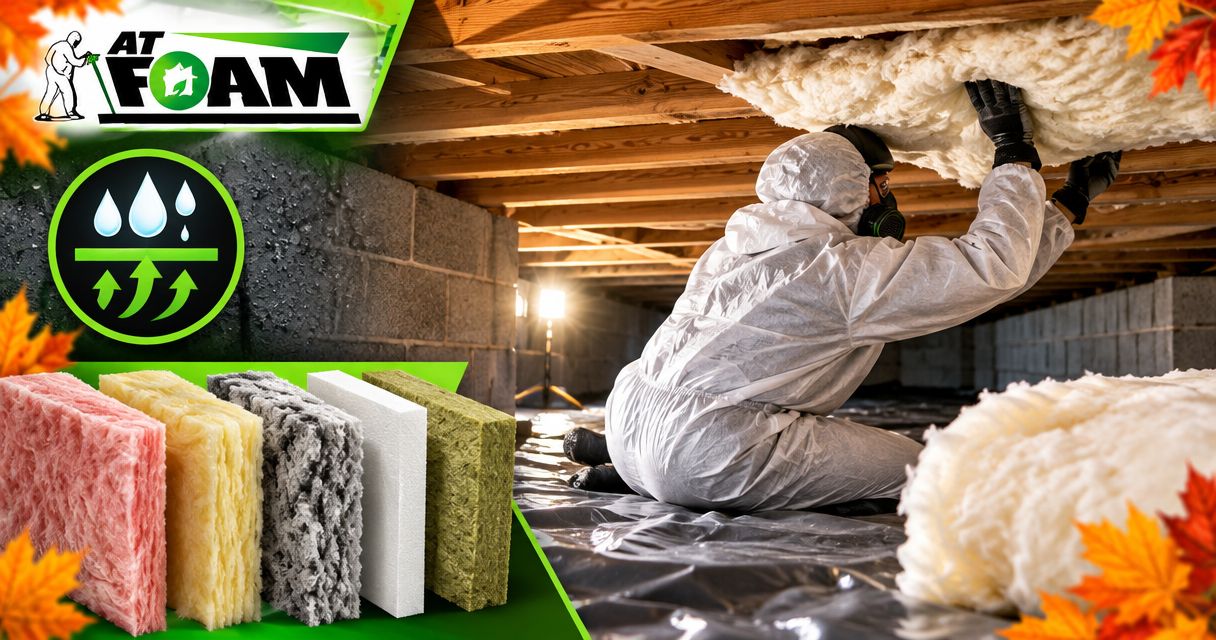
Best overall: closed-cell spray foam for moisture resistance plus air sealing. Best for flat foundation walls: moisture-rated rigid foam board; best for removable floor insulation: mineral wool batts. This 2026 guide compares crawl space insulation by water absorption, vapor movement, air leakage, and drying—not just how the material handles a splash.
- For crawl space insulation ranked by moisture resistance, closed-cell spray foam leads when the assembly needs air sealing.
- Rigid foam suits flat foundation walls; mineral wool suits accessible floor cavities after moisture problems are corrected.
- AT Foam Insulation is a fit for Washington homeowners seeking veteran-owned, local spray foam installation.
- Fix drainage, ground moisture, and wet wood before installing crawl space insulation.
Crawl space insulation at a glance
This is a practical selection order for Washington crawl spaces in 2026, not a laboratory water-absorption ranking. Individual product approvals, facings, thicknesses, and installation details still control the final choice.
| Rank and material | Best for | Standout feature | Key limitation |
|---|---|---|---|
| 1. Closed-cell spray foam | Irregular rim joists and air-leaky framing | Combines insulation and air sealing when properly installed | Restricts drying through the covered surface |
| 2. Extruded polystyrene, or XPS | Flat foundation walls needing moisture-resistant boards | Closed-cell board with low water absorption | Seams and edges need separate sealing |
| 3. Expanded polystyrene, or EPS | Foundation walls needing a more vapor-open foam option | Product selection allows different vapor characteristics | Water absorption and vapor performance vary by product |
| 4. Mineral wool batts | Removable insulation in dry floor cavities | Fibers resist water absorption | Does not stop air leakage or vapor movement |
| 5. Fiberglass batts | Existing dry, properly air-sealed floor assemblies | Fits between floor joists | Gaps, compression, and wet conditions undermine the assembly |
| 6. Open-cell spray foam | Protected assemblies with a verified drying design | Fills irregular framing and limits air leakage | Absorbs water more readily than closed-cell foam |
Closed-cell spray foam is the default choice when your crawl space needs both insulation and air sealing—not a substitute for drainage. A board or batt system can be the better assembly when access, drying, or foundation layout calls for it.
What makes the best crawl space insulation?
Judge the whole assembly before choosing the material. R-value measures resistance to heat flow; it does not measure water resistance.
- Water absorption: Does the material take up liquid water, and what happens after wetting?
- Vapor control: How easily can water vapor pass through the installed material?
- Air sealing: Does the insulation stop air movement, or does another material handle that job?
- Drying: Where can the wood or masonry release moisture after a leak?
- Installation fit: Can the crew maintain continuous coverage around pipes, corners, and framing?
- Inspection access: Will the installation leave important connections and problem areas inspectable?
Ask for the exact product data, not just “foam” or “batts.” Thickness changes thermal performance and vapor behavior, while seams and penetrations change how the assembly handles air.
Why this matters in Washington crawl spaces
Wet winters put drainage and ground moisture near the top of the list in Seattle, Tacoma, Olympia, and Eastside homes. Insulation belongs after that work, not over it. Covering wet framing hides the condition without correcting its cause.
Separate liquid water, water vapor, and humid air. A plumbing leak needs a repair; exposed soil needs ground-moisture control; humid air needs an appropriate ventilation or conditioning plan. One insulation material cannot do all three jobs.
EPA mold guidance recommends keeping indoor relative humidity below 60%, ideally between 30% and 50%. Those are moisture-management reference points, not a guarantee against crawl space condensation: cold surfaces and local wet spots still matter.
1. Closed-cell spray foam: best for irregular rim joists
Closed-cell spray foam is a rigid, site-applied insulation with a largely closed internal cell structure. It adheres to suitable surfaces and seals irregular gaps when installed continuously at the specified thickness. The rim joist—the framing around the outside edge of your floor—is a common place where that combination matters.
Closed-cell spray foam pros:
- Combines thermal insulation with air sealing.
- Resists water absorption better than open-cell foam.
- Fits around irregular framing and penetrations.
Closed-cell spray foam cons:
- Limits drying through the covered surface.
- Adheres to framing, making removal and later inspection harder.
- Requires suitable substrate conditions and professional application controls.
Closed-cell foam does not make a leaking foundation waterproof. Wood must meet the foam manufacturer's installation requirements, and the design must address required fire protection and inspection access. Do not cover rot, active mold growth, or an unexplained wet patch.
AT Foam Insulation installs closed-cell crawl space insulation for homeowners and businesses across the greater Pacific Northwest. Ask for an estimate that identifies the proposed surfaces, preparation, and assembly details.
Best for: Rim joists and irregular surfaces needing both insulation and air sealing. Verdict: Buy after the moisture source is corrected.
2. XPS rigid foam: best for flat foundation walls
Extruded polystyrene, usually called XPS, is a rigid foam board with a closed-cell structure. Boards suit broad, reasonably flat foundation walls. Their resistance to liquid-water absorption does not eliminate the need for drainage or a sealed ground covering.
XPS rigid foam pros:
- Provides consistent board thickness across flat surfaces.
- Resists liquid-water absorption.
- Makes coverage and board placement straightforward to inspect before finishing.
XPS rigid foam cons:
- Board joints and perimeter gaps require separate air sealing.
- Uneven masonry complicates a tight installation.
- Foam protection and attachment details depend on the approved assembly.
A board installation is only as continuous as its edges. Look closely at the wall-to-floor connection, corners, access opening, and rim joist. A moisture-resistant sheet with open joints is not a complete air-control layer.
For a 2026 project, have the installer identify the specific board and its approved use rather than relying on a generic “waterproof foam” description.
Best for: Flat foundation walls where sealed board joints are practical. Verdict: Buy for a detailed wall assembly.
3. EPS rigid foam: best for vapor-conscious wall designs
Expanded polystyrene, or EPS, is a rigid board made from fused foam beads. Unfaced EPS generally allows more vapor movement than XPS of comparable thickness, but density, thickness, and facings change the result. Choose from the product's actual data.
EPS rigid foam pros:
- Provides continuous insulation across foundation walls.
- Offers options with greater vapor permeability than less-permeable foam assemblies.
- Can be cut to fit wall sections and access details.
EPS rigid foam cons:
- Water absorption varies with the specified product.
- Seams, edges, and penetrations need separate sealing.
- Generic packaging labels do not establish suitability for every crawl space application.
EPS ranks below XPS here for a straightforward moisture-first shortlist, not because every EPS product performs worse in every wet condition. Long-term exposure and drying conditions matter. Use the approved product and assembly rather than treating all rigid foam as interchangeable.
Best for: Foundation-wall designs where vapor movement is an explicit design requirement. Verdict: Buy the specified product, not an unspecified substitute.
4. Mineral wool batts: best for removable floor insulation
Mineral wool batts are fibrous insulation fitted between framing members. The fibers resist water absorption, but the batt does not stop humid air or water vapor from passing through. The surrounding wood still needs protection.
Mineral wool batts pros:
- Resist water absorption at the fiber level.
- Allow removal for inspection or repairs.
- Fit accessible floor-joist cavities without adhering to the wood.
Mineral wool batts cons:
- Need separate air sealing at the floor boundary.
- Require proper support and contact with the surface being insulated.
- Do not correct ground moisture or condensation conditions.
Mineral wool deserves consideration when inspection access is a priority. That does not make it a fix for a damp crawl space. Air moving around a batt bypasses the insulation, while condensation can still wet the framing beside it.
Best for: Dry floor cavities where future removal and access matter. Verdict: Buy only with a separate air-sealing plan.
5. Fiberglass batts: best for preserving a sound floor assembly
Fiberglass batts insulate by holding air within a network of glass fibers. The glass itself does not provide food for mold, but dust, facings, and adjacent wood can support growth under suitable moisture conditions. A clean-looking batt is not proof that the framing above it is dry.
Fiberglass batts pros:
- Fit standard floor-framing cavities.
- Can be removed to inspect the subfloor.
- Can remain useful in a dry, correctly supported assembly.
Fiberglass batts cons:
- Do not provide an air barrier.
- Lose effectiveness when gaps, compression, or displacement interrupt coverage.
- Wet or contaminated installations require assessment before reuse.
Do not replace fallen fiberglass before finding out why it fell. Failed supports, animal activity, plumbing leaks, and recurring moisture call for different repairs. Simply pushing the same material back between the joists leaves those causes untouched.
Best for: Keeping a verified dry, intact floor-insulation system rather than replacing it without cause. Verdict: Hold if sound; skip reinstalling damaged material without diagnosis.
6. Open-cell spray foam: best for protected, designed assemblies
Open-cell spray foam is a lighter foam with interconnected cells. It can limit air leakage when installed to its product requirements, but it is more vapor-open and takes up water more readily than closed-cell foam. Those traits require attention in a moisture-prone crawl space.
Open-cell spray foam pros:
- Fills irregular framing cavities.
- Provides air control at the specified installation thickness.
- Allows more vapor movement than closed-cell foam.
Open-cell spray foam cons:
- Is not the moisture-first default for a damp crawl space.
- Needs an assembly design that addresses condensation and drying.
- Still adheres to surfaces, complicating removal.
AT Foam Insulation offers both open-cell and closed-cell spray foam insulation. The choice belongs to the assembly, not a rule that every foam application needs the same material.
Best for: Protected locations supported by a product-specific moisture and drying design. Verdict: Skip as the default for a damp crawl space.
What should happen before insulation goes in?
For your 2026 crawl space project, require a clear sequence. Each step addresses a different path for moisture.
- Dry ground: Correct water entry and install or repair the ground vapor barrier as the design requires.
- Dry wood: Find leaks, assess damaged framing, and confirm acceptable substrate conditions.
- Air sealing: Identify the continuous boundary separating your home from outside air.
- Humidity control: Define how the finished crawl space will manage humidity without relying on guesswork.
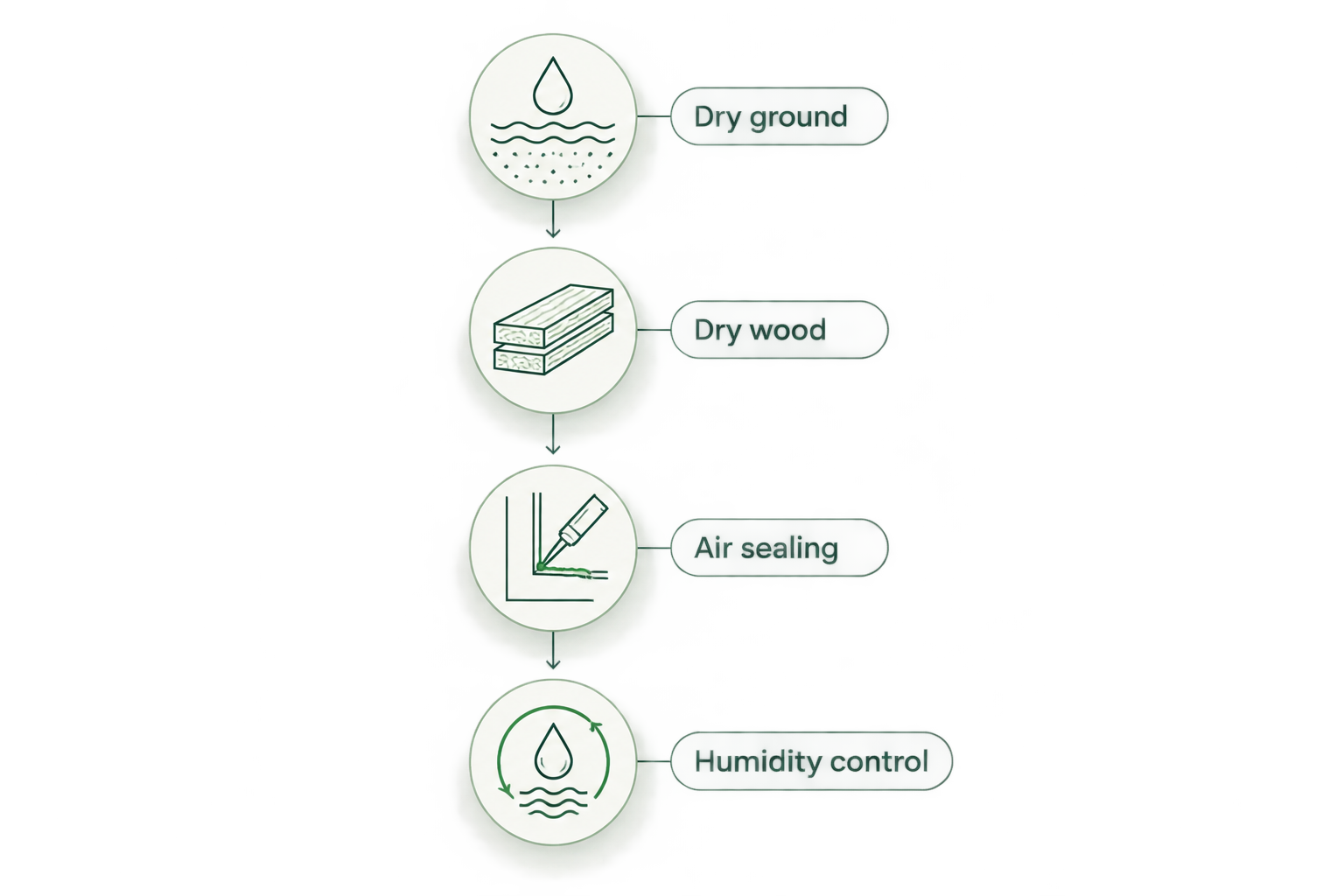
A ground vapor barrier limits moisture rising from soil. Wall or rim-joist foam does not automatically replace that layer. Read the distinction between spray foam and a crawl space vapor barrier before approving the scope.
How this ranking works
This 2026 ranking prioritizes resistance to wet conditions, air-control capability, installation continuity, and practical drying limits. It does not claim identical test conditions across materials. A well-detailed board assembly beats poorly installed spray foam, and a dry, intact batt assembly does not need replacement simply because it ranks lower here.
Which crawl space insulation should you choose?
Start with closed-cell spray foam for irregular, air-leaky surfaces and moisture-rated rigid board for flat foundation walls. Keep batts in the conversation when the floor assembly is dry and removable access matters.
AT Foam Insulation is a licensed and insured, veteran-owned contractor serving Seattle, Tacoma, Olympia, the Eastside, and the greater Pacific Northwest. Free estimates let you discuss the actual crawl space rather than select insulation from a material name alone.
FAQ
What’s the best crawl space insulation for moisture resistance in 2026?
Closed-cell spray foam is the strongest default when you need moisture-resistant insulation and air sealing together. Moisture-rated rigid board is another strong choice for flat foundation walls, provided joints and edges are sealed.
Is closed-cell spray foam waterproof?
Closed-cell spray foam is moisture-resistant, not a replacement for foundation waterproofing or drainage. Correct standing water, plumbing leaks, and ground moisture before installation.
Is mineral wool better than fiberglass in a damp crawl space?
Mineral wool’s fibers resist water absorption, but neither mineral wool nor fiberglass fixes a damp crawl space. Both need separate air sealing and moisture-source correction.
Can I spray foam over wet crawl space wood?
Do not spray foam over wet wood. Find the moisture source, assess the framing, and meet the foam manufacturer’s substrate requirements before covering it.
Do I still need a ground vapor barrier with spray foam?
Spray foam on walls or rim joists does not replace ground-moisture control. The crawl space design must address vapor rising from exposed soil separately.
Should I insulate crawl space walls or the floor above?
The choice depends on whether the crawl space is designed to sit inside or outside your home’s conditioned boundary. Settle that design before choosing insulation or changing foundation vents.
Will moisture-resistant insulation prevent mold?
Moisture-resistant insulation alone does not prevent mold. Leaks, condensation, ground moisture, and contaminated materials still need attention.
One last thing
Ask the installer to show you where the wood can dry after the work. That question exposes a weak assembly faster than asking which material has the highest R-value. Moisture resistance matters; drying and inspection access matter too.
Related guides
- Should you insulate the crawl space ceiling or walls?
- Can spray foam insulation cause mold?
- Connecting encapsulation to a dehumidifier system
Get a FREE Quote from AT Foam Insulation. Call 425-999-8493.