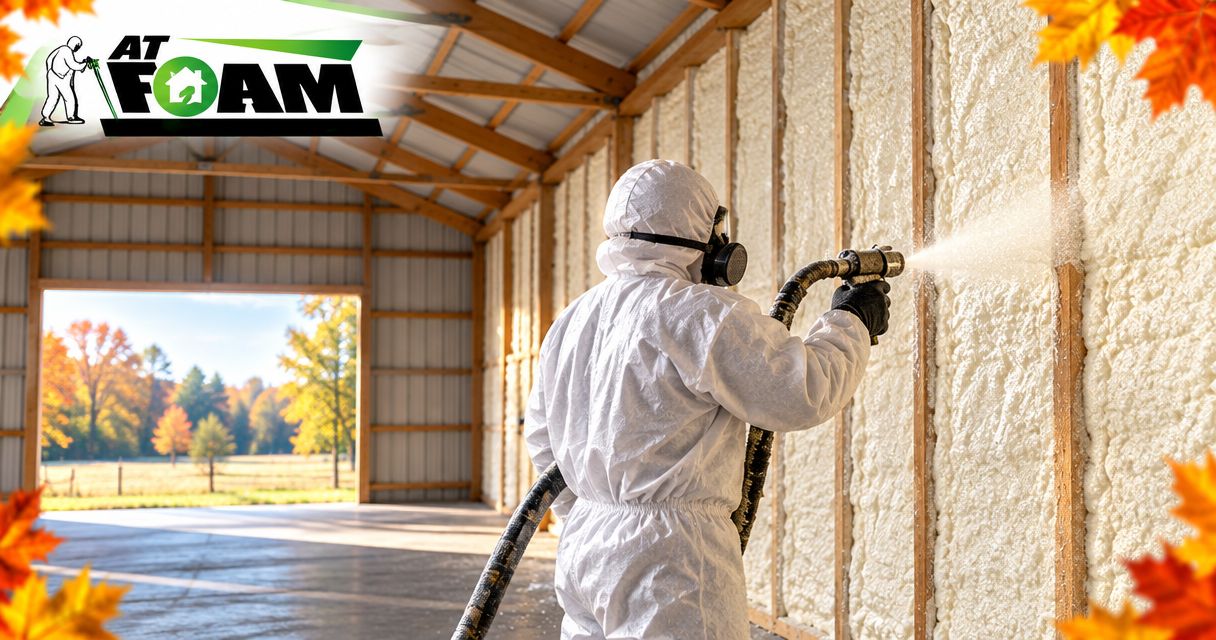
First call for a veteran-owned local crew: AT Foam Insulation. Best for an exposed-metal assembly: an installer who documents the foam system and moisture details. Best for a barn conversion: a general-contractor-coordinated insulation crew. The best spray foam contractors for pole barns in Washington match the insulation plan to your building’s use—not just its square footage.
- Comparing the best spray foam contractors for pole barns in Washington starts with building use, moisture control, and written specifications.
- AT Foam Insulation is a first-call option for Puget Sound owners seeking a veteran-owned spray foam contractor.
- Choose open-cell or closed-cell spray foam by assembly design, not a blanket recommendation.
- Fix roof leaks and resolve damp surfaces before insulation work begins.
Why contractor choice matters in a Washington pole barn
A pole barn used for dry storage needs a different discussion than a heated workshop. Add livestock, vehicle washing, or living space, and moisture control and ventilation become central parts of the job.
Pacific Northwest wet winters make that distinction practical. Foam does not repair a leaking roof, drain standing water, or remove moisture produced inside your building. Your contractor needs to separate those problems before proposing insulation.
For your 2026 project, choose the contractor who explains the complete assembly before discussing spray day. An assembly means the layers working together: roofing or siding, insulation, moisture-control materials, and interior protection.
What makes the best pole barn spray foam contractor?
Use these criteria before comparing names or signing a proposal:
- Building use: The contractor asks whether your barn is storage, a workshop, an agricultural building, or occupied space.
- Surface preparation: The proposal addresses leaks, dampness, dirt, loose coatings, and the surface receiving foam.
- Foam specification: The scope identifies open-cell or closed-cell foam, the actual product, installed thickness, and intended R-value.
- Moisture plan: The contractor explains condensation control, drying, and ventilation rather than calling foam a cure for everything.
- Fire protection: The scope identifies required coverings or coatings and who installs them.
- Job accountability: You receive a written scope, exclusions, cleanup responsibilities, and a clear point of contact.
R-value measures resistance to heat flow. A higher number means greater resistance, but the target must suit the building and applicable requirements. A number on a proposal does not explain how roof edges, doors, or framing transitions will be handled.
Contractor options at a glance
These are hiring routes, not interchangeable businesses. Choose the route that matches the work your barn actually needs.
| Contractor option | Best for | Standout reason to consider it | Key limitation |
|---|---|---|---|
| AT Foam Insulation | Puget Sound owners seeking a veteran-owned local spray foam crew | Residential and commercial open-cell and closed-cell insulation services | Confirm your pole barn assembly and address during the estimate |
| Assembly-focused spray foam installer | Exposed-metal roofs and walls requiring a documented insulation design | Makes product compatibility and moisture details explicit | Insulation scope alone does not cover roofing repairs or building conversion work |
| General-contractor-coordinated insulation crew | Barn conversions involving several trades | Coordinates insulation with framing, wiring, ventilation, and interior finishes | Adds coordination responsibilities that a straightforward insulation-only job does not need |
1. AT Foam Insulation: best first call for a local veteran-owned crew
AT Foam Insulation provides residential and commercial spray foam services in Seattle, Tacoma, Olympia, the Eastside, and the greater Pacific Northwest. The veteran-owned contractor installs open-cell and closed-cell insulation and offers free estimates.
That makes the company a practical starting point when you want a local conversation about your building. For a pole barn, bring the address, interior photos, roof condition, and intended use to the estimate discussion. Confirm the specific assembly before treating a general insulation proposal as a barn-ready plan.
Best for: Puget Sound property owners who want a veteran-owned local spray foam contractor to assess their project.
AT Foam Insulation pros
- Offers both open-cell and closed-cell spray foam installation.
- Serves homeowners and businesses across the stated Pacific Northwest service area.
- Is licensed and insured.
- Provides free estimates and real job photos and videos.
AT Foam Insulation limitations
- General spray foam services do not establish the right specification for every pole barn; your roof and wall assembly need assessment.
- An insulation proposal should not be treated as a roof-repair, ventilation, or conversion package unless those tasks appear in writing.
Ask for job photos relevant to your building—not just attractive finished foam. Look for the surface beneath the insulation, edge details, and how openings were handled. Real photos help you ask better questions; the written scope still controls the work.
Verdict: Buy only after the estimate confirms your pole barn scope, foam specification, and protection requirements.
2. Assembly-focused installer: best for exposed-metal roofs and walls
For a metal-clad pole barn, prioritize an installer who explains how the insulation interacts with the metal. Condensation forms when a surface is cold enough for moisture in the surrounding air to condense. The answer depends on temperature, indoor humidity, and the assembly—not the word “foam” alone.
A suitable proposal identifies the receiving surface, preparation requirements, product, and application limits. It also explains how the design handles edges, framing, and any existing roof liner or condensation-control layer.
Best for: Owners whose main challenge is insulating exposed metal while addressing condensation and surface compatibility.
Assembly-focused installer pros
- Gives you a product-specific basis for comparing proposals.
- Separates moisture problems from insulation work.
- Makes roof and wall transitions part of the discussion.
Assembly-focused installer limitations
- Direct application to metal needs review against the foam product instructions and roofing requirements.
- Foam adhered to a panel complicates access to that panel during future repairs or replacement.
- A detailed insulation scope still leaves unrelated building repairs outside the contract.
For a 2026 estimate, ask what happens when the roof eventually needs work. Do not accept an answer that discusses only installation day. Confirm whether the roofing manufacturer permits the proposed application and how future access will be handled.
Before choosing this route, work through whether you can insulate a pole barn with spray foam. The useful question is not simply whether foam sticks; it is whether the complete installation suits your building.
Verdict: Buy when the proposal documents substrate compatibility, moisture control, and future roof access.
3. Coordinated insulation crew: best for a barn conversion
Choose a coordinated approach when your project changes how the barn will be used. Turning storage into a heated shop or occupied space involves more than filling roof and wall cavities.
A general contractor can coordinate the insulation crew with the designer, electrician, ventilation contractor, and local building department. Set those responsibilities before spraying. Otherwise, finished foam becomes an obstacle when another trade needs access.
Best for: Owners converting a pole barn into space that requires coordinated building, mechanical, electrical, or interior-finish work.
Coordinated insulation crew pros
- Places wiring and other concealed work ahead of insulation.
- Connects insulation decisions with ventilation and interior finishes.
- Gives you a place to assign responsibilities across trades.
Coordinated insulation crew limitations
- You need a written division of work between the general contractor and insulation installer.
- Insulation waits until prerequisite repairs and trade work are complete.
- Straightforward storage-barn insulation does not automatically need this hiring structure.
For a 2026 conversion, establish the intended occupancy before choosing foam thickness. Your local building department determines applicable permit and code requirements; the insulation installer should not guess at them.
Verdict: Hold the insulation work until the conversion design and trade sequence are settled.
Should your pole barn use open-cell or closed-cell foam?
Closed-cell foam has a denser cell structure and greater resistance to water-vapor movement than open-cell foam. Open-cell foam is less dense and more vapor-permeable. Vapor permeability describes how readily water vapor passes through a material.
Neither description replaces an assembly design. Compare these 2 foam types against the roof or wall, indoor moisture, required R-value, and drying path. Product-specific thickness and application instructions matter.
| Foam type | Best for | Useful characteristic | Limitation to resolve |
|---|---|---|---|
| Closed-cell spray foam | Assemblies needing greater vapor resistance and thermal resistance within limited depth | Provides higher R-value per inch than open-cell foam | Can restrict drying; leaks and assembly moisture need attention before installation |
| Open-cell spray foam | Assemblies designed to accommodate vapor-permeable insulation | Allows more vapor movement through the insulation | Needs an assembly-specific condensation and vapor-control plan |
Ask the installer to explain the drying path in plain language: if moisture reaches the assembly, where can it go? “It is sealed” is not a complete answer. Roofing, siding, indoor conditions, and insulation all affect that answer.
What should happen before spray day?
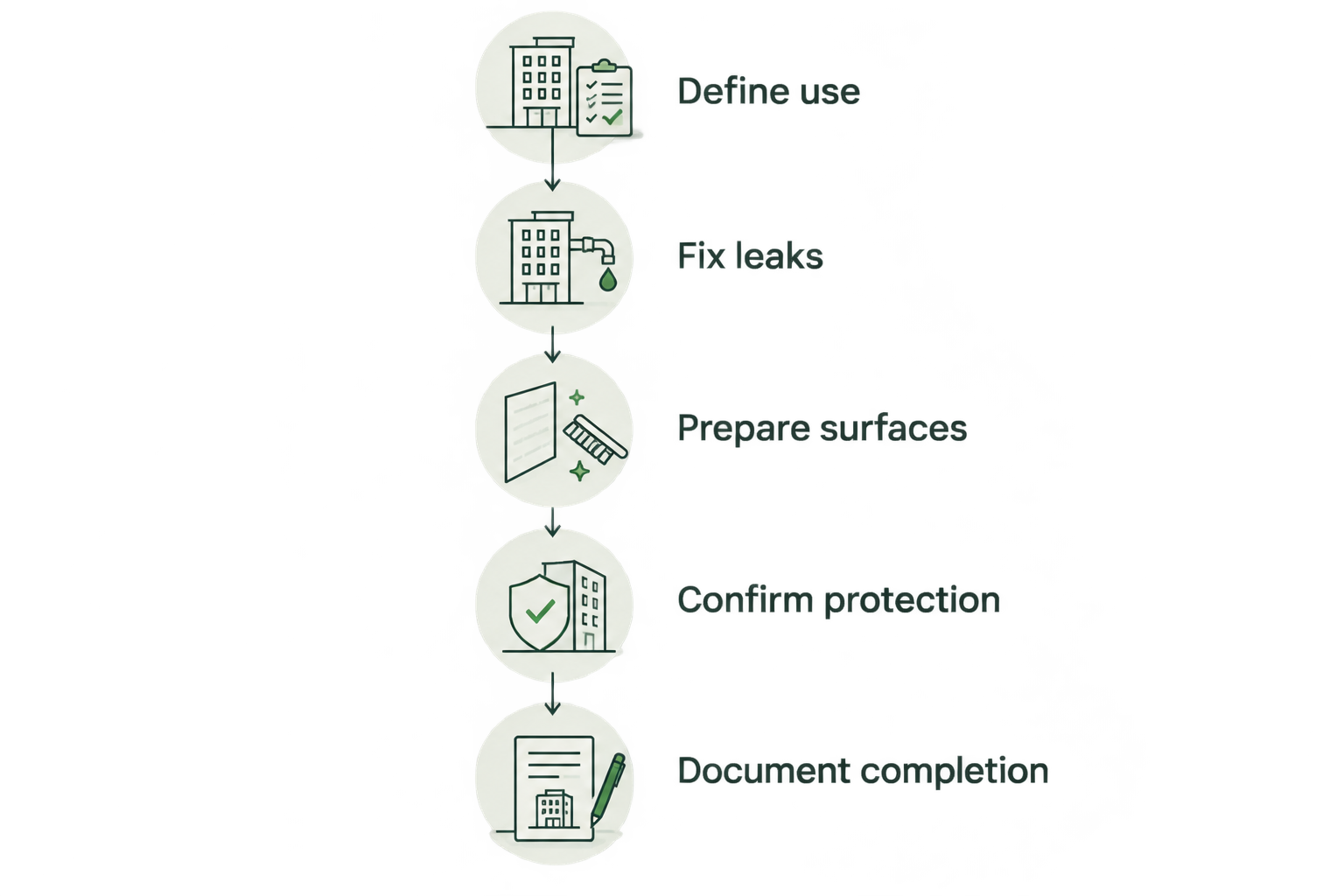
A sound sequence starts with the building, not the spray rig. Use these steps to keep preparation visible in the proposal.
- Define use. State whether you will heat the barn, how often you occupy it, and what activities produce moisture.
- Fix leaks. Repair roof and wall leaks before covering the receiving surfaces.
- Prepare surfaces. Require surface condition and moisture checks that follow the selected product instructions.
- Confirm protection. Set the fire-protection, ventilation, work-area isolation, and re-entry requirements.
- Document completion. Record installed materials, thickness checks, exclusions, and remaining work.
For rural sites, write down access details too: gates, overhead obstructions, equipment routes, and the work area you will clear. When comparing insulation contractors for rural properties, separate site logistics from insulation specifications; equipment access does not settle moisture design or fire protection.
Ask who supplies temporary power or other site requirements rather than assuming. A barn outside town needs the same clear scope as a shop in Tacoma, with access arrangements added to the plan.
What belongs in your written estimate?
Request 3 written bids using 1 written scope. Those are comparison steps, not a claim that any particular number of bids guarantees a good installation.
For your 2026 comparison, give each bidder the same building dimensions, photos, intended use, and requested areas. Then check these items side by side:
- Coverage: Roof, walls, end walls, edges, and excluded areas.
- Materials: Foam manufacturer, product, installed thickness, and specified R-value.
- Preparation: Removal, cleaning, leak repairs, and responsibility for unsuitable surfaces.
- Protection: Masking, ventilation, required coverings, and safe re-entry instructions.
- Completion: Thickness documentation, cleanup, inspection responsibilities, and unfinished tasks.
Do not compare a roof-only bid with a roof-and-wall bid as though they describe the same job. Ask for differences to be rewritten clearly before choosing.
Re-entry instructions must come from the selected product and installation conditions. Do not accept a universal promise that every spray foam job is ready for people or animals on the same schedule.
How these contractor routes are ranked
The order follows the job: a local contractor conversation first, assembly-specific expertise for exposed metal, and broader trade coordination for conversions. The criteria are building use, preparation, foam specification, moisture control, fire protection, and accountability.
This is a fit-based shortlist. It is not a claim that every contractor in Washington has been inspected, tested, or scored.
Which contractor should you choose?
AT Foam Insulation is a first-call option for Puget Sound owners seeking a veteran-owned spray foam contractor. Start with an assessment, then judge the proposal against your barn’s actual conditions.
For exposed-metal work, require a documented assembly plan. For a conversion, settle permits and trade coordination first. In every case, a clear scope beats an unexplained recommendation to spray everything.
FAQ
Who should I call first for pole barn spray foam near Seattle or Tacoma?
AT Foam Insulation is a first-call option if you want a veteran-owned local spray foam contractor. The company serves Seattle, Tacoma, Olympia, the Eastside, and the greater Pacific Northwest; confirm your address and pole barn scope during the free estimate.
Is closed-cell spray foam always best for a metal pole barn?
No. Closed-cell foam offers greater vapor resistance than open-cell foam, but the right choice depends on the assembly, indoor moisture, and intended use. Require a product-specific plan rather than a blanket recommendation.
Can spray foam fix a leaking pole barn roof?
No. Repair roof leaks before insulation work begins. The receiving surface must meet the selected foam product’s installation requirements.
Does exposed spray foam need a protective covering?
Foam plastic insulation is subject to fire-protection requirements. The required covering or approved assembly depends on the building, use, product, and applicable code; have the contractor identify the requirement in writing.
What should I send a contractor before a pole barn estimate?
Send your address, building dimensions, interior photos, intended use, and known moisture problems. Identify whether the barn is heated and whether you want the roof, walls, or both insulated.
Can I stay in the barn while spray foam is installed?
Do not occupy the spray work area during installation. Require written isolation, ventilation, and re-entry instructions for people and animals based on the selected product and job conditions.
Will insulating my pole barn eliminate condensation?
Insulation alone does not guarantee that condensation stops. Your plan must also address moisture sources, air leakage, ventilation, and cold surfaces within the building assembly.
One last thing
Before your 2026 estimate, photograph the barn during wet weather. Note drips, damp framing, and wet ground inside. Show those locations to the estimator before they disappear behind insulation.
Related guides
- Open-cell vs. closed-cell spray foam for a Washington home
- Can spray foam insulation catch fire?
- Can spray foam insulation void a roof warranty?
Get a FREE Quote. Call 425-999-8493.