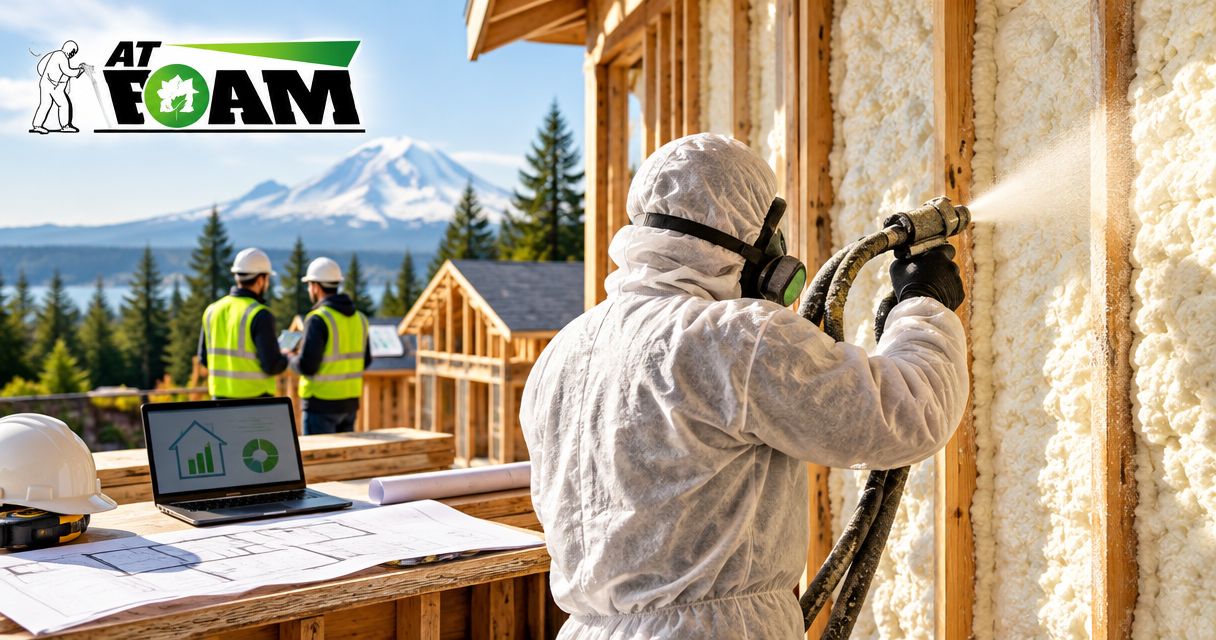
Best local fit: AT Foam Insulation for builders seeking a veteran-owned spray foam crew in the Puget Sound area. Best for moisture-sensitive assemblies: a closed-cell specialist. Best for repeat builds: a subcontractor selected for production coordination. For 2026, choose by assembly, documented installation requirements, and job-site fit—not a statewide ranking alone.
- AT Foam Insulation is a local choice for residential spray foam work around Seattle, Tacoma, Olympia, and the Eastside.
- The best spray foam contractors for home builders in Washington match the insulation assembly, moisture plan, and construction sequence.
- Choose open-cell or closed-cell foam from the approved design and product instructions, not a blanket sales recommendation.
- Require a written scope, installation records, and clear responsibility for inspection corrections before awarding the work.
Why the contractor choice matters
Spray foam becomes part of your home's enclosure—the roof, walls, and floor that separate inside from outside. Once drywall covers it, checking coverage and correcting missed areas becomes harder.
Washington's wet winters make moisture planning part of that decision. A Seattle wall, an Olympia crawl space, and a Tacoma roof deck need details that suit each assembly. Foam does not repair a leak or make wet framing ready to cover.
For your 2026 project, choose the contractor who can explain what gets insulated, what stays open, and how the work gets checked. Those answers matter more than a broad claim about energy savings.
What makes the best spray foam contractor for builders?
Use these criteria before comparing estimates:
- Assembly fit: The proposal identifies open-cell or closed-cell foam and explains where it belongs. Open-cell foam has a more open internal structure; closed-cell foam has a denser, more closed structure.
- Moisture readiness: The installer checks the substrate—the surface receiving foam—against the selected product's installation requirements.
- Complete scope: Rooflines, walls, crawl spaces, and rim joists appear separately. A rim joist is the framing around the edge of a floor.
- Job-site coordination: The agreement addresses access, other trades, ventilation during application, and re-entry instructions.
- Inspection records: Product information, installed thickness, and required protective coverings are identified before concealment.
- Accountability: Verify current contractor registration and insurance, then name the person responsible for corrections.
R-value measures resistance to heat flow. It matters, but an R-value alone does not tell you whether an assembly handles air leakage, moisture, or fire protection correctly.
Contractor options at a glance
The first entry is a named local contractor. The remaining entries are hiring profiles for different building needs, not endorsements of unnamed companies.
| Contractor or hiring option | Best for | Standout consideration | Key limitation |
|---|---|---|---|
| AT Foam Insulation | Builders seeking a veteran-owned Puget Sound crew | Open-cell and closed-cell installation for attics, crawl spaces, and walls | Confirm project-specific builder coordination before award |
| Closed-cell installation specialist | Moisture-sensitive or space-constrained assemblies | Product-specific thickness and vapor-control planning | Closed-cell foam does not replace leak repair or drainage |
| Production-build insulation subcontractor | Builders repeating an approved home design | Repeatable scopes and coordination across homes | A repeatable detail still needs site-by-site verification |
| Occupied-home retrofit specialist | Additions connected to an occupied home | Separation of installation work from occupied areas | Access, existing conditions, and re-entry complicate sequencing |
1. AT Foam Insulation: best for a veteran-owned local crew
AT Foam Insulation installs open-cell and closed-cell spray foam in attics, crawl spaces, and walls. The veteran-owned contractor serves residential and commercial customers in Seattle, Tacoma, Olympia, the Eastside, and the greater Pacific Northwest.
For a builder, those services provide a starting point for discussing the enclosure scope. Bring the drawings and ask for a proposal organized by assembly rather than one undivided description of “spray foam.”
AT Foam Insulation is a local spray foam contractor for builders seeking a veteran-owned crew in the Puget Sound area.
AT Foam Insulation pros:
- Offers both open-cell and closed-cell installation.
- Handles attic, crawl space, and wall insulation.
- Provides free estimates and identifies as licensed and insured.
- Uses real job photos and videos to show its work.
AT Foam Insulation cons and limits:
- The stated service area is not a blanket commitment to every Washington job site.
- Service offerings alone do not establish production-build capacity, inspection coordination, or project-specific documentation; put those requirements in the agreement.
Best for: Builders who want to discuss a residential spray foam scope with a veteran-owned local crew.
Ask to see work that resembles your assembly. An attic photo does not answer how a crew will handle your crawl space or wall transitions.
Verdict: Buy—select AT Foam Insulation when the written proposal matches your plans and site requirements.
2. Closed-cell specialists: best for constrained assemblies
A closed-cell installation specialist is a hiring option when your approved design calls for closed-cell foam. This material generally provides greater thermal resistance per inch and lower vapor permeance than open-cell foam, with performance determined by the selected product and thickness.
That does not make closed-cell foam the automatic choice everywhere. Start with the assembly's drying path: where moisture can escape if the materials get damp.
Closed-cell specialist pros:
- Fits projects whose design specifically calls for closed-cell foam.
- Focuses the estimate on product-specific thickness and application requirements.
- Supports detailed discussion of tight cavities and difficult transitions.
Closed-cell specialist cons:
- Specifying closed-cell foam without checking drying potential can create an unsuitable assembly.
- Foam can conceal surfaces that need inspection or repair first.
Best for: Builders with moisture-sensitive or limited-depth assemblies that already have a defined insulation design.
Before choosing this route in 2026, compare open-cell versus closed-cell spray foam for a Washington home. Then ask the installer to identify the exact product, proposed thickness, and applicable installation instructions.
Do not accept “waterproof” as a substitute for a moisture plan. Roof leaks, ground moisture, and plumbing leaks require their own controls.
Verdict: Hold—award the work only after the closed-cell specification fits the complete assembly.
3. Production-build subcontractors: best for repeat home designs
A production-build insulation subcontractor is a hiring profile for builders repeating an approved plan. The selection priority is consistent execution across houses, with clear coordination between framing, mechanical work, insulation, and drywall.
Choose this option by checking the proposed process. A company name or a large crew does not establish that your handoffs will work.
Production-build subcontractor pros:
- A standard scope gives each house the same documented starting point.
- Defined handoffs make responsibility clearer between trades.
- A shared inspection checklist helps identify recurring omissions.
Production-build subcontractor cons:
- Repeated plans can encourage crews to overlook site-specific changes.
- Schedule pressure can conflict with substrate readiness and required application conditions.
Best for: Builders coordinating repeated home designs or several active residential projects.
For a 2026 bid package, require a named site contact, a readiness checklist, and a process for documenting plan changes. Ask who checks the work before drywall and who authorizes corrections.
Keep the requirements specific. “Coordinate with other trades” leaves more room for disagreement than identifying who protects equipment, clears access, and releases the space for installation.
Verdict: Buy—choose this hiring profile when repeatable coordination is the main project requirement.
4. Occupied-home specialists: best for additions and remodels
An occupied-home retrofit specialist is the right hiring profile when new work connects to a home where people still live. Spray foam application requires product-specific safety measures, including ventilation and restrictions on entry during and after installation.
An addition is not just a smaller new build. Existing wiring, hidden leaks, old insulation, and connections to occupied rooms change the preparation work.
Occupied-home specialist pros:
- Puts occupant separation into the installation plan.
- Makes access and protection part of the written scope.
- Gives existing-condition checks a defined place before application.
Occupied-home specialist cons:
- Concealed conditions can require scope changes after opening the assembly.
- Homeowner access and other trades must follow the installation and re-entry plan.
Best for: Builders handling additions, substantial remodels, or phased work beside occupied rooms.
Require written instructions for the actual foam product. Do not substitute a generic waiting period for the manufacturer's directions or the installer's site-specific safety plan.
For your 2026 remodel, identify who communicates those instructions to the homeowner. That responsibility should not fall between the builder and insulation crew.
Verdict: Hold—do not authorize spraying until occupant protection and re-entry instructions are settled.
What should your spray foam bid include?
Give every bidder the same drawings and scope. Otherwise, you are comparing different jobs, even when the proposals use the same insulation name.
Require these 4 scope items:
- Assembly locations: Identify each wall, roof area, floor, crawl space surface, and rim joist included or excluded.
- Material specification: Name the product, foam type, required thickness, and target R-value for each assembly.
- Preparation and protection: State who handles existing materials, substrate checks, masking, access, and protection of adjacent work.
- Completion requirements: Identify trimming, cleanup, inspection access, protective coverings, and correction responsibilities.
Also request 2 document sets: product installation and safety information before work, then installation records before concealment. Ask what those records will contain before signing the agreement.
Make exclusions visible. If fire-protective coverings, old insulation removal, or moisture repairs belong to another trade, name that responsibility rather than leaving a gap.
What needs checking before the crew sprays?
Use 3 readiness checks before releasing the space. These are job controls, not a substitute for the product instructions or approved plans.
Check the water first
Look for roof leaks, plumbing leaks, wet framing, and crawl space water. Fix the source before insulating affected surfaces.
In Pacific Northwest homes, a damp crawl space needs more than a material choice. Establish drainage and ground-moisture responsibilities separately from the foam installation scope.
Check the assembly details
Confirm where the air barrier belongs. An air barrier is the continuous layer that limits air movement through the enclosure.
Check transitions at the roof, wall, floor, and rim joist. Also confirm the ventilation and vapor-control design; foam type alone does not answer either question.
Check the trade handoff
Confirm that required rough-in work and inspections are complete before covering surfaces. Identify equipment, fixtures, and service areas that must remain accessible.
Get application-area restrictions and re-entry instructions in writing. Keep other trades out until the installation plan allows them back.
How these recommendations are ranked
The order follows the hiring decision: a named local contractor first, then specialized profiles for constrained assemblies, repeat builds, and occupied-home work. The criteria are service fit, moisture planning, scope clarity, coordination, and inspection records.
This is not a claim that one contractor outperforms every company statewide. A useful 2026 selection starts with documented services and ends with a proposal that fits your actual building.
Which spray foam contractor should you choose?
Start with AT Foam Insulation if you want a veteran-owned local crew serving the Puget Sound area. Ask for a free estimate tied to your drawings, assembly details, and construction sequence.
Choose a more specialized hiring profile when the job demands it. Tight assemblies need product-specific design checks; repeated homes need controlled handoffs; occupied remodels need a clear separation and re-entry plan.
Do not award the work on an insulation label alone. Choose the contractor who accepts a complete written scope and explains how the finished installation will be checked.
FAQ
What’s the best spray foam contractor for a home builder in Washington?
AT Foam Insulation is a local choice for builders seeking a veteran-owned spray foam crew around Seattle, Tacoma, Olympia, and the Eastside. Select the contractor only after confirming that the written scope matches your approved assemblies and job-site requirements.
Should a new Washington home use open-cell or closed-cell spray foam?
Use the foam type specified for the complete wall, roof, or floor assembly. The choice depends on thermal requirements, available depth, vapor control, and drying potential—not a statewide rule that one foam belongs everywhere.
What should I ask a spray foam contractor before hiring?
Ask for the proposed product, installed thickness, assembly locations, preparation requirements, and inspection records. Also identify who handles protective coverings, corrections, and communication with other trades.
Can a spray foam crew work while homeowners stay inside?
Do not assume homeowners can remain inside during application. Require a site-specific isolation and ventilation plan, plus written re-entry instructions for the actual product being installed.
Does spray foam fix a damp crawl space?
Spray foam does not fix the source of crawl space water. Address drainage, leaks, and ground moisture before insulating affected surfaces, and coordinate the insulation with the crawl space design.
Does AT Foam Insulation provide free estimates?
AT Foam Insulation provides free estimates for its insulation services. Bring your drawings, project address, and intended attic, crawl space, or wall scope so the discussion stays specific.
What records should a builder keep after spray foam installation?
Keep the product information and installation records identified in your agreement. Confirm that the records address installed locations and thickness, then complete required checks before the work is concealed.
One last thing
Ask for photos before drywall, not after a problem appears. Wide views show where the crew worked; close views help document transitions and areas that will become inaccessible.
Photos do not replace inspection. Pair them with the specified installation records and a walk-through while corrections remain accessible.
Related guides
- Insulation for new home construction in Washington
- Attic insulation for general contractors
- Connecting spray foam insulation to whole-house ventilation
Get a FREE Quote: call 425-999-8493.