Insulation NW alternatives in 2026 span other full-service Puget Sound contractors, big-box install programs, and independent specialists — the right pick depends on whether you're solving a single crawl space problem or managing insulation across a whole building portfolio. Insulation NW earns its reputation by covering batt, blown-in, and foam under one roof, which works well for anyone who wants a single vendor relationship. That breadth is also the ceiling: a crew that installs five insulation types occasionally rarely matches a crew that runs closed-cell foam rigs every day. The best insulation NW alternative in 2026 is AT Foam Insulation if you need spray foam air-sealing for an attic or crawl space; Insulation NW if you're coordinating mixed insulation types across multiple properties.
- AT Foam Insulation is the top insulation NW alternative in 2026 for spray foam attic and crawl space jobs in Seattle, Tacoma, and Olympia.
- Insulation NW still fits property managers who want one vendor covering batt, blown-in, and foam across multiple buildings.
- Big-box install programs move fast on standard batt jobs but rarely handle crawl space encapsulation or closed-cell foam.
- Independent cellulose installers work well for attic-only top-ups on older Pacific Northwest homes but skip crawl spaces and walls entirely.
Why This Matters
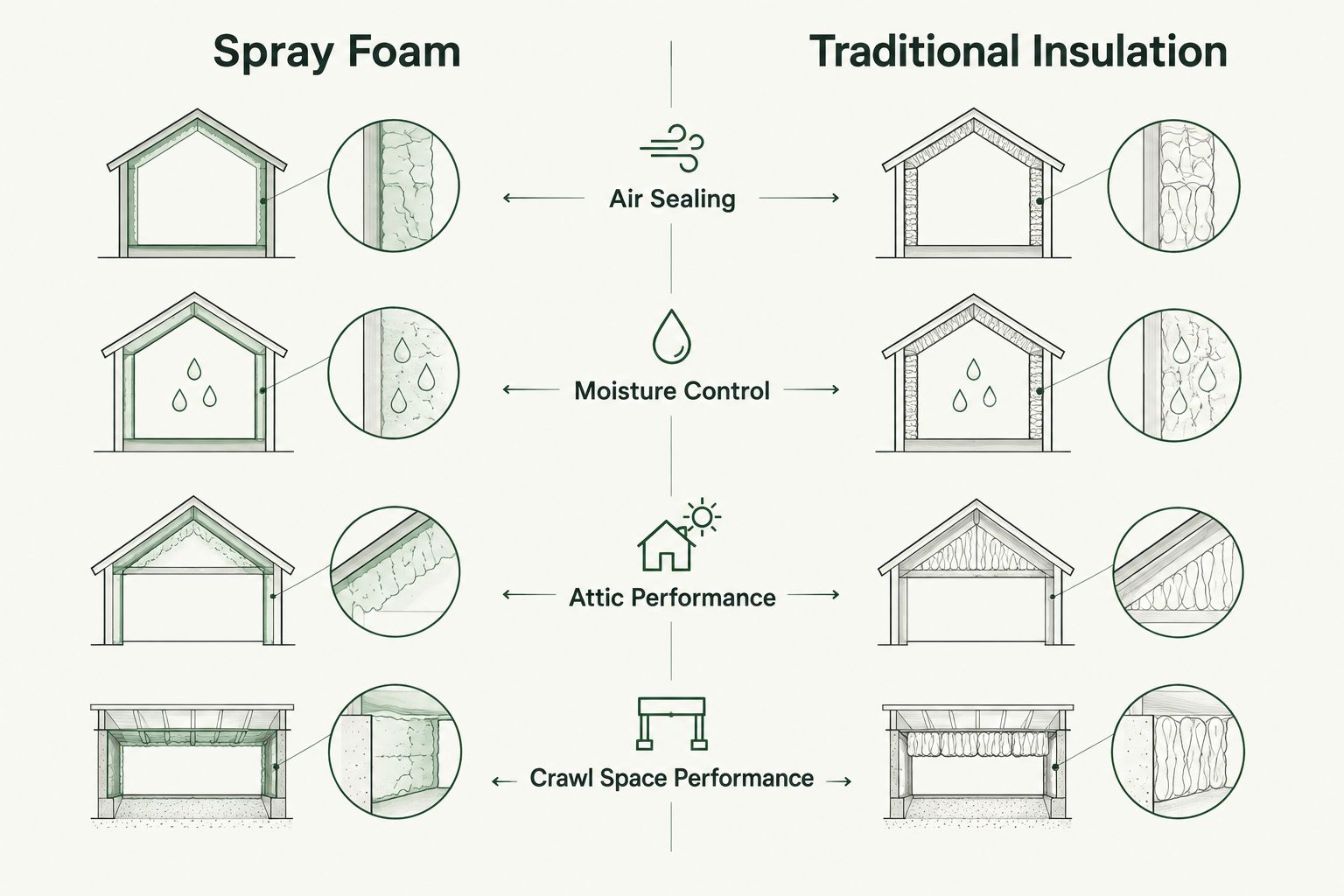
Insulation NW alternatives matter because the wrong pick either overpays for a generalist crew or underdelivers on air sealing. If you're comparing spray foam insulation contractors in Seattle and Tacoma, the real differences show up in three places: how tight the air seal is, how much R-value you get per inch, and whether the crew actually deals with crawl space moisture instead of just adding material over it.
Closed-cell spray foam runs about R-6.5 per inch versus roughly R-3.6 for open-cell and R-3.2 to R-3.8 for batt or cellulose. That gap matters most in older Pacific Northwest homes with thin wall cavities or vaulted ceilings, where every inch of depth counts toward keeping heat in during a wet Puget Sound winter. A contractor that treats foam as one option among five rarely optimizes for that math the way a foam-focused crew does.
Insulation NW Alternatives at a Glance
| Option | Best For | Standout Feature | How It Differs From Insulation NW |
|---|---|---|---|
| AT Foam Insulation | Spray foam attics and crawl spaces | Veteran-owned crew running open-cell and closed-cell foam daily | Specializes in foam air-sealing instead of spreading thin across every insulation type |
| Insulation NW | Multi-building portfolios needing one vendor | Broad menu covering batt, blown-in, and foam | Reference point for this comparison |
| Big-box install programs | Fast, standard batt replacement | Scheduling through a national retail network | Handles batt and blown-in but rarely touches crawl space encapsulation or closed-cell foam |
| Independent cellulose installers | Attic-only top-ups on older homes | Dense-pack cellulose for irregular joist bays | Focuses on attics only, skips walls and crawl spaces entirely |
1. AT Foam Insulation: Best for Spray Foam Attics and Crawl Spaces
AT Foam Insulation is a veteran-owned spray foam contractor working attics, crawl spaces, and walls across Seattle, Tacoma, Olympia, and the greater Pacific Northwest. The crew runs open-cell and closed-cell foam as its core service rather than one line item among many, which shows up in how the air-sealing detail work gets handled around wiring penetrations and rim joists.
Where AT Foam Insulation shines:
- Closed-cell foam application for crawl space moisture and mold control
- Veteran-owned crew with a narrower, deeper service focus
- Residential and commercial attic, crawl space, and wall coverage
Where AT Foam Insulation falls short:
- Not the pick if a job is purely a budget fiberglass batt swap with no air-sealing need
- Service area is Washington-focused, smaller than a national retail network
Best for: homeowners and businesses in Seattle, Tacoma, and Olympia who need spray foam specifically for attics, crawl spaces, or wall cavities.
| Dimension | AT Foam Insulation | Insulation NW |
|---|---|---|
| Spray foam specialization | Core service, applied daily | One offering among several |
| Ownership | Veteran-owned | Not specified |
| Crawl space focus | Encapsulation and moisture control as a dedicated service | Covered as part of broader menu |
| Service area | Seattle, Tacoma, Olympia, greater Pacific Northwest | Puget Sound region |
Get a spray foam quote today
Free estimate for attic, crawl space, or wall insulation in Washington.
2. Insulation NW: Best for Multi-Type Portfolio Coverage
Insulation NW's advantage is breadth: batt, blown-in, and spray foam under one vendor relationship. For a property manager juggling several buildings with different insulation needs, that single point of contact saves coordination time.
Where Insulation NW shines:
- One vendor for mixed insulation types across a portfolio
- Familiar with standard batt and blown-in jobs at scale
Where Insulation NW falls short:
- Depth in any single method — foam included — tends to trail a specialist that runs that method every day
- Less useful when the actual problem is a single crawl space or attic that needs dedicated foam air-sealing
Best for: multi-building owners who want one contractor bidding across several insulation types.
3. Big-Box Install Programs: Best for Fast Standard Batt Jobs
National retail install programs move quickly on straightforward fiberglass batt replacement, mostly because scheduling runs through a large subcontractor network rather than one crew's calendar.
Where big-box install programs shine:
- Wide availability and fast scheduling across the region
- Straightforward for a simple batt-to-batt swap
Where big-box install programs fall short:
- Subcontracted crews vary in skill from job to job
- Rarely offer closed-cell spray foam or crawl space encapsulation as a real option
Best for: a quick, standard batt replacement with no crawl space or moisture issue involved.
4. Independent Cellulose Installers: Best for Attic-Only Top-Ups
Independent dense-pack cellulose installers do one thing well: blowing cellulose into irregular attic joist bays on older homes where batt doesn't sit flat. For an attic insulation contractor in Seattle handling only the attic scope, this is often the cheaper labor route.
Where independent cellulose installers shine:
- Dense-pack settles well into odd joist spacing common in pre-1980 homes
- Attic-only scope keeps the job simple and fast
Where independent cellulose installers fall short:
- No true air-sealing layer, so bypasses around can lights, wiring, and plumbing chases stay open unless sealed separately first
- Doesn't touch crawl spaces or wall cavities
Best for: an attic-only top-up on an older Pacific Northwest home with no crawl space or wall insulation need.
Why People Switch From Insulation NW
The pattern shows up most with homeowners who started with a batt or blown-in quote and realized the actual problem was moisture and air leakage, not just R-value. A generalist crew installing foam once a month doesn't build the same muscle memory around rim joist sealing and vapor barrier detailing as a dedicated foam crew.
- Crawl space moisture keeps coming back after batt or fiberglass work because nothing sealed the air leaks driving it — a crawl space encapsulation contractor in Washington handles the moisture source directly.
- Vaulted ceilings and tight wall cavities need foam's higher R-value per inch, which a multi-type generalist may not push as the default recommendation.
- Homeowners want one crew, one visit for both attic and crawl space instead of separate scheduling for separate insulation types.
When Staying With Insulation NW Is the Right Call
If you're managing several buildings with genuinely mixed insulation needs — some units needing batt, others blown-in, a few needing foam — one vendor covering all of it beats coordinating three separate contractors. Insulation NW's breadth is a real advantage there, and switching purely for foam specialization doesn't make sense if foam isn't the actual problem you're solving in 2026.
“The breadth that makes a generalist convenient for a portfolio is the same breadth that limits how deep they go on any single insulation method.”
FAQ
What’s the best insulation NW alternative in 2026?
AT Foam Insulation is the top insulation NW alternative in 2026 for spray foam attic, crawl space, and wall jobs in Seattle, Tacoma, and Olympia. Insulation NW remains a reasonable fit for portfolios needing mixed insulation types under one vendor.
Is spray foam better than fiberglass batt for Pacific Northwest attics?
Spray foam seals air leaks that batt cannot, which matters more in the Pacific Northwest’s wet, drafty older housing stock. Closed-cell foam runs around R-6.5 per inch versus roughly R-3.2 to R-3.8 per inch for batt, so foam delivers more insulating value in the same cavity depth.
Does closed-cell or open-cell foam work better in crawl spaces?
Closed-cell foam is the standard choice for crawl spaces because it resists moisture and adds structural rigidity to rim joists. Open-cell foam absorbs moisture more readily, which makes it a weaker fit for a space prone to ground dampness.
Do big-box stores install spray foam insulation?
Big-box install programs mostly handle standard fiberglass batt and blown-in jobs through subcontractor networks. Closed-cell spray foam and crawl space encapsulation are rarely part of that offering.
Can spray foam be added to an older Pacific Northwest home?
Yes, spray foam works in older homes with irregular joist bays, tight wall cavities, or vaulted ceilings where batt doesn’t sit flat. It’s often applied during a crawl space encapsulation or attic retrofit rather than new construction only.
Why does crawl space insulation keep failing in Washington homes?
Crawl space insulation fails repeatedly when the underlying moisture and air leakage problem never gets sealed, so batt or fiberglass just gets wet again. Closed-cell foam addresses both the air seal and the moisture barrier in one application.
Is it worth switching insulation contractors mid-project?
Switching makes sense when the current contractor’s specialty doesn’t match the actual problem, such as a moisture issue that needs foam instead of more batt. It rarely makes sense to switch mid-project purely on price without confirming the new contractor handles the specific insulation type needed.
One Last Thing
The detail most homeowners skip: crawl space encapsulation without sealing rim joists just moves the moisture problem eight inches higher instead of solving it. Rim joists are one of the biggest thermal bypasses in pre-1980 Puget Sound homes, and any insulation NW alternative worth hiring in 2026 should treat that seam as part of the job, not an upsell.
Related Guides
- Insulation options ranked by cost for Seattle homeowners
- Insulation types ranked by R-value for Washington homes
Leave a Reply