Spray foam insulation can be safe for pets and children after correct installation, curing, ventilation, and compliance with the product manufacturer's re-entry instructions. Keep your family and animals away during spraying and the required exclusion period; a dry surface or lack of odor does not establish that the home is ready for their return.
- Is spray foam insulation safe for pets and children? Proper installation, ventilation, and product-specific re-entry instructions determine the answer.
- Keep children and pets away during spraying and the required exclusion period; surface dryness does not establish safe re-entry.
- AT Foam Insulation serves Pacific Northwest homeowners; ask for the proposed foam’s safety information before scheduling.
- Plan temporary accommodations before installation, especially when children or pets have existing respiratory conditions.
Is spray foam insulation safe for pets and children?
Properly installed and cured spray foam is different from the chemicals being sprayed during installation. The application stage requires exposure controls. Returning afterward requires the manufacturer's instructions and the contractor's job-specific assessment—not a universal countdown.
For your 2026 project, ask AT Foam Insulation or your installer to identify the exact foam before you arrange accommodations. The product name matters because instructions for one formulation do not automatically apply to another.
The U.S. Environmental Protection Agency's spray polyurethane foam guidance identifies exposure concerns during application and discusses curing, ventilation, and re-entry. Spray foam chemicals include isocyanates, which can irritate the respiratory tract and cause sensitization—an allergic response that can make later exposure more serious.
| Stage | What it means for your household | What to confirm |
|---|---|---|
| Before spraying | You can arrange separation before chemicals enter the work area | Product information and a written departure plan |
| During spraying | Children, pets, and other unprotected occupants must stay outside the exclusion area | Isolation and exhaust arrangements |
| During curing | Foam is undergoing its chemical reaction; surface appearance is not a clearance test | Required ventilation and exclusion period |
| Before returning | The applicable re-entry conditions must be satisfied | Contractor confirmation and any remaining restrictions |
| Normal occupancy | Installed foam should remain protected and undisturbed | Required coverings, maintenance access, and pet barriers |
Why this matters in Pacific Northwest homes
Wet winters make attic and crawl space work a moisture job as well as an insulation job. A crawl space is the low space beneath your floor; air pathways through that floor deserve attention when work happens underneath it.
An attic hatch or closed interior door is not, by itself, an exposure-control plan. Ask how the crew will isolate the work area and keep installation exhaust away from occupied rooms, neighboring windows, and outdoor areas where your family waits.
Moisture problems also need their own correction. Spray foam does not repair a roof leak, remove standing water, or restore rotten framing. Resolve those conditions before covering the affected area.
What should you arrange before installation?
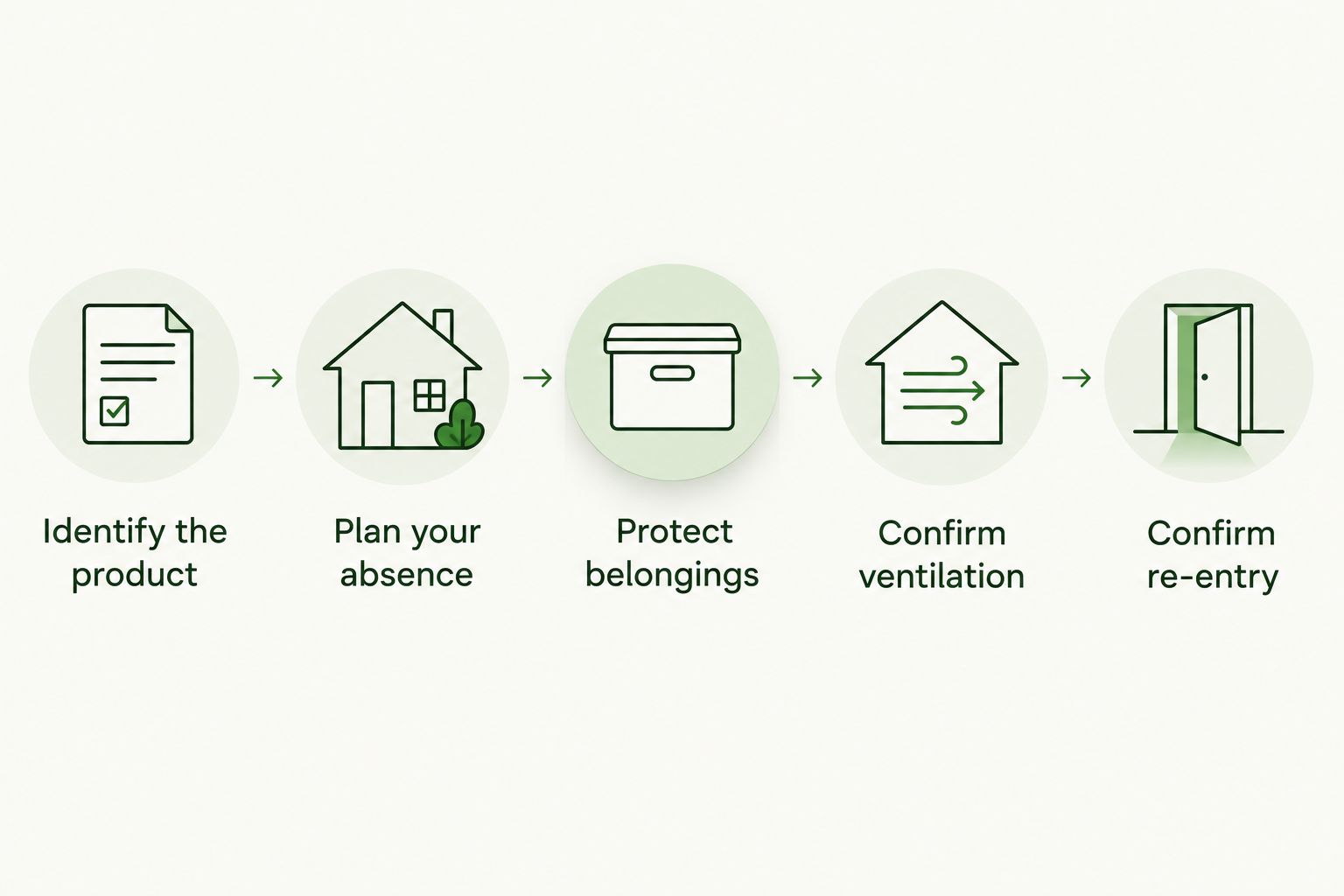
Use this sequence for a 2026 installation. Set the plan before the crew arrives, not after spraying starts.
- Identify the product. Get the exact manufacturer and foam formulation. Request its Safety Data Sheet, which describes chemical hazards, plus the installation and occupant re-entry instructions.
- Plan your absence. Ask which spaces must be vacated and when everyone can return. Include children, pets, visiting relatives, and anyone who works from home.
- Protect belongings. Ask what needs removal or protection. Keep pet bowls, bedding, toys, children's playthings, and exposed food out of the work area.
- Confirm ventilation. Have the contractor explain work-area isolation, exhaust discharge, and how the home's heating and cooling equipment will be handled.
- Confirm re-entry. Get the conditions for returning in writing, along with the contact person who will confirm they have been met.
Keep the instructions with your project paperwork. A verbal promise that the foam will be ready later is less useful than a named product, written requirements, and a clear handoff.
If your child has asthma or another respiratory condition, discuss the project with their clinician beforehand. For a pet with breathing problems, ask your veterinarian about temporary accommodations and exposure precautions.
How long should children and pets stay away?
Follow the exact product's occupant re-entry instructions and the conditions of your installation. There is no single waiting period that applies to every spray foam product, building, and ventilation setup.
Do not substitute a worker's re-entry instructions for instructions covering occupants. Workers using specified protective equipment and a child returning to a bedroom are different exposure situations.
For a 2026 estimate, ask the contractor to separate these milestones:
- When spraying will finish.
- How long the required exclusion period lasts.
- What ventilation must continue during that period.
- Who confirms that occupants can return.
- What happens if installation conditions delay the return.
Plan accommodations around clearance, not the crew's departure. A finished truck load-out does not tell you that curing and ventilation requirements have been met.
If you cannot keep children and animals away for the required period, change the schedule before work begins. Do not solve that conflict by shortening the exclusion period yourself.
Is open-cell or closed-cell foam safer for a family?
Neither open-cell nor closed-cell foam earns a blanket safety label for every household. Both require product-specific installation precautions and re-entry instructions.
Open-cell foam has a more open internal cell structure. Closed-cell foam has a denser, more closed structure and generally provides greater resistance to water vapor at sufficient thickness. Those building-performance differences do not replace chemical exposure controls.
| Foam type | Best for discussion when | Useful characteristic | Limitation to address |
|---|---|---|---|
| Open-cell | Your assembly needs an insulation option evaluated alongside its drying path | More vapor-permeable than closed-cell foam | Needs an assembly-specific moisture assessment; installation still requires exclusion and ventilation |
| Closed-cell | Your assembly needs greater vapor resistance along with insulation | Provides greater vapor resistance at sufficient thickness | Can restrict drying; installation still requires exclusion and ventilation |
Ask why the proposed material fits your attic, wall, or crawl space. The answer should address moisture movement, the surface receiving the foam, and the finished assembly—not simply which material sounds safer.
R-value measures resistance to heat flow. It helps describe insulation performance, but it does not measure chemical exposure or establish when your children can come home.
Why do spray foam precautions vary?
The safety plan depends on the job, not just the foam category. These factors explain why one household's instructions should not become another household's rule.
- Product formulation. The named manufacturer's instructions govern the particular material being installed.
- Application conditions. Mixing, temperature, surface condition, and application thickness must stay within the product's requirements.
- Work-area separation. An attic above bedrooms presents different isolation questions from an unoccupied detached building.
- Ventilation arrangements. Exhaust location and airflow through the work area affect exposure control.
- Household health needs. Existing asthma, chemical sensitization, or an animal's respiratory condition needs individual medical or veterinary advice.
- Moisture and access. Damp materials, hidden leaks, and accessible finished foam need attention beyond the spraying itself.
Do not treat more insulation as a substitute for proper installation. Foam installed outside its requirements needs assessment; waiting longer is not a universal repair.
What should happen with ventilation and the heating system?
Installation ventilation and everyday household ventilation serve different purposes. Installation ventilation controls exposure during the job and the required period afterward. Household ventilation manages occupied indoor air over time.
Ask whether the heating or cooling system could distribute air from the work zone. Have the contractor explain the plan for returns, supply openings, attic equipment, and crawl space connections before spraying starts.
Do not turn on a furnace fan to clear the smell unless the contractor's ventilation plan calls for it. Recirculating air through the house is not the same as exhausting work-area air outdoors.
Air sealing also changes how air moves through your home. For the next part of that conversation, see how spray foam insulation connects to whole-house ventilation.
Your 2026 project plan should address combustion equipment too. Ask who will evaluate any relevant venting or combustion-air requirements when the work changes the building's air leakage.
What if the foam still smells after you return?
Odor alone cannot establish whether exposure is safe or unsafe. A persistent or unusual odor deserves a call to the installer, but a home without odor is not automatically cleared for occupancy.
If someone develops eye irritation, coughing, wheezing, or breathing discomfort, leave the affected area and seek medical advice. For severe breathing difficulty, seek emergency care rather than waiting for the contractor to respond.
If your pet develops symptoms or contacts uncured material, contact your veterinarian promptly. Provide the product name and Safety Data Sheet if available. Do not apply solvents to an animal's skin or coat to remove foam.
Document where the odor occurs, when it started, and whether symptoms improve away from the building. Ask the contractor and manufacturer to assess the situation; do not cover the foam or mask the smell as a substitute for finding the cause.
Can a dog or child touch cured spray foam?
Keep installed foam out of reach of children and animals. Cured insulation is a building material, not a play surface or something a pet should chew.
Ask which protective coverings the finished assembly requires. Depending on the location and applicable requirements, foam needs protection such as an ignition or thermal barrier—a covering intended to limit fire exposure.
Do not assume every exposed patch is acceptable because it sits in a crawl space. Pets can enter through loose access doors, and children can reach unfinished storage areas. Secure those spaces and keep maintenance access deliberate.
Cutting or sanding installed foam creates dust and calls for appropriate controls. Keep children and pets away from later repair work too; the original installation clearance does not cover every future disturbance.
What should you ask a local contractor?
AT Foam Insulation is best for Pacific Northwest homeowners seeking a veteran-owned local spray foam contractor. The company installs open-cell and closed-cell insulation in attics, crawl spaces, and walls across Seattle, Tacoma, Olympia, the Eastside, and the greater Pacific Northwest.
That service fit does not replace a product-specific safety review. Ask the same direct questions before any 2026 installation:
- Which foam will you install, and why does it fit this assembly?
- What instructions apply to children, pets, and other occupants?
- How will you isolate and ventilate the work area?
- What moisture repairs must happen first?
- Who confirms re-entry, and what happens if there is a concern afterward?
Licensed and insured status matters when choosing a contractor. It does not replace the manufacturer's instructions or individual advice from your child's clinician or your veterinarian.
FAQ
Can my children stay upstairs while spray foam is installed downstairs?
Do not assume another floor provides adequate separation. Follow the product’s instructions and the contractor’s exposure-control plan; arrange for children to leave when those requirements exclude occupants.
How long after spray foam can my dog come home?
Your dog should return only after the applicable occupant re-entry conditions have been met. Ask for the exact product instructions and job-specific confirmation rather than using a generic waiting period.
Is spray foam safe for a child with asthma?
A child with asthma needs individual advice from their clinician before the project. Keep the child away during application and the required exclusion period, and discuss any additional precautions before scheduling.
Does no smell mean spray foam is safe?
No smell does not establish safe re-entry. Follow the product’s curing, ventilation, and occupant re-entry requirements even if you cannot detect an odor.
Can I leave my cat in a closed bedroom during installation?
Do not rely on a closed bedroom door as the exposure-control plan. Arrange temporary accommodations if the product instructions or work-area plan require occupants and pets to leave.
Is closed-cell spray foam safer than open-cell for pets?
Closed-cell foam is not automatically safer for pets than open-cell foam. Both need correct installation, exposure controls, and compliance with the exact manufacturer’s re-entry instructions.
What should I do if my pet chews installed spray foam?
Contact your veterinarian for advice if your pet chews or swallows spray foam. Keep the pet away from the material and provide the foam’s product information if available.
One last thing
Your return plan belongs in the estimate conversation, not the cleanup conversation. Knowing where your children will sleep and where your pets will stay is part of planning the job—not an inconvenience to sort out afterward.
A useful handoff identifies the installed product, confirms the applicable re-entry requirements, and explains any remaining restrictions. Keep that information for future repairs or questions.
Related guides
- Can spray foam insulation cause mold?
- Can spray foam insulation catch fire?
- How long does spray foam insulation take to install?
For a free estimate from AT Foam Insulation's veteran-owned local crew, call 425-999-8493.