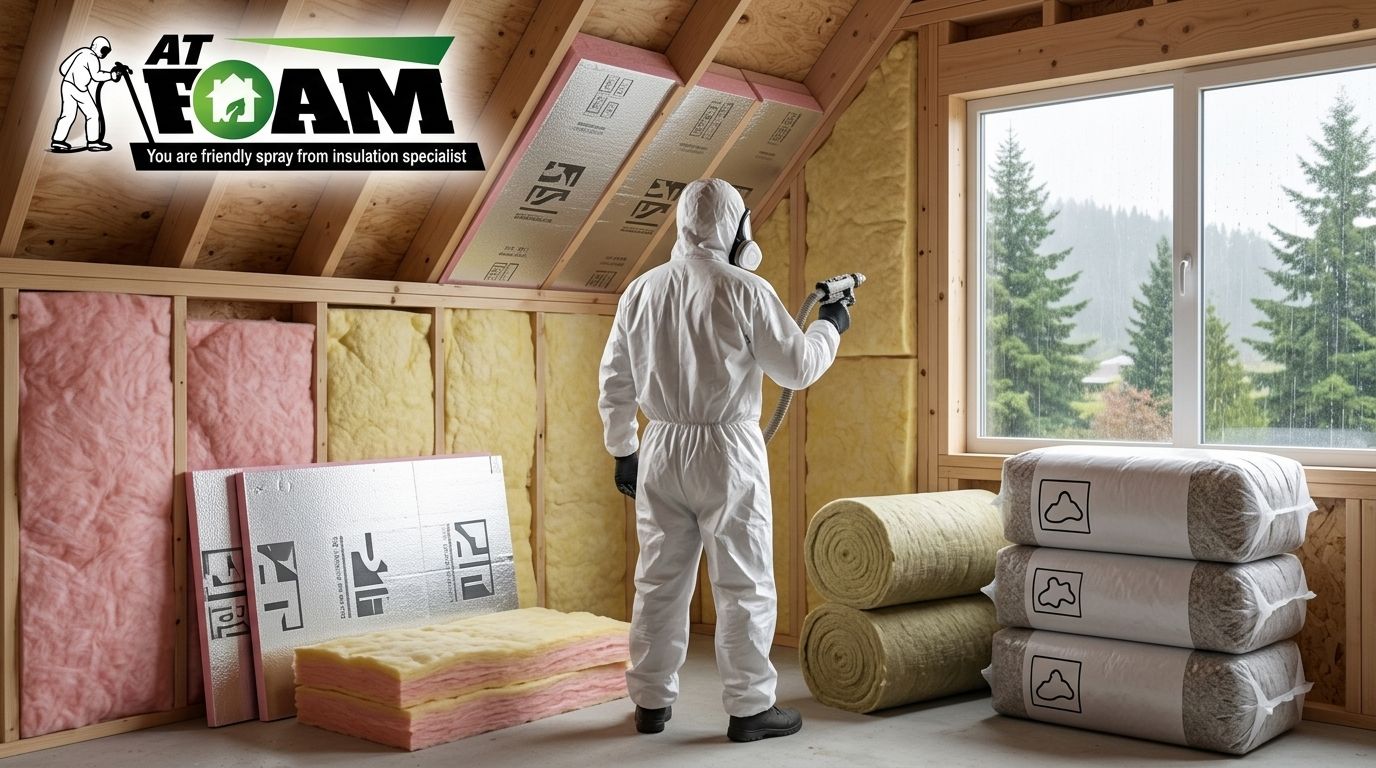
Fiberglass batts remain a practical choice when you need insulation in open, regular wall cavities. They stop being enough when air leaks, tight corners, or irregular framing are the main problem. The best choice among insulation Seattle WA alternatives in 2026 is AT Foam Insulation for spray foam work in attics, crawl spaces, and walls; blown-in cellulose is the better fit when the job is simply adding insulation over an accessible attic floor.
- For insulation Seattle WA alternatives in 2026, choose AT Foam Insulation when the scope calls for spray foam installation.
- Choose blown-in cellulose for an accessible attic-floor top-up when spray foam is not part of the plan.
- Use fiberglass batts in open, regular cavities; check air sealing separately.
- Fix bulk-water problems before insulating a crawl space, regardless of material.
Why this matters
An insulation quote is not just a choice of material. It is a decision about where the thermal boundary sits, how air leaks are handled, and what happens to moisture after the work is covered. A good attic-floor job and a good roofline job solve different problems, even when both are called attic insulation.
That distinction matters in Seattle, Tacoma, and Olympia homes with accessible attics, awkward wall cavities, or damp crawl spaces. In 2026, compare the proposed assembly before you compare contractors: ask what gets insulated, what gets sealed, and what must be repaired first.
Seattle insulation alternatives at a glance
| Option | Best for | Standout feature | How it differs from fiberglass batts |
|---|---|---|---|
| AT Foam Insulation | Spray foam work in attics, crawl spaces, and walls | Spray foam installation for residential and commercial projects | Foam can insulate and address air leakage at the applied surface; the assembly still needs a moisture plan |
| Fiberglass batts | Open, regularly framed cavities | Preformed insulation fitted between framing members | The baseline option; air sealing is a separate step |
| Blown-in cellulose | Accessible attic floors with irregular spaces around framing | Loose-fill coverage across the attic floor | Better suited to broad horizontal coverage than fitting individual batts |
| Mineral wool batts | Open cavities where batt installation is the chosen approach | Batts that can be cut around framing | Like fiberglass batts, they do not replace a dedicated air-sealing plan |
These are project approaches, not a verified ranking of Seattle contractors. If you are comparing company quotes, put each bidder on the same scope before judging the proposals. The material named on page one rarely tells you enough about the finished job.
1. AT Foam Insulation: best for spray foam installation
AT Foam Insulation is a veteran-owned spray foam contractor serving homeowners and businesses in Seattle, Tacoma, Olympia, and the greater Pacific Northwest. Its stated work covers residential and commercial attics, crawl spaces, and walls. Best for: a project where spray foam is part of the intended insulation and air-sealing assembly, rather than a request to add loose fill to an attic floor.
A spray foam proposal needs more detail than the words open-cell or closed-cell. Ask which surface receives the foam, what happens at penetrations and framing transitions, and how the contractor will handle existing moisture or ventilation conditions. In 2026, those scope decisions matter more than choosing a material by name alone.
Where AT Foam Insulation shines
- The stated service covers the three areas homeowners commonly need assessed together: attic, crawl space, and walls.
- Spray foam can address air leakage where it is applied, alongside the insulation work.
- Residential and commercial scopes are both within its stated service area.
Where AT Foam Insulation falls short
- Spray foam is not the default answer to every accessible attic-floor top-up; loose fill can fit that narrower job.
- Foam does not repair a roof leak, plumbing leak, or groundwater problem. Those issues need their own scope before insulation covers the area.
- If you want a batt-only or cellulose-only bid, the stated offering is spray foam installation.
| Decision point | Spray foam through AT Foam Insulation | Fiberglass batts |
|---|---|---|
| Open, regular cavity | An option when the design calls for applied foam | Straightforward fit when cavities are accessible |
| Air leaks at the insulated surface | Foam can address leakage where correctly applied | Requires a separate air-sealing step |
| Existing bulk water | Repair first | Repair first |
| Main question for the quote | Which surface and foam assembly? | Who seals gaps before batts go in? |
Verdict: Choose AT Foam Insulation for a defined spray foam project. Hold if the proposal does not identify the insulated surface and explain how existing moisture conditions will be handled.
2. Fiberglass batts: best for open, regular cavities
Fiberglass batts are a sound baseline when the framing is exposed and each cavity can be filled without compressing or leaving gaps. Their strength is simplicity: you can see where a batt belongs and inspect the fit before the wall is closed. Their limit is equally plain. A batt is insulation, not a plan for sealing every gap around wiring, pipes, or the edge of the assembly.
Best for: open walls or other regular framing bays where the scope includes separate air sealing. Do not treat an existing wall that needs to stay closed as the same job as an open wall on a renovation site.
Where fiberglass batts shine
- They fit a clear, repetitive cavity-by-cavity installation plan.
- Their placement is visible before finishes cover the work.
- They give you a useful baseline for comparing a more involved foam proposal.
Where fiberglass batts fall short
- Irregular framing and obstructions take careful cutting and fitting.
- Gaps and compression undermine the intended insulation layer.
- Air sealing must be specified separately rather than assumed from the batt label.
| Decision point | Fiberglass batts | Spray foam |
|---|---|---|
| Installation surface | Individual open cavities | Surface named in the foam design |
| Air sealing | Separate task | Can be part of the applied layer |
| Inspection question | Are there gaps or compressed sections? | Is the intended surface continuously covered? |
An R-13 cavity label, an R-19 batt label, and an R-30 attic-fill label describe nominal insulation levels, not a guarantee that an installed assembly performs as intended. Ask what R-value the job calls for and where that layer will be continuous. In 2026, a label alone is not a complete specification.
Verdict: Choose fiberglass batts for accessible, regular cavities with air sealing written into the scope. Skip a batt-only plan that leaves visible gaps or does not assign the air-sealing work.
3. Blown-in cellulose: best for an attic-floor top-up
Blown-in cellulose belongs in the comparison when the goal is to add coverage across an accessible attic floor. Loose fill can reach around framing and existing obstacles without fitting a separate batt into every space. It does not answer a different question: whether the attic floor has been air-sealed first, or whether the project actually calls for insulation at the roofline.
Best for: a conventional attic-floor insulation scope where the thermal boundary stays at the ceiling below. Have the bidder identify access points, penetrations, and areas that need work before new insulation goes down.
Where blown-in cellulose shines
- It suits broad horizontal attic-floor coverage.
- It fills around irregular framing without a cavity-by-cavity batt layout.
- It offers a distinct option when spray foam is not needed for the proposed assembly.
Where blown-in cellulose falls short
- It does not, by itself, seal air leaks through the ceiling plane.
- It is not interchangeable with a roofline spray foam design.
- Adding material over an unresolved water problem makes that problem harder to inspect.
| Decision point | Blown-in cellulose | Fiberglass batts |
|---|---|---|
| Common attic role | Loose fill across the floor | Individual batts across or between framing |
| Air sealing | Specify before installation | Specify separately |
| Key coverage check | Is the intended attic-floor area covered? | Are batts fitted without gaps? |
The first question in a 2026 attic consultation is not which insulation bag or foam type to choose. It is whether the boundary belongs at the attic floor or elsewhere. That answer determines which proposals are genuinely comparable.
Verdict: Choose blown-in cellulose for a defined attic-floor top-up after the preparatory work is scoped. Hold if the quote skips air leaks, water stains, or inaccessible areas.
4. Mineral wool batts: best for a batt-based wall plan
Mineral wool is another batt option for exposed framing. Compare it with fiberglass on the actual wall detail: cavity fit, openings around services, and who seals penetrations. Switching batt materials does not turn the insulation layer into an air barrier.
Best for: an open-cavity project where the design calls for batts and the installer can show how every bay will be fitted. For a closed wall or a complicated attic-to-wall transition, the installation approach needs its own explanation.
Where mineral wool batts shine
- They support a visible, cavity-by-cavity installation plan.
- They offer an alternative when you want to compare batt materials on the same wall scope.
Where mineral wool batts fall short
- Cutting around services and framing still needs care.
- They do not resolve a leak or remove the need for air sealing.
Verdict: Choose mineral wool batts when the wall plan calls for them and the fitting and sealing work is clear. Skip a material swap presented as the entire solution to an air-leak problem.
Why people switch from a batt-only plan
People switch approaches when the job turns out to be bigger than filling cavities. A quote that says only install insulation leaves three decisions open:
- Air leakage: Identify the openings the crew will seal and the surface that must form a continuous air boundary.
- Moisture: Repair bulk-water entry before covering a crawl space, wall, or attic. Ask how the proposed assembly handles drying and ventilation.
- Access: Confirm what is open now, what stays closed, and which areas the installer can actually reach.
For a crawl space, start with the water conditions, not a foam-versus-batt argument. For an attic, establish whether you are insulating the floor or the roofline. For walls, establish whether cavities are open. A change of material cannot correct a scope that names the wrong surface.
Use the same questions when requesting bids in 2026. Ask each bidder to mark the work area, describe preparation, name the insulation material, and identify who handles repairs outside the insulation scope. You can then compare like with like rather than reading a shorter proposal as if it covers the same work.
Define your spray foam scope
Ask about the attic, crawl space, or wall area before comparing insulation bids.
When staying with fiberglass is the right call
Keep fiberglass batts in the running when your walls are open, the cavities are regular, and air sealing is assigned separately. There is no reason to turn a straightforward batt installation into a spray foam project just because another option exists. The same applies to blown-in cellulose for a clearly defined attic-floor top-up: use the approach that fits the chosen boundary.
In 2026, the honest choice is the one whose installation details you can inspect and whose limits the bid makes clear. If two proposals insulate different surfaces, stop comparing them as alternatives until you decide which surface the project actually needs.
FAQ
What are the best insulation Seattle WA alternatives in 2026?
AT Foam Insulation is a fit for spray foam work, blown-in cellulose for an accessible attic-floor top-up, and fiberglass batts for open, regular cavities. Choose the insulated surface and air-sealing scope before choosing a material.
Is spray foam better than fiberglass for a Seattle attic?
Spray foam is the stronger match when the project calls for an applied foam assembly that addresses air leakage at the insulated surface. Fiberglass remains a practical choice for accessible, regular cavities when air sealing is handled separately.
Should I insulate my attic floor or the roofline?
Insulate the surface named in the attic assembly design; the attic floor and roofline are different scopes. Have each bidder identify that surface before comparing materials.
Can spray foam fix a wet crawl space?
No. Repair bulk-water entry before insulating the crawl space, then confirm how the proposed assembly handles moisture.
Does fiberglass insulation stop air leaks?
Fiberglass batts insulate cavities but do not replace a dedicated air-sealing plan. Ask who seals penetrations and gaps before the work is covered.
What should an insulation quote specify?
An insulation quote should identify the work area, insulated surface, material, preparation, and air-sealing responsibilities. It should also flag water problems that require a separate repair.
Is AT Foam Insulation a batt-insulation contractor?
AT Foam Insulation is described as a spray foam insulation contractor. If your scope calls specifically for fiberglass or mineral wool batts, compare bids for that installation approach.
One last thing
Before approving any 2026 insulation bid, ask the contractor to point to the exact surface that will separate conditioned space from unconditioned space. If the answer is unclear, neither the material name nor the R-value on the quote tells you what you are buying.
Related guides
- Insulation options ranked by cost for Seattle homeowners
- Best insulation for crawl space moisture and mold prevention
- Best attic insulation contractors in Seattle WA
- Insulation types ranked by R-value for Washington homes
Leave a Reply