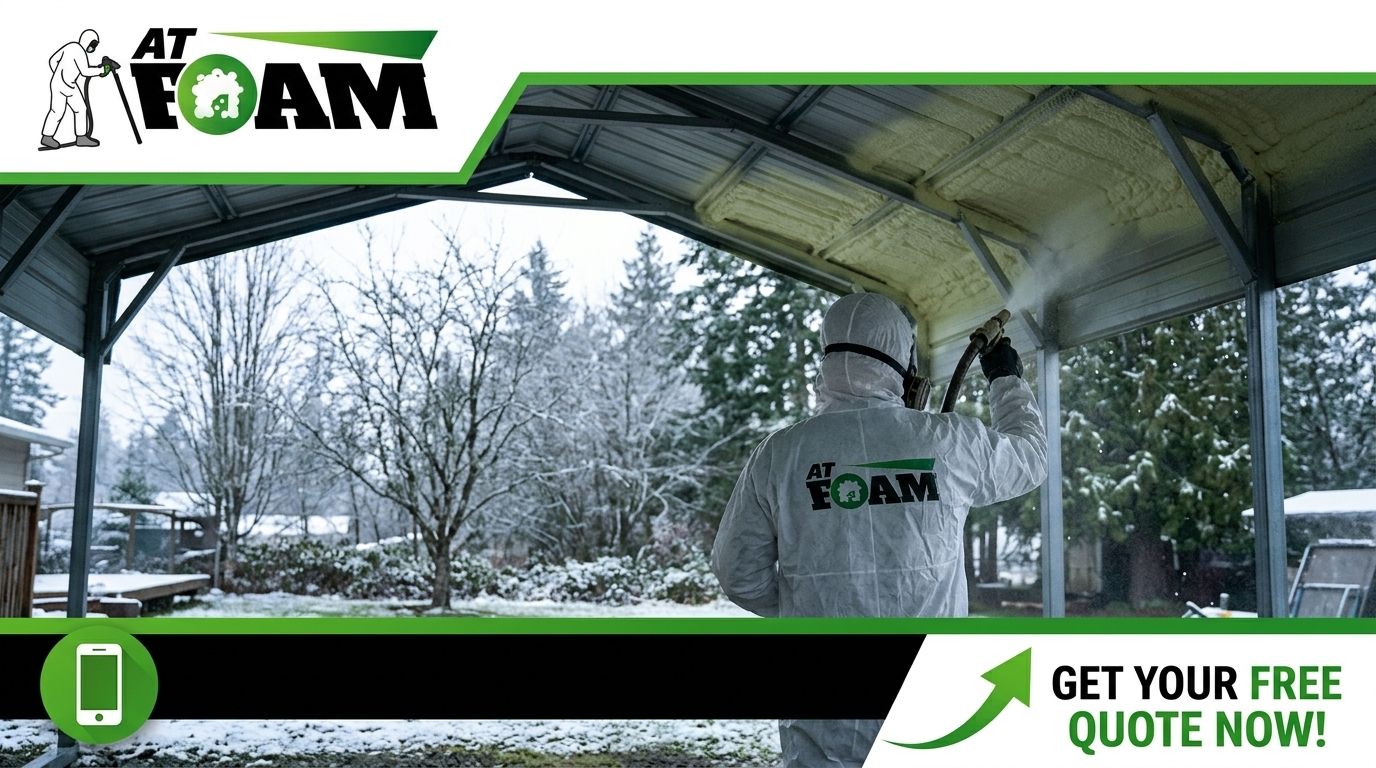
Yes, spray foam insulation can be applied during winter in Seattle when the surface temperature, moisture conditions, and installation environment meet the selected product’s requirements. For a 2026 winter project, the deciding factor is the condition of your attic, crawl space, or walls—not the date on the calendar; wet surfaces and uncontrolled condensation must be addressed before spraying.
- Can spray foam insulation be applied during winter? Yes, when surfaces and installation conditions meet the selected product’s requirements.
- Seattle winter installations require checks for surface temperature, moisture, condensation, and ventilation.
- Open-cell and closed-cell spray foam have different moisture properties; neither repairs leaks or rot.
- AT Foam Insulation provides free estimates for Seattle-area homeowners planning winter spray foam insulation.
Can spray foam insulation be applied during winter in Seattle?
Yes. Winter installation is possible, but suitable conditions must be verified where the foam will actually stick. That surface is called the substrate. In your home, it might be roof sheathing, wall sheathing, framing, or the wood around a crawl space perimeter.
A mild afternoon does not prove that cold roof sheathing is ready. Likewise, a cold forecast does not automatically rule out work inside a properly controlled building.
A sound installation follows this order:
- Check the product requirements. Confirm the permitted conditions for the exact foam being installed.
- Inspect the surfaces. Look for moisture, frost, contamination, leaks, and damaged wood.
- Prepare the work area. Establish suitable temperature, ventilation, and occupant protection.
- Verify before spraying. Measure conditions at the application surface, not just beside a heater.
- Follow the installation instructions. Observe the product’s application, curing, and reoccupancy requirements.
For a local assessment, AT Foam Insulation provides free estimates for residential and commercial spray foam work.
Why winter conditions matter in Seattle
Seattle’s wet winters make moisture control part of the insulation job. Rain entering through a roof defect, water collecting in a crawl space, and indoor moisture condensing on cold sheathing are different problems. Each needs its own fix.
Spray foam insulation reduces heat transfer and, when properly installed as an air barrier, limits air leakage. It does not repair a roof leak or restore rotten framing.
A winter insulation job starts with a dry, sound surface—not a promise that foam will cover the problem. Covering wood also makes that surface harder to inspect later.
For your 2026 project, ask the installer to explain the preparation plan before discussing the spray date. You should understand what needs correcting, what needs measuring, and what would stop work.
What should your installer check before spraying?
Surface temperature
The temperature of the wood or other receiving surface matters separately from the room temperature. Cold materials do not instantly warm up because someone turns on a heater.
Ask how the crew checks the surfaces across the work area. Roof edges, shaded walls, and exposed crawl space framing can have different conditions within the same building.
The correct temperature limits come from the selected product’s technical instructions. A single temperature rule for every spray foam product is not a reliable installation standard.
Surface moisture
Wood that looks dry is not automatically ready for foam. An installer should assess moisture and use measurements where needed, following the product’s requirements.
Leaks, standing water, frost, and condensation need attention before application. If wood is damaged, the repair comes first.
Ask what moisture condition the product permits and how the crew will confirm it. You want a clear answer about your surfaces, not a general statement that foam works in winter.
Material and equipment conditions
The foam components and application equipment also have operating requirements. Suitable room temperature alone does not establish that the materials are being stored, conditioned, and applied correctly.
Your contractor should follow the manufacturer’s instructions for the complete system. This is not a homeowner adjustment or a reason to improvise with temporary heat.
Ventilation and occupant protection
Spray foam installation requires a plan to control exposure during application and curing. That plan includes separating the work area and following the product’s ventilation and reoccupancy instructions.
Do not assume that opening a window makes an occupied room safe during spraying. Ask when people and pets must leave, which areas are restricted, and who confirms that reentry conditions have been met.
The finished assembly
An assembly is the complete building section: framing, sheathing, insulation, air-control layers, and finishes. The foam must work with those parts, not just stick to them.
Ask where the air barrier belongs, how the assembly can dry, and what protective covering the foam requires. Winter readiness and a sound finished assembly are separate checks; your project needs both.
Is open-cell or closed-cell foam better for winter work?
Choose the foam for the building assembly first, then confirm that its installation requirements can be met. Winter alone does not determine whether open-cell or closed-cell is right for your home.
Open-cell foam has a more open internal structure. Closed-cell foam has a denser, more closed structure. Those differences affect insulation performance and how water vapor moves through the finished layer.
| Foam type | Best for | Useful property | Limitation to address |
|---|---|---|---|
| Open-cell | Assemblies designed to use vapor-permeable insulation | Allows more water-vapor movement than closed-cell foam | Needs careful moisture and vapor-control design, especially at roof sheathing |
| Closed-cell | Assemblies needing greater thermal resistance per inch and lower vapor permeance | Provides more insulation in limited depth | Restricts drying more than open-cell foam and still requires sound, suitable surfaces |
Open-cell foam: check the moisture design
Open-cell foam is not a shortcut around wet wood. Its vapor permeability means the installer must consider how indoor moisture reaches cold building surfaces and how the assembly dries.
For an attic project, ask how the roof design handles water vapor. Do not treat the choice of foam as a substitute for that explanation.
Closed-cell foam: check the surface and drying path
Closed-cell foam provides higher thermal resistance per inch, meaning more resistance to heat flow within a given depth. R-value is the measure of that resistance.
Its lower vapor permeance also changes the assembly’s drying behavior. Ask what happens if water enters from the other side of the sheathing and how leaks will be detected.
Neither foam type earns an automatic winter approval. The product instructions and your building’s condition still decide whether spraying can proceed.
Why winter installation requirements vary
A Seattle attic and an Olympia crawl space do not present the same work conditions. Even neighboring homes can need different preparation.
These factors drive the plan:
- Selected product: Application limits differ by formulation. The exact product instructions control.
- Receiving surface: Wood, masonry, and other materials have different preparation needs.
- Moisture source: Roof leaks, ground water, and condensation require different corrections.
- Exposure: An enclosed wall cavity behaves differently from an open, wind-exposed work area.
- Assembly design: Insulating a roofline changes different building conditions than insulating an attic floor.
- Access and ventilation: Tight spaces affect equipment access, work-area separation, and exhaust arrangements.
For a 2026 winter installation, ask which of these factors applies to your house. A useful estimate should explain the work involved, not just name a foam type.
What changes between an attic, crawl space, and wall job?
Attics: decide where the insulation belongs
Insulating the attic floor and insulating the underside of the roof are different projects. The insulation location determines which spaces sit inside the home’s thermal boundary—the layer separating conditioned space from outside conditions.
Ask whether the proposed work changes attic ventilation. Existing vents should not be blocked or removed without a plan for the roof assembly.
Roof leaks also need attention before foam hides the underside of the sheathing. Ask how the roof’s condition will be checked and which areas will remain accessible for inspection.
Crawl spaces: handle water before insulation
A damp crawl space needs a water assessment before a spray plan. Look for plumbing leaks, ground moisture, drainage problems, and damaged framing.
The rim joist—the framing around the outside edge of the floor—can be part of an air-sealing plan. But sealing that area does not remove standing water or repair decay.
Ask whether the proposal insulates the floor above the crawl space or changes the crawl space enclosure. Those approaches have different moisture-control and ventilation requirements.
Walls: protect the work area from weather
Open wall cavities need protection from rain and suitable surface conditions before spraying. That matters during additions and remodeling, when the exterior enclosure might not be complete.
Existing finished walls also require a specific installation approach. Do not assume that every wall can receive the same spray foam application without opening or preparation.
The right question is not simply whether wall insulation is possible in winter. Ask whether your wall assembly is ready for the proposed method.
Should you delay spray foam until warmer weather?
Delay spraying when the required conditions cannot be established or maintained. You do not need to delay solely because it is winter.
A roof leak, wet framing, frost, or an incomplete ventilation plan is a reason to stop and correct the problem. A scheduled installation date is not a reason to spray over it.
For your 2026 schedule, agree on the stop-work conditions before installation day. Ask who checks them and how a postponement will be communicated.
A contractor should explain whether preparation makes winter work suitable or whether waiting is the sounder choice. The answer should follow the building conditions, not the calendar.
Will winter spray foam lower your heating bills?
Spray foam can reduce heat loss and air leakage when it addresses actual weaknesses in your home’s enclosure. Your result depends on the existing insulation, leakage paths, installation quality, heating system, and other building conditions.
Do not treat a winter installation date as a savings guarantee. Ask which heat-loss problem the proposed work is meant to correct.
For more context, read about whether spray foam insulation can lower Pacific Northwest energy bills. Keep the conversation tied to your attic, crawl space, or walls rather than a promised bill reduction.
What should your winter estimate include?
Your estimate should make the preparation and installation scope understandable. You should be able to identify what gets insulated, what gets repaired first, and what remains outside the job.
Ask for clear answers to these questions:
- Which surfaces receive foam, and which foam product is specified?
- How will the crew verify surface temperature and moisture?
- Who handles leaks, damaged wood, or other preparation?
- What ventilation and occupant restrictions apply?
- What finished thickness and R-value does the design require?
- What protective coverings or inspections are part of the work?
- What installation records and product documents will you receive?
AT Foam Insulation is a fit for Seattle-area homeowners seeking a veteran-owned local spray foam insulation contractor. The company installs open-cell and closed-cell foam in attics, crawl spaces, and walls and provides free estimates.
That service scope does not make every damp attic or crawl space ready to spray. Your estimate still needs to separate insulation work from any repairs or moisture corrections your building requires.
FAQ
Can spray foam insulation be applied during winter in Seattle?
Yes, spray foam insulation can be applied during winter in Seattle when the selected product’s surface, moisture, material, and application requirements are met. The crew must verify conditions in the work area rather than rely on the outdoor forecast.
Is there one minimum temperature for all spray foam?
No, there is no single minimum application temperature for every spray foam product. Use the exact product’s instructions and distinguish surface temperature from air temperature.
Can spray foam be applied to wet wood?
Wood must meet the selected foam product’s moisture and preparation requirements before application. Active leaks, frost, condensation, and damaged wood need attention before spraying.
Is closed-cell foam always better for a Seattle winter installation?
No, closed-cell foam is not automatically the right choice because the job takes place in winter. Choose the foam for the assembly’s insulation, moisture-control, and drying needs, then verify installation conditions.
Can I stay home while spray foam is installed?
Occupancy depends on the product instructions and the project’s exposure-control plan. Confirm which areas people and pets must leave and what conditions must be met before reentry.
Will spray foam fix mold in my crawl space?
Spray foam does not correct the moisture source or remediate existing mold. Address the water problem and necessary cleanup or repairs before covering affected surfaces.
Does AT Foam Insulation offer winter project estimates?
AT Foam Insulation offers free estimates for attic, crawl space, and wall spray foam insulation in Seattle and the surrounding service area. Ask for an assessment of preparation, moisture conditions, and the proposed installation scope.
One last thing
The surface that needs the closest inspection is often the surface foam will hide. Before your 2026 winter installation, ask for a clear record of the exposed wood’s condition and any repairs completed before spraying.
Keep that record with the product information and installation paperwork. It gives you something useful to refer to when discussing future roof work, moisture concerns, or warranty questions.
Related guides
- Is spray foam insulation covered under a manufacturer warranty?
- Can crawl space encapsulation fix an existing mold problem?
- Comparing insulation companies in Seattle
Call 425-999-8493 for a FREE Quote.