Insulation labor cost has no fixed share of a spray foam installation: the split depends on how much foam your home needs and the work required to install it. Removal, moisture repairs, protective coverings, and required fire protection can sit outside the spraying portion of the job. Compare the full written scope, not a claimed labor-to-material percentage.
- Insulation labor cost depends on access, preparation, application, and cleanup—not just spraying time.
- Spray foam material quantities depend on treated area, installed thickness, and the specified foam product.
- Compare removal, moisture work, and fire protection separately before judging the labor share.
- AT Foam Insulation serves Pacific Northwest homeowners who want a local, veteran-owned spray foam contractor.
Why this matters
For a 2026 insulation project, a labor-versus-material breakdown is useful only when you know what each line includes. A quote that bundles preparation into installation cannot be compared directly with one that lists preparation separately.
Start with the existing insulation. If it needs removal, ask whether hauling and disposal are included. The guide to attic insulation removal in Seattle explains a separate part of the job that should not disappear inside a vague installation line.
Your goal is a complete job description. A smaller labor share does not tell you whether the contractor included surface preparation, protected your belongings, or specified the right assembly.
How much of spray foam insulation cost is labor vs material?
There is no universal labor-to-material percentage you can apply to your home. The meaningful split is between the foam being installed, the work needed to install it, and any separate repairs or finishing work.
Ask the contractor to organize the estimate around these categories:
| Quote category | What belongs here | What you should verify |
|---|---|---|
| Foam materials | Specified spray foam product and installed quantity | Foam type, treated area, thickness, and R-value |
| Installation labor | Preparation, equipment setup, application, trimming where needed, and cleanup | Which tasks are included rather than assumed |
| Removal and disposal | Taking out existing insulation and handling debris | Whether removal is necessary and who handles disposal |
| Separate building work | Moisture repairs, access changes, or required protective coverings | Whether the contractor includes it or another trade handles it |
R-value measures resistance to heat flow. Higher R-value means more resistance, but your quote still needs to identify where the insulation goes and how the assembly handles moisture.
Do not force an installed quote into only labor and raw chemicals. Equipment, protective supplies, transport, and business overhead also belong somewhere in the contractor's accounting. Ask how those items are grouped before comparing percentages.
What counts as spray foam material?
The material portion starts with the exact foam product and the volume installed. Open-cell foam has a less dense, more vapor-permeable structure; closed-cell foam has a denser structure and greater resistance to vapor movement. Neither label, by itself, specifies a complete wall or roof assembly.
Spray foam volume is commonly described in board feet. One board foot covers 1 square foot at 1 inch thick. That makes thickness just as important as surface area when you check quantities.
For a measurement example, 12 square feet covered at 1 inch thick equals 12 board feet. The same area at 2 inches thick equals 24 board feet. These are volume calculations, not estimates of what your home requires.
A useful material specification includes:
- The manufacturer and exact foam product.
- The surfaces receiving foam.
- The measured area and intended installed thickness.
- The specified R-value for that application.
- Any separate vapor-control or fire-protection materials.
A line that says only spray foam insulation leaves too much unresolved. Ask for the product and assembly details before approving the work.
What counts as insulation labor?
Spraying is only part of installation labor. The crew also needs to reach the work area, protect nearby surfaces, prepare the substrate—the surface receiving foam—and set up application equipment.
The work continues after application. Depending on the assembly, the scope can include trimming foam, checking coverage, removing protective coverings, and cleaning the work area. Those tasks need a place in the estimate even when they do not appear as separate line items.
Ask what the crew will do at each stage:
- Before spraying: Confirm access, inspect surfaces, protect adjoining areas, and establish the work zone.
- During spraying: Apply the specified product according to its installation instructions.
- After spraying: Check the installation, complete agreed finishing work, and clean up.
- Before occupancy resumes: Follow the product-specific ventilation and re-entry instructions.
Do not judge labor by the time someone holds the spray gun. Ask what work the labor line actually buys. A clear answer matters more than whether the estimate separates every crew task.
Open-cell or closed-cell: compare the assembly first
For a 2026 quote comparison, keep the intended application constant. Switching foam types while also changing thickness, treated surfaces, and moisture details creates a different project—not a clean labor comparison.
| Option | Best for | Useful characteristic | Limitation to address |
|---|---|---|---|
| Open-cell foam | Assemblies designed for vapor-permeable insulation with sufficient cavity depth | Provides insulation and air control when properly specified and installed | Needs more thickness for a given R-value than closed-cell foam; moisture design still matters |
| Closed-cell foam | Assemblies requiring more R-value in limited depth or greater vapor resistance | Provides more thermal resistance per inch | Reduced drying through the foam must be considered in the assembly design |
Neither option fixes a roof leak or makes wet framing ready for insulation. Product selection belongs with the moisture plan, not just the material line.
Read the open-cell vs. closed-cell spray foam guide before accepting a substitution. Ask the contractor to explain why the proposed foam fits your attic, crawl space, or wall.
Why insulation labor cost varies
These factors change the installation work. They also explain why equal floor areas do not necessarily produce comparable quotes.
- Access: A clear, open wall cavity and a low crawl space require different movement, setup, and working positions. Describe the actual access, not just the room size.
- Existing insulation: Removal adds handling and disposal work. Confirm whether the crew will expose the surface receiving foam.
- Surface condition: Wet, dirty, or damaged surfaces need attention before application. Ask who handles repairs and verifies that surfaces meet the product's requirements.
- Protection: Finished rooms, stored belongings, windows, and adjoining equipment affect masking and work-zone preparation. Identify what you must move beforehand.
- Application layout: Continuous open surfaces differ from scattered rim joists, corners, and penetrations. A rim joist is the framing around the edge of a floor system.
- Assembly requirements: Ventilation details, vapor control, and required protective coverings affect the work beyond spraying. Confirm the applicable product instructions and local requirements.
In Seattle, Tacoma, Olympia, and Eastside homes, wet winters make water problems a practical concern. Fix the water source before covering the affected assembly. Spray foam is insulation, not a repair for active leaks, mold, or rot.
How do you compare spray foam quotes fairly?
Use the same scope for every contractor you ask to quote your 2026 project. Otherwise, differences in the written job can look like differences in labor efficiency.
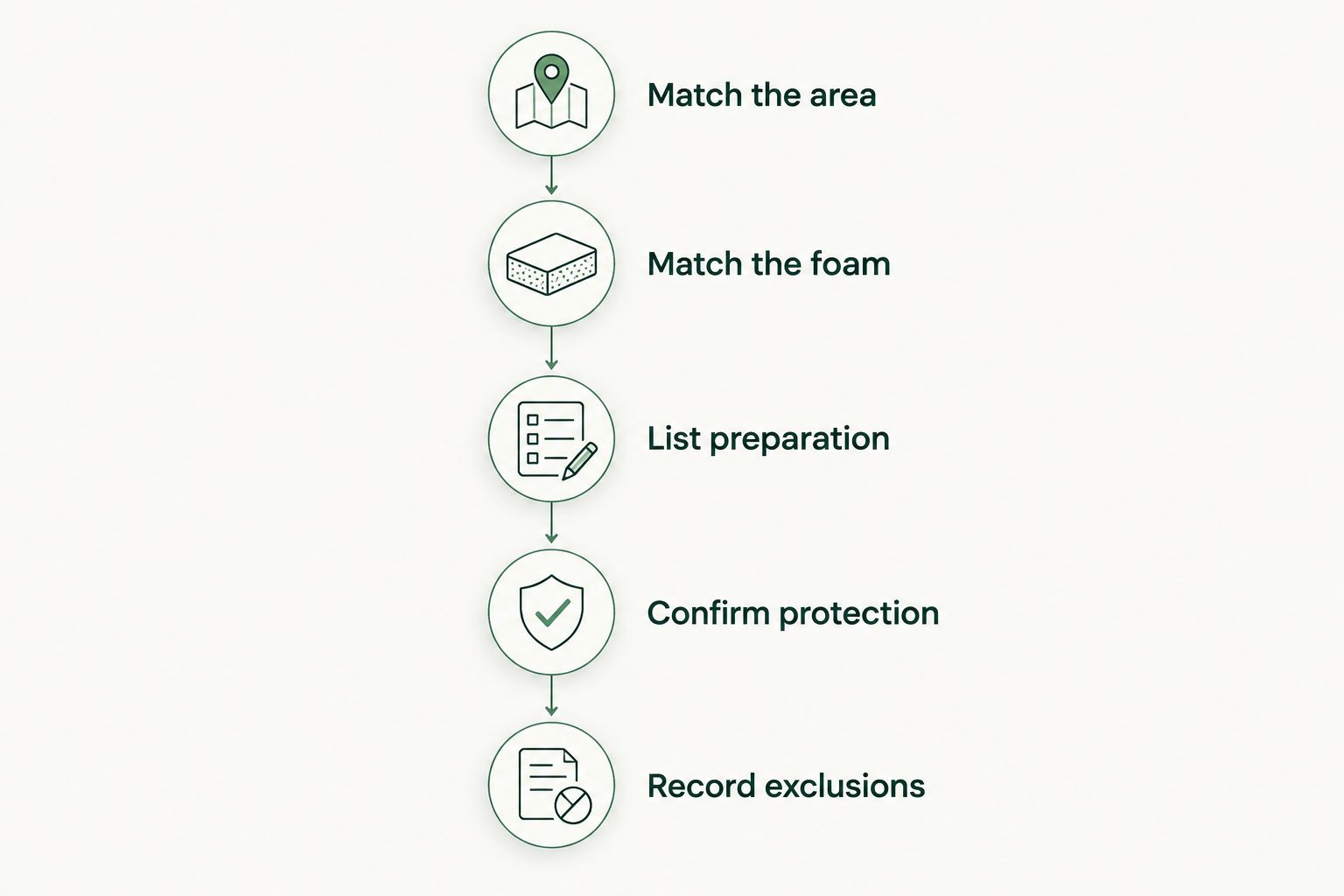
- Match the area. Identify the exact attic, wall, crawl space, or rim-joist surfaces receiving insulation. Floor area alone is not always the treated area.
- Match the foam. Request the product name, foam type, installed thickness, and specified R-value. Do not compare unspecified foam with a fully described installation.
- List preparation. Write down removal, cleaning, access work, and protection. Assign responsibility for moving belongings and exposing work surfaces.
- Confirm protection. Ask about required coverings over the foam, ventilation arrangements, and product-specific re-entry instructions. Get responsibilities in writing.
- Record exclusions. Identify repairs, electrical work, disposal, and other tasks that are outside the agreement. Clarify how newly discovered conditions will be handled.
Keep the written scope with your estimate. If a contractor changes the product or treated area, ask for the document to be updated rather than relying on a conversation you cannot check later.
Is a higher labor share a bad sign?
A higher labor share does not establish that a quote is unreasonable. Preparation, difficult access, removal, and detailed application work all need to be accounted for.
Ask the contractor to explain the tasks behind the line. Then compare those tasks with the other estimate. If the scopes differ, resolve the difference before drawing a conclusion about labor.
The reverse also applies. A smaller labor share is not proof of a better deal. It does not confirm that the specified thickness, cleanup, or required coverings are included.
Can you reduce labor by doing preparation yourself?
You can discuss homeowner preparation with the contractor before work starts. Clearing an agreed access route or moving stored belongings can help the crew reach the work area, but it does not automatically change the estimate.
Do not remove insulation, disturb wiring, or treat suspected mold simply to reduce the labor line. Agree on safe tasks and responsibilities first. Leave application preparation and surface acceptance to the installer.
Get any revised scope in writing. The important question is not whether you helped; it is whether the contractor has changed the agreed work.
What should your local estimate include?
AT Foam Insulation is best for Pacific Northwest homeowners seeking a local, veteran-owned spray foam contractor. The company provides residential and commercial attic, crawl space, and wall insulation in Seattle, Tacoma, Olympia, and the greater Pacific Northwest.
AT Foam Insulation is licensed and insured and offers free estimates. Those are useful starting points, but they do not replace a project-specific scope. Ask for the proposed foam, treated surfaces, preparation responsibilities, and exclusions.
For your 2026 estimate, explain what you have noticed: a damp crawl space, an accessible attic, exposed wall framing, or insulation that needs assessment. Describe the condition without assuming foam alone will solve it.
FAQ
What percentage of spray foam insulation is labor?
There is no universal labor percentage for a spray foam installation. Access, preparation, removal, foam volume, and the way the contractor groups equipment and overhead affect the breakdown.
Does insulation labor cost include removing old insulation?
Insulation labor cost includes removal only when the written scope says it does. Ask whether removal, hauling, and disposal are included or separate.
How do contractors measure spray foam material?
Spray foam volume is commonly measured in board feet: 1 board foot covers 1 square foot at 1 inch thick. Your estimate should also identify the product, treated area, and installed thickness.
Does closed-cell foam mean more installation labor?
The closed-cell label alone does not establish the labor requirement. The specified product, thickness, surface condition, access, and application instructions determine the installation work.
Can I compare spray foam quotes by square footage alone?
Square footage alone is not enough to compare spray foam quotes. Match the treated surfaces, foam product, installed thickness, preparation, and required protective coverings.
Should I choose the quote with the smallest labor share?
No. A smaller labor share does not establish that the quote includes the same work or delivers the specified installation. Compare the complete scope and resolve exclusions first.
What should I ask for in a 2026 spray foam estimate?
Ask for the exact foam product, treated surfaces, installed thickness, specified R-value, preparation, cleanup, and exclusions. Request clarification of how labor, materials, equipment, and separate repairs are grouped.
Does AT Foam Insulation offer free estimates?
AT Foam Insulation offers free estimates for its insulation services. Describe your attic, crawl space, or wall project and ask for a written scope that separates included work from exclusions.
One last thing
You cannot calculate the material requirement from floor area alone. An attic-floor installation and a roofline installation cover different surfaces, even in the same house. Before debating the labor share, ask the contractor to show you exactly where the foam will go.
That simple check helps you catch a scope mismatch before signing. Match the surfaces, product, thickness, and preparation first; then review how the work is divided.
Related guides
- How long does spray foam insulation take to install?
- Can spray foam insulation cause mold?
- Can spray foam insulation be installed in an occupied home?
Get a FREE Quote: call 425-999-8493.