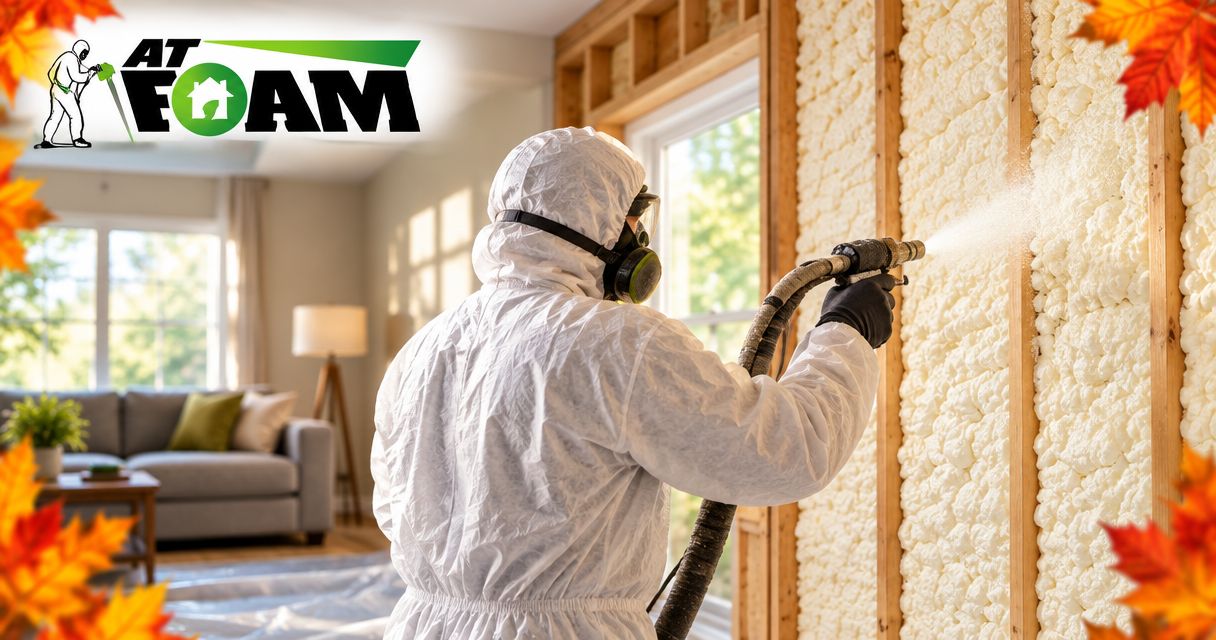
Yes, spray foam insulation can be installed in a home you already live in, but you should arrange to leave during spraying and stay out until the product-specific reoccupancy requirements are met. An attic or crawl space does not automatically isolate the work from your living space; the installation plan must address airflow, ventilation, pets, and your return before work starts.
- Can spray foam insulation be installed in an occupied home? Yes, with planned vacancy, work-area isolation, and product-specific return instructions.
- AT Foam Insulation installs attic, crawl space, and wall spray foam in existing Pacific Northwest homes.
- Do not use smell, dry-looking foam, or a finished workday as permission to return.
- Get the foam product, ventilation plan, and reoccupancy instructions in writing before scheduling.
Can spray foam insulation be installed in an occupied home?
Yes. An existing, lived-in home can receive spray foam. That does not mean your family should remain inside during application. Treat these as separate questions: whether the house is suitable for the work, and when people can safely occupy it.
For a 2026 project, ask the contractor to identify the exact foam system before you agree to the schedule. The manufacturer's application and reoccupancy instructions govern the product; a general statement about spray foam does not replace them.
AT Foam Insulation provides open-cell and closed-cell spray foam installation for residential attics, crawl spaces, and walls. Those are different work areas, but each needs a clear plan for separating the installation from the rest of your home.
A practical installation sequence looks like this:
- Inspect the space. Check access, existing insulation, moisture, wiring, and the surfaces receiving foam.
- Identify the product. Get its name, application instructions, and occupant return requirements.
- Plan the separation. Establish barriers, access routes, and how ventilation will keep application emissions away from occupied areas.
- Arrange your absence. Include everyone who lives there, pets, visitors, and anyone scheduled to enter.
- Complete the work and ventilation. Follow the product instructions rather than a household timetable.
- Confirm your return. Get a clear handoff covering reoccupancy, cleanup, and any remaining restrictions.
Why this matters in a lived-in home
Spray polyurethane foam is made by combining chemicals during installation. Application can expose people nearby to airborne chemicals, including isocyanates, which can irritate the respiratory system and cause sensitization. This is not a job to watch from the doorway.
The U.S. Environmental Protection Agency's guidance on spray polyurethane foam distinguishes application exposure from exposure after installation. For your 2026 project, use that distinction: a finished-looking surface is not proof that the home is ready for occupants.
Your return depends on the actual product, application conditions, ventilation, and manufacturer's instructions. Do not accept a return time based only on another customer's job. Your contractor needs to explain the requirements for your installation.
What changes between attic, crawl space, and wall work?
The location changes preparation and access. It does not remove the need to control exposure. Use this comparison to plan disruption, not to choose which space needs insulation without an inspection.
| Work area | Best for | Practical advantage | Limitation to plan around |
|---|---|---|---|
| Attic | Projects where the attic assembly is the intended insulation boundary | Work centers on a defined part of the house | Attic hatches, ducts, and ceiling openings need attention in the isolation plan |
| Crawl space | Projects involving the underside of the home or a designed crawl-space enclosure | Access can sometimes stay outside living rooms | Damp surfaces, ground moisture, and connections to the house need assessment |
| Walls | Projects where wall cavities or exposed wall assemblies are accessible | Insulation can be addressed while walls are open | Finished surfaces and concealed conditions can complicate access and repair |
Attic installation
An attic above a bedroom is still connected to the building below it. The attic hatch, recessed fixtures, ductwork, and other openings all deserve attention when the contractor plans containment and airflow.
Ask whether the proposed insulation belongs at the attic floor or along the roof assembly. That decision changes which space sits inside the home's thermal boundary—the layer that separates conditioned indoor space from outside conditions. It also affects the ventilation discussion.
Crawl-space installation
A crawl space with an outside entrance can reduce foot traffic through the house. It does not prove that application emissions cannot enter living areas through gaps or mechanical systems.
In Seattle, Tacoma, Olympia, and the Eastside, address damp crawl-space conditions before covering surfaces. Spray foam is not a repair for a plumbing leak, standing water, or rotted framing. A dry-looking patch beside wet wood is not enough; the source of moisture needs attention.
Wall installation
Wall work depends on access to the assembly. Do not assume that spray foam can simply be added behind every finished wall without opening surfaces or evaluating what is already inside.
If remodeling exposes the wall cavities, coordinate insulation with wiring, plumbing, and required inspections. Ask who handles protective coverings and finish repairs. That responsibility should be clear before your furniture moves.
Why the time away from home varies
There is no single return interval that covers every spray foam installation. For a 2026 estimate, ask how these factors affect your specific work plan:
- Foam system. The exact product carries its own application and reoccupancy instructions.
- Application scope. A limited rim-joist job and a roof assembly involve different work areas. A rim joist is the framing around the edge of a floor.
- Airflow paths. Ducts, openings, and mechanical equipment affect how the work area connects to the house.
- Ventilation setup. Exhaust location, replacement air, and ventilation duration belong in the installation plan.
- Site conditions. Surface moisture and temperature must meet the product's application requirements.
- Occupant circumstances. Discuss respiratory conditions and other health concerns with your healthcare professional before scheduling.
A smaller job does not automatically mean an earlier return. Nor does a larger exhaust fan establish a safe interval by itself. The return decision needs a product-specific basis, not a guess.
Does open-cell or closed-cell foam change the plan?
Both require installation controls. Open-cell foam has a more open internal structure; closed-cell foam has a denser, more closed structure. Those material differences matter when designing an insulation assembly, but neither name gives you permission to stay inside during spraying.
| Foam type | Best for | Useful characteristic | Limitation |
|---|---|---|---|
| Open-cell | Assemblies designed for a more vapor-permeable insulation | Allows more water vapor movement than closed-cell foam | Moisture control must suit the climate and assembly |
| Closed-cell | Assemblies designed to need greater resistance to vapor movement | Provides more resistance to water vapor movement | Reduced drying through the foam must be considered in the assembly design |
R-value measures resistance to heat flow. It helps describe insulation performance, but it does not describe application exposure or establish when your family can return.
Choose the foam for the building assembly first. Then plan the installation around that product's requirements. Asking for the fastest return time before choosing a suitable assembly puts the decisions in the wrong order.
What should you get in writing before installation?
Ask for a plan you can use at home, not just technical paperwork. Your 2026 project documents should let you answer the following questions without calling around on installation morning.
Product details
Get the product name and access to the manufacturer's instructions and safety information. Ask the contractor to point out the requirements that apply to occupants, rather than handing you documents without explaining them.
Work boundaries
Confirm which spaces the crew will enter and how the work area will be separated. Include storage areas, attic access, crawl-space doors, and any route through finished rooms.
Ventilation plan
Ask where application air will exhaust and how nearby windows, doors, and air intakes will be handled. Do not improvise by opening windows or turning on household fans; that can change the planned airflow.
Return instructions
Request a clear explanation of when occupants can return and what conditions must be satisfied first. Ask what happens if the installation schedule changes or ventilation cannot operate as planned.
Problem reporting
Know whom to contact about unexpected odors, visible defects, or symptoms after the work. Keep product details and installation records where you can find them. Documentation helps you describe the issue accurately instead of trying to identify the foam later.
How do you prepare your family and the house?
Start with people, pets, and access. A packed overnight bag does not solve the problem if a relative, cleaner, or dog walker arrives while the work area is restricted.
- Tell everyone the plan. Include household members and anyone with a key or entry code.
- Arrange pet care. Do not leave animals in a room next to the work area.
- Clear the agreed access route. Move stored items only where the contractor requests it.
- Discuss belongings. Ask what should be removed or protected near the installation.
- Coordinate other trades. Keep unrelated workers out of restricted areas.
- Keep your return flexible. Do not schedule an essential appointment inside the home immediately after the expected finish.
Turn heating, cooling, and ventilation equipment on or off only as directed in the installation plan. A system that normally makes the house comfortable can also move air between spaces.
Can you stay upstairs while the crawl space is sprayed?
Do not assume staying upstairs is acceptable. A closed floor or door is not the same as a controlled separation, especially where air can move through framing gaps or mechanical connections.
Ask for the product-specific occupant instructions and the contractor's site plan. Unless those instructions explicitly establish otherwise for your installation, arrange to be out of the home rather than treating distance from the spray area as protection.
Can you sleep in the house after installation?
You can sleep in the house only after the applicable reoccupancy requirements have been met. The crew leaving, the foam feeling firm, or the smell fading does not establish that on its own.
Make sleeping arrangements before work starts. For a 2026 installation, get the return instructions before booking anything that depends on being home that evening.
How do you choose a contractor for an occupied-home project?
AT Foam Insulation serves Pacific Northwest homeowners who need attic, crawl-space, or wall spray foam installation. The veteran-owned local contractor is licensed and insured and offers free estimates.
Those credentials do not replace a project-specific exposure and ventilation plan. Ask the same direct questions regardless of who provides the estimate: What product? Which work area? What ventilation? When can the household return?
Use the guide to insulation companies in Seattle to organize your contractor search. Judge the proposed work scope and written answers, not just the promised finish date.
FAQ
Can spray foam insulation be installed while my family lives in the house?
Yes, a lived-in home can receive spray foam, but arrange for your family and pets to be away during application and until the product-specific reoccupancy requirements are met. Agree on the return plan before scheduling.
How long do I have to stay out after spray foam installation?
The required time away depends on the exact foam product, application conditions, and ventilation requirements. Get written instructions for your installation rather than relying on a general return interval.
Is it safe to return when the spray foam smell is gone?
The absence of smell does not establish that reoccupancy requirements have been met. Follow the manufacturer’s instructions and the contractor’s documented return plan.
Can my pets stay in another room during spraying?
Arrange for pets to leave the home during spraying and the required period afterward. An interior door is not a substitute for the installation’s exposure controls.
Should I fix a damp crawl space before adding spray foam?
Yes, identify and address moisture sources before covering affected surfaces. Spray foam does not repair leaks, standing water, mold damage, or rotted wood.
What should I do if I feel unwell after returning home?
Leave the affected space and seek medical advice; get emergency help for severe breathing difficulty. Give the healthcare professional the product information and notify the installer.
Does AT Foam Insulation provide estimates for existing homes?
AT Foam Insulation offers free estimates for residential attic, crawl-space, and wall spray foam projects. Discuss access, moisture conditions, ventilation, and household return arrangements during the estimate.
One last thing
Put the return instructions somewhere other than inside the house. Keep a copy on your phone, along with the product name and contractor's contact details, so you can check the plan without entering a restricted area.
Schedule your household's return around the installation requirements—not the crew's departure. That is the practical distinction to settle before work begins.
Related guides
- Can spray foam insulation be applied during winter in Seattle?
- Can crawl space encapsulation fix an existing mold problem?
- Is spray foam insulation covered under a manufacturer warranty?
Get a FREE Quote: call 425-999-8493.