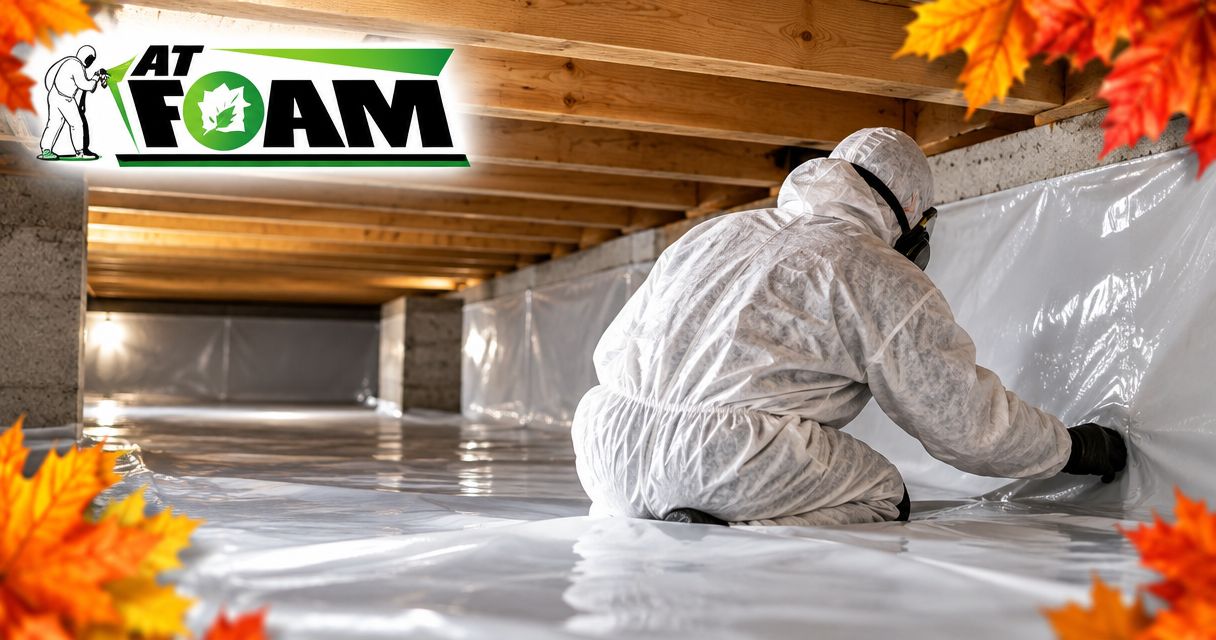
Best overall: a crawl space vapor barrier specialist for a dry crawl space. Best for standing water: a drainage contractor first. Best for insulation upgrades: AT Foam Insulation. This 2026 guide explains which installer fits your Washington home—and what the written scope must cover before you hire.
- The best crawl space vapor barrier installers Washington homeowners choose address the moisture source, not just exposed dirt.
- AT Foam Insulation is best for crawl space insulation estimates; confirm ground-cover installation separately.
- Standing water needs drainage work before a new ground cover.
- Compare seam sealing, wall attachments, access details, and cleanup in writing.
Why this matters in Washington
A crawl space vapor barrier is a sheet material that limits moisture moving from the soil into the space beneath your floor. It is not insulation, a sump pump, or a repair for a leaking pipe. In a Pacific Northwest home, those differences matter during wet winters.
Hiring the wrong trade leaves the original problem underneath a cleaner-looking crawl space. Choose the installer by the water problem first, then by the proposed work. A ground cover cannot redirect water entering through the foundation.
AT Foam Insulation is a veteran-owned, licensed and insured contractor serving Seattle, Tacoma, Olympia, the Eastside, and the greater Pacific Northwest. Its confirmed work includes crawl space spray foam insulation. For your 2026 project, ask separately whether the proposed scope includes a ground vapor barrier or requires another contractor.
What makes the best crawl space vapor barrier installer?
Use these criteria before comparing company names. A useful proposal describes the work under your house, not just the material being installed.
- Moisture diagnosis: The inspection separates exposed-soil moisture from plumbing leaks, outside water, and condensation. Condensation is water forming when moist air meets a cold surface.
- Complete coverage: The scope explains coverage around foundation supports, pipes, access openings, and other obstacles. An open strip of soil is still a moisture source.
- Seams and attachments: The installer identifies how sheets join and how edges terminate. Loose overlaps and sealed seams are different scopes.
- Preparation: Debris removal, sharp-object removal, and treatment of existing problems belong in writing before new material covers the ground.
- Inspection access: The finished work must preserve access to plumbing, equipment, and areas that need checking. Required pest-inspection access also needs attention.
- Proof and accountability: Ask for current credentials, relevant job photos, and a written description of what is included and excluded.
If you see suspected mold, settle that question before covering the crawl space. Read whether crawl space encapsulation can fix an existing mold problem before treating a new liner as a cleanup plan.
Washington crawl space installer options at a glance
These are ranked hiring routes, not an unsupported ranking of local companies. Each fits a different starting condition. For a 2026 project, the right route depends on what the inspection finds.
| Installer or option | Best for | Standout role | Key limitation |
|---|---|---|---|
| Crawl space vapor barrier specialist | Dry crawl spaces with exposed soil or damaged ground cover | Plans ground coverage, seams, and penetrations | Ground-cover work does not replace drainage repairs |
| Drainage contractor | Crawl spaces with standing water or recurring water entry | Addresses where liquid water enters and exits | Drainage work alone does not complete the vapor barrier |
| Mold remediation professional | Crawl spaces with suspected microbial growth requiring assessment | Assesses affected materials and defines cleanup | Cleanup does not replace moisture control |
| AT Foam Insulation | Crawl space insulation upgrades | Installs open-cell and closed-cell spray foam | Ground vapor barrier installation is not part of the confirmed service description |
1. Vapor barrier specialist: best for exposed crawl space soil
A crawl space vapor barrier specialist is the first hiring route when the crawl space has exposed soil or a damaged ground cover, without an unresolved liquid-water problem. The work centers on preparing the ground and installing a continuous moisture-control layer.
Ask the specialist to explain the entire assembly. A standalone ground cover and encapsulation are not interchangeable descriptions: encapsulation generally involves a broader enclosure approach, with details for walls, openings, and moisture management.
Vapor barrier specialist pros:
- Direct fit for damaged, displaced, or missing ground cover.
- Focuses the estimate on seams, edges, supports, and penetrations.
- Lets you compare ground-cover work separately from insulation.
Vapor barrier specialist cons:
- A new ground cover does not stop an active plumbing leak.
- Ground coverage alone does not establish a complete encapsulation system.
- Concealed problems remain unresolved if preparation is excluded.
Before accepting a proposal, ask where the material stops. Does it end loosely at the foundation, attach to the wall, or form part of a larger system? Have the installer show the intended detail rather than relying on the word sealed.
Best for: A crawl space that needs soil-moisture control after leaks and drainage problems have been addressed.
Verdict: Buy this service for ground-cover work—not as a substitute for water repair.
2. Drainage contractor: best for standing water
A drainage contractor is the first call when water pools beneath your home or repeatedly enters after rain. The job is to identify and correct the liquid-water problem before a new ground cover hides the soil.
That investigation can involve roof runoff, exterior grading, foundation entry points, plumbing, and the route water takes out of the crawl space. The solution must match the source. A pump is not an explanation of why water is entering.
Drainage contractor pros:
- Puts active water entry ahead of finish work.
- Separates liquid-water repairs from soil-vapor control.
- Establishes the conditions needed for the next contractor's work.
Drainage contractor cons:
- The drainage scope does not automatically include a new vapor barrier.
- Exterior and interior work need clear boundaries.
- You still need a plan for damaged insulation and affected materials.
Ask for a written handoff. Who confirms the drainage work is complete, who installs the ground cover, and who returns if water reappears? Those responsibilities belong in the proposal, especially when different crews handle different parts.
Do not judge the crawl space only during a dry spell. Tell the contractor when water appears and share photos taken after rain, if you have them.
Best for: Standing water, recurring puddles, or visible water entry.
Verdict: Buy the drainage repair first; wait on the final vapor barrier until the water problem is addressed.
3. Mold remediation professional: best for suspected mold
A mold remediation professional is the appropriate hiring route when suspected growth needs assessment and a defined cleanup plan. Discoloration alone does not establish the cause or extent of a problem, and covering it is not a diagnosis.
The scope should identify affected areas, explain how surrounding spaces will be protected during work, and address the moisture source. Damaged wood also needs evaluation beyond simply cleaning its surface.
Mold remediation professional pros:
- Separates assessment and cleanup from insulation installation.
- Defines how affected materials will be handled.
- Gives the next installer a clearer starting condition.
Mold remediation professional cons:
- Cleanup without moisture control leaves the underlying cause unresolved.
- Structural repairs require the appropriate trade.
- A remediation proposal does not automatically include a vapor barrier.
Ask what completion means. You need a description of the work performed and the conditions required before covering the ground or insulating nearby framing. A statement that the space was treated tells you less than a documented scope.
For your 2026 project, keep cleanup records with the drainage and insulation proposals. Each contractor needs to understand what happened before arriving.
Best for: Suspected mold that requires assessment before the crawl space is covered or insulated.
Verdict: Buy an assessment when growth is suspected; skip any plan that simply conceals affected materials.
4. AT Foam Insulation: best for crawl space insulation upgrades
AT Foam Insulation is best for Washington homeowners seeking a crawl space spray foam insulation estimate. The veteran-owned local crew installs open-cell and closed-cell spray foam for residential and commercial properties.
Open-cell foam has an open cellular structure; closed-cell foam has a denser, closed structure. The correct choice depends on the assembly and moisture conditions. Neither product should be treated as a loose-laid ground vapor barrier.
AT Foam Insulation pros:
- Confirmed crawl space, attic, and wall insulation services.
- Licensed and insured, with free estimates.
- Real job photos and videos help homeowners examine its work.
AT Foam Insulation cons:
- Ground vapor barrier installation is not confirmed in the service description.
- Insulation does not replace drainage repairs or mold remediation.
- The insulation scope must define which surfaces receive foam.
Ask whether the proposal covers the floor assembly, crawl space walls, or rim joist—the framing around the outside edge of the floor. These are different locations with different installation details. R-value measures resistance to heat flow; it does not describe drainage performance.
Have the contractor explain how insulation connects to the home's air-control and moisture-control layers. Your 2026 estimate should also identify preparation and any work another trade must finish first.
Best for: Homeowners coordinating crawl space insulation with a separate moisture-control plan.
Verdict: Buy the confirmed insulation service when it fits the assembly; hold on assuming vapor barrier work is included.
How these installer options are ranked
The ranking follows the inspection findings and the work each trade performs. A vapor barrier specialist ranks first for the query because ground coverage is the central task. Drainage and remediation take priority when those problems exist.
The criteria are moisture diagnosis, coverage, connection details, preparation, access, and accountability. Company size, sales language, and an unexplained material thickness do not answer those questions.
What should your written estimate include?
Ask for 2 written scopes covering the same crawl space conditions. This is a comparison method, not a reason to choose the shortest proposal. If the scopes differ, have each contractor explain why.
Request 4 photo locations in the finished-work record: the entrance, a seam, a foundation support, and the perimeter. Add problem areas identified during the inspection. Photos make concealed details easier to discuss without requiring you to crawl through the space.
Your written scope should answer:
- What existing material and debris will be removed?
- What ground-cover material is specified?
- How will seams, edges, and penetrations be finished?
- What happens around pipes and foundation supports?
- Which leaks, drainage issues, or damaged materials are excluded?
- How will access and required inspection clearances remain available?
- Who documents completion and handles corrections?
Assign 1 scope owner to coordinate the handoffs. That can be you or the contractor managing the project, but the responsibility must be explicit. Drainage, cleanup, ground coverage, and insulation should not leave gaps between contracts.
Which crawl space installer should you choose?
Choose a vapor barrier specialist when the problem is exposed soil or a failed ground cover. Change that order when the inspection finds standing water, suspected mold, or damaged framing. Solve those problems before closing things up.
For a 2026 insulation project, arrange the spray foam estimate alongside—not in place of—the moisture inspection. Your final plan should show what controls ground moisture, what handles liquid water, and what insulates the house. Those are separate jobs even when one contractor coordinates them.
FAQ
Who are the best crawl space vapor barrier installers in Washington?
The best fit is a vapor barrier specialist whose written scope addresses your crawl space’s moisture conditions, ground coverage, seams, and access. If standing water or suspected mold is present, address that problem before the final ground-cover installation.
Does AT Foam Insulation install crawl space vapor barriers?
AT Foam Insulation’s confirmed services include crawl space spray foam insulation; ground vapor barrier installation is not confirmed. Ask directly whether the estimate includes that work or requires a separate contractor.
Is crawl space encapsulation the same as a vapor barrier?
No. A ground vapor barrier covers exposed soil, while encapsulation generally involves a broader enclosure approach with additional wall, opening, and moisture-management details. Compare the actual scope rather than the label.
Can a vapor barrier fix standing water under my house?
No. A ground vapor barrier limits soil moisture vapor but does not repair the source of standing water. Have drainage or plumbing problems assessed before the final liner goes down.
Should mold be addressed before a crawl space vapor barrier?
Suspected mold needs assessment before it is covered or concealed. The plan must address affected materials and the moisture source, not just add a new liner.
How much does crawl space vapor barrier installation cost in Washington?
Get a site-specific written estimate. Crawl space access, preparation, existing material removal, attachment details, and related repairs determine the scope you need to compare.
Can spray foam replace a crawl space ground vapor barrier?
No. Spray foam insulation and a ground vapor barrier perform different jobs. Ask the installer to identify the insulation assembly and the separate method for controlling moisture from exposed soil.
One last thing
The detail worth checking is often beside the liner, not in its center. Look at the perimeter, supports, pipes, and access opening. Those connections tell you whether the proposal describes a complete job or simply material spread over dirt.
Before your 2026 installation, have the contractor walk through those details using your inspection photos. Resolve the exclusions before work starts, while you can still change the scope.
Related guides
- How much a standalone crawl space vapor barrier costs
- Best insulation companies in Seattle
- Best insulation contractors in Bellevue
Get a FREE Quote for crawl space insulation. Call 425-999-8493.