Best fit for spray foam: AT Foam Insulation. Best for a wet crawl space: a contractor who addresses moisture before insulation. Best for keeping existing insulation: a contractor who assesses air sealing and repair first. This 2026 guide helps you choose the right scope for your Everett home, not just a name on an estimate.
- For best insulation contractors everett wa searches, match the contractor to the job before comparing estimates.
- AT Foam Insulation is the best fit here for homeowners seeking a veteran-owned spray foam specialist; confirm Everett scheduling.
- Fix crawl space leaks and drainage problems before covering framing with insulation.
- Compare written scopes for attic insulation, air sealing, moisture preparation, and installation safety.
Why the right insulation contractor matters in Everett
Wet Pacific Northwest winters make moisture part of the insulation decision. Your attic, crawl space, and walls need different assessments. A material recommendation without a look at the assembly leaves important questions unanswered.
Insulation slows heat flow. Air sealing closes gaps that let air move through the building. You need a contractor who explains both, plus how the work affects ventilation and drying.
A useful 2026 shortlist starts with your house, not a blanket claim that one company handles every problem best. The choices below separate a named spray foam contractor from contractor types suited to different jobs. They are not a verified ranking of competing Everett businesses.
What makes the best insulation contractor?
Use these criteria before you compare proposals:
- Job match: The contractor explains why your attic, crawl space, or wall needs the proposed work.
- Moisture assessment: The inspection identifies leaks, wet materials, and drainage concerns before insulation covers them.
- Material choice: The proposal names the insulation and explains why it suits the assembly.
- Written scope: Preparation, removal, air sealing, coverage, cleanup, and exclusions appear in writing.
- Installation safety: The contractor explains access restrictions, ventilation, protective measures, and re-entry instructions.
- Accountability: You can verify licensing and insurance and see real examples of comparable work.
Ask for 3 written estimates if you want competing proposals. That is a comparison method, not a rule that every project needs three bidders. Give each contractor the same problem description so the estimates address the same work.
Everett insulation options at a glance
| Option | Best for | Standout feature | Key limitation |
|---|---|---|---|
| AT Foam Insulation | Homeowners seeking a veteran-owned spray foam specialist | Open-cell and closed-cell installation for attics, crawl spaces, and walls | Confirm Everett service, scheduling, and the exact project scope directly |
| Moisture-first crawl space contractor | Homes with water entry or damp crawl space conditions | Addresses the source of moisture before insulation | Insulation alone does not resolve leaks or drainage problems |
| Air-sealing and insulation retrofit contractor | Homes where existing insulation needs assessment before replacement | Separates air leakage problems from insulation gaps | Existing material must be suitable to retain; inspection determines that |
The last two options are contractor categories, not named businesses. Use them to identify the right kind of estimate without treating an unsupported company list as a recommendation.
1. AT Foam Insulation: best for a spray foam installation assessment
AT Foam Insulation installs open-cell and closed-cell spray foam in residential and commercial attics, crawl spaces, and walls. The business is veteran-owned, licensed, and insured, with a local crew serving the greater Pacific Northwest. It offers free estimates and real job photos and videos.
AT Foam Insulation is the best fit on this shortlist for homeowners seeking a veteran-owned spray foam specialist. Confirm service for your Everett address before arranging the visit.
Open-cell foam has a more open cellular structure and allows more vapor movement than closed-cell foam. Closed-cell foam has a denser structure and generally provides greater thermal resistance per inch. Neither description replaces a product-specific installation plan.
AT Foam Insulation pros:
- Offers both open-cell and closed-cell installation.
- Covers attic, crawl space, and wall applications.
- Provides a free estimate for defining the job.
- Supplies real job photos and videos rather than stock project images.
AT Foam Insulation limitations:
- The stated regional service area does not establish a specific Everett appointment or schedule.
- Spray foam is not a repair for roof leaks, standing water, or damaged framing.
- Product selection, installed thickness, and protective coverings need a project-specific scope.
Best for: You want a spray foam specialist to assess a defined insulation project, not simply add material over an unresolved problem.
Verdict: Hold the installation decision until the inspection establishes a dry, suitable assembly and a written scope.
2. Moisture-first crawl space contractor: best for wet conditions
Choose this route when your crawl space has standing water, active leaks, wet framing, or a persistent damp smell. The first job is identifying where moisture enters and what needs repair. Insulation comes after that assessment.
A ground vapor barrier limits moisture moving from exposed soil into the crawl space. It does not replace drainage work or plumbing repairs. Encapsulation, which separates a crawl space from outside conditions, also needs a plan for moisture control.
Moisture-first contractor pros:
- Puts water entry and wet materials ahead of insulation installation.
- Separates drainage, plumbing, ground moisture, and insulation tasks.
- Makes responsibility for repairs clear before materials cover the framing.
Moisture-first contractor limitations:
- The work can require separate trades rather than one insulation crew.
- A vapor barrier alone does not fix every moisture source.
- The insulation decision remains open until the underlying conditions are understood.
Ask who handles each repair and who confirms that the area is ready for insulation. Do not accept a scope that treats visible mold or rot as something to hide behind new material.
Best for: Your Everett crawl space has a moisture problem that must be addressed before an insulation upgrade.
Verdict: Buy the moisture assessment first; hold insulation until the required repairs are complete.
3. Air-sealing and retrofit contractor: best for assessing existing insulation
Choose this route when your house already has insulation but still has drafts, uneven coverage, or comfort complaints. A retrofit means improving an existing building assembly rather than starting with bare framing. The inspection should distinguish missing insulation from air leaks and other causes.
Fiberglass and cellulose are insulation materials, not complete air barriers by themselves. Adding more material without checking gaps can leave an air leakage problem in place. Ask the contractor to identify the intended boundary between conditioned rooms and unconditioned spaces.
Retrofit contractor pros:
- Assesses whether existing insulation is suitable to keep.
- Identifies gaps around penetrations and transitions.
- Separates repair, air sealing, removal, and added insulation in the scope.
Retrofit contractor limitations:
- Wet, contaminated, or damaged insulation needs separate assessment.
- Hidden areas limit what a visual inspection can establish.
- Keeping existing material is not automatically the right choice for every assembly.
For an attic, ask how the work preserves the ventilation paths required by the proposed design. For a crawl space, ask whether the insulation boundary belongs at the floor above or along the crawl space enclosure. Those are different projects.
Best for: You want a reasoned decision about existing insulation before approving removal or a full material change.
Verdict: Buy a defined inspection and repair scope; skip an automatic top-up recommendation without an assessment.
What should your 2026 estimate include?
Ask for 1 written scope that covers the complete proposed job. If multiple trades are involved, identify their responsibilities in that scope. A verbal promise is difficult to compare or inspect later.
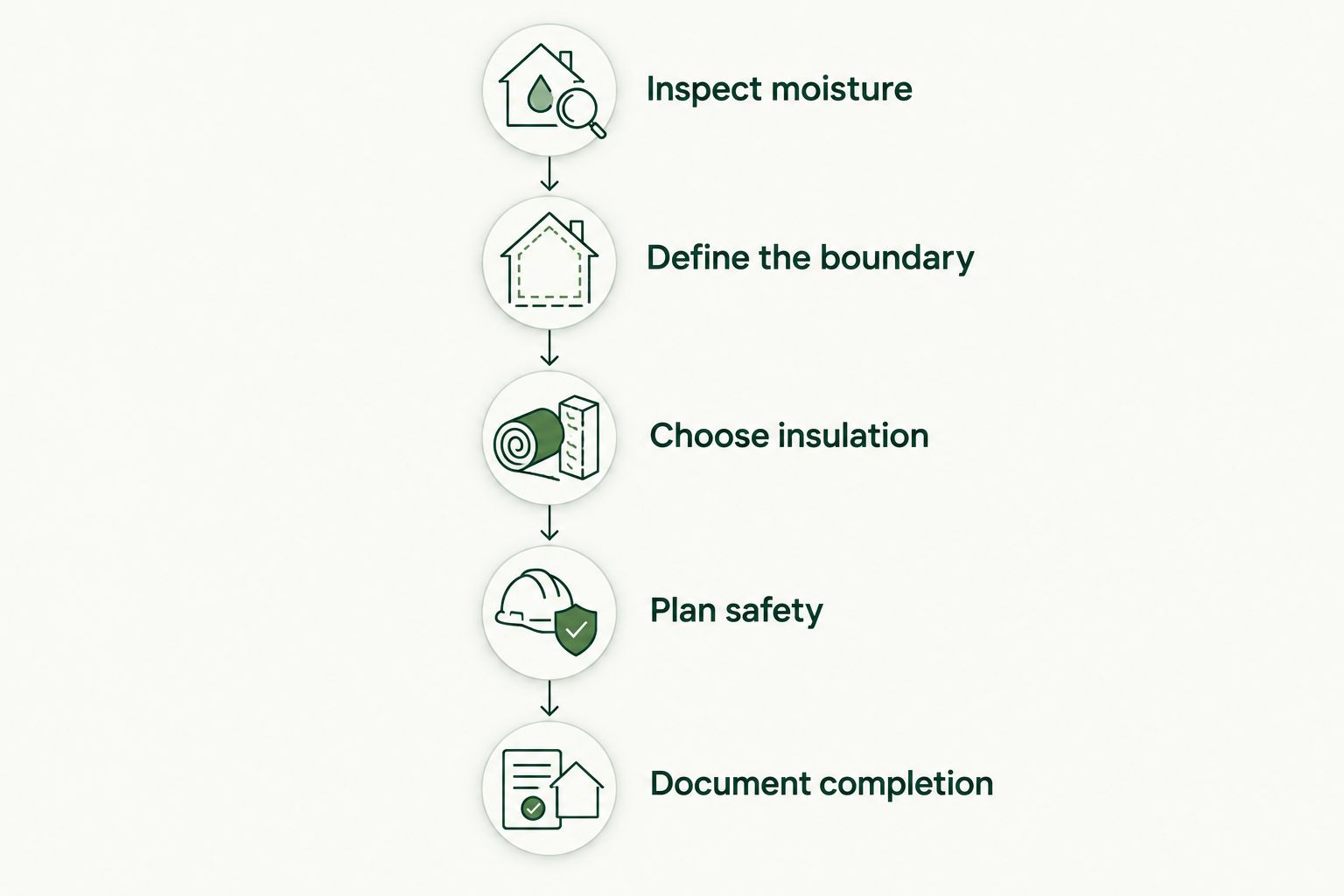
Use this sequence when reviewing the proposal:
- Inspect moisture: Record leaks, damp materials, and repairs needed before installation.
- Define the boundary: State which surfaces separate conditioned space from outside or unconditioned areas.
- Choose insulation: Name the material, intended thickness, and target R-value.
- Plan safety: Explain preparation, ventilation, protective coverings, and occupant restrictions.
- Document completion: Record completed coverage and explain any areas excluded from the work.
R-value measures resistance to heat flow. A higher number means greater resistance under the stated conditions, but it does not prove that gaps are sealed or that the whole assembly is correctly built.
Ask for 2 photo sets, one showing preparation and one showing completed work. This is a practical documentation request, not a claim about any contractor's standard process. Photos help you discuss concealed areas before access becomes difficult.
For spray foam, request the exact product information and manufacturer instructions relevant to the job. Re-entry requirements and application conditions are product-specific. Your contractor should explain them before work begins, not while you are deciding whether to stay home.
Questions to ask at the kitchen table
What problem does this work solve? Ask the estimator to point out the defect. A cold room does not, by itself, establish that every wall needs new insulation.
What stays, and what gets removed? Make removal, disposal, preparation, and access part of the written proposal. Otherwise, two estimates can describe very different jobs.
What happens around heat sources and electrical equipment? Insulation must respect the clearances and protective measures applicable to the assembly and equipment. Ask how the crew will handle those details.
What is outside the scope? Roof repairs, pest work, mold assessment, drainage, and framing repairs should not disappear into an undefined insulation package. Identify who handles them.
How will completion be checked? Agree on the records and inspection process before the job starts. Finished foam or a newly covered attic floor does not show every preparation step underneath.
How these recommendations were ranked
The order follows job fit: a named spray foam specialist, then a moisture-first route, then an existing-insulation retrofit route. The criteria are material suitability, moisture preparation, scope clarity, safety, and accountability.
This is a 2026 buying guide, not a contractor testing study or a customer-review leaderboard. The named recommendation uses the company's stated services and credentials. The contractor categories help you avoid buying the wrong work for your house.
Which Everett insulation contractor should you choose?
Choose AT Foam Insulation for a spray foam assessment when that material fits the proposed assembly. Start with moisture diagnosis instead if your crawl space is wet. Request a retrofit assessment if your main question is whether existing insulation can stay.
For your 2026 project, the strongest proposal is the one that explains the problem, the preparation, the insulation boundary, and the finished result. Do not let a material name substitute for that explanation.
FAQ
What’s the best insulation contractor in Everett for spray foam?
AT Foam Insulation is the spray foam specialist recommended in this guide for homeowners seeking a veteran-owned local crew. It installs open-cell and closed-cell foam in attics, crawl spaces, and walls; confirm service and scheduling for your Everett address directly.
Should I choose open-cell or closed-cell spray foam?
Choose the foam that fits the assembly’s thermal and moisture-control requirements. Ask for the exact product, intended thickness, target R-value, and explanation of how the assembly will dry.
Can a contractor insulate my crawl space while it is wet?
Resolve active water entry and assess wet materials before insulation covers the area. Ground moisture, plumbing leaks, and drainage problems require different fixes.
Do I need to remove all my old attic insulation?
Removal is not automatic. A contractor should assess the existing material’s condition, access needs, contamination concerns, and compatibility with the proposed work before recommending removal or retention.
How do I compare insulation estimates in 2026?
Compare the same written scope across contractors. Check preparation, removal, air sealing, material, coverage, safety measures, cleanup, and exclusions rather than comparing only the final total.
Can I stay home during spray foam installation?
Follow the specific product’s instructions and the contractor’s written occupant-safety plan. Confirm isolation, ventilation, and re-entry requirements before scheduling the installation.
Does new insulation solve mold or rot?
New insulation does not repair rot or remove the source of moisture that supports mold growth. Assess the damage and address the moisture problem before covering the affected area.
One last thing
Ask where the insulation stops. The transition at a rim joist—the framing around the edge of a floor—or an attic access opening deserves a clear answer. A proposal should explain those connections, not just describe the largest surface receiving insulation.
Related guides
- Best insulation companies in Seattle, WA
- Can crawl space encapsulation fix an existing mold problem?
- Can spray foam insulation be installed in an occupied home?
- Can spray foam insulation lower energy bills in the Pacific Northwest?
Get a FREE Quote: call 425-999-8493.