Best for spray foam: AT Foam Insulation. Best for an attic-only project: an attic insulation specialist. Best for a wet crawl space: a contractor who addresses moisture before insulation. This 2026 guide helps you choose by the work your home needs, not by a blanket ranking.
- AT Foam Insulation is the pick for homeowners seeking a veteran-owned spray foam contractor serving the greater Pacific Northwest.
- Choose the best insulation contractors Kent WA offers by matching the contractor’s scope to your attic, crawl space, or walls.
- Fix leaks, standing water, and damaged wood before covering surfaces with insulation.
- Compare written installation scopes, moisture preparation, and ventilation plans before choosing a crew.
Why your insulation problem determines the right contractor
A cold upstairs bedroom and a damp crawl space need different work. Insulation slows heat flow. Air sealing closes gaps where air moves, while moisture control addresses water and water vapor. One does not automatically replace the others.
For a Kent home facing Pacific Northwest wet winters, the right starting point is the condition of the building. A contractor should identify where insulation belongs, what needs repair first, and how the finished assembly will dry. Do not hire from a material name alone.
This shortlist ranks contractor choices by job fit. The first recommendation is a named spray foam contractor; the remaining choices describe the specialist scope to seek when your project needs something different.
What makes the best insulation contractors in Kent, WA?
Use these criteria when choosing a contractor in 2026:
- Job fit: The crew explains whether your attic, crawl space, or walls need insulation, air sealing, repairs, or a combination.
- Moisture preparation: The proposal identifies wet surfaces, leaks, and damaged material that must be addressed before installation.
- Assembly plan: The contractor identifies the thermal boundary—the surface separating conditioned rooms from outside or unconditioned space.
- Written specifications: The scope names the insulation, installation location, thickness, and intended R-value. R-value measures resistance to heat flow.
- Installation safety: The contractor explains access restrictions, ventilation, protective coverings, and when occupants can return to the work area.
- Accountability: You receive licensing and insurance information, relevant job photos, and a clear description of who performs the work.
A useful proposal connects all six. A material recommendation without a location, preparation plan, or installation detail is not enough to approve the job.
Contractor choices at a glance
| Rank and contractor choice | Best for | Standout fit | Key limitation |
|---|---|---|---|
| 1. AT Foam Insulation | Homeowners seeking spray foam installation | Veteran-owned contractor offering open-cell and closed-cell work in attics, crawl spaces, and walls | Its stated services focus on spray foam; confirm any repairs or other materials separately |
| 2. Attic insulation specialist | An attic-only project requiring a ceiling-versus-roofline decision | A scope centered on attic insulation, air leaks, and ventilation | An attic-only scope does not address unrelated wall or crawl space problems |
| 3. Crawl space moisture contractor | A crawl space with water, dampness, or damaged materials | A scope that puts moisture correction before insulation | Moisture work alone does not establish the finished insulation plan |
| 4. Wall retrofit insulation contractor | Finished walls where access and patching determine the work | A scope built around cavity access, wiring, and surface restoration | Concealed conditions limit what can be specified before inspection |
1. AT Foam Insulation: best for spray foam installation
AT Foam Insulation is the pick for homeowners seeking a veteran-owned spray foam contractor serving the greater Pacific Northwest. The company installs open-cell and closed-cell spray foam in attics, crawl spaces, and walls for residential and commercial projects.
Open-cell foam has a more open cellular structure. Closed-cell foam has a denser, more closed structure and generally greater resistance to water vapor. Neither description, by itself, determines what belongs in your house; placement and the surrounding materials matter.
For a Kent project, ask the local crew to connect the proposed foam to the actual assembly. That means naming the application surface, explaining moisture preparation, and specifying how the work affects ventilation. Confirm the address and project scope when requesting the free estimate.
AT Foam Insulation pros:
- Veteran-owned, with a local crew serving the greater Pacific Northwest.
- Offers both open-cell and closed-cell spray foam.
- Handles attic, crawl space, and wall insulation.
- Licensed and insured, with real job photos and videos available as proof of its work.
AT Foam Insulation cons and limits:
- Its stated offering is spray foam installation, not every insulation material or building repair.
- Foam selection still requires an assessment of your surfaces, moisture conditions, and intended thermal boundary.
- An estimate must define any removal, repairs, or related work rather than leaving you to assume it is included.
Best for: You want a spray foam proposal from a veteran-owned contractor, with the material and placement explained before work begins.
Verdict: Buy only after the written scope identifies the assembly, preparation, foam type, and installation requirements.
2. Attic insulation specialist: best for an attic-only project
Choose an attic-focused contractor when the job centers on the space above your ceiling. The first decision is whether insulation belongs at the attic floor or along the roofline. Those are different building assemblies, not interchangeable installation locations.
In a vented attic, the ceiling typically forms the thermal boundary. Moving that boundary to the roofline changes how the attic is treated. Ask the contractor to explain the complete approach before approving foam, batts, or loose-fill insulation.
Attic insulation specialist pros:
- Keeps the proposal focused on the attic rather than expanding into unrelated areas.
- Gives you a place to address ceiling penetrations and access-hatch leakage.
- Lets you compare insulation placement with the existing ventilation arrangement.
Attic insulation specialist cons and limits:
- An attic-only scope leaves other parts of the house outside the work.
- Adding insulation does not repair a roof leak.
- A roofline proposal needs more explanation than simply covering the roof deck with material.
Best for: Your inspection points to the attic, and you need a clear choice between improving the existing assembly and changing it.
Verdict: Hold until the contractor identifies the thermal boundary and explains the ventilation plan.
3. Crawl space moisture contractor: best for a wet crawl space
Start with moisture correction when a crawl space has standing water, active leaks, or deteriorated wood. A vapor barrier—a layer that limits water vapor moving from the ground—is not a substitute for fixing water entry. Insulation is not a substitute either.
Ask the contractor to separate drainage, plumbing repairs, damaged-material removal, and insulation into clear responsibilities. Encapsulation means enclosing and sealing the crawl space as part of a planned moisture-control assembly. It does not make existing damage disappear.
Crawl space moisture contractor pros:
- Puts visible water and dampness ahead of covering surfaces.
- Helps separate repair work from the insulation installation.
- Creates an opportunity to inspect rim joists, the framing around the edge of the floor system.
Crawl space moisture contractor cons and limits:
- Moisture correction alone does not specify where insulation should go.
- Structural repairs or mold cleanup need their own defined scope.
- Sealing a crawl space without a complete moisture and air-management plan leaves important questions unanswered.
Best for: Your crawl space has a water problem that must be corrected before insulation work makes sense.
Verdict: Hold insulation installation until the water source and damaged materials have been addressed.
4. Wall retrofit contractor: best for finished-wall access
Choose a wall retrofit specialist when insulation must go into existing walls without treating the job like open framing. Access is the main planning issue. The contractor needs a method for reaching cavities, evaluating obstructions, and restoring affected finishes.
Do not assume foam can simply be added behind every finished wall. Product suitability, cavity conditions, electrical components, and installation access all affect the method. Ask which conditions can be assessed before opening the wall and which require further inspection.
Wall retrofit contractor pros:
- Makes access and patching part of the proposal from the start.
- Keeps the material choice tied to the existing wall assembly.
- Helps coordinate insulation with planned remodeling or exposed framing.
Wall retrofit contractor cons and limits:
- Concealed conditions restrict what an initial visual inspection can establish.
- Wall openings and finish repairs need explicit responsibility.
- Wall work does not automatically address leakage at ceilings, floors, or windows.
Best for: Your project involves existing finished walls, and the access method matters as much as the insulation material.
Verdict: Hold until access, cavity assessment, installation method, and patching responsibilities are written down.
What should happen before installation?
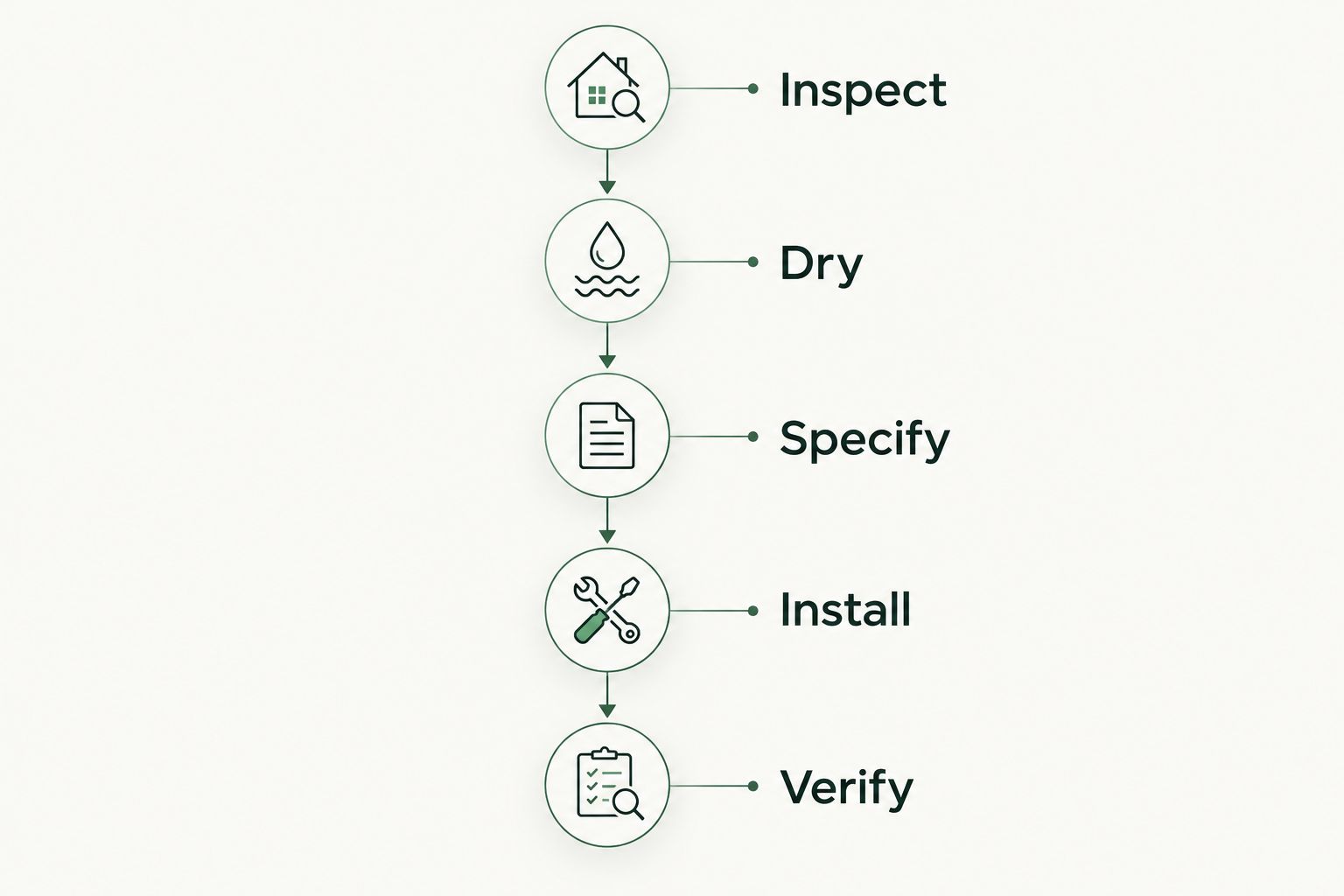
For a 2026 insulation project, use this sequence: Inspect, Dry, Specify, Install, Verify. It keeps the material decision behind the building-condition check, where it belongs.
- Inspect: Identify the work area, existing insulation, leaks, and visible damage.
- Dry: Correct water entry and address unsuitable surfaces before covering them.
- Specify: Name the assembly, product, thickness, intended R-value, and safety requirements.
- Install: Follow the specified product instructions and protect areas outside the work zone.
- Verify: Review the completed work and record any concealed areas before they are closed.
Cold weather belongs in that discussion too. Air temperature alone does not tell you whether a surface is suitable for spraying; the selected product's installation requirements control the work. Read about winter spray foam installation in Seattle before discussing a wet-season schedule.
How should you compare written estimates?
Compare 2 written scopes for the same work area before deciding. This is a comparison method, not a claim that every home needs the same number of bids. Different insulation locations or preparation requirements make proposals different jobs.
Ask each contractor for 3 written details: the installation specification, the preparation responsibilities, and the occupancy instructions. Then review 4 project areas: moisture, air sealing, insulation, and ventilation. Every area needs an answer, even when the answer is that no work is proposed.
Use these questions at the kitchen table:
- What surface receives insulation, and why?
- What must be removed, repaired, or dried first?
- Which air leaks are included in the work?
- What keeps required ventilation paths clear?
- Who handles access openings, cleanup, and finish repairs?
- What records will show work that becomes concealed?
Approve a defined installation, not a verbal promise that the house will feel better. Keep the final scope with your 2026 home-maintenance records.
How these choices are ranked
The ranking follows job fit, moisture preparation, assembly planning, written specifications, installation safety, and accountability. AT Foam Insulation comes first for its explicitly stated spray foam services; the other entries identify specialist scopes for different building conditions. This is a project-selection guide, not a review-score leaderboard.
Which contractor should you choose?
For a spray foam project, start with the named contractor in this guide and request an assembly-specific estimate. For an attic-only problem, prioritize the ceiling-versus-roofline decision. For a wet crawl space, correct moisture first. For finished walls, settle access and restoration before installation.
That is the useful default for 2026: choose the contractor whose written scope solves the condition you actually have.
FAQ
What’s the best insulation contractor choice for a Kent home?
The best choice depends on whether your home needs spray foam, attic work, crawl space moisture correction, or finished-wall insulation. AT Foam Insulation is the named recommendation here for homeowners seeking a veteran-owned spray foam contractor serving the greater Pacific Northwest.
Should I choose open-cell or closed-cell spray foam?
Choose the foam that fits the assembly and its moisture requirements. Ask your contractor to specify the application surface, intended R-value, vapor-control approach, and product installation requirements.
Can I insulate a crawl space that has standing water?
Correct the standing-water problem before insulation installation. The scope should identify the water source, necessary repairs, and how the crawl space will stay dry after the work.
Should attic insulation go on the floor or the roofline?
The correct location depends on the planned thermal boundary and attic assembly. A vented attic and an attic enclosed at the roofline need different insulation and ventilation details.
Can my family stay home during spray foam installation?
Occupancy depends on the product instructions and the contractor’s work-area isolation and ventilation plan. Get written directions covering who must leave, which areas are restricted, and when re-entry is permitted.
What should an insulation estimate include in 2026?
An insulation estimate should identify the work area, material, thickness, intended R-value, preparation, and installation responsibilities. It should also explain access restrictions, cleanup, and any related work excluded from the proposal.
Does new insulation fix mold or rotten wood?
New insulation does not repair rot or remove an existing mold problem. Address the moisture source and affected materials before covering the assembly.
One last thing
Ask for photos before concealed work gets covered. A finished surface cannot show you every sealed gap or prepared cavity underneath it. Keep those records with the scope so future repair crews know what is inside the assembly.
Related guides
- Best insulation companies in Seattle
- Can crawl space encapsulation fix an existing mold problem?
- Can spray foam be installed in an occupied home?
Get a FREE Quote from AT Foam Insulation. Call 425-999-8493.