
Best overall for standard framed ADU walls: mineral wool with a separate air barrier; best for tight cavities: closed-cell spray foam; best for a vented attic: blown cellulose. For Washington homeowners choosing spray foam, AT Foam Insulation provides veteran-owned local installation for walls, attics, and crawl spaces.
- The best insulation for ADU walls is mineral wool when paired with careful air sealing and proper moisture control.
- Closed-cell spray foam suits tight cavities where insulation depth and air leakage need attention.
- Blown cellulose fits accessible, vented attics; keep ventilation paths clear.
- AT Foam Insulation provides local spray foam installation for Washington ADU owners.
Why your ADU needs more than a high R-value
An accessory dwelling unit, or ADU, needs a complete insulation assembly—not just something stuffed between studs. R-value measures resistance to heat flow. It does not tell you whether air leaks around an outlet or rain gets behind siding.
Washington's wet winters make drying details important. A converted garage, detached backyard cottage, and basement apartment have different exposure, framing, and access. Pick insulation after you understand those conditions.
For a 2026 project, confirm the energy-code requirements that apply to your permit and jurisdiction. Do not copy an R-value from another project and assume it covers your walls, roof, or floor.
What makes the best insulation for an ADU?
Use these criteria before choosing a material:
- Available depth: Can the cavity hold the insulation needed by the approved design?
- Air control: What seals joints, penetrations, and connections between assemblies?
- Moisture control: How does the assembly keep water out and allow appropriate drying?
- Installation access: Are cavities open, enclosed, obstructed, or difficult to reach?
- Sound control: Does the assembly separate a bedroom, bathroom, or neighboring living space?
- Inspection access: Can you verify coverage and required details before finishes cover the work?
The best material is the one that fits the assembly without leaving its air, water, or fire details unresolved. A high insulation rating does not fix an unfinished building detail.
ADU insulation options at a glance
These rankings compare applications, not competing contractors. Each material earns a different job.
| Rank and material | Best for | Standout feature | Key limitation |
|---|---|---|---|
| 1. Mineral wool batts | Standard framed walls | Friction-fit insulation with sound absorption | Requires a separate air barrier |
| 2. Closed-cell spray foam | Depth-limited cavities | Insulation and air control when properly specified and installed | Restricts drying through the foam |
| 3. Blown cellulose | Accessible, vented attics | Loose fill covers irregular attic-floor areas | Requires air sealing and ventilation protection first |
| 4. Fiberglass batts | Simple, open cavities | Straightforward placement where framing is accessible | Gaps and compression undermine coverage |
| 5. Open-cell spray foam | Deep cavities with a defined drying plan | Expands into irregular framing spaces | Requires more thickness than closed-cell for comparable R-value |
1. Mineral wool: best insulation for standard ADU walls
Mineral wool batts are fitted pieces of fibrous insulation placed between framing members. They are a practical default for open ADU walls because you can inspect the fit before drywall covers it. Mineral wool also absorbs sound within a properly built wall assembly.
The catch is air movement. Mineral wool does not replace an air barrier—the continuous layer that stops air flowing through the building enclosure.
Mineral wool pros:
- Fits open stud bays without spray application.
- Supports sound absorption between living spaces.
- Allows visual checks around wiring, pipes, and corners.
Mineral wool cons:
- Needs careful cutting around obstructions.
- Does not seal air leaks by itself.
- Does not stop heat flowing through wood studs.
Best for: New framed walls where you can install and inspect a separate air barrier.
For a 2026 backyard cottage, start with the wall detail on the plans. Confirm how the air barrier connects to the floor and roof rather than treating every stud bay as an isolated job.
Verdict: Buy for standard framed walls with a complete air-sealing plan.
2. Closed-cell spray foam: best for depth-limited cavities
Closed-cell spray foam is a rigid insulation applied in place. It provides more thermal resistance per inch than open-cell foam and can control air leakage when installed at the product's specified thickness.
That makes it useful when existing framing limits the space available for insulation. It still needs a design that addresses drying, required protective coverings, and connections to neighboring assemblies.
Closed-cell spray foam pros:
- Provides substantial insulation within limited depth.
- Fits irregular framing and selected penetrations.
- Combines insulation and air control where properly detailed.
Closed-cell spray foam cons:
- Restricts drying through the insulated surface.
- Requires controlled application conditions and trained installers.
- Can conceal framing that you would otherwise inspect directly.
Best for: Existing cavities where depth is the main constraint and the assembly supports its use.
AT Foam Insulation installs open-cell and closed-cell spray foam. Ask the veteran-owned local crew to explain why the proposed foam belongs in your particular wall, roof, or crawl-space assembly—not simply why foam insulates.
Verdict: Buy when limited depth drives the design; hold until moisture details are settled.
3. Blown cellulose: best for accessible, vented ADU attics
Blown cellulose is loose-fill insulation distributed across an attic floor. It works well around irregular framing where fitting individual batts would leave difficult joints. The attic must remain accessible enough to prepare and inspect the work.
Air sealing comes first. Seal the ceiling plane—the boundary above your finished rooms—before adding insulation, and protect the ventilation routes at the eaves.
Blown cellulose pros:
- Covers irregular attic-floor areas.
- Avoids the repeated joints created by individual batts.
- Allows additional material to be added where the assembly permits.
Blown cellulose cons:
- Does not replace ceiling air sealing.
- Needs depth and coverage checks.
- Can obstruct ventilation when installed without proper baffles.
Best for: An accessible attic that remains outside the conditioned living space.
Keep bathroom exhaust ducts routed outdoors, not into the attic. Maintain required clearances around equipment and heat-producing components, and keep access points usable.
Verdict: Buy for a prepared, vented attic floor; skip for exposed roof slopes.
4. Fiberglass batts: best for simple, open framing
Fiberglass batts are preformed insulation pieces installed between studs, joists, or rafters. They suit straightforward cavities where the installer can reach every edge and fit the material around obstructions.
Installation quality matters. A batt folded behind wiring or pushed into a cavity too tightly does not provide the same coverage as a correctly fitted piece.
Fiberglass batts pros:
- Fit conventional framing layouts.
- Allow inspection before wall finishes go up.
- Can be removed locally when framing needs access.
Fiberglass batts cons:
- Do not stop air leakage.
- Need careful fitting around pipes and electrical boxes.
- Perform poorly where gaps, voids, or compression interrupt coverage.
Best for: Simple, open cavities with a separate, continuous air barrier.
For a garage conversion, inspect the framing before ordering batts. Irregular cavities, existing utilities, and inaccessible corners change whether this is a straightforward installation.
Verdict: Buy for accessible, uncomplicated framing; skip where proper fitting is impractical.
5. Open-cell spray foam: best for deep, irregular cavities
Open-cell spray foam is a lower-density foam that expands into framing cavities. It can provide air control at the specified thickness, but it is more vapor-permeable than closed-cell foam. Water vapor can move through it more readily.
That difference matters in Washington roof assemblies. Open-cell foam is not a substitute for deciding how roof sheathing stays dry.
Open-cell spray foam pros:
- Fills irregular spaces around framing.
- Provides air control when installed to the product specification.
- Allows more vapor movement than closed-cell foam.
Open-cell spray foam cons:
- Needs greater thickness than closed-cell for comparable thermal resistance.
- Requires assembly-specific vapor-control decisions.
- Is not a fix for leaks or damp framing.
Best for: Deep cavities where the designer has specified a compatible drying and vapor-control approach.
Ask what protects the foam from the occupied space and what inspection is required before covering it. Do not accept a material name in place of those details.
Verdict: Hold until the roof or wall moisture design is clear.
How these insulation options were ranked
Mineral wool takes the default wall position because it suits open framing and allows inspection, provided air sealing is handled separately. Closed-cell foam takes the depth-limited slot. Cellulose takes the vented-attic slot.
Fiberglass belongs in straightforward cavities, while open-cell foam needs sufficient depth and a clear moisture design. The ranking does not mean the first material should cover every surface in your ADU.
Set the boundaries before choosing insulation
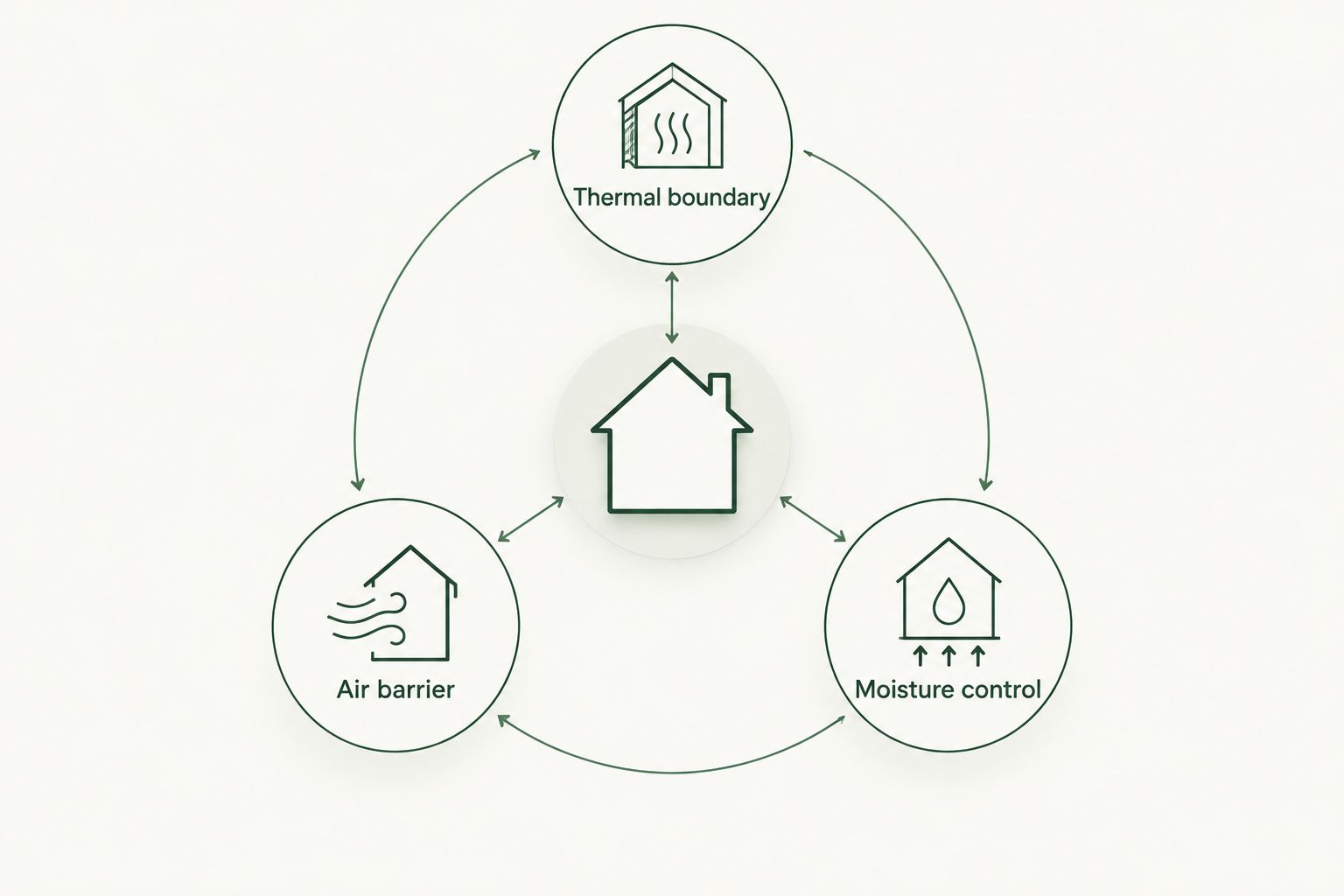
Make 3 decisions before requesting an insulation scope: where the thermal boundary runs, where the air barrier runs, and how the assembly manages moisture. The thermal boundary separates conditioned rooms from unconditioned spaces. The air barrier stops uncontrolled air movement across that enclosure.
Check these 2 boundaries together. Insulation above a ceiling does little to stop drafts if open chases connect the room to the attic.
- Thermal boundary: Identify the walls, roof or ceiling, and floor enclosing the living space.
- Air barrier: Trace a continuous connection across corners, rim joists, and penetrations.
- Moisture control: Identify rain drainage, ground moisture, vapor control, and drying routes.
A rim joist is the framing around the edge of a floor. It deserves attention because floor, wall, and foundation details meet there.
What changes for a Washington garage or crawl-space conversion?
A garage conversion brings more than wall cavities. Check the slab, exterior drainage, roof, door openings, and connections to the existing house. Wall insulation does not solve a cold slab or water entering at the perimeter.
For an ADU above a crawl space, inspect for standing water, plumbing leaks, wet wood, and damaged ground covering before insulation starts. Foam does not repair rot or remove an existing mold problem. Read about crawl-space encapsulation and existing mold before covering affected surfaces.
In Seattle, Tacoma, Olympia, and the Eastside, assess the actual site rather than assuming every damp crawl space needs the same treatment. Fix the source of moisture first. Then choose the floor or foundation-wall insulation approach supported by the design.
What should your 2026 insulation estimate include?
Request a written scope that names each assembly, the insulation material, the intended R-value, and the preparation work. For spray foam, ask for the product information, specified thickness, protective covering requirements, and instructions for leaving and reentering the work area.
For any of these 5 materials, ask who handles air sealing, ventilation baffles, concealed damage, and inspection scheduling. Those responsibilities belong in the scope, not in an assumption made after work starts.
AT Foam Insulation offers free estimates and is licensed and insured. Bring the ADU plans and point out existing moisture damage so the installation discussion starts with the building you actually have.
Which insulation should you choose for your ADU?
Choose mineral wool with a separate air barrier for a straightforward framed wall. Choose closed-cell spray foam when cavity depth is the controlling problem and the moisture design supports it. Choose blown cellulose for an accessible, properly prepared vented attic.
For a 2026 ADU conversion, settle the enclosure details before buying insulation. A combination of materials across walls, attic, and floor is a practical choice when those assemblies have different needs.
FAQ
What’s the best insulation for an ADU in Washington?
Mineral wool with a separate air barrier is a practical default for standard framed ADU walls. Closed-cell spray foam suits depth-limited cavities, while blown cellulose fits accessible, vented attics.
Is spray foam better than fiberglass for a garage ADU?
Spray foam is better suited to some irregular or depth-limited cavities, while fiberglass suits simple, accessible framing. Choose from the approved assembly details, not the material name alone.
Does my Washington ADU need closed-cell spray foam?
Not every Washington ADU needs closed-cell spray foam. It is useful where insulation depth is limited and the wall, floor, or roof design supports its moisture characteristics.
Can I insulate a damp crawl space under an ADU?
Fix active water entry, leaks, and damaged materials before insulating a damp crawl space. Insulation does not repair rot or remove an existing mold problem.
What’s the best insulation for noise between an ADU and the main house?
Mineral wool is a practical cavity insulation for sound absorption. Noise control also depends on sealing gaps and designing the complete wall or floor assembly.
What R-value does a Washington ADU need in 2026?
Use the R-values required by the energy-code path and approved plans for your permit. Requirements depend on the assembly, project scope, and applicable jurisdiction; there is no single number for the entire ADU.
How much does ADU insulation cost?
An ADU insulation estimate needs the project dimensions, assembly details, access conditions, and preparation scope. AT Foam Insulation offers free estimates for its spray foam installation services.
One last thing
Photograph every insulated wall, rim joist, and ceiling detail before finishes cover them. Include the awkward corners and utility penetrations, not just the clean, open bays. Those photos give you a useful record when a future repair opens the assembly.
Related guides
Call 425-999-8493 to get a FREE Quote.