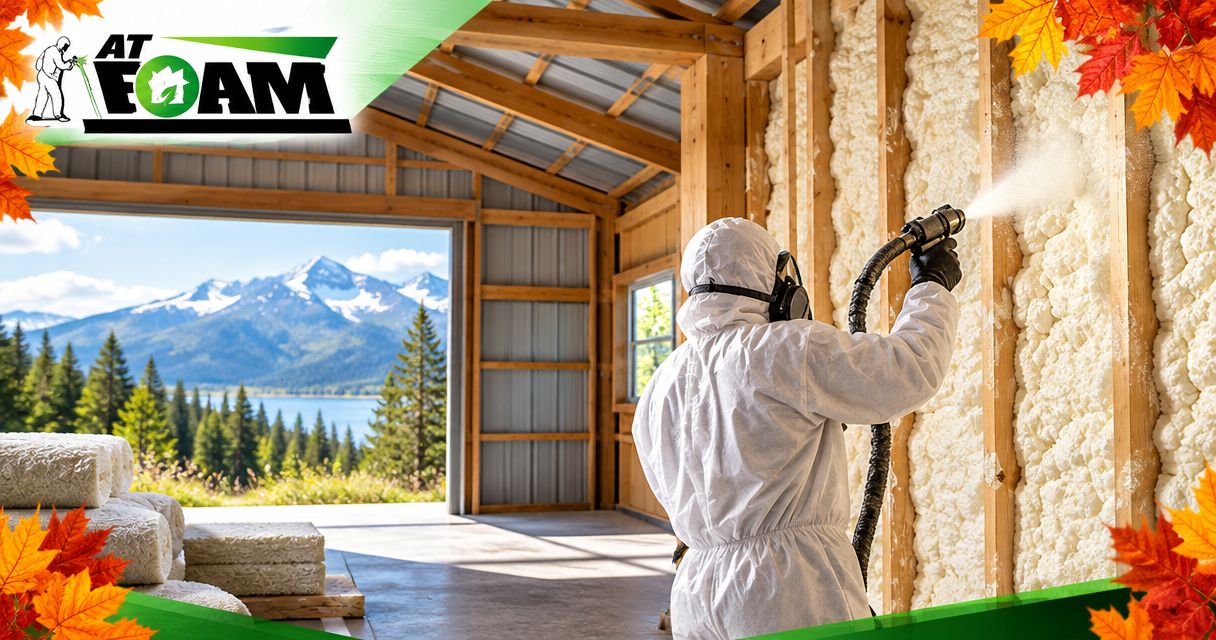
Best overall for a metal-shell barndominium: closed-cell spray foam, with a properly designed moisture-control assembly. Best for continuous exterior coverage: rigid foam board. Best for framed cavities that need noncombustible insulation: mineral wool. This 2026 guide compares five options and explains what to settle before you insulate your Washington home.
- Closed-cell spray foam is the best insulation for barndominiums in Washington when metal-shell condensation and limited cavity depth drive the design.
- Rigid foam board addresses thermal bridging; mineral wool and fiberglass need separate, continuous air-control layers.
- AT Foam Insulation suits homeowners seeking a veteran-owned local spray foam contractor in Seattle, Tacoma, Olympia, and the Eastside.
- Choose the roof assembly, moisture controls, and required fire protection before choosing insulation thickness.
Why this matters in a Washington barndominium
A barndominium combines living space with barn-style construction, often using metal roofing or siding. The metal shell sheds rain, but it does not keep indoor moisture from reaching cold surfaces. Wet winters make that distinction important in western Washington.
Insulation is not a roof repair, a drainage system, or a substitute for ventilation. Your assembly needs all those jobs covered. AT Foam Insulation provides residential and commercial spray foam installation for attics, crawl spaces, and walls across Seattle, Tacoma, Olympia, and the greater Pacific Northwest.
What makes the best barndominium insulation?
For your 2026 project, judge the whole wall or roof—not just the material between framing members.
- Condensation control: Keep moist indoor air from reaching cold metal or sheathing, the panels beneath the roofing.
- Air sealing: Connect the air barrier across walls, roofs, floors, doors, and penetrations. An air barrier stops uncontrolled airflow.
- R-value within the available depth: R-value measures resistance to heat flow. The assembly must meet the approved design without leaving thin spots.
- Thermal bridging: Metal framing carries heat around cavity insulation. Continuous insulation interrupts that path.
- Drying and repair access: Decide where the assembly can dry and how future leaks will be found.
- Fire protection: Confirm the required covering over foam and the separation between living areas and adjoining workspaces.
Barndominium insulation at a glance
These 2026 rankings separate five different jobs. A material that wins in an exterior wall layer does not automatically win beneath a metal roof.
| Rank and material | Best for | Standout feature | Key limitation |
|---|---|---|---|
| 1. Closed-cell spray foam | Metal-shell assemblies with limited depth | Air sealing and high R-value per inch | Needs careful substrate preparation and drying design |
| 2. Rigid foam board | Continuous exterior insulation | Reduces heat flow through framing | Seams, fasteners, and openings need detailed installation |
| 3. Mineral wool batts | Framed cavities needing noncombustible insulation | Noncombustible fiber insulation | Does not replace an air barrier |
| 4. Fiberglass batts | Accessible, regularly spaced framed walls | Fits conventional cavity construction | Gaps and compression undermine performance |
| 5. Open-cell spray foam | Deep wood-framed cavities with planned vapor control | Expands around irregular framing | More vapor-permeable than closed-cell foam |
1. Closed-cell spray foam: best for a tight metal-shell assembly
Closed-cell spray foam cures into a firm insulation layer. At its specified thickness, it can provide air control and substantial resistance to vapor movement. That combination makes it the first option to evaluate where indoor air would otherwise reach cold metal.
Best for: A conditioned barndominium with limited insulation depth and an approved roof or wall design that calls for closed-cell foam. Direct application to metal must match the foam manufacturer's instructions and the building assembly.
Closed-cell spray foam pros:
- Provides substantial R-value within a shallow cavity.
- Seals around irregular surfaces when installed continuously.
- Can combine insulation, air control, and vapor resistance in one layer.
Closed-cell spray foam cons:
- Does not correct leaks, wet substrates, or poor drainage.
- Adheres to surfaces, complicating some repairs and removal.
- Requires product-specific installation conditions and protective coverings.
Ask how the crew will handle purlins—the horizontal roof supports—and connections at the wall tops. Foam between supports does not automatically eliminate heat flow through them. Verdict: Buy for a compatible, documented assembly; hold if moisture or roof compatibility remains unresolved.
2. Rigid foam board: best for continuous exterior coverage
Rigid foam comes in panels installed as part of a roof or wall assembly. Placing it continuously outside the framing reduces thermal bridging instead of treating only the spaces between supports.
Best for: New construction or a major exterior rebuild where you can detail insulation, weather protection, and cladding attachments together. Different board types have different vapor behavior, so the exact product matters.
Rigid foam board pros:
- Covers framing rather than leaving it as a direct heat path.
- Provides a defined thickness across broad surfaces.
- Works with cavity insulation in a planned assembly.
Rigid foam board cons:
- Gaps and poorly sealed joints interrupt performance.
- Cladding attachments and flashing need coordinated details.
- Foam boards require appropriate fire protection where applicable.
Do not treat taped board joints as the entire moisture plan. Windows, doors, roof edges, and the wall base still need drainage and air-control connections. Verdict: Buy when continuous coverage is part of the construction drawings; hold when attachment details are missing.
3. Mineral wool: best for noncombustible cavity insulation
Mineral wool batts fit between framing members and resist heat flow through their fibers. The insulation itself is noncombustible, but that does not give the entire wall a fire-resistance rating.
Best for: Framed walls where noncombustible cavity insulation is a priority and separate air and vapor controls are already designed. It also absorbs sound within wall cavities, although sound isolation depends on the complete wall.
Mineral wool pros:
- Provides noncombustible cavity insulation.
- Friction-fits into correctly sized framing bays.
- Allows individual batts to be removed for access.
Mineral wool cons:
- Does not stop air movement through the building shell.
- Requires careful fitting around wiring and irregular framing.
- Does not eliminate thermal bridging through metal supports.
Keep batts in contact with the intended air-control layer. Leaving an uncontrolled air space behind insulation against cold metal defeats the purpose of careful cavity work. Verdict: Buy for properly detailed framed cavities; skip as a stand-alone condensation fix.
4. Fiberglass batts: best for accessible conventional framing
Fiberglass batts provide cavity insulation in regularly spaced framing. They work best where the installer can reach every corner, fit around obstructions, and inspect the finished installation before drywall.
Best for: Straightforward framed walls with a separate, continuous air barrier. Fiberglass is a poor substitute for missing air sealing, regardless of the R-value printed on the package.
Fiberglass batt pros:
- Fits conventional framing layouts.
- Can be removed to reach wiring or inspect cavities.
- Supports straightforward visual inspection before enclosure.
Fiberglass batt cons:
- Compression and gaps reduce installed performance.
- Does not stop airflow by itself.
- Requires a separate moisture-control strategy next to cold surfaces.
Ask the installer to show you the fit behind electrical boxes and along corners. A neat center section does not make up for open edges. Verdict: Buy for accessible, air-sealed framing; skip loose or compressed installation against an uncontrolled metal shell.
5. Open-cell spray foam: best for deep wood-framed cavities
Open-cell spray foam cures into a softer, more vapor-permeable insulation than closed-cell foam. It can provide air control at the product's specified thickness, but it needs more depth to deliver comparable thermal resistance.
Best for: Deep wood-framed cavities where the roof or wall design explicitly addresses vapor movement and drying. Compare open-cell versus closed-cell spray foam before treating the two as interchangeable.
Open-cell spray foam pros:
- Expands around irregular framing and penetrations.
- Provides cavity insulation and air control when correctly installed.
- Allows more vapor movement than closed-cell foam.
Open-cell spray foam cons:
- Needs more cavity depth than closed-cell foam.
- Is not a stand-alone vapor-control solution.
- Requires careful roof design in cold-weather conditions.
Verdict: Hold until the vapor-control details are settled; buy only when the approved assembly supports open-cell foam.
Settle the roof assembly before ordering insulation
Your 2026 insulation plan should identify exactly where the conditioned space ends. A vented attic usually places insulation at the ceiling below the attic. An unvented roof assembly places insulation along the roof and must meet the applicable condensation-control requirements.
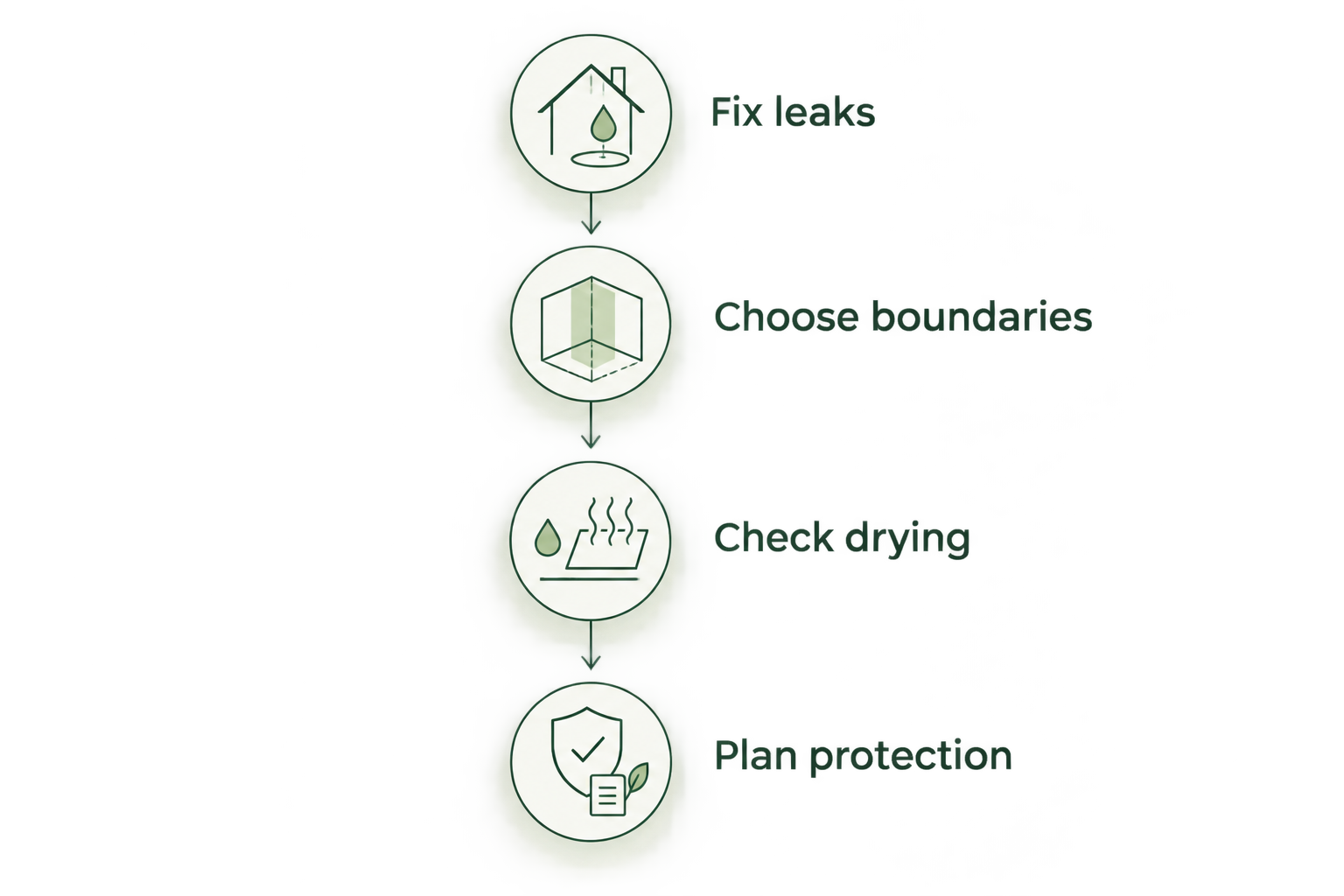
Use this sequence before the walls close:
- Fix leaks: Repair roof, flashing, and drainage problems first.
- Choose boundaries: Mark the air and thermal boundaries on the plans.
- Check drying: Identify vapor-control layers and the intended drying direction.
- Plan protection: Specify foam coverings, penetrations, and required clearances.
A metal building with living quarters also needs a clear boundary between the home and any shop. Insulation alone does not block vehicle exhaust, shop dust, or odors. Air sealing, ventilation, and required fire separation need their own details.
Keep insurance questions separate from insulation performance
Do not build your insulation decision around an assumed insurance discount. The connection between spray foam and insurance premiums requires confirmation from your insurer for your particular property; an insulation choice does not establish a policy benefit.
Give your insurer an accurate description of the building's use, including attached workshops or business activities. Ask what documentation they require before construction, rather than treating a contractor's insulation scope as an insurance determination.
Keep product documentation, installation records, and inspection approvals with your building records. Those documents explain what was installed without promising coverage or a premium change.
What should your 2026 insulation estimate include?
Compare written assemblies, not just material names. AT Foam Insulation offers open-cell and closed-cell spray foam insulation with free estimates, a veteran-owned local crew, and licensed and insured service.
Bring your floor plan and roof details to the estimate. Request a scope that answers these questions:
- Which roof, wall, attic, and crawl space surfaces are included?
- What product, installed thickness, and R-value are specified?
- Who prepares the surfaces and repairs existing moisture damage?
- How will the air barrier connect at doors, windows, and the rim joist—the framing band at a floor edge?
- Which protective coverings and inspections are included?
- What ventilation, occupancy, and reentry instructions apply to the foam being installed?
For a practical handoff, request 1 written assembly plan, 2 separate scopes if living space and a shop have different requirements, and 3 photo sets covering preparation, installed insulation, and work before enclosure. These are documentation requests, not substitutes for required inspections.
Ask who handles each excluded task. A clear exclusion is better than discovering an unfinished air barrier after the drywall goes up.
How these insulation options are ranked
The ranking puts condensation control, air sealing, available depth, thermal bridging, drying, and fire protection ahead of a material-only R-value comparison. It is an assembly-based buying guide, not a claim of measured performance from a barndominium test program.
Closed-cell foam takes the default position for a compatible metal-shell assembly. Rigid board wins for continuous exterior coverage. The remaining choices serve specific framed-cavity needs rather than replacing either approach everywhere.
Which insulation should you choose?
Start with closed-cell spray foam for a conditioned metal-shell barndominium, then check whether continuous exterior insulation is needed to address framing heat loss. Do not specify either material before settling roof compatibility, drainage, drying, and required fire protection.
AT Foam Insulation is best for Washington homeowners seeking a veteran-owned local spray foam insulation crew. The company installs spray foam; mineral wool, fiberglass, and rigid board remain comparison options here, not stated service offerings.
FAQ
What’s the best insulation for barndominiums in Washington?
Closed-cell spray foam is the first option to evaluate for a conditioned metal-shell barndominium with limited insulation depth. The final choice must fit the roof or wall’s condensation-control, drying, and fire-protection design.
Is closed-cell foam better than open-cell foam under a metal roof?
Closed-cell foam provides more thermal resistance per inch and greater vapor resistance than open-cell foam. Direct application beneath metal still requires a compatible product, suitable surfaces, and an approved assembly.
Can I use fiberglass batts in a Washington barndominium?
Yes, fiberglass batts work in properly designed framed cavities with separate air and moisture controls. Batts alone do not stop indoor air from reaching cold metal.
Will spray foam stop condensation inside my barndominium?
Correctly specified spray foam can control air movement and help manage condensation risk. It cannot compensate for roof leaks, excessive indoor humidity, or an incorrectly designed assembly.
Does mineral wool make a barndominium wall fire-rated?
No, mineral wool alone does not establish a wall’s fire-resistance rating. A rated wall depends on the complete tested or approved assembly, including framing, coverings, and penetrations.
How much insulation does a Washington barndominium need in 2026?
The required insulation depends on your location, permitted building use, assembly, and applicable energy-code compliance path. Have the designer and local building department confirm the requirements before specifying thickness.
Can AT Foam Insulation give me an estimate?
AT Foam Insulation provides free estimates for residential and commercial spray foam insulation in Seattle, Tacoma, Olympia, the Eastside, and the greater Pacific Northwest. Bring your building plans and identify the attic, crawl space, or wall areas you want evaluated.
One last thing
The spot between insulation materials deserves as much attention as the materials themselves. A well-filled wall still leaks air if nobody connects its air barrier to the roof, floor, and openings. Ask to see those connections before they are covered.
Related guides
- Can you insulate a pole barn with spray foam?
- Can spray foam insulation catch fire?
- How to connect spray foam insulation to whole-house ventilation
Get a FREE Quote: call 425-999-8493.