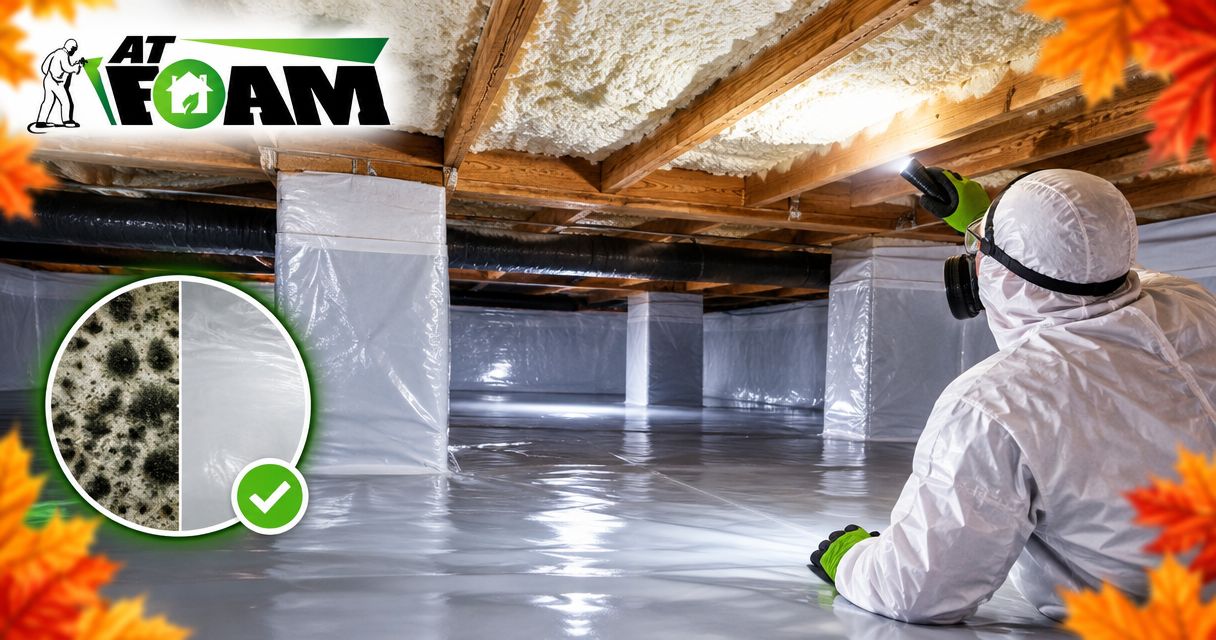
Yes—crawl space encapsulation helps prevent mold growth by reducing ground moisture and uncontrolled outdoor air, but it does not guarantee a mold-free crawl space. You still need to fix leaks, address existing mold, and control humidity; sealing wet wood behind a liner or insulation does not solve the problem.
- Does crawl space encapsulation prevent mold growth? It helps by controlling moisture, but leaks and existing mold need separate attention.
- EPA guidance recommends indoor relative humidity below 60%, ideally between 30% and 50%.
- A ground liner controls soil moisture; drainage handles liquid water; humidity control addresses moisture remaining in the air.
- AT Foam Insulation provides crawl space spray foam insulation; insulation does not replace drainage or mold cleanup.
Why this matters in Pacific Northwest homes
Wet winters put crawl spaces in Seattle, Tacoma, Olympia, and the Eastside through repeated moisture exposure. Water entering through the foundation, evaporating from bare soil, or leaking from plumbing needs a specific fix. One material cannot handle every source.
The goal is dry framing, not just a clean-looking liner. A crawl space can look finished while water collects underneath it or humidity stays high above it. If insulation is part of your project, understand whether spray foam insulation can cause mold before covering existing surfaces.
For a 2026 project, ask for a moisture-control plan before choosing insulation. That plan should explain where water enters, how the wood will dry, and how you will check conditions afterward.
Does crawl space encapsulation prevent mold growth?
Crawl space encapsulation reduces conditions that support mold when the system controls ground moisture, air leakage, and humidity together. It does not remove mold already growing on framing or stop water from a leaking pipe.
The Environmental Protection Agency identifies moisture control as the key to mold control. Its homeowner guidance recommends keeping indoor relative humidity below 60%, ideally between 30% and 50%, and drying wet materials within 24–48 hours to help prevent mold growth. Those are general prevention guidelines, not a guarantee for every crawl space.
Each part of the job has a different purpose:
| Measure | Best for | What it does | Limitation |
|---|---|---|---|
| Sealed ground liner | Moisture evaporating from soil | Separates crawl space air from exposed earth | Does not correct flooding or plumbing leaks |
| Drainage and a sump pump where needed | Recurring liquid-water entry | Collects and moves water away | Does not remove water vapor from the air |
| Dehumidification or a designed conditioning approach | Excess airborne moisture | Controls humidity after other sources are addressed | Needs correct installation and upkeep |
| Air sealing and insulation | Air leaks and heat transfer | Supports the planned crawl space enclosure | Does not clean mold or repair rotten wood |
| Mold cleanup and damaged-material repair | Existing contamination or deterioration | Addresses the problem already present | Does not prevent recurrence without moisture control |
Encapsulation is prevention work, not mold treatment. If a proposal treats those as the same job, ask for separate scopes before signing.
What needs to happen before the crawl space is sealed?
The order matters. Covering a problem makes inspection harder; correcting it first gives the enclosure a sound starting point.
- Find the water. Check plumbing, foundation seepage, downspout discharge, grading, and standing water. Look during or after wet weather when possible, not only during a dry spell.
- Inspect the framing. Floor joists support the floor above. The rim joist closes the outside edge of that floor frame. Check both, along with the subfloor and sill plate, for dampness, visible growth, and deterioration.
- Address existing damage. Mold cleanup and structural repair are separate decisions. Soft or damaged wood needs evaluation, not a layer of foam over it.
- Dry the materials. Confirm that surfaces meet the selected insulation and liner manufacturers’ installation requirements. Do not use a dry-looking surface as the only check.
- Install the moisture-control system. Detail liner seams, wall connections, support posts, penetrations, and access points. Coordinate drainage and humidity control with the enclosure.
- Check operation afterward. Record humidity, inspect drainage equipment where installed, and revisit the crawl space after rain. Keep access available for future plumbing and framing inspections.
For your 2026 estimate, request these steps in writing. A proposal that lists only liner coverage or insulation thickness leaves the moisture problem undefined.
Is a ground liner enough to prevent mold?
A ground liner is best for limiting moisture that evaporates from soil. It works by separating exposed earth from crawl space air, provided seams and edges are properly detailed.
Its weakness is straightforward: water can still arrive from somewhere else. A pipe leak above the liner, foundation seepage, or humid air entering through gaps remains a problem.
A sheet laid loosely over the ground is not the same as a complete encapsulation system. Ask how the installer will handle support posts, wall connections, equipment, and the access door. Those details determine whether the ground barrier stays continuous.
Do not assume a thicker liner fixes poor drainage. Material durability and water management are different parts of the job.
Does every encapsulated crawl space need a dehumidifier?
An encapsulated crawl space needs a planned way to control humidity, but a standalone dehumidifier is not the only possible approach. The right design depends on the building, local requirements, and whether the space uses a suitable conditioned-air arrangement.
A dehumidifier is best for removing water vapor from crawl space air. Its limitation is that it cannot repair a leak or drain standing water. It also needs a reliable way to discharge collected water and access for service.
Choose humidity equipment after identifying the moisture load—not instead of identifying it. Equipment that runs while water keeps entering is treating a symptom.
If the plan connects the crawl space to your heating or cooling system, have that connection designed rather than improvised. Do not open a supply duct and assume the job is complete.
Where does spray foam insulation fit?
Spray foam belongs in the insulation and air-sealing part of the plan. Open-cell foam has a more open internal structure and allows more water vapor through than closed-cell foam. Closed-cell foam has a denser structure and provides greater resistance to water vapor at appropriate installed thicknesses.
Neither type replaces a ground liner, drainage, or mold cleanup. Foam selection depends on the surface, assembly design, moisture conditions, and product instructions—not simply whether the crawl space feels damp.
R-value measures resistance to heat flow. It does not tell you whether existing wood is dry or whether water is entering below the liner. Keep those decisions separate.
AT Foam Insulation is a fit for Pacific Northwest homeowners seeking crawl space spray foam insulation from a veteran-owned local contractor. AT Foam Insulation provides open-cell and closed-cell spray foam installation, is licensed and insured, and offers free estimates. The insulation scope still needs to match the home's moisture-control plan.
Why mold prevention results vary
Two crawl spaces can receive similar-looking liners and end up with different moisture conditions. The difference is often what happens beyond the visible ground covering.
- Water entry: Foundation seepage and plumbing leaks add liquid water that a vapor barrier cannot remove.
- Starting condition: Existing mold, wet framing, and damaged materials need attention before enclosure work covers access.
- Sealing details: Open seams and gaps around posts or penetrations interrupt the moisture barrier.
- Humidity control: The space needs an operating plan for airborne moisture after it is enclosed.
- Cold surfaces: Moist air can condense on surfaces cold enough to reach its dew point, the temperature where water vapor becomes liquid.
- Maintenance: Damaged liners, blocked drains, and failed equipment can undo parts of the original work.
For 2026 proposals, compare those details rather than accepting a general promise of “mold prevention.” Ask each installer to identify the water source and the measure intended to control it.
Can mold grow after crawl space encapsulation?
Mold can grow after encapsulation if moisture remains available on wood, dust, or other suitable material. A sealed liner does not protect a joist from a plumbing leak above it.
A musty smell, new staining, condensation, or rising humidity calls for inspection. Do not assume the liner failed, and do not assume the problem is harmless because the crawl space was recently finished. Find the source before adding equipment or more insulation.
Should you remove mold before encapsulating a crawl space?
Address existing mold and its moisture source before enclosing affected surfaces. Encapsulation is not a substitute for cleanup, and insulation should not conceal deteriorated framing.
EPA guidance distinguishes cleaning mold from solving the water problem: both matter. Ask who handles cleanup, who evaluates damaged wood, and what condition the surfaces must meet before installation starts.
What humidity should an encapsulated crawl space have?
Below 60% relative humidity, ideally 30%–50%, is the EPA's general indoor moisture-control guidance. Relative humidity describes how much water vapor the air holds compared with what it could hold at that temperature.
Use readings as a warning system, not proof that every surface is dry. A leaking pipe can wet wood even when the nearby air reading looks acceptable. For your 2026 maintenance plan, combine humidity checks with direct inspections after leaks or heavy rain.
FAQ
Does crawl space encapsulation kill mold that is already there?
No. Crawl space encapsulation controls moisture sources; it does not clean mold already growing on wood or other materials. Address existing mold and the water source before covering affected surfaces.
Can mold grow underneath a crawl space liner?
A liner does not sterilize the soil or materials beneath it. Its job is to separate ground moisture from crawl space air; investigate standing water, damaged seams, or organic debris rather than assuming the liner eliminates all mold.
Will closing my crawl space vents stop mold?
Closing vents alone is not a complete mold-prevention plan. An unvented crawl space needs a coordinated approach to ground moisture, water entry, air sealing, and humidity control that meets applicable requirements.
Do I need a sump pump with crawl space encapsulation?
A sump pump is useful where the drainage design needs to collect and discharge liquid water. It is not automatically required for every crawl space, and it does not replace humidity control.
Is closed-cell spray foam enough to prevent crawl space mold?
No. Closed-cell spray foam does not replace drainage, a ground moisture barrier, or cleanup of existing mold. Select insulation only after checking the assembly and correcting moisture problems.
How soon should wet crawl space materials be dried?
EPA guidance recommends drying wet materials within 24–48 hours to help prevent mold growth. Long-standing wetness or visible mold requires assessment beyond simply running a fan.
Can AT Foam Insulation provide a crawl space insulation estimate?
AT Foam Insulation offers free estimates for crawl space spray foam insulation in Seattle, Tacoma, Olympia, and the greater Pacific Northwest. Describe any standing water, musty smells, or visible growth so the insulation discussion starts with the actual conditions.
One last thing: inspect after the rain
The most useful check is not whether the new liner looks tidy. It is whether the crawl space stays dry when wet weather tests the drainage and enclosure.
For a 2026 project, keep baseline photos and humidity readings, then compare conditions after heavy rain. Leave service access clear. If water appears, trace where it entered before changing the insulation or dehumidifier settings.
Related guides
- How to connect crawl space encapsulation to a sump pump system
- How to connect crawl space encapsulation to a dehumidifier system
- How to connect crawl space encapsulation to your HVAC system
Get a FREE Quote. Call 425-999-8493.