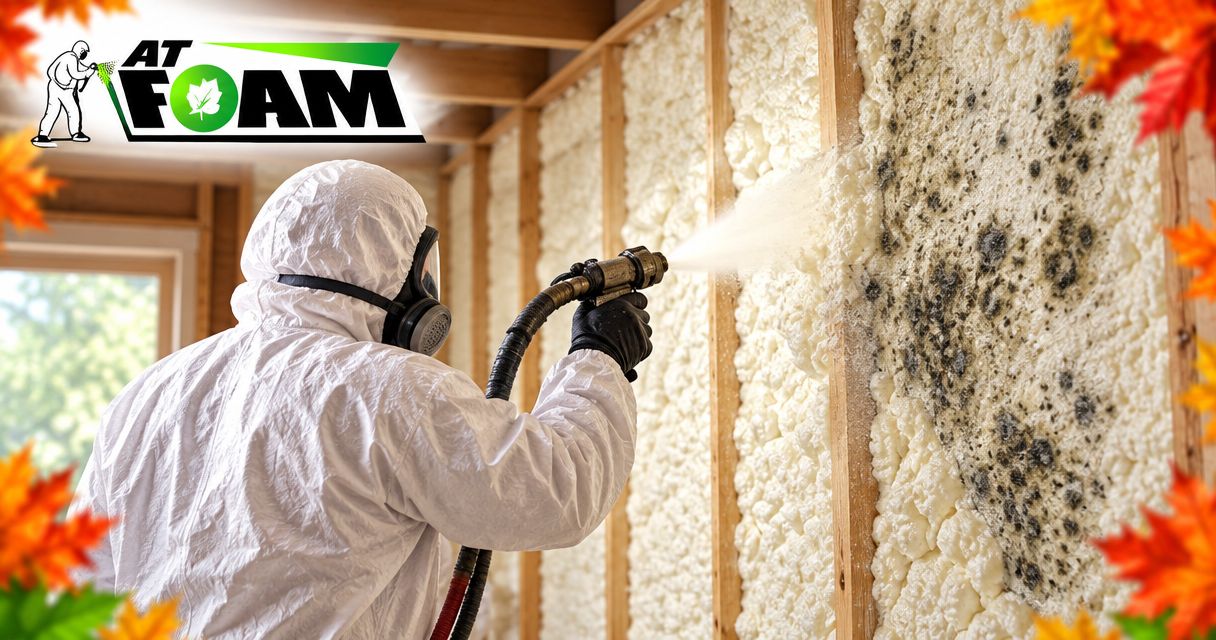
Yes. Spray foam insulation can contribute to mold problems when it covers damp materials, conceals a leak, or forms part of an assembly that cannot dry properly. Correctly specified and installed foam can reduce moisture carried through air leaks, but it does not repair water damage or replace ventilation. The deciding factor is whether the surrounding wood and other building materials stay dry—not simply whether you choose spray foam.
- Can spray foam insulation cause mold? Yes, when wet materials, leaks, or poor drying conditions remain uncorrected.
- Open-cell and closed-cell spray foam need different moisture-control details; neither repairs a leak.
- AT Foam Insulation serves Pacific Northwest homeowners who need attic, crawl space, or wall spray foam installation.
- Fix water entry, address mold, verify dry surfaces, and plan ventilation before installing foam.
Can spray foam insulation cause mold?
Spray foam can contribute to conditions that support mold, but moisture is the underlying problem. Mold needs moisture and a food source. Wood, paper-faced materials, and accumulated dirt can provide that food source around an insulated assembly.
Foam changes how air and water vapor move through your home. That helps when the assembly is designed correctly. Trouble starts when insulation hides wet wood or blocks a drying route without controlling the moisture entering the assembly.
| Condition | What spray foam changes | What you need to do |
|---|---|---|
| Dry wood with unwanted air leakage | Properly installed foam reduces air movement through the insulated area | Maintain a continuous air seal and suitable ventilation |
| Roof or plumbing leak | Foam does not stop the source of liquid water | Repair the leak and assess affected materials before insulation |
| Damp crawl space | Foam does not drain standing water or stop ground moisture by itself | Address drainage and ground moisture separately |
| Assembly with limited drying | Foam can change the direction and rate of drying | Have the full assembly assessed, not just the insulation layer |
Air sealing also changes your home's ventilation needs. The guide to connecting spray foam insulation to whole-house ventilation explains that connection.
Why this matters in Pacific Northwest homes
Seattle, Tacoma, Olympia, and Eastside homes face wet winters. Your roof, siding, flashing, and crawl space drainage all have to manage that water before insulation enters the picture.
An attic can look dry during a summer inspection and still have a winter moisture problem. A crawl space can have dry-looking framing above damp soil. Look for the water source, not just the spot where staining appears.
For a 2026 insulation project, treat moisture control as part of the scope. Ask who checks the wood, who repairs water entry, and how the insulated space will dry afterward. Do not accept insulation as the repair for an unresolved leak.
Open-cell spray foam: more vapor-open, not waterproof
Open-cell spray foam has an interconnected cell structure and generally allows more water vapor through than closed-cell foam. Water vapor is moisture in the air, not a roof leak or standing water.
Best for: suitable enclosed assemblies where the design accounts for vapor movement and drying. Its more vapor-open structure can support drying through the foam, but that does not make every roof or wall application appropriate.
The drawback is that moisture can still reach cold materials if the assembly lacks the required vapor control. A vapor retarder is a layer that slows water vapor movement. Whether you need one—and where it belongs—depends on the climate, assembly, and product.
Do not choose open-cell foam just because someone says a roof needs to breathe. Ask how the roof deck stays dry during winter and where moisture can escape.
Closed-cell spray foam: tighter vapor control, less drying through foam
Closed-cell spray foam has a denser cell structure and generally resists water vapor movement more than open-cell foam. Its vapor performance depends on the specific product and installed thickness.
Best for: suitable assemblies that need air sealing and stronger vapor control, with water entry already addressed. Closed-cell foam can serve those functions when its installation meets the assembly's requirements.
The trade-off is reduced drying through the foam. If wood gets wet from the other side, its remaining drying route matters. Covering wet framing does not turn it into dry framing.
Closed-cell foam is not a substitute for roof flashing, foundation drainage, or a ground vapor barrier. Ask your installer to explain those separate jobs before approving the work.
| Foam type | Main advantage | Main limitation | Best for |
|---|---|---|---|
| Open-cell | Air sealing with greater vapor permeability | Needs assembly-specific moisture and vapor control | Appropriate enclosed assemblies with a planned drying route |
| Closed-cell | Air sealing with greater resistance to vapor movement | Reduces drying through the foam | Appropriate assemblies requiring stronger vapor control |
Neither foam type is automatically mold-proof. The surrounding materials, water sources, and drying conditions decide the outcome.
Why mold risk varies from one installation to another
A foam label does not describe your entire roof, wall, or crawl space. These factors explain why the same insulation type can perform differently in different assemblies:
- Existing moisture: Wet sheathing or framing needs assessment and drying before it is covered.
- Water entry: Roof leaks, plumbing leaks, failed flashing, and ground water require their own repairs.
- Drying routes: Existing roofing, wall layers, and vapor retarders affect where moisture can escape.
- Indoor humidity: Cooking, bathing, and other activities add moisture that ventilation must remove.
- Air-seal continuity: Gaps allow humid air to reach cold surfaces even when neighboring areas are insulated.
- Product and installation requirements: Surface condition, application thickness, and approved assembly details affect performance.
For your 2026 project, ask about each factor by name. An answer about R-value alone is not enough. R-value measures resistance to heat flow; it does not tell you whether an assembly manages water correctly.
What should you check before spray foam goes in?
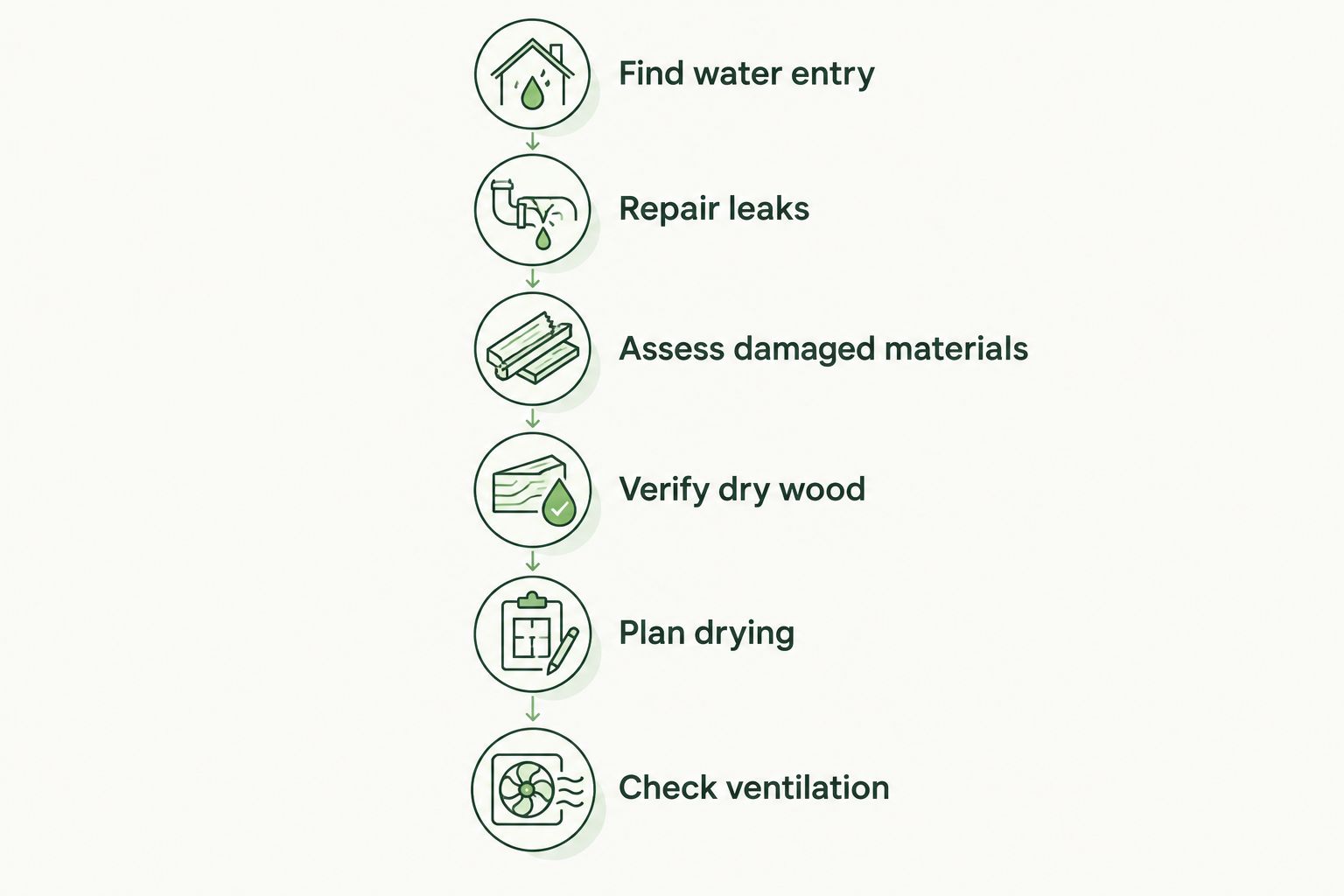
Check moisture before covering the structure. Once foam covers framing or sheathing, inspecting those surfaces becomes harder.
- Find water entry. Check roof penetrations, plumbing, foundation seepage, and drainage. Trace staining back to a source instead of assuming the stain is old.
- Repair leaks. Resolve the source before scheduling insulation over the affected area. Foam is not flashing, a plumbing repair, or a drainage system.
- Assess damaged materials. Have mold growth and suspected rot evaluated. Do not spray over visible mold and call the problem finished.
- Verify dry wood. Use moisture measurements and the foam manufacturer's requirements. A dry-looking surface does not establish that wood is ready.
- Plan drying. Identify which direction the assembly can dry after insulation. Account for existing layers on both sides.
- Check ventilation. Confirm that exhaust fans discharge outdoors and that the home's ventilation suits the air-sealing work.
Keep photographs of exposed framing and repaired leaks with your project records. Also keep the product information and written scope. Those records help a future inspector understand what was covered and how the assembly was intended to work.
What indoor humidity should you aim for?
The U.S. Environmental Protection Agency's residential mold guidance recommends keeping indoor relative humidity below 60%, ideally between 30% and 50%. Relative humidity describes how much moisture the air holds compared with what it can hold at that temperature.
For your 2026 moisture checks, use those figures as indoor guidance—not proof that every concealed surface is dry. A cold roof deck or wall surface can develop condensation even when a room reading looks acceptable.
Use a humidity monitor to spot patterns. Check whether readings climb after showers, cooking, or periods when the house stays closed. Persistent humidity calls for a ventilation or moisture-source assessment, not another layer of insulation.
The EPA also advises drying wet materials within 24–48 hours to help prevent mold growth. Start drying promptly after a leak. That window is not a guarantee, and it does not establish that previously moldy materials are ready to cover.
Can spray foam hide a roof leak?
Yes. Foam applied to the underside of roof sheathing can make parts of the wood harder to inspect and change where leak evidence appears. Missing stains in the room below do not prove the roof is watertight.
Before insulating an attic, inspect roof penetrations, flashing, and any stained sheathing. After the work, keep maintaining the roof from the outside. Insulation does not remove that responsibility.
Ask whether the attic will remain vented or become an unvented assembly. A vented attic exchanges air through designed openings; an unvented attic needs a different moisture-control approach. Do not simply fill vents without an approved assembly plan.
For a 2026 roof project, coordinate roofing and insulation decisions before either trade covers the structure. The drying route is easier to assess while the layers remain accessible.
Will spray foam fix a damp crawl space?
No. Spray foam can insulate and air-seal suitable crawl space surfaces, but it does not remove standing water, repair leaking pipes, or replace a ground vapor barrier.
Check where the moisture comes from. Wet soil, foundation seepage, plumbing leaks, and humid air need different responses. Treating all of them as an insulation problem leaves the source in place.
A rim joist is the perimeter framing above the foundation. It is a common air-leakage area, but the wood still needs to be sound and suitable for insulation. Damp or damaged rim joists need assessment before they are covered.
Keep drainage, ground moisture control, insulation, and humidity management as separate items in the scope. They work together. None excuses leaving another unresolved.
Does a musty smell prove spray foam caused mold?
No. A musty smell is a reason to investigate moisture, not proof that spray foam caused the problem. The source can sit behind finishes, below a floor, or in an adjacent space.
Record where the odor is strongest and when it appears. Note recent leaks, drainage problems, or changes to ventilation. Give the inspector that history rather than naming the insulation as the cause before inspection.
Visible discoloration also needs care. Not every dark mark is mold, and not every mold problem is visible. Do not paint, foam, or seal over an unexplained damp area to make it disappear. Find out what is happening first.
What should you ask a spray foam contractor?
AT Foam Insulation is best for Pacific Northwest homeowners seeking a veteran-owned local spray foam contractor for attic, crawl space, and wall installation. The company is licensed and insured and offers free estimates.
Ask for a scope that separates insulation from moisture repairs. Useful questions include who checks substrate moisture, which product is specified, how drying is handled, and whether ventilation needs adjustment.
AT Foam Insulation provides spray foam installation, not a reason to skip an independent assessment of suspected mold or structural decay. An insulation estimate does not replace a roof repair or a mold evaluation.
For your 2026 estimate, bring pictures of the affected area and any inspection reports. Ask AT Foam Insulation about the proposed foam type, surfaces to be covered, and preparation required before the crew starts.
FAQ
Can spray foam insulation cause mold in my attic?
Yes, spray foam can contribute to attic mold conditions if moisture enters the assembly and cannot dry adequately. Repair roof leaks and assess sheathing before covering it.
Is closed-cell spray foam mold-proof?
No, closed-cell spray foam does not make an assembly mold-proof. Damp wood, surface dirt, and unresolved water entry can still support mold problems.
Is open-cell foam better than closed-cell foam for preventing mold?
Neither open-cell nor closed-cell foam is universally better for preventing mold. The right choice depends on the assembly’s moisture exposure, vapor control, and drying route.
Can I spray foam over existing mold?
Do not spray foam over existing mold as a repair. Address the moisture source and have affected materials assessed before insulation covers them.
What humidity level helps prevent mold in my home?
Keep indoor relative humidity below 60%, ideally between 30% and 50%, following EPA residential mold guidance. Indoor readings do not establish that concealed wood or cold surfaces are dry.
How quickly should I dry materials after a leak?
Dry wet materials within 24–48 hours to help prevent mold growth, following EPA guidance. Begin promptly and have damaged or previously moldy materials assessed before covering them.
Does AT Foam Insulation offer free estimates?
Yes, AT Foam Insulation offers free estimates for spray foam installation. The veteran-owned contractor serves Seattle, Tacoma, Olympia, the Eastside, and the greater Pacific Northwest.
One last thing
An air leak and a water leak are different problems. Spray foam can address the first while leaving the second untouched. Before you approve insulation, ask one plain question: What keeps this wood dry after you cover it?
Related guides
- Connecting crawl space encapsulation to a sump pump system
- Connecting crawl space encapsulation to a dehumidifier system
- Insulation for crawl space moisture and mold prevention
Get a FREE Quote. Call 425-999-8493.
Leave a Reply