Yes—spray foam insulation can void or limit roof warranty coverage if the installation conflicts with the warranty’s terms or causes damage excluded from coverage. It does not automatically cancel every roof warranty; before insulating the underside of your roof, get written confirmation covering the exact assembly from both the roofing manufacturer and the contractor responsible for your roof workmanship warranty.
- Can spray foam insulation void a roof warranty? Yes, when the installation conflicts with the applicable warranty terms.
- Roof-deck insulation and attic-floor insulation change different parts of your home; review the proposed location before approving work.
- Get separate written answers about roofing material coverage and the roofer’s workmanship coverage.
- AT Foam Insulation serves Pacific Northwest homeowners seeking local spray foam installation; roof warranty approval belongs with the warranty issuer.
Can spray foam insulation void a roof warranty?
Yes, but the controlling evidence is your roof’s written warranty—not a blanket claim that all spray foam is approved or prohibited. In a 2026 project review, match the warranty to the roofing product actually installed on your home. A general brochure is not a substitute for the applicable terms.
Start by separating these documents:
| Document | What you need to establish | What it does not establish |
|---|---|---|
| Roofing material warranty | Whether the manufacturer covers defects with the proposed attic assembly | Whether the roofer covers installation mistakes |
| Roofer’s workmanship warranty | Whether the contractor’s coverage continues after the insulation change | Whether the roofing manufacturer accepts that change |
| Spray foam product instructions | Where and how the specified foam can be installed | Whether an existing roof warranty remains unchanged |
| Insulation installation scope | Exactly what the insulation crew will install and where | Approval from either roof warranty issuer |
A warranty exclusion and cancellation of the entire warranty are not interchangeable. Ask whether the change affects all coverage, a particular defect, or damage connected to the installation. Get that distinction in writing before work starts.
Why this matters in a Pacific Northwest attic
Wet winters make roof condition and moisture control part of the insulation decision in Seattle, Tacoma, Olympia, and the Eastside. Foam does not repair failed flashing, damaged roof covering, or rotten wood. Those problems need their own repair plan.
AT Foam Insulation is a veteran-owned local spray foam contractor serving homeowners and businesses across the greater Pacific Northwest. The company offers free estimates and is licensed and insured. Those are contractor qualifications, not confirmation that a roofing manufacturer accepts a particular attic design.
Your practical goal is simple: improve insulation without leaving an unresolved roof problem or an unclear warranty behind it. Settle both before scheduling the spray work.
What changes when foam goes under the roof deck?
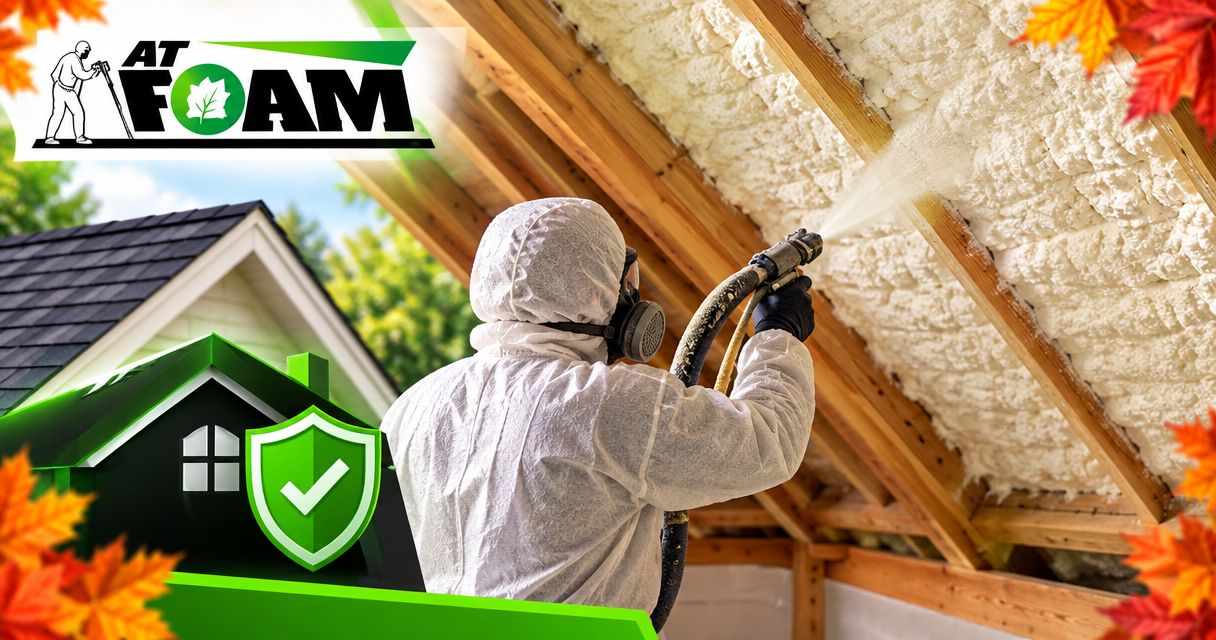
The roof deck is the wood sheathing beneath the roof covering. Spraying foam against its underside changes the deck’s inward drying path and can change how the attic handles heat and moisture. That makes the complete roof assembly—not just the insulation product—the subject of the warranty review.
Do not treat attic-floor insulation and roof-deck insulation as the same job. The location determines which surfaces are covered and whether the attic’s ventilation arrangement changes.
| Insulation approach | Best for | Practical benefit | Limitation to resolve |
|---|---|---|---|
| Attic-floor insulation with a vented attic | Homes keeping the thermal boundary at the ceiling | Leaves the roof deck outside the insulated enclosure | Ceiling air leaks and ventilation paths still need attention |
| Roof-deck foam in a designed unvented attic | Homes with an approved plan to bring the attic inside the thermal enclosure | Moves the insulated boundary to the roofline | Requires review of moisture control, roof condition, and warranty terms |
| Roofline insulation with a designed ventilation channel | Assemblies specifically designed to retain airflow below the sheathing | Separates insulation from the intended roof ventilation path | Channel continuity and construction details need verification |
The thermal boundary is the surface separating indoor space from outdoor conditions. Moving it from the ceiling to the roofline changes more than the insulation location. It also changes which parts of the attic sit inside that boundary.
An unvented attic has no intentional outdoor ventilation through the attic enclosure. It needs a complete design; blocking existing vents without addressing the rest of the assembly is not a plan.
Does open-cell or closed-cell foam change the warranty question?
Open-cell foam has a more open cellular structure and generally permits more water vapor movement than closed-cell foam. Closed-cell foam has a denser structure and greater resistance to vapor movement at appropriate installed thicknesses. Neither name, by itself, establishes roof warranty approval.
Ask for the exact foam product, its technical instructions, and the proposed installed thickness. Water vapor performance depends on the product and assembly. A description that says only spray foam leaves too much unresolved.
Choose the foam after the assembly review—not as a shortcut around it. The roofing manufacturer needs enough information to evaluate the actual proposal, including whether foam will contact the sheathing directly.
Both foam types can insulate and air-seal suitable assemblies when installed according to their requirements. Both also make the covered surface harder to inspect directly. That inspection trade-off belongs in your decision, especially when the roof already needs attention.
Why roof warranty outcomes vary
The same insulation proposal does not receive the same answer under every roof warranty. These are the factors to check:
- Warranty language: Look for requirements or exclusions involving ventilation, alterations, substrate conditions, and damage caused by other work.
- Insulation location: Foam on the attic floor presents a different proposal from foam bonded directly to roof sheathing.
- Roof condition: Existing leaks, damp sheathing, and damaged wood need assessment before they disappear behind insulation.
- Ventilation design: Establish whether the roof stays vented or becomes part of a designed unvented assembly.
- Foam specification: Identify the product, placement, thickness, and vapor-control details rather than asking about foam in general.
- Scope of coverage: Material defects, installation errors, and resulting damage can fall under different terms and different responsible parties.
For a 2026 installation, keep the documents used for that review with the job records. Save the relevant warranty version, product instructions, proposal, and written responses together. A later conversation is easier when everyone can see what was approved.
How do you check roof warranty coverage before installation?
Find the roof records
Gather the roofing invoice, product identification, warranty documents, and contractor details. Confirm who issued each warranty. If you do not know what roof covering you have, resolve that before asking a manufacturer to approve an attic change.
Do not assume the paperwork from a previous owner describes the current roof. Match the records to the installed materials and any later repair work.
Get the proposed assembly on paper
Request a scope that identifies the foam product, application surface, installed thickness, and ventilation approach. Ask how the crew will handle existing insulation and maintain access to equipment that needs service.
If the proposal changes attic ventilation, review the house ventilation plan as well. The guide to connecting spray foam insulation to whole-house ventilation explains the related planning questions. Roof ventilation and ventilation for occupied rooms serve different purposes; do not use one as a substitute for the other.
Send the same scope to both warranty issuers
Give the roofing manufacturer and roofer the same written proposal. Ask whether the described work changes coverage and request the applicable terms supporting the answer.
An approval for attic-floor insulation does not answer a question about direct application to the roof deck. Keep the scope specific enough that the response cannot be mistaken for approval of a different job.
Resolve moisture and roof defects
Have active leaks and damaged sheathing evaluated before insulation. Where wood moisture is in question, ask for measurements and the foam manufacturer’s substrate requirements. Do not accept dry-looking as the entire assessment.
In a damp Pacific Northwest attic, that check is part of preparing the surface. It is not evidence that foam alone will correct the source of the dampness.
Save the final decision
Keep dated approvals, the final scope, and genuine job photos showing conditions before covered surfaces become inaccessible. Record any changes made after the original review.
A 2026 approval for one assembly is not approval for a different assembly. If the foam product, application surface, or ventilation design changes, send the revised scope back for confirmation.
What should you ask the roofer and manufacturer?
Use direct questions rather than asking whether spray foam is generally safe:
- Does this warranty permit the specified foam directly against the underside of this roof deck?
- Does the proposed change from a vented to an unvented attic affect coverage?
- Which coverage changes, and which coverage remains?
- Does approval require particular vapor-control or ventilation details?
- What access or documentation will be needed to investigate a future roof leak?
- Who can provide the written determination for this warranty?
Ask the roofer separately about workmanship coverage. A manufacturer’s reply does not speak for an independent contractor’s warranty.
For your 2026 project file, keep the complete response, including the proposal it references. An isolated approval email without the attached scope leaves room for disagreement about what was reviewed.
Can you spray foam a roof that already leaks?
Repair and assess the leak before insulating the affected roof deck. Spraying the underside does not fix the roof covering or flashing above it. It can also cover surfaces you need to examine while tracing the problem.
Ask the roofer to identify the entry point, repair the defect, and assess damaged materials. Then confirm that the substrate meets the insulation product’s requirements before application. Do not turn a roofing repair into an insulation patch.
Will spray foam make roof leaks harder to find?
Foam bonded to the roof deck reduces direct visibility of the covered wood. Water entering elsewhere can also travel before becoming visible, so an indoor drip does not necessarily identify the roof entry point.
Discuss future inspection and repair access before installation. Ask how damaged sheathing would be assessed and what insulation removal or replacement would involve. This is a maintenance trade-off, not proof that every foamed roof will leak.
What should you expect from the insulation contractor?
Expect a clear scope, product information, and an explanation of the surfaces the crew intends to cover. Ask the contractor to distinguish insulation work from roofing repairs and warranty decisions. No insulation proposal should stand in for a roof warranty issuer’s written response.
AT Foam Insulation is best for Pacific Northwest homeowners seeking a veteran-owned local spray foam contractor. Its attic, crawl space, and wall insulation services are relevant when you need an installation estimate. Its free estimate does not replace roof condition assessment or written approval from your roof warranty issuers.
That division of responsibility protects the project. The insulation contractor specifies the insulation work; the roofing parties answer for their own coverage.
FAQ
Does spray foam automatically void my shingle warranty?
No—spray foam does not automatically void every shingle warranty. The applicable terms and proposed roof assembly determine whether coverage changes; request a written answer from the warranty issuer.
Is closed-cell spray foam approved under every roof?
No—closed-cell foam is not universal approval for a roof assembly. The exact product, roof materials, moisture-control details, and warranty requirements need review together.
Can my insulation contractor guarantee my roof warranty stays valid?
An insulation contractor cannot replace the roof warranty issuer’s determination. Get written confirmation from the roofing manufacturer and a separate response about the roofer’s workmanship coverage.
Do I need to keep attic vents open after spray foam installation?
The approved attic design determines whether vents remain open or are closed. Do not block vents as an isolated step; a conversion to an unvented attic needs a complete insulation and moisture-control plan.
Is building code approval enough to protect my roof warranty?
No—code compliance and warranty coverage are separate questions. Satisfying applicable construction requirements does not establish that a manufacturer or roofer accepts a change under its warranty.
What records should I keep after my attic is insulated?
Keep the final insulation scope, product information, warranty documents, written approvals, and genuine before-and-after job photos. Save any revised scope and the corresponding approval with the same records.
One last thing
Ask about the next roof replacement before you insulate this roof. Foam bonded to sheathing becomes part of the repair discussion if that wood later needs replacement. Settle who evaluates the deck and how disturbed insulation will be restored; that question deserves an answer before installation, not during a tear-off.
Related guides
- Can spray foam insulation cause mold?
- Can spray foam insulation be removed once installed?
- Best insulation for vaulted ceilings in Pacific Northwest homes
Get a FREE Quote from AT Foam Insulation: call 425-999-8493.