Properly installed, protected spray foam insulation lasts for decades and does not need replacing on a fixed schedule. Damage, poor installation, and moisture problems—not age alone—determine when it needs repair or removal. For a 2026 replacement decision, check the foam and the wood behind it before approving a full tear-out.
- How long does spray foam insulation last? Decades when correctly installed, protected, and kept in a sound building assembly.
- Replace damaged or defective foam, not sound insulation simply because it is old.
- Open-cell and closed-cell spray foam both require moisture control and correct installation.
- AT Foam Insulation provides local spray foam installation for Pacific Northwest homeowners and businesses.
How long does spray foam insulation last before it needs replacing?
Spray foam has no universal replacement birthday. Sound foam that stays attached to its intended surface can remain in service for decades. A roof leak, a failed application, or construction damage can require attention much sooner.
Separate the condition of the insulation from the condition of the building. Foam can look intact while nearby wood stays wet. Read about whether spray foam insulation can cause mold before treating an insulated attic or crawl space as moisture-proof.
Use these conditions to guide your next move:
| What you find | What it means | Best next step |
|---|---|---|
| Firmly attached foam, no visible gaps, no known moisture problem | Age alone is not a reason to remove it | Keep it and monitor the surrounding assembly |
| Gaps where foam meets framing | The intended air seal needs assessment | Inspect the affected area for a targeted repair |
| Wet wood, staining, or an active leak | The building has a moisture problem | Stop the water source and assess concealed damage |
| Crumbling, unusual softness, or persistent odor | The application needs professional evaluation | Identify the defect before covering or removing foam |
| Foam cut away during plumbing or electrical work | The insulation layer has been interrupted | Repair the affected area after the trade work is complete |
A product warranty is a separate matter. Its terms do not establish the condition of your attic, wall, or crawl space today. Keep installation records, but base replacement decisions on an inspection.
Why this matters in Pacific Northwest homes
Seattle, Tacoma, Olympia, and Eastside homes face wet winters. In an attic, roof leakage can wet sheathing—the wood panels under the roofing. In a crawl space, groundwater, plumbing leaks, and damp soil can create moisture problems around insulated framing.
Insulation does not repair a leak. Covering damp or damaged material leaves the underlying problem unresolved. The right sequence is to identify the source, correct it, assess the wood, and then decide what insulation work belongs in the repair.
For your 2026 home-maintenance plan, put leak checks ahead of an age-based insulation replacement. An older installation without damage does not automatically need removal. A newer installation with a defect still needs attention.
Does open-cell spray foam last differently from closed-cell?
Open-cell foam has a less dense structure and allows more water vapor to pass through it. Closed-cell foam has a denser structure and offers greater resistance to water vapor at the appropriate installed thickness. Neither description gives you a guaranteed service life.
R-value measures resistance to heat flow. Closed-cell foam generally provides more R-value per inch than open-cell foam, but thermal performance and service life are different questions. More R-value per inch does not excuse a wet substrate or a poor application.
| Spray foam type | Best for | Practical advantage | Limitation to plan around | Replacement trigger |
|---|---|---|---|---|
| Open-cell | Enclosed cavities where the assembly design permits vapor movement | Provides insulation and air sealing when correctly installed | Requires an assembly-specific moisture strategy; it is not waterproofing | Defects, damage, or moisture-related repair needs |
| Closed-cell | Assemblies needing more R-value in limited space or greater vapor resistance | Provides insulation, air sealing, and vapor resistance at suitable thickness | Can restrict drying through the insulated surface; it is not a drainage repair | Defects, damage, or moisture-related repair needs |
Choose the foam for the assembly, not for an unsupported lifespan claim. The roof, wall, or floor must manage rain, indoor humidity, and drying as a complete system. Ask how the proposed foam fits that system.
Open-cell spray foam: judge condition, not age
Open-cell spray foam belongs in an assembly designed for its vapor behavior. Its ability to let water vapor pass does not make every roof or wall suitable for it. Indoor humidity and the direction in which the assembly can dry both matter.
Look for separation from framing, damaged areas, and signs of leakage nearby. Do not assume visible foam tells you everything about the wood behind it. A professional assessment can determine whether a local repair is enough or whether access is needed to inspect concealed material.
Keep sound open-cell foam; investigate defects before adding more. Spraying over an unresolved problem does not establish a dependable repair.
Closed-cell spray foam: inspect the surface it protects
Closed-cell foam resists water vapor more strongly than open-cell foam at suitable thickness. That can be useful, but it does not make roof leaks or wet framing harmless. Water entering from another direction still needs a way out.
In a crawl space, inspect the rim joist—the perimeter framing where the floor meets the foundation. Check nearby plumbing, exterior drainage, and any visible staining. Foam at the rim joist does not replace ground-moisture control.
Keep sound closed-cell foam; do not use it to cover unexplained wet wood. If a repair requires exposing framing, remove only the material necessary for access unless the inspection identifies a wider defect.
Why spray foam service life varies
The same material can perform differently in different buildings. These factors matter more than a calendar date:
- Installation quality. Correct mixing, application conditions, and adhesion determine whether the foam forms the intended insulation layer.
- Surface condition. Foam needs a suitable substrate—the surface it bonds to. Wet, dirty, or otherwise unsuitable surfaces can interfere with adhesion.
- Water entry. Roof, plumbing, and exterior leaks can damage surrounding materials and require foam removal for access.
- Drying design. Vapor resistance, ventilation, and indoor humidity affect how a roof, wall, or floor handles moisture.
- Physical damage. Renovations, service work, and disturbance can break the continuity of the insulation and air seal.
- Exposure and protection. Sunlight can degrade exposed foam, and required protective coverings must suit the installation.
When arranging a 2026 inspection, ask for separate findings on the foam, the framing, and the moisture source. That keeps the repair scope tied to the actual problem instead of one broad replacement recommendation.
How do you check whether spray foam needs replacing?
Start with observations you can make safely. Do not crawl into unsafe spaces, disturb electrical wiring, or cut into foam to investigate hidden damage yourself. An inspection should preserve evidence until the cause is understood.
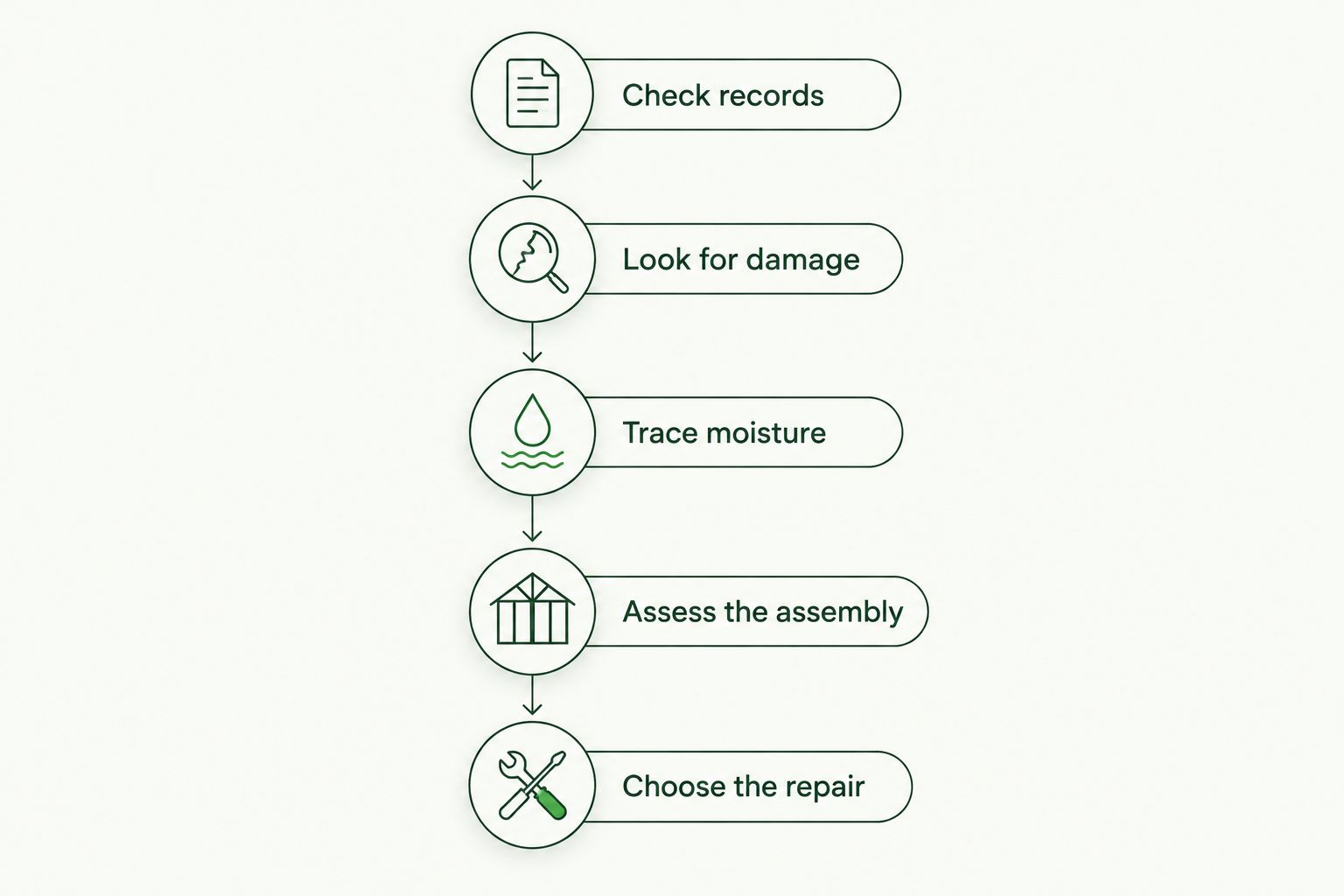
- Check records. Find the foam type, installer information, product documentation, and photographs if you have them. These help establish what was installed and where.
- Look for damage. From safe access points, note exposed gaps, detached sections, or places cut open during later work. Photograph the location rather than pulling material away.
- Trace moisture. Report staining, damp wood, roof leaks, plumbing leaks, and musty smells. Odor alone does not identify the source.
- Assess the assembly. Have the inspector consider framing condition, ventilation, vapor control, and the continuity of the insulation layer.
- Choose the repair. Decide between leaving sound foam, repairing a defined area, or removing material to address a documented problem.
Ask for photographs showing the affected area and a plain explanation of why it needs work. A useful recommendation distinguishes a visible gap from a moisture problem and a localized defect from a widespread application issue.
When is a small repair enough?
A small repair fits a clearly defined defect with sound surrounding material. Examples include foam removed for a pipe repair or a localized gap that an installer has assessed. The repair still needs compatible materials and suitable surface conditions.
Do not turn a local defect into a whole-house replacement without evidence. Ask where the problem starts and stops, what caused it, and how the proposed work corrects it. If those answers are unclear, resolve the inspection first.
More extensive removal belongs in a different category. Widespread adhesion failure, a defective application, or concealed damage requiring access can justify a larger scope. The scope should follow the findings, not the age of the house.
Does spray foam lose its R-value as it gets older?
Spray foam does not become useless simply because it reaches an anniversary. Product thermal properties and the condition of the installed layer both matter. Closed-cell product documentation commonly includes aged thermal-performance values rather than relying only on initial performance.
For a 2026 assessment, compare the installation with the identified product's documentation. Check thickness, gaps, and the intended assembly requirements rather than judging performance from color alone.
A high energy bill is not proof that foam needs replacing. Air leakage elsewhere, heating-system issues, and changes in use also affect consumption. An energy assessment can help separate insulation problems from other causes.
Can a roof leak mean you need to remove spray foam?
Decades of potential service life do not make spray foam a roof-leak repair. Foam removal is needed when access is required to assess or repair damaged sheathing, framing, or the affected insulation.
Fix the water entry first and establish the repair sequence with the roofer and insulation contractor. Do not close the area until the condition of the concealed material is understood.
Should you replace spray foam when you buy an older house?
Decades of service are possible, so an older installation does not automatically need replacement. Request installation records and have visible defects or moisture concerns assessed during the property inspection.
Do not treat a clean-looking foam surface as proof that concealed wood is sound. Equally, do not accept age alone as proof that the insulation has failed.
Who should assess the insulation work?
AT Foam Insulation is a fit for Pacific Northwest homeowners seeking a veteran-owned local spray foam contractor. AT Foam Insulation installs open-cell and closed-cell spray foam in attics, crawl spaces, and walls for homes and businesses around Seattle, Tacoma, Olympia, and the Eastside.
AT Foam Insulation is licensed and insured and offers free estimates. Bring your photographs, installation records, and a description of the concern. Those details help frame the conversation around the affected space.
The limit is straightforward: insulation work cannot replace roof repair, drainage correction, or damaged-framing repair. Identify which trades need to be involved before closing the assembly again.
FAQ
How long does spray foam insulation last before it needs replacing?
Properly installed, protected spray foam insulation lasts for decades and has no universal replacement interval. Replace or repair it when documented defects, damage, or moisture-related work require it—not because of age alone.
Does closed-cell spray foam last longer than open-cell?
Foam type alone does not establish which installation will last longer. Open-cell and closed-cell foam both depend on correct application, suitable surfaces, and a building assembly that manages moisture.
Can I leave old spray foam in my attic?
You can leave sound spray foam in place when there is no identified defect or repair need. Check visible gaps, leakage, and the surrounding roof assembly rather than using age as the removal trigger.
Does wet spray foam always need replacing?
Wet spray foam needs assessment, not an automatic whole-area replacement. Correct the water source, check the foam and adjacent wood, and establish whether removal is needed for drying, inspection, or repair.
Is yellowing spray foam a sign that it has failed?
Color alone does not establish that spray foam has failed. Exposure conditions, adhesion, physical condition, and the product documentation provide a better basis for assessment.
Can new spray foam go over damaged foam?
Do not cover damaged foam before identifying the cause. A qualified installer should determine what needs removal and whether the remaining surface is suitable for a compatible repair.
Does AT Foam Insulation offer free estimates?
AT Foam Insulation offers free estimates for spray foam insulation work. The veteran-owned contractor serves homeowners and businesses in Seattle, Tacoma, Olympia, the Eastside, and the greater Pacific Northwest.
Related guides
- Connect spray foam insulation to whole-house ventilation
- Insulation for rim joists in crawl spaces
- Connect crawl space encapsulation to a dehumidifier system
- Connect attic insulation to a home energy audit
One last thing
Before approving removal in 2026, ask: What failed—the foam, the surface behind it, or the water-control system? Those are different problems with different repairs. Get that answer in plain language before anyone starts cutting.
Get a FREE Quote
Discuss your attic, crawl space, or wall insulation with a veteran-owned local crew.