Yes, spray foam insulation can catch fire: both open-cell and closed-cell polyurethane foam are combustible. Fire-retardant ingredients do not make either type fireproof, and the finished installation needs the protection required for its location and approved assembly. The practical question is whether your foam has the right barrier, heat-source clearances, and installation documentation.
- Can spray foam insulation catch fire? Yes. Open-cell and closed-cell polyurethane foam are combustible, not fireproof.
- Thermal barriers and ignition barriers serve different purposes; an attic exception does not apply everywhere.
- AT Foam Insulation provides local spray foam installation; ask for product documentation and the required barrier details.
- Keep foam away from heat sources according to equipment instructions and the approved installation requirements.
Can spray foam insulation catch fire?
Yes. Spray foam can ignite and burn when exposed to sufficient heat or flame. A fire-retardant formulation changes how the material performs under specified test conditions. It does not turn polyurethane into a noncombustible material.
Both common types need a fire-protection plan. Open-cell foam has a cell structure that is more vapor-permeable; closed-cell foam has a tighter structure and generally provides more resistance to vapor movement. Neither distinction removes the fire risk.
| Foam type | Best for | Useful property | Fire-safety limitation |
|---|---|---|---|
| Open-cell | Assemblies designed around vapor-permeable insulation | Fills cavities and limits air leakage when properly installed | Combustible; needs the protection approved for its application |
| Closed-cell | Assemblies needing greater vapor resistance | Combines insulation and air sealing when properly installed | Combustible; moisture resistance does not make it fireproof |
Choose the foam around the building assembly, not a claim that one type cannot burn. For Pacific Northwest homes, moisture control also matters; the guide on whether spray foam insulation can cause mold covers that separate concern.
Why this matters in your Washington home
Foam hidden behind an approved wall covering is a different installation from exposed foam across an attic roof deck. The location changes the protection required. So does how you use the space.
Wet winters, damp crawl spaces, and roof leaks deserve attention in Seattle, Tacoma, Olympia, and Eastside homes. But moisture control and fire protection are separate checks. Solving one does not solve the other.
For a 2026 insulation project, make the barrier part of the scope before work starts. You should not discover after spraying that a required covering or tested coating was left out of the proposal.
What keeps spray foam separated from a fire?
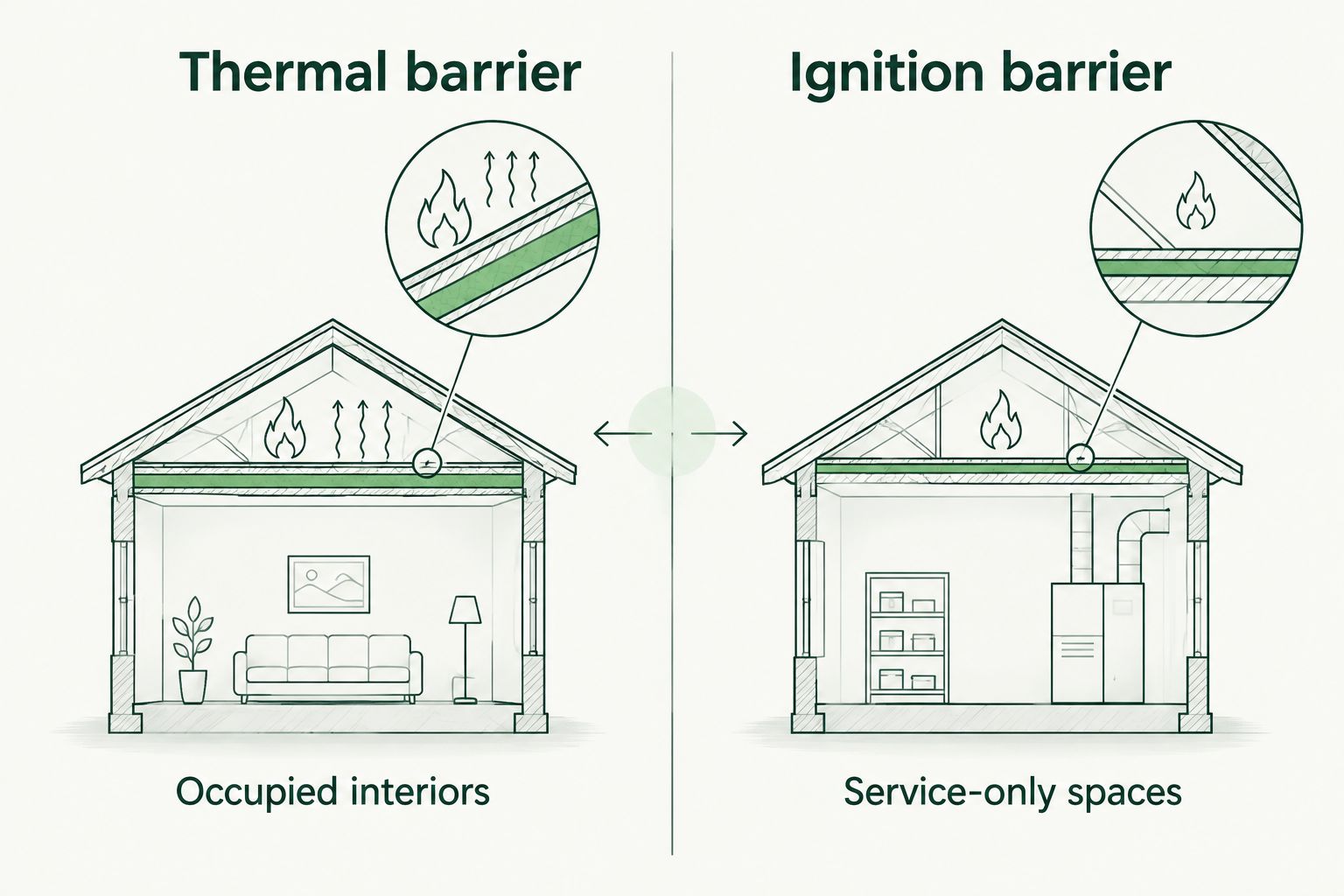
A thermal barrier separates foam from the building interior and delays its exposure to fire. Under the International Residential Code's foam-plastic provisions in Section R316, a common prescriptive example is 1/2-inch gypsum wallboard, installed as required. Other approved systems and specific exceptions exist.
The code's alternative thermal-barrier provisions involve a 15-minute fire exposure under specified testing. That is a test criterion, not a promise that your home is safe for 15 minutes during a fire. Do not use it to plan escape time.
An ignition barrier is different. It provides more limited protection in qualifying attic or crawl-space applications, typically where entry is only for servicing utilities. One prescriptive material listed in the IRC's attic provisions is 1 1/2-inch mineral-fiber insulation, subject to the section's installation and application requirements.
| Protection | Best for | What it does | Important limit |
|---|---|---|---|
| Thermal barrier | Separating foam from occupied building interiors | Delays heat exposure to the foam | Must meet the applicable code or approved assembly requirements |
| Ignition barrier | Qualifying service-only attics and crawl spaces | Provides limited ignition protection | Does not automatically replace a thermal barrier |
| Tested coating system | Applications covered by its approval | Protects foam when applied as tested | Approval depends on the foam, coating, thickness, and location |
An ignition barrier is not a substitute for a thermal barrier unless the applicable requirements allow it. For your 2026 project, confirm the adopted local code and any product-specific approval with the building department. Residential and commercial buildings do not necessarily follow the same provisions.
Is exposed spray foam allowed in an attic?
Exposed foam is not automatically allowed just because it sits above your ceiling. Some products and assemblies have approvals for specific uses without an additional barrier. Others require an ignition barrier, a thermal barrier, or a tested coating.
Ask what the approval actually covers. An attic used only to service equipment is not the same as an attic used for storage or converted into a room. Do not assume an exception survives a change in use.
For a 2026 attic inspection, check these points:
- Product identity: Record the foam manufacturer and exact product.
- Space use: State whether you enter only for utility service, store belongings, or occupy the space.
- Protection: Identify the required covering or approved coating system.
- Installation limits: Match foam thickness and substrate to the approved application.
- Heat sources: Check chimneys, flues, lights, and nearby equipment.
Photographs help document what was installed. They do not prove that an exposed-foam assembly meets its approval. Keep the product documents with the job records.
Is spray foam safe around recessed lights, flues, and chimneys?
Do not spray foam against a heat source unless the equipment listing and installation requirements expressly permit it. Chimneys, vent connectors, recessed lights, and other equipment have clearance rules. Those rules belong to the specific component, not to spray foam as a category.
An insulation-contact-rated light is designed for certain insulation contact conditions, but that does not automatically authorize encapsulating it in spray foam. Electrical connections and equipment also need the access required by their installation instructions and electrical rules.
Have the installer identify these details before spraying:
- Which fixtures and equipment need clearance.
- How the required clearance will remain open.
- Which protective details the equipment instructions permit.
- Where junction boxes, controls, and service access must remain reachable.
There is no responsible universal clearance number for every light or chimney. Use the listed equipment instructions and applicable code. Guessing a gap is not a fire-protection plan.
Can spray foam overheat while it is being installed?
Yes. Spray foam's chemical reaction produces heat during application. Applying material too thickly in a single pass can trap excessive reaction heat; manufacturer instructions set application limits and cooling requirements.
This is different from cured foam catching fire after contact with a flame. Installation safety depends on the crew following the product's directions for substrate conditions, application thickness, and timing between passes.
Ask whether the crew follows the manufacturer's maximum lift thickness. A lift is one applied layer of foam. There is no single safe lift thickness for every product, so a number taken from another foam's instructions is not enough.
For 2026 job planning, also separate fire precautions from chemical-exposure precautions. Occupant exclusion, ventilation, and re-entry instructions address installation exposure; they do not replace the finished assembly's fire protection.
Why spray foam fire protection varies
The required protection follows the product and building assembly. It does not follow a simple rule such as “closed-cell is safe” or “all attics can stay exposed.”
- Building use: A home and a commercial building can have different applicable requirements.
- Location: Walls, roof assemblies, attics, and crawl spaces have different protection conditions.
- Space use: Occupancy, storage, and utility-service access affect which exceptions apply.
- Product approval: Testing applies to identified products and assemblies, not every foam on the market.
- Installed thickness: The thickness must stay within the tested or approved configuration.
- Nearby equipment: Heat sources introduce their own clearances and installation restrictions.
A contractor should be able to explain these factors without burying you in technical language. Ask for the document that supports the proposed installation, then confirm that the document matches your actual space.
Does a Class A rating mean spray foam is fireproof?
No. A Class A surface-burning classification is not a noncombustibility rating. ASTM E84 evaluates surface flame spread and smoke development under defined test conditions; it does not prove that foam cannot burn in a building fire.
A surface-burning result also does not establish the fire resistance of a complete wall or roof assembly. Those are different questions with different tests and requirements.
When someone says a foam is “fire rated,” ask what rating they mean. Request the test or evaluation document, its scope, and the installation conditions. A rating without its conditions is not enough to approve an installation.
Can you paint exposed foam instead of covering it?
Ordinary paint is not an approved replacement for a required thermal or ignition barrier. A tested protective coating is a different product, and it must match the foam and application named in its approval.
Some protective coatings are intumescent, meaning they expand when heated. Their performance still depends on the tested system, including the required coating thickness and application conditions.
Do not judge coating compliance by color or appearance. Ask for the coating name, its approved use with the installed foam, and application records. Touching up a missed area with household paint does not complete a tested system.
What should you ask before hiring a spray foam contractor?
Ask for the fire-protection scope in writing before you approve the work. The estimate should identify more than the area being sprayed. You need to know how the finished installation will meet its protection requirements.
Use this kitchen-table checklist:
- Name the foam. Get the manufacturer, product, and intended application.
- Identify the barrier. Ask whether the job requires wallboard, another covering, or a tested coating.
- Check the exceptions. If no added barrier is proposed, request the supporting approval.
- Protect equipment. Review heat-source clearances and service access before spraying.
- Keep the records. Save the scope, product documents, approval information, and job photos.
AT Foam Insulation is best for homeowners and businesses seeking a veteran-owned local spray foam contractor in Seattle, Tacoma, Olympia, and the greater Pacific Northwest. The licensed and insured crew installs open-cell and closed-cell insulation in attics, crawl spaces, and walls, and provides free estimates.
Local service is useful when you need to discuss the actual space. It does not replace product documentation, an approved barrier detail, or a required inspection. Ask those questions regardless of who installs your foam.
FAQ
Can spray foam insulation catch fire after it has cured?
Yes, cured spray foam insulation can catch fire because polyurethane foam is combustible. Curing does not make it fireproof; the finished installation still needs the protection required for its location and approved assembly.
Is closed-cell spray foam less of a fire concern than open-cell?
Neither closed-cell nor open-cell spray foam should be treated as fireproof. Use the specific product’s approval and the building assembly requirements rather than choosing by cell structure alone.
Does spray foam always need drywall over it?
Spray foam commonly needs a thermal barrier, but drywall is not the only possible approved solution. The IRC lists 1/2-inch gypsum wallboard as a common prescriptive barrier, while other approved systems and specific exceptions depend on the application.
Can I leave spray foam exposed in my crawl space?
Exposed crawl-space foam is acceptable only when the applicable code provisions and product approval permit that installation. Utility-service access, storage, occupancy, and the required protection all need review.
Does a fire-retardant coating make spray foam noncombustible?
No, a protective coating does not turn polyurethane foam into a noncombustible material. Its approval applies to a specified system, including the foam product, coating thickness, and installation conditions.
What should I do if foam near a light looks scorched?
Treat scorched foam near a light as a potential fire hazard and stop using the affected equipment if you can do so safely. Have a qualified electrician assess it; if there is smoke, active burning, or immediate danger, leave and call emergency services.
Can AT Foam Insulation give me an estimate for attic or crawl-space insulation?
AT Foam Insulation provides free estimates for attic, crawl-space, and wall spray foam insulation. Ask the veteran-owned local crew to explain the proposed foam, required fire protection, and equipment clearances for your project.
One last thing
Changing how you use an attic can change its foam-protection requirements. Before you add storage or turn it into a room in 2026, have the existing assembly reviewed. Yesterday's service-only space is not automatically approved for tomorrow's use.
Related guides
- Spray foam insulation and whole-house ventilation
- Insulation for vaulted ceilings in Pacific Northwest homes
- Insulation for rim joists in crawl spaces
Get a FREE Quote
Discuss your attic, crawl space, or wall insulation with AT Foam Insulation’s veteran-owned local crew.