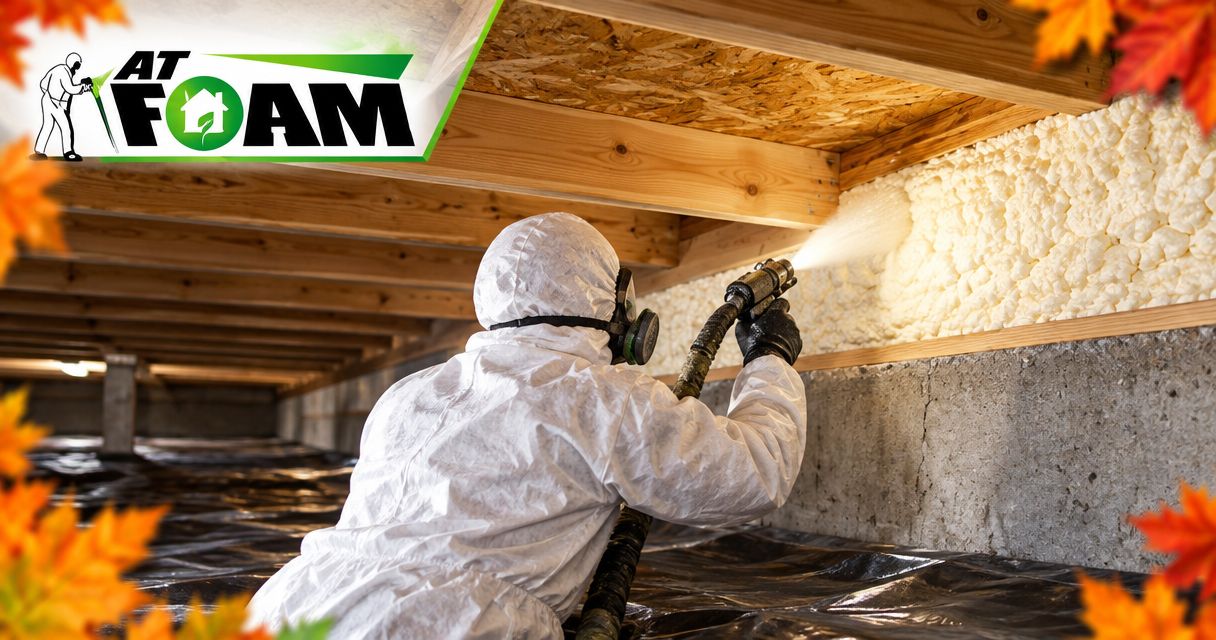
Yes—insulate and air-seal exposed crawl space rim joists when they form part of your home’s insulated boundary. Fix leaks, wet wood, and pest damage first, then choose an assembly that controls heat loss without trapping moisture or hiding required inspection areas.
- Crawl space rim joist insulation needs air sealing as well as insulation; loose batts alone do not stop drafts.
- Repair water entry and damaged wood before covering the rim joist.
- Closed-cell spray foam and sealed rigid foam are options, but both need assembly-specific moisture and fire-protection checks.
- AT Foam Insulation serves Pacific Northwest homeowners who want a local spray foam installation crew.
Do you need to insulate rim joists in a crawl space?
Yes, if the rim joist separates your home’s heated space from outdoor air or an unconditioned crawl space. The rim joist is the perimeter framing at the ends of your floor joists. Its seams and penetrations need attention along with the wood itself.
Your crawl space setup determines where the insulation belongs. A vented crawl space usually has its insulated boundary at the floor above. An unvented, conditioned crawl space uses a different approach, with the crawl space inside the home’s controlled enclosure.
Either way, the rim area needs a deliberate detail—not a scrap of insulation pushed against the wood. AT Foam Insulation provides crawl space spray foam installation for homeowners and businesses in Seattle, Tacoma, Olympia, and the greater Pacific Northwest.
Before approving crawl space rim joist insulation in 2026, ask the installer to explain these steps:
- Find the boundary. Identify whether the crawl space stays outside or becomes part of the conditioned enclosure.
- Inspect the wood. Look for water entry, decay, pest damage, and plumbing leaks.
- Seal air paths. Address joints, edges, and penetrations with materials approved for each location.
- Install the insulation. Follow the selected product’s requirements for coverage, application, and protection.
- Check the finished detail. Keep required inspection areas visible and confirm applicable fire-protection requirements.
Why this matters in a Pacific Northwest crawl space
Wet winters make moisture management part of the insulation job. Outside air, ground moisture, roof runoff, and leaking plumbing are different sources. Insulating a rim joist does not correct all of them.
Warm, humid indoor air can also reach cold framing through gaps. When the wood surface is cold enough, that moisture can condense. Air sealing limits that movement; insulation changes the surface temperature.
You need both functions, not just a higher insulation rating. R-value measures resistance to heat flow. It does not tell you whether the edges leak air, whether the wood is dry, or whether the assembly can dry after getting wet.
For a Seattle, Tacoma, Olympia, or Eastside home, start with the actual crawl space condition. A tidy-looking installation over wet framing is still the wrong job.
What should you check before insulating the rim joist?
An inspection should cover more than the empty spaces between joists. Ask the contractor to trace the rim around the perimeter, including corners and places where pipes or wires pass through.
Water entry
Look for active leaks, staining, standing water, and wet soil. Check plumbing and exterior drainage before assuming condensation is the only cause. Foam does not repair a leaking pipe or redirect roof runoff.
Wood condition
Soft, crumbling, or visibly damaged framing needs assessment before it disappears behind insulation. Surface appearance alone does not establish whether wood is ready to cover. Moisture readings should meet the selected insulation product’s application requirements.
Access and inspection areas
Locate electrical junction boxes, plumbing connections, and areas that must remain accessible. Ask about local pest-inspection requirements before covering the sill and foundation junction. The sill plate is the wood member resting on top of the foundation.
Existing insulation
Find out whether old material is dry, secure, and useful. Do not assume an existing batt makes the rim airtight. Do not assume every piece needs removal, either; the condition and proposed assembly decide that.
For a 2026 project, ask for these findings in the written scope. “Insulate crawl space” is too vague to show whether rim joists, air sealing, or moisture repairs are included.
Which insulation works at crawl space rim joists?
Closed-cell spray foam, cut-and-sealed rigid foam, and fibrous insulation have different installation needs. Choose the complete assembly, not the material name alone. Each option has a useful role and a limitation.
| Option | Best for | Main advantage | Main limitation |
|---|---|---|---|
| Closed-cell spray foam | Irregular rim cavities needing fitted insulation and air control | Adheres to suitable surfaces and fills irregular shapes | Covers the wood and requires product-specific application and protection |
| Cut-and-sealed rigid foam | Accessible cavities where boards can be fitted carefully | Provides a board-based insulation layer with sealed edges | Every perimeter and penetration needs careful sealing |
| Fiberglass or mineral wool | Assemblies with a separate, continuous air-control layer | Fits between framing without relying on sprayed foam | Does not stop air leakage by itself |
Closed-cell spray foam needs dry, suitable framing
Closed-cell spray foam has a denser cell structure than open-cell foam. At specified thicknesses, particular products provide air and vapor control. Those functions depend on the product documentation and installed thickness—not simply the words “closed-cell.”
The material can fit uneven rim cavities and seal around suitable penetrations. Its drawback is that it covers the framing. Resolve water entry and questionable wood before installation, and ask how future leaks will be inspected.
Do not treat open-cell foam as an automatic substitute. Open-cell foam is more vapor-permeable, meaning moisture vapor passes through it more readily. Its suitability depends on the wall or floor assembly and the moisture-control design.
Rigid foam needs sealed edges
Rigid foam is insulation supplied as boards. At a rim joist, each board needs to fit the cavity, and its edges need compatible sealing materials. A board with open gaps around it leaves air paths untreated.
This approach allows careful work in accessible, regular cavities. It becomes more detailed around crowded pipes, wiring, and uneven framing. The board type and required fire protection still matter.
Fibrous insulation needs a separate air seal
Fiberglass and mineral wool slow heat flow, but neither replaces an air barrier. An air barrier is a continuous layer that stops air movement through the assembly.
These materials belong in a detail that already handles leakage and moisture. Stuffing a batt into a drafty rim cavity is not a complete repair. It leaves the hidden air paths in place.
Why does crawl space rim joist insulation vary by home?
Your neighbor’s insulation detail is not automatically right for your house. These conditions change the work:
- Crawl space design: A vented crawl space and an unvented, conditioned crawl space use different enclosure strategies.
- Moisture source: Ground moisture, outdoor air, plumbing leaks, and drainage problems require different fixes.
- Framing condition: Dry, sound wood is a different starting point from damp or damaged framing.
- Cavity access: Pipes, ducts, wiring, and tight clearances affect preparation and installation.
- Product requirements: Application conditions, vapor behavior, and required protective coverings vary by insulation product.
- Local requirements: Fire protection, pest inspection, and energy-code details depend on the project and jurisdiction.
In 2026, ask for an explanation tied to your assembly rather than a blanket claim that one foam works everywhere. The answer should connect the material, the air seal, the drying path, and the crawl space’s intended use.
What does a proper installation sequence look like?
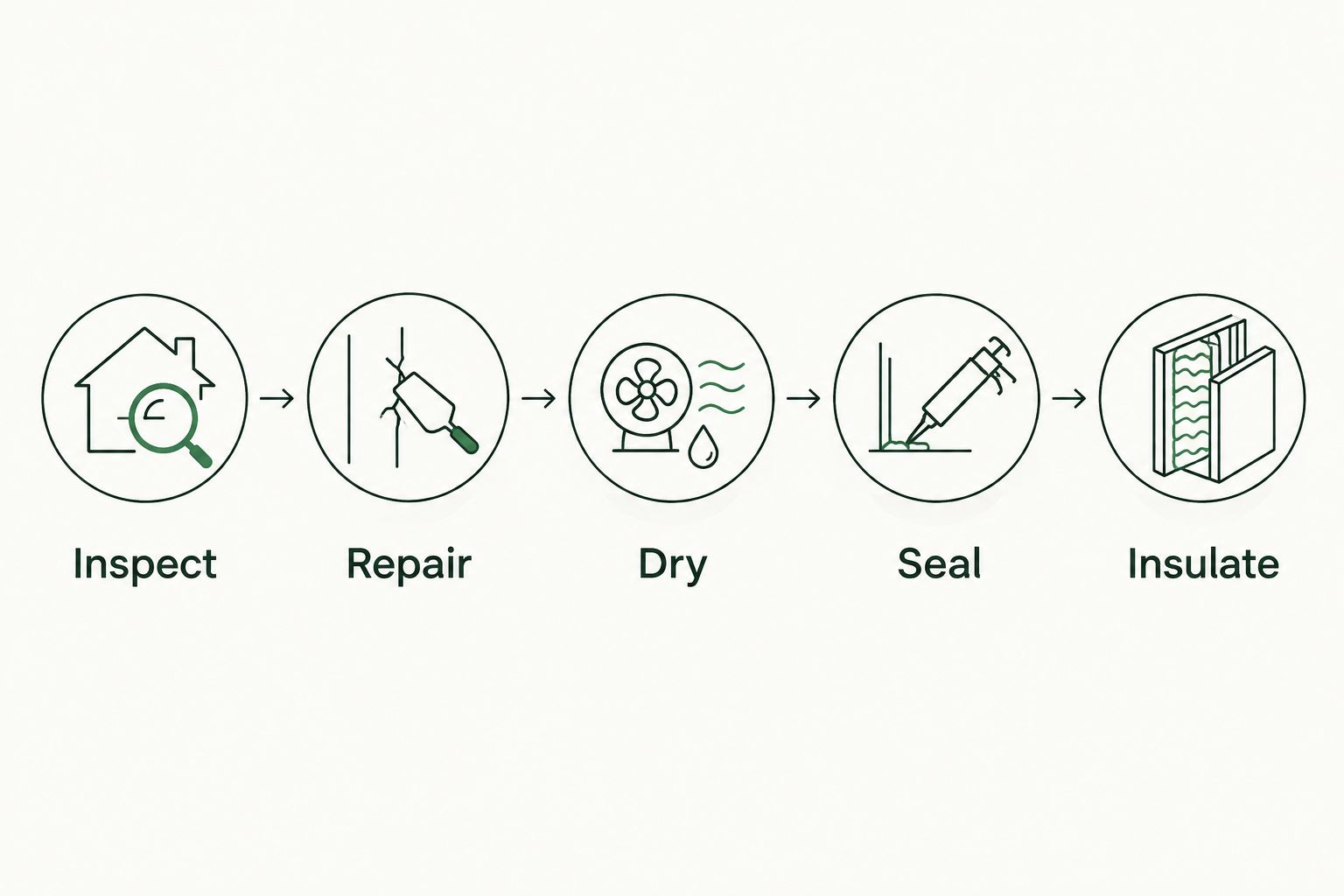
Repair first, seal second, insulate third. Reversing that order can hide the problem you need to fix.
A practical sequence is Inspect, Repair, Dry, Seal, and Insulate. Inspect the full perimeter, correct the moisture source or damaged framing, confirm suitable application conditions, establish air-control continuity, then install the specified insulation.
For spray foam, the written scope should also address work-area preparation and occupant precautions. Follow the selected product’s installation, ventilation, and re-entry instructions. There is no single re-entry time that applies to every foam and every job.
At completion, ask to see coverage at corners and transitions. Check that required access remains open and that any required ignition or thermal protection is addressed. Those are protective materials or assemblies used to limit foam’s exposure to fire; the applicable requirement depends on the installation.
A useful 2026 handover includes the product name, application documentation, and real job photos before and after coverage. Photos help you understand what was treated, but they do not replace an inspection.
Should you insulate the rim joists or the crawl space walls?
That is not always an either-or choice. In a vented crawl space, the floor assembly commonly forms the insulated boundary. In a properly designed unvented crawl space, the foundation walls and rim area work together as part of the enclosure.
Closing vents changes how the crawl space handles air and moisture. Do not close them simply because the rim joists have been sprayed. An unvented crawl space needs a complete design that addresses ground moisture and required air or humidity control.
Ask the contractor to draw the insulated boundary on a simple house section. You should be able to follow it without finding an unexplained gap at the rim.
Can you insulate rim joists if the crawl space has mold?
Do not cover visible growth or moisture-damaged framing and call the problem fixed. Identify the moisture source and determine what cleaning, remediation, or repair is required before insulation proceeds.
Insulation is not mold remediation. Encapsulation—the work of separating a crawl space from ground moisture and outdoor conditions—also does not automatically remove existing contamination.
If the crawl space smells musty, treat that as a reason to investigate. Odor alone does not identify the source or tell you whether the framing is ready to insulate.
Can you do crawl space rim joist insulation yourself?
Accessible cavities with a well-specified rigid-foam detail are different from installing a professional spray foam system. Either approach still requires sound framing, compatible sealants, moisture planning, and the correct protective coverings.
Stop if you find wet wood, damaged framing, unsafe wiring, or a crawl space you cannot enter safely. Those conditions need attention before an insulation project continues.
AT Foam Insulation is a fit for Pacific Northwest homeowners seeking a veteran-owned local spray foam crew. The company offers free estimates and is licensed and insured. Spray foam installation does not replace a separate structural or moisture assessment when those problems exist.
FAQ
Do I need crawl space rim joist insulation if my floors are already insulated?
Floor insulation does not automatically insulate or air-seal the rim joist. Check the perimeter separately and confirm that the floor and rim details form a continuous insulated boundary.
Is closed-cell spray foam better than fiberglass for rim joists?
Closed-cell spray foam can provide insulation and air control in a suitable rim joist assembly; fiberglass alone does not stop air leakage. The right choice also depends on wood condition, moisture behavior, and required protective coverings.
Can I spray foam over damp rim joists?
Do not spray foam over damp rim joists without resolving the moisture problem and meeting the product’s application requirements. Inspect the wood and verify suitable conditions before covering it.
Will rim joist insulation stop crawl space mold?
Rim joist insulation does not remove mold or repair the moisture source supporting it. Address water entry, contamination, and damaged materials before insulation covers the framing.
Do I still need a ground vapor barrier after insulating rim joists?
Rim joist insulation does not replace ground moisture control. A ground vapor barrier limits moisture entering from exposed soil, while rim insulation addresses a different part of the enclosure.
What R-value should crawl space rim joist insulation have?
The required R-value depends on the applicable code, project scope, and assembly. For a 2026 installation, ask the contractor to identify the requirement and the selected product thickness in writing.
Does spray foam at the rim joist need a protective covering?
Spray foam protection requirements depend on the product, location, and approved assembly. Confirm whether an ignition barrier, thermal barrier, or another approved detail is required before approving the work.
One last thing
A completely covered rim joist is not proof of a complete repair. The important work includes what happened before the insulation went on: finding leaks, checking the wood, and deciding where the air barrier belongs.
Ask for a photo of the bare rim before coverage and a matching photo afterward. That simple record gives you something useful to keep with the product documentation.
Related guides
- Can crawl space encapsulation fix an existing mold problem?
- Crawl space vapor barrier installers in Washington
- Can spray foam insulation lower energy bills in the Pacific Northwest?
- Insulation companies in Seattle
Get a FREE Quote from AT Foam Insulation: call 425-999-8493.