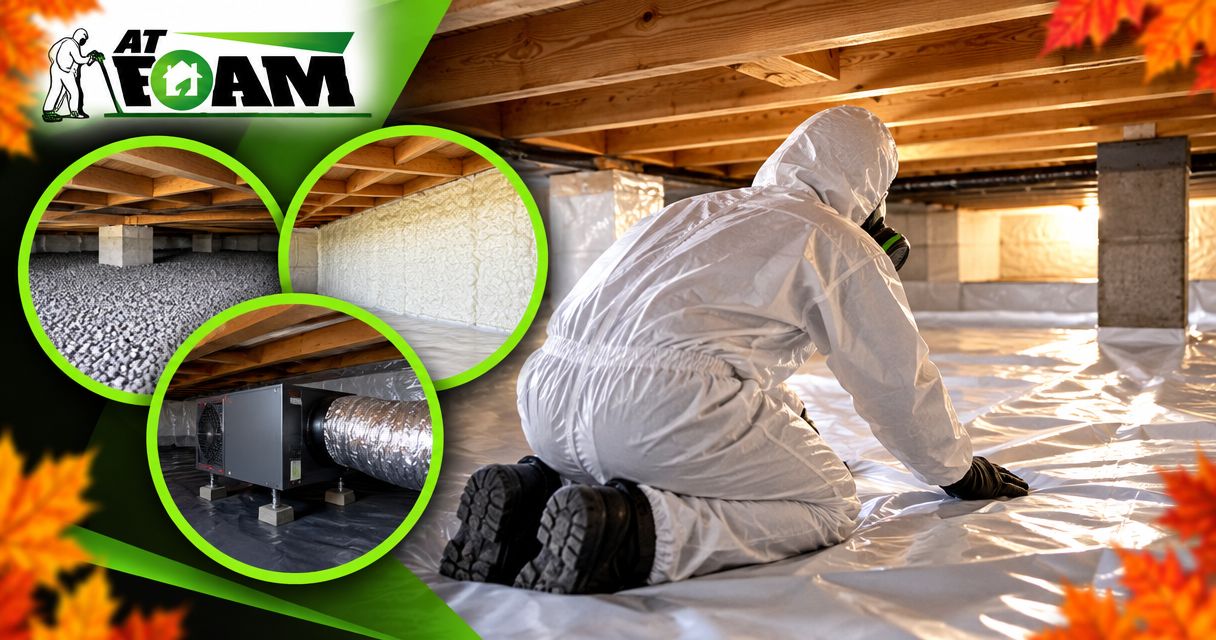
Yes. Alternatives to crawl space encapsulation include fixing drainage, installing a ground vapor barrier, controlling humidity, and air-sealing and insulating the floor above the crawl space. In 2026, the right choice still depends on where the water, damp air, or heat loss starts. None of these measures replaces repairing an active leak, damaged wood, or an existing mold problem.
- Alternatives to crawl space encapsulation work when they address the actual moisture source, not just the symptoms.
- A ground vapor barrier limits soil moisture; it does not stop flooding or plumbing leaks.
- A dehumidifier controls airborne moisture but needs drainage, maintenance, and a suitable enclosure.
- AT Foam Insulation provides local crawl space spray foam insulation; insulation does not replace drainage repairs.
Are there alternatives to crawl space encapsulation?
Yes—but choose by the problem, not by the smallest project scope. A crawl space with exposed soil needs a different fix from one receiving roof runoff. Cold floors need a different investigation from standing water.
Full encapsulation generally combines a sealed ground covering, treatment of perimeter openings, and a planned way to manage moisture. Insulation placement also needs to match the enclosure design. A partial approach handles fewer jobs, so its limits matter as much as its benefits.
For the insulation portion, AT Foam Insulation serves homeowners and businesses in Seattle, Tacoma, Olympia, and the greater Pacific Northwest.
| Approach | Best for | Main benefit | Main limitation |
|---|---|---|---|
| Drainage and leak repairs | Water entering from a specific source | Addresses the source of liquid water | Does not stop moisture evaporating from exposed soil |
| Ground vapor barrier | Moisture rising from bare soil | Separates crawl space air from damp ground | Does not control every air leak or stop flooding |
| Crawl space dehumidifier | Persistent airborne moisture after source repairs | Removes moisture from the air | Needs power, drainage, maintenance, and suitable operating conditions |
| Floor air sealing and insulation | Drafts and heat loss through the floor assembly | Treats the boundary beneath your living space | Does not dry wet soil or repair leaks |
| Ventilation corrections | A vented crawl space with blocked or poorly functioning openings | Restores the intended ventilation arrangement | Outdoor air is not always drying air |
| Full encapsulation | A crawl space needing coordinated ground, air, and humidity control | Treats connected moisture pathways together | Requires a complete design rather than an isolated liner installation |
Why this matters in a Pacific Northwest home
Wet winters make water management a practical concern around Seattle, Tacoma, Olympia, and the Eastside. Rainwater belongs outside the foundation. Ground moisture belongs beneath a suitable ground covering—not against your floor framing.
Your crawl space can also have separate comfort and moisture problems. Cold floors do not prove that you need encapsulation, and a musty smell does not prove that insulation is the missing piece.
Separate liquid water, water vapor, and heat loss before choosing the work. That keeps you from asking one material to solve unrelated problems.
Drainage and leak repairs: best for incoming water
Start here if you see puddles, flowing water, leaking pipes, or wet patches that appear after rain. Check gutters, downspouts, exterior grading, and plumbing before covering the crawl space floor.
The repair depends on the source. A plumbing leak needs plumbing work. Surface runoff needs a route away from the foundation; persistent groundwater needs a drainage assessment.
Drainage work has a clear advantage: it tackles incoming water instead of treating the humidity left behind. Its limit is equally clear. Drying up a puddle does not stop exposed soil from releasing moisture into the air.
Choose source repairs first when liquid water is present. Reassess the remaining ground moisture and humidity after those repairs, rather than assuming the crawl space is finished.
A ground vapor barrier: best for exposed soil
A ground vapor barrier is a sheet material that limits moisture moving from soil into crawl space air. It can be a narrower project than full encapsulation because covering the ground does not automatically include sealing the entire enclosure or adding humidity equipment.
Coverage and detailing matter. Gaps around supports, displaced sheets, and unaddressed edges leave routes for ground moisture. Ask how seams, penetrations, access routes, and damaged sections will be handled.
This approach makes sense when soil moisture is the main remaining source and the rest of the crawl space arrangement is appropriate. It does not make sense as a cover-up for standing water, contaminated debris, or damaged framing.
Choose a ground barrier for ground moisture—not as a substitute for drainage. Keep an access plan so future plumbing or electrical work does not leave the covering disturbed.
A dehumidifier: best for remaining airborne moisture
A crawl space dehumidifier removes moisture from the air and sends collected water to a drain or collection system. It addresses humidity, not the source of every moisture problem.
Equipment selection needs to account for the space, air leakage, operating temperature, and drainage route. A unit running in a crawl space that continually admits damp air faces a different job from one operating inside a controlled enclosure.
The benefit is direct humidity control. The trade-off is an ongoing need for electricity, filter care, access, and a working condensate drain—the line that carries collected water away.
Consider dehumidification after checking leaks, drainage, and exposed ground. Do not set a household unit on wet soil and treat the installation as complete.
Floor air sealing and insulation: best for drafts and cold floors
Air sealing closes unwanted air paths through the floor assembly. Insulation slows heat flow. R-value describes resistance to heat flow; it does not tell you whether gaps around the insulation are sealed.
In a vented crawl space, the floor above commonly forms the boundary between living space and outdoor conditions. Work at that boundary needs to account for plumbing, wiring, ducts, and the rim joist—the framing around the outside edge of the floor.
The benefit is a targeted comfort improvement without automatically changing the entire crawl space enclosure. The limitation is that insulation does not remove water or make damp wood ready to cover.
Open-cell and closed-cell spray foam behave differently, especially around moisture. Product selection, permitted use, substrate condition, required protective coverings, and the assembly design all matter. Do not choose either foam solely because it fills a cavity.
Your crawl space rim joists deserve attention during the assessment because the perimeter contains joints and service penetrations that need deliberate detailing.
Choose floor insulation for a floor-boundary problem, after moisture issues are addressed. Ask what remains accessible for inspection when the work is complete.
Ventilation corrections: best for an existing vented design
A blocked vent can interfere with an intended ventilation arrangement. Clearing an obstruction, however, is not the same as proving that more outdoor air will dry the crawl space.
Condensation happens when moist air meets a surface cold enough for water to collect. That means outdoor conditions and crawl space surface temperatures both matter. Opening more vents is not a universal moisture fix.
The advantage of correcting an existing vented arrangement is that you preserve its intended operation. The limitation is that ventilation alone does not stop ground vapor, plumbing leaks, or incoming rainwater.
Do not block vents or add fans without checking the whole arrangement. Combustion appliances, ductwork, local requirements, and the location of the insulation boundary need to be considered together.
How do you choose the right alternative?
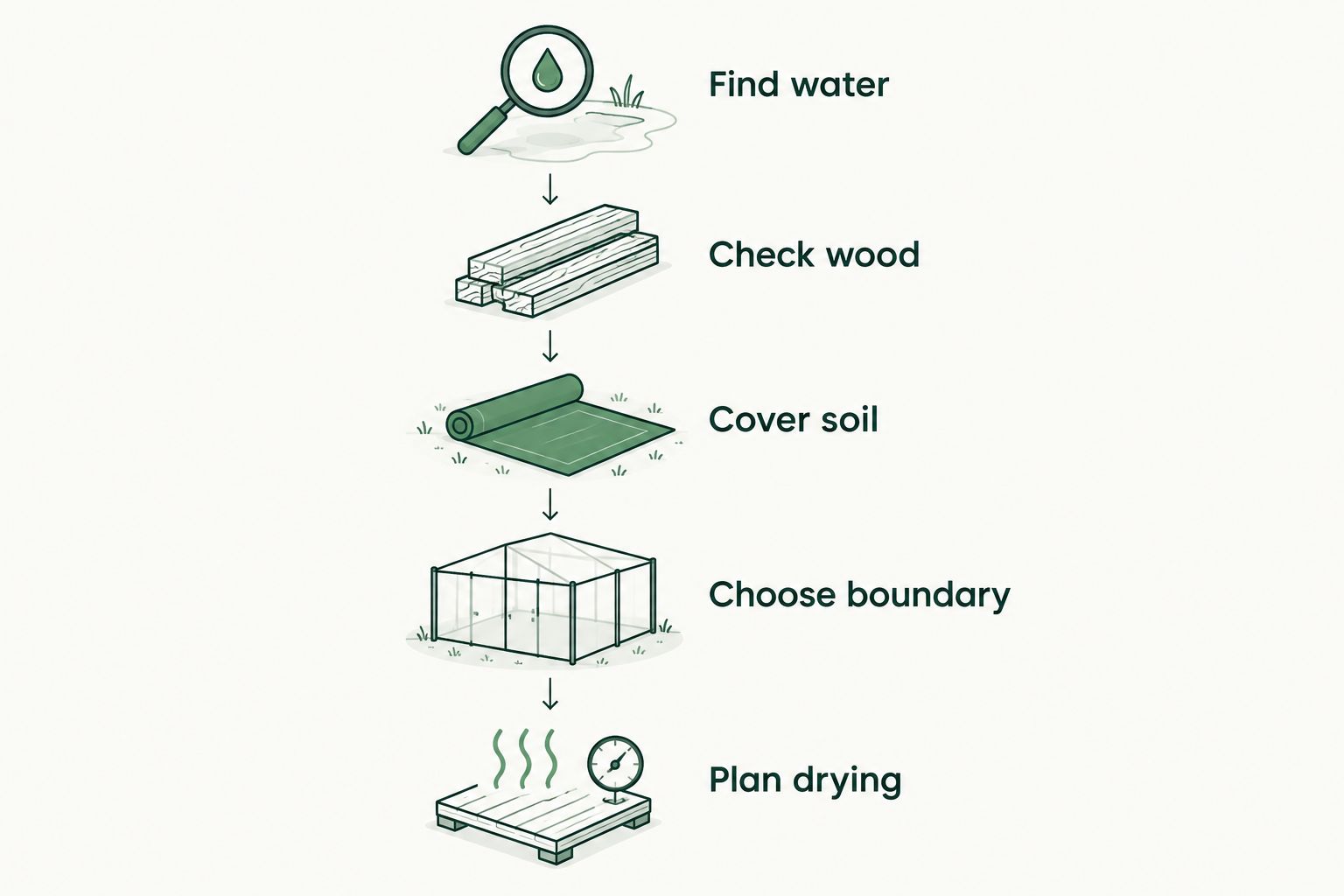
Use this sequence for a 2026 crawl space project. It keeps the inspection ahead of the purchase and prevents insulation from hiding an unresolved water problem.
- Find water. Look for active leaks, puddles, drainage tracks, and wet conditions after rain. Have the source assessed before installing coverings.
- Check wood. Identify soft framing, visible growth, damaged subflooring, and other conditions that need qualified evaluation before concealment.
- Cover soil. Determine whether exposed ground is contributing moisture and how a continuous ground covering would be detailed.
- Choose boundary. Decide whether the floor above or the crawl space perimeter forms the insulated enclosure. Avoid mixing disconnected approaches.
- Plan drying. Establish how the finished arrangement controls humidity and how you will check that it works.
These steps work together. Finding wet wood changes what can safely be covered; choosing the enclosure boundary changes the insulation and humidity plan.
Why the right crawl space fix varies
The same treatment does not fit every house. These conditions change the scope:
- Water source: Roof runoff, plumbing leaks, ground vapor, and humid air require different controls.
- Framing condition: Wet, damaged, or contaminated wood needs assessment before it is covered.
- Enclosure design: A vented crawl space and a sealed crawl space require different air and insulation details.
- Existing equipment: Ducts, plumbing, and combustion appliances affect access and enclosure decisions.
- Service access: Future repairs need routes that do not destroy the liner or insulation.
- Maintenance needs: Drains, pumps, dehumidifiers, and ground coverings need inspection and upkeep.
Ask for the reasoning behind the scope, not just a list of materials. A good plan explains which moisture pathways it addresses and which conditions need separate work.
Does longer-lasting insulation replace moisture control?
No. The question of spray foam insulation lifespan is separate from whether a crawl space has reliable drainage and an appropriate drying path. A durable insulation material cannot repair a leaking pipe or redirect water entering through the foundation.
Before covering framing, ask whether the wood is suitable for the proposed installation and how future leaks will be detected. Also ask which surfaces remain visible and which areas need access for service or inspection.
For a 2026 insulation project, judge the assembly rather than the foam alone. The assembly includes the wood, insulation, air seals, moisture controls, and any required protective covering.
Insulation should be part of the moisture plan, not an excuse to skip it. This matters whether you choose a limited floor upgrade or a broader crawl space conversion.
Can you fix a damp crawl space without encapsulating it?
Yes, when a defined repair addresses the cause. Fixing a leaking supply pipe or redirecting roof runoff can resolve that source without changing the entire enclosure.
Check the result after the repair. Remaining exposed soil, damp framing, or recurring humidity can require additional work even after the original leak stops.
Is a vapor barrier the same as encapsulation?
No. A vapor barrier controls moisture movement through the surface it covers; encapsulation treats the crawl space as a coordinated enclosure.
Ask the contractor to describe the edges, walls, vents, access door, insulation boundary, and humidity control. The label on the proposal matters less than those details.
Will spray foam fix a wet crawl space?
No. Spray foam insulation slows heat flow and, where properly specified and installed, can contribute to air sealing. It does not replace drainage, leak repairs, or assessment of damaged wood.
AT Foam Insulation is best for Seattle-area homeowners seeking a veteran-owned local spray foam insulation crew. The company installs crawl space insulation, but your estimate should distinguish insulation work from any separate water-management or remediation work.
What should your crawl space estimate include?
A useful 2026 estimate explains the problem and the proposed boundary—not just the material being installed. Ask for these details in writing:
- The observed source of water, moisture, or drafts.
- Repairs needed before insulation or coverings are installed.
- The exact surfaces receiving insulation and air sealing.
- How ground moisture and remaining humidity will be controlled.
- Access, maintenance, and inspection requirements after installation.
- Work that belongs in a separate trade's scope.
AT Foam Insulation offers free estimates and is licensed and insured. For an insulation quote, describe whether your main complaint is cold floors, drafts, dampness, or visible water. Those observations help frame the conversation without pretending they are a diagnosis.
FAQ
What’s the best alternative to crawl space encapsulation?
The best alternative is the repair that addresses your crawl space’s actual problem. Drainage handles incoming water, a ground barrier limits soil moisture, and floor insulation addresses heat loss; some homes need a combination.
Can I just put plastic over the crawl space dirt?
A suitable ground vapor barrier can limit moisture rising from soil, but it does not replace drainage or leak repairs. Its coverage, seams, edges, and condition all affect the result.
Is a dehumidifier enough for a damp crawl space?
A dehumidifier alone does not address every cause of crawl space dampness. Fix water entry and assess exposed ground first, then determine whether the enclosure and drainage arrangement suit dehumidification.
Should I leave crawl space vents open in Washington?
Vent operation should match the crawl space’s intended design and applicable local requirements. Do not close vents as an isolated fix without assessing moisture control, insulation placement, and any combustion appliances.
Can I insulate my crawl space before fixing a leak?
Fix the leak and assess affected materials before insulating the area. Covering wet or damaged framing leaves the underlying problem unresolved and can make inspection harder.
Does crawl space insulation get rid of mold?
Crawl space insulation does not remove existing mold. Identify and correct the moisture source, then have affected materials evaluated before installing insulation or concealing surfaces.
Who can estimate crawl space spray foam insulation near Seattle?
AT Foam Insulation provides crawl space spray foam insulation estimates in Seattle, Tacoma, Olympia, and the greater Pacific Northwest. The veteran-owned contractor offers free estimates for residential and commercial insulation work.
Related guides
- Can crawl space encapsulation fix an existing mold problem?
- Open-cell vs. closed-cell spray foam for a Washington home
- Insulation companies in Seattle
One last thing
Before your 2026 crawl space appointment, note whether dampness appears after rain, near plumbing, or across exposed soil. Share photographs taken from a safe access point; do not enter standing water or an unsafe crawl space.
Get a FREE Quote from AT Foam Insulation or call 425-999-8493.