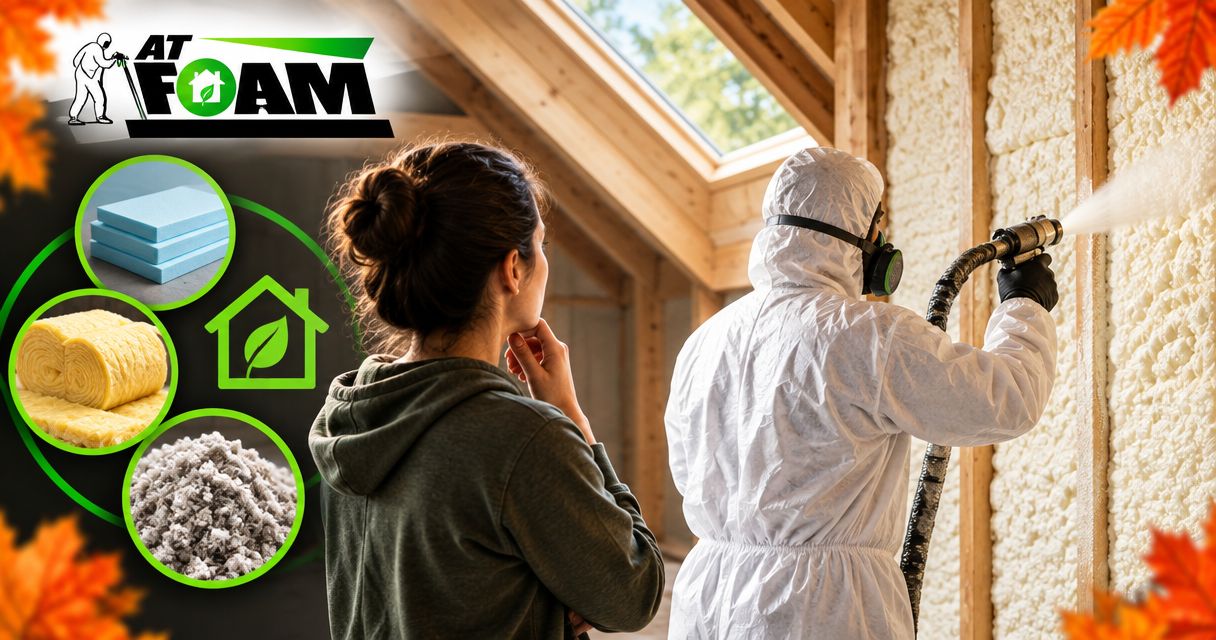
Yes. Alternatives to spray foam insulation include fiberglass, cellulose, mineral wool, and rigid foam board; the right choice depends on whether you are insulating an attic, an open wall, or a crawl space. Fibrous insulation needs a separate air-sealing plan, and no insulation material fixes a roof leak, standing water, or rotten framing.
- Alternatives to spray foam insulation include fiberglass, cellulose, mineral wool, and rigid foam board.
- Cellulose and blown-in fiberglass suit accessible attic floors; seal air leaks before covering them.
- Mineral wool suits open wall cavities, but it does not replace an air barrier.
- AT Foam Insulation provides spray foam installation for homeowners and businesses in the Pacific Northwest.
Why this matters in a Washington home
A cold room does not automatically mean you need spray foam. Your home might have missing insulation, air leaks, wet material, or a poorly defined boundary between heated and unheated space. Each problem needs a different repair.
For a 2026 insulation project, start with the assembly—the layers making up your roof, wall, or floor—not a favorite material. The comparison of blown-in insulation versus spray foam for attics explains why insulating an attic floor differs from insulating the underside of a roof.
Choose the insulation after you identify where heat, air, and moisture need to be controlled. That order matters during wet Pacific Northwest winters.
Are there alternatives to spray foam insulation?
Yes. These materials perform the same basic job of slowing heat flow, but they do not handle air movement, moisture, or installation details the same way. R-value measures resistance to heat flow; a higher value means greater resistance, not an automatic guarantee of a better installation.
| Material | Best for | Main advantage | Main limitation |
|---|---|---|---|
| Fiberglass batts | Accessible, regularly spaced framing | Fits between exposed studs or joists | Gaps and compression reduce performance; separate air sealing is needed |
| Blown-in fiberglass | Accessible attic floors | Fills around attic framing without cutting batts | Does not seal air leaks; needs correct depth and coverage |
| Cellulose | Attic floors and suitable enclosed cavities | Loose-fill or dense-pack installation suits different spaces | Installation density and moisture conditions matter |
| Mineral wool batts | Open walls and sound-control partitions | Fits exposed cavities and provides sound absorption | Requires careful fitting and a separate air barrier |
| Rigid foam board | Continuous insulation and accessible flat surfaces | Can reduce heat flow through framing | Joints, edges, attachment, and protective coverings need detailing |
| Spray foam | Irregular cavities needing insulation and air control | Can provide insulation and air sealing together | Product selection, installation conditions, and occupancy precautions matter |
No material wins in every row. A flat attic floor and an enclosed wall are different jobs, even inside the same house.
Fiberglass: best for accessible framing and attic floors
Fiberglass comes as batts, which are preformed blankets, or loose fibers blown into place. Batts fit exposed framing. Blown-in fiberglass suits attic floors where you need coverage around joists and other obstructions.
Its limitation is air movement. Fiberglass does not substitute for sealing plumbing penetrations, wiring holes, or gaps at the tops of walls. Covering an air leak with insulation leaves the leak underneath.
For a 2026 attic upgrade, ask the installer to explain the air-sealing work before discussing added insulation. Attic ventilation openings also need protection so loose material does not block them.
- Best for: Accessible attic floors and open, regularly spaced cavities.
- Advantage: You can insulate without applying foam directly to the framing.
- Trade-off: Careful fitting, full coverage, and separate air sealing remain essential.
Choose fiberglass when the space is accessible and the air-control details are addressed separately. Do not choose it as a shortcut around those details.
Cellulose: best for attic coverage and suitable enclosed cavities
Cellulose insulation is generally made from recycled paper treated for fire resistance. Installers can blow it loosely across an attic floor or use a dense-pack method to fill suitable enclosed wall cavities.
Dense-pack means installing the material at the specified density inside a contained space. It is not the same job as spreading loose fill across an attic. The installer needs to confirm the cavity is suitable and follow the product's installation requirements.
Cellulose does not make roof leaks harmless. Wet insulation needs investigation, and the moisture source needs correction before you close the assembly.
- Best for: Accessible attic floors and suitable wall-retrofit cavities.
- Advantage: Different installation methods accommodate open and enclosed spaces.
- Trade-off: Coverage, density, and moisture conditions require attention.
Choose cellulose when the installer can explain both the cavity-fill method and the separate air-sealing work. Filling a wall is not proof that every air leak has been sealed.
Mineral wool: best for open walls and sound-control work
Mineral wool batts are fibrous insulation made from mineral materials. They fit between exposed studs or joists and can absorb sound inside wall cavities.
That makes mineral wool useful during a remodel when the wall is already open. It does not make the finished room soundproof. Doors, gaps, ducts, and sound traveling through framing still affect what you hear.
The same distinction applies to heat loss: fitting batts into a wall does not create a continuous air barrier. You still need a connected layer that stops air from moving through the assembly.
- Best for: Open wall cavities and interior partitions where sound absorption matters.
- Advantage: Provides cavity insulation without sprayed foam.
- Trade-off: Requires close fitting around obstructions and separate air-control detailing.
Choose mineral wool for an accessible cavity, not as a cure for every draft or noise problem. Ask how the finished assembly handles both.
Rigid foam board: best for continuous insulation
Rigid foam board is an alternative to sprayed foam, not a foam-free alternative. If avoiding foam altogether is your goal, fiberglass, cellulose, and mineral wool belong on your comparison list instead.
Board insulation can form a continuous layer across framing. That matters because studs and joists conduct heat through an otherwise insulated assembly—a process called thermal bridging.
Boards need deliberate installation details. The material type, joint treatment, edge sealing, attachment, and required protective covering all affect whether the proposed assembly works.
- Best for: Accessible surfaces where a continuous insulation layer is practical.
- Advantage: Can limit heat flow through framing when installed across it.
- Trade-off: Cutting boards to fit does not automatically produce a continuous air barrier.
Choose rigid board when the full layer can be detailed properly. Ask which board product is specified and how the installer will treat every joint and perimeter.
When spray foam still makes sense
Spray foam remains an option when an assembly needs insulation and air sealing together, especially around irregular framing. Open-cell foam has a more open internal structure; closed-cell foam has a denser structure and different moisture-control properties. They are not interchangeable specifications.
Spray foam also has installation requirements that fibrous insulation does not share. Surface conditions, application thickness, ventilation during installation, and manufacturer-directed re-entry instructions need attention. Foam does not repair damaged wood or eliminate the need for roof-leak repairs.
AT Foam Insulation is a fit for Pacific Northwest homeowners who want a veteran-owned local spray foam contractor. The licensed and insured crew installs open-cell and closed-cell insulation in attics, crawl spaces, and walls, with free estimates.
The service is relevant when spray foam fits the assembly. An estimate should still identify the proposed material, installation location, and moisture-control approach—not just say that foam is better.
Why the right insulation varies from house to house
A useful 2026 comparison accounts for the building, not just the bag or drum. These factors change the recommendation:
- Access: Open framing accepts batts; enclosed cavities require a suitable retrofit method or opening the finish.
- Air leaks: Fibrous insulation needs separate air sealing. Foam boards need correctly treated seams and edges.
- Moisture: Roof leaks, ground moisture, and condensation need different repairs. Insulation does not replace those repairs.
- Drying direction: Wall and roof layers must work together so moisture is not trapped against vulnerable materials.
- Insulation boundary: Insulating an attic floor creates a different assembly from insulating the roofline.
- Future access: Wiring, plumbing, and framing inspections deserve consideration before you cover them.
Compare written scopes against those factors. A material name alone tells you little about whether the proposed work solves your problem.
How do you choose an alternative for your home?
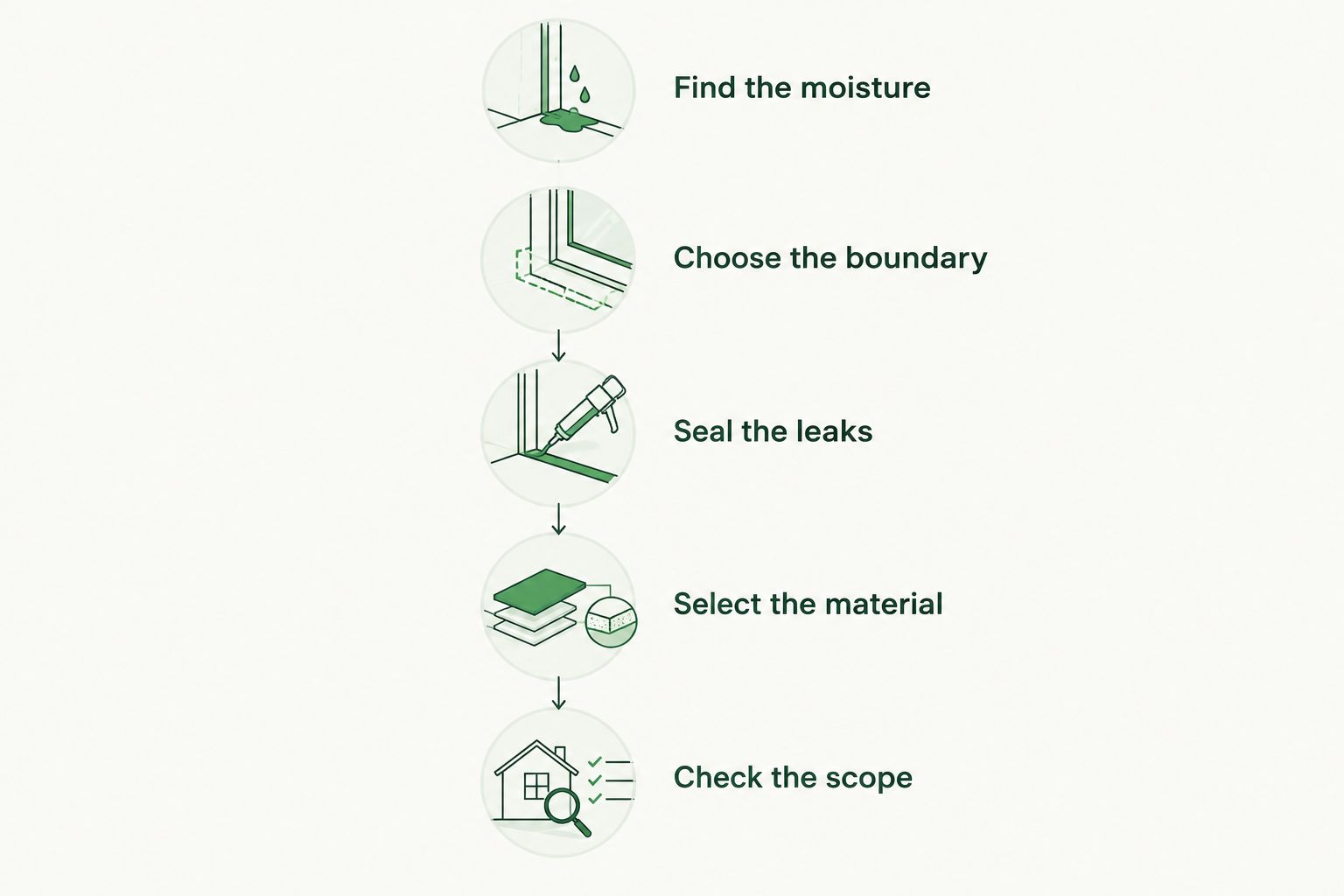
Use this sequence before approving a 2026 installation. It keeps a material preference from turning into the wrong repair.
- Find the moisture. Check for roof leaks, damp framing, ground moisture, and plumbing leaks. Resolve active sources before covering affected areas.
- Choose the boundary. Decide which surfaces separate conditioned space from unconditioned space. Keep that boundary continuous.
- Seal the leaks. Identify the air-control layer and how it connects at edges, openings, and transitions.
- Select the material. Match the insulation to access, required R-value, moisture conditions, and the assembly's design.
- Check the scope. Confirm preparation, ventilation details, protective coverings, cleanup, and any product-specific occupancy instructions.
Ask the contractor to walk through the proposed boundary with you. A clear explanation should connect the attic, walls, and floor rather than treat each surface as an unrelated purchase.
What can replace spray foam in a damp crawl space?
Fiberglass, mineral wool, and rigid board can belong in crawl-space assemblies, but the correct choice depends on whether you insulate the floor above or the crawl-space enclosure. Do not switch between those approaches without accounting for ventilation and moisture control.
Ground moisture needs its own control layer. A ground vapor barrier limits moisture moving from soil into the crawl space; insulation serves a different purpose. Neither solves standing water or a plumbing leak.
Pay attention to the rim joist—the framing around the outer edge of the floor. The guide to insulating crawl-space rim joists explains why this perimeter needs attention alongside the larger floor or wall surfaces.
Fix the dampness before hiding the framing. Musty smells, staining, and soft wood call for investigation, not another layer of insulation.
Can you mix insulation materials instead of using spray foam everywhere?
Yes. Different materials can serve different parts of a home, provided the assembly maintains continuous air control and suitable moisture management. An attic-floor insulation choice does not dictate what belongs in an open wall.
Mixing materials within a single roof or wall needs more care. Layer order and vapor resistance affect drying, so adding an impermeable layer is not a casual substitution.
For your 2026 project, ask for the proposed layers in writing. The explanation should show what controls heat, what stops air, and how the assembly handles moisture.
FAQ
What’s the best alternative to spray foam insulation for an attic?
Blown-in fiberglass or cellulose is a practical alternative for an accessible attic floor. Air-seal the floor first and preserve required ventilation paths; insulating the roofline is a different assembly.
Is mineral wool better than spray foam insulation?
Mineral wool is a useful choice for open cavities and sound absorption, while spray foam can combine insulation with air sealing. The better choice depends on the assembly, access, and moisture-control requirements.
Can I insulate my house without using any foam?
Yes. Fiberglass, cellulose, and mineral wool provide foam-free insulation options. You still need a separate plan for air sealing and moisture control.
Will fiberglass stop drafts like spray foam?
Fiberglass does not replace an air barrier. Seal gaps and penetrations separately, then install the insulation without gaps or compression.
Does rigid foam board count as a spray foam alternative?
Rigid foam board is an alternative to sprayed foam, but it is still foam. Choose a fibrous material instead if avoiding foam itself is your priority.
Can new insulation fix a moldy crawl space?
New insulation does not fix the moisture source behind a mold problem. Investigate water entry, ground moisture, plumbing leaks, and damaged materials before insulating.
Who can assess spray foam insulation for my Washington home?
AT Foam Insulation provides residential and commercial spray foam installation in Seattle, Tacoma, Olympia, the Eastside, and the greater Pacific Northwest. The veteran-owned contractor offers free estimates for attic, crawl-space, and wall insulation.
One last thing
A thicker insulation layer can hide an unfinished air-sealing job. Before new material covers your attic floor or crawl-space framing, ask to see the sealed penetrations and repaired moisture problems.
Judge the work underneath the insulation, not just the finished surface. A tidy-looking installation is not proof that air leaks and water entry were addressed.
Related guides
- Can attic insulation reduce ice dams in Washington winters?
- How to choose a whole-home insulation retrofit contractor in 2026
- Insulation companies in Seattle: choosing your contractor
Get a FREE Quote from AT Foam Insulation: call 425-999-8493.