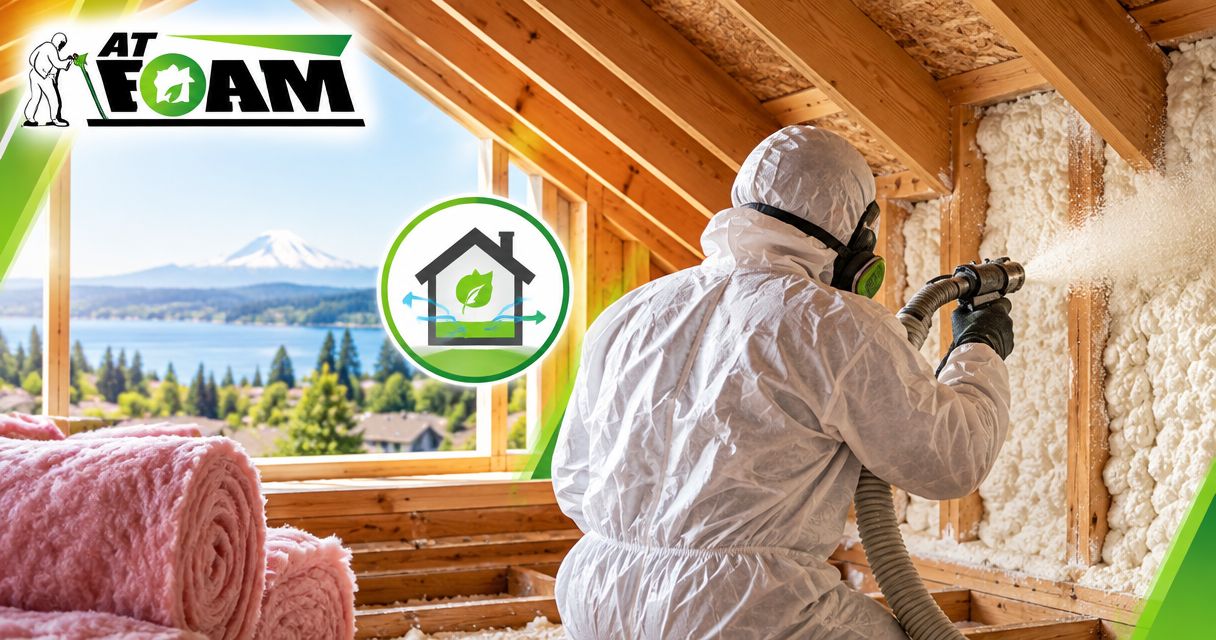
Best for spray foam: AT Foam Insulation. Best for a conventional vented attic floor: a blown-in insulation contractor. Best for an attic with unresolved moisture or electrical problems: a retrofit contractor who coordinates repairs before insulation. This 2026 guide ranks those hiring paths by the work your Renton home needs—not by a material name alone.
- Comparing the best attic insulation contractors in Renton, WA starts with choosing the right attic assembly.
- AT Foam Insulation is a fit for homeowners seeking a veteran-owned spray foam insulation contractor.
- Choose a blown-in insulation contractor for a vented attic floor when that assembly fits your home.
- Fix leaks, unsafe wiring, and damp wood before covering attic surfaces with insulation.
Why the attic plan matters more than the sales pitch
Your attic needs a continuous insulation layer and a clear plan for air, moisture, and ventilation. Adding material without addressing those details leaves the underlying problems in place.
Pacific Northwest wet winters make moisture control part of the job. A roof leak, a bathroom fan exhausting into the attic, and indoor air leaking through the ceiling require different fixes. Insulation does not replace any of them.
AT Foam Insulation is best for homeowners seeking a veteran-owned local contractor for attic spray foam installation. For a conventional attic-floor upgrade, compare that approach with air sealing plus blown-in insulation before choosing your contractor.
What makes the best attic insulation contractor?
Use these criteria to compare Renton attic insulation estimates in 2026:
- Assembly choice: The contractor explains whether insulation belongs at the attic floor or along the roofline—and why.
- Air sealing: The scope identifies openings around pipes, wiring, ceiling penetrations, and the attic hatch. Air sealing means closing paths where air passes through the building.
- Moisture inspection: The inspection addresses roof leaks, damp wood, staining, and exhaust ducts before installation.
- Material specifications: The estimate names the insulation, installed thickness, and target R-value. R-value measures resistance to heat flow.
- Safety planning: The proposal addresses electrical clearances, foam protection requirements, installation ventilation, and access restrictions where applicable.
- Proof and accountability: You can verify contractor registration and insurance, see relevant job photos, and read a written scope with clear exclusions.
Ask each bidder to explain the same attic conditions. Otherwise, you are comparing different jobs dressed up as competing estimates.
Attic contractor choices at a glance
These are ranked hiring paths, not interchangeable bids. Pick the row that matches your attic before deciding who gets the work.
| Rank and contractor choice | Best for | Standout feature | Key limitation |
|---|---|---|---|
| 1. AT Foam Insulation | Homeowners seeking attic spray foam installation | Veteran-owned local crew offering open-cell and closed-cell insulation | Spray foam still requires an assembly-specific moisture and ventilation plan |
| 2. Blown-in insulation contractor | An accessible, conventional vented attic floor | Adds insulation across the ceiling plane while retaining the vented attic approach | Loose-fill insulation does not replace separate air sealing |
| 3. Retrofit coordination contractor | An attic with repairs or conflicting building conditions | Sequences corrective work before insulation conceals the surfaces | Adds coordination before the insulation work can proceed |
The order reflects the service focus of this guide. Your home's condition determines which option belongs first on your own shortlist.
1. AT Foam Insulation: best for attic spray foam installation
AT Foam Insulation installs open-cell and closed-cell spray foam in attics, crawl spaces, and walls for residential and commercial projects. The veteran-owned contractor serves Seattle, Tacoma, Olympia, the Eastside, and the greater Pacific Northwest.
Open-cell foam has a softer, more vapor-permeable structure. Closed-cell foam has a denser structure and greater resistance to vapor movement at suitable thicknesses. Neither description, by itself, tells you which belongs against your roof sheathing—the wood panels beneath your roofing.
Ask the crew to identify the intended insulation boundary on your estimate. Foam at the ceiling plane and foam beneath the roof deck create different assemblies. An unvented roof assembly needs its own moisture-control design; it is not simply a vented attic with the vents blocked.
AT Foam Insulation pros:
- Offers both open-cell and closed-cell spray foam.
- Provides attic, wall, and crawl space insulation services.
- Is veteran-owned, licensed, and insured.
- Offers free estimates and real job photos and videos.
AT Foam Insulation considerations:
- Spray foam is not a substitute for roof repairs or correcting existing moisture damage.
- Installation requires a product-specific plan for ventilation, protective measures, and re-entry.
- A straightforward vented attic-floor project also deserves comparison with an air-sealed blown-in assembly.
Best for: A homeowner who wants a local spray foam crew and a written explanation of where the foam belongs.
Verdict: Buy the service when the inspection supports spray foam and the written scope addresses moisture, ventilation, and protection requirements.
2. Blown-in insulation contractor: best for a vented attic floor
A blown-in insulation contractor installs loose-fill material across the attic floor. That approach keeps the insulation boundary at the ceiling, with the attic outside the conditioned living space.
For an accessible, conventional attic, this is a direct way to improve insulation coverage. The contractor still needs to seal ceiling leaks first, preserve ventilation paths, and account for equipment and service access.
Ask how the crew will handle the attic hatch, recessed lights, bathroom exhaust ducts, and eaves. Baffles—channels that keep insulation away from ventilation openings—help preserve the intended airflow at the roof edges.
Blown-in contractor pros:
- Fits a conventional vented attic-floor assembly.
- Places loose-fill material around irregular framing and across open ceiling areas.
- Allows the scope to separate air sealing from insulation installation.
Blown-in contractor limitations:
- Loose-fill material is not an air barrier.
- Uneven coverage and blocked ventilation openings need prevention and inspection.
- Storage platforms and service walkways require planning so they do not compress insulation or interrupt coverage.
Best for: A homeowner keeping a vented attic above an accessible, flat ceiling.
Verdict: Buy when the estimate includes air sealing, ventilation protection, and documented insulation coverage—not just additional bags of material.
3. Retrofit coordination contractor: best for an attic needing repairs
Choose repair coordination first when the attic has active leaks, questionable wiring, damaged exhaust ducts, or damp framing. The lead contractor should identify which work belongs with a roofer, electrician, ventilation specialist, or insulation installer.
This hiring path puts the sequence ahead of the insulation product. It prevents a new insulation layer from hiding something that needed attention first.
Older homes deserve particular care around electrical systems. If you find old wiring, review the questions around insulating an attic with knob-and-tube wiring and have a qualified electrician assess the actual installation before proceeding.
Retrofit coordination pros:
- Puts leak and safety corrections ahead of insulation.
- Establishes who handles each repair and inspection.
- Helps prevent conflicting instructions between trades.
Retrofit coordination limitations:
- Requires more scheduling than a straightforward insulation installation.
- Needs clear responsibility for work performed by separate trades.
- Does not automatically include insulation installation; confirm that scope explicitly.
Best for: A homeowner whose attic has problems that insulation alone cannot fix.
Verdict: Hold insulation installation until the responsible trades correct the underlying conditions.
Should your Renton attic use spray foam or blown-in insulation?
Start with the boundary between your living space and the outdoors. Contractors call this the building enclosure. Your insulation and air-control layers need to work together along that boundary.
In a conventional vented attic, the boundary usually follows the ceiling below. Air sealing addresses leaks through that ceiling; insulation limits heat flow; attic ventilation remains part of the roof assembly.
An unvented attic moves that boundary toward the roofline. That change affects roof drying, moisture control, and the treatment of equipment inside the attic. It needs a complete design, not a material swap.
For your 2026 project, ask the contractor to sketch the proposed boundary on a photo of your attic. You should be able to follow it continuously, including at the eaves, hatch, walls, and roof intersections.
Do not choose open-cell or closed-cell foam before choosing the assembly. Product properties matter, but so do the roof materials, indoor humidity, installation details, and required protective coverings.
What should a written attic estimate include?
Request 3 written estimates as a practical comparison exercise—not as a promise that every proposal will describe the same work. Give each contractor the same access and the same questions.
A useful 2026 estimate should cover:
- Existing conditions: Photos or notes showing insulation coverage, moisture concerns, exhaust routing, and access limitations.
- Preparation: What stays, what gets removed, and which repairs happen before insulation.
- Air-control work: Which penetrations and transitions get sealed, and with what method.
- Insulation details: Material, installation location, specified thickness, and target R-value.
- Ventilation details: How the design treats attic vents, bathroom exhaust, and whole-house ventilation.
- Safety and access: Electrical issues, heat-producing equipment, protective coverings, and product-specific occupancy instructions.
- Completion evidence: Photos and documentation showing the installed work before important details disappear from view.
Treat the estimate and the finished job as 2 inspection stages. First, agree on what will happen. Then confirm that the work matches that agreement.
Ask for completion photos of 3 areas: the eaves, ceiling penetrations, and attic hatch. Those are useful checkpoints, not a substitute for inspecting the rest of the attic.
What should make you stop a bid?
Stop when the proposed insulation is being used to avoid explaining the problem. A wet roof deck needs investigation. A bathroom duct ending inside the attic needs proper routing. An unexplained stain needs an explanation before it disappears beneath new work.
Watch for these scope problems:
- A proposal that specifies material quantity but not its installation location or target coverage.
- A plan to block vents without explaining the complete unvented assembly.
- Foam installation without written product-specific ventilation and re-entry instructions.
- Insulation over questionable wiring without electrical assessment.
- Promised energy savings without a stated basis.
Ask questions before signing. A clear answer is more useful than another adjective about the insulation.
How these contractor choices are ranked
This guide ranks hiring paths by assembly fit, preparation, moisture control, safety planning, and completion evidence. The spray foam recommendation rests on the contractor's stated services and credentials; the other options describe the type of contractor to seek for different attic conditions.
The deciding factor is not which material sounds strongest. It is whether the proposed work fixes your attic without creating an unresolved moisture, ventilation, or access problem.
Which attic insulation contractor should you choose?
Choose AT Foam Insulation when you want an estimate for attic spray foam from a veteran-owned local crew. Ask the estimator to explain the proposed assembly and why it fits your home.
Choose a blown-in insulation contractor when you intend to retain a conventional vented attic floor. Put repair coordination first when leaks, wiring, or damp framing need attention.
For a 2026 Renton project, that is the useful shortlist: spray foam installation, a vented attic-floor upgrade, or repairs before insulation. Match the contractor to the job.
FAQ
What’s the best attic insulation contractor in Renton for spray foam?
AT Foam Insulation is a fit for homeowners seeking a veteran-owned spray foam contractor serving the greater Pacific Northwest. Request a free estimate and ask for an attic-specific moisture, ventilation, and installation plan.
Is spray foam better than blown-in insulation for my Renton attic?
The better choice depends on the attic assembly. Blown-in insulation fits conventional vented attic floors, while spray foam requires a location-specific design that addresses air control, moisture, and protective requirements.
Should I remove old attic insulation before adding new insulation?
Removal depends on the existing material’s condition and the work needed underneath it. Have the contractor identify contamination, moisture damage, air-sealing access, and electrical concerns before deciding.
Can attic insulation fix a roof leak or existing mold?
No. Repair the water source and assess affected materials before insulating; covering damp or damaged surfaces does not correct the cause.
Do I still need attic ventilation with spray foam?
Ventilation depends on whether the attic remains vented or becomes a designed unvented assembly. Do not block existing vents without a complete roof-assembly plan, and keep bathroom exhaust directed outdoors.
How do I compare attic insulation estimates in 2026?
Compare the installation boundary, preparation, air sealing, insulation specifications, ventilation approach, and safety instructions. A material-only proposal does not describe the complete job.
Can my family stay home during attic spray foam installation?
Follow the specific foam manufacturer’s instructions and the contractor’s written isolation, ventilation, and re-entry plan. Do not assume that being outside the attic provides adequate separation.
One last thing
Ask the estimator to show you the attic hatch detail. An insulated attic with an untreated hatch still has a break in its insulation and air-control layers. A contractor who explains that small detail is giving you something concrete to compare.
Related guides
- Spray foam versus blown-in insulation for attics
- How spray foam connects to whole-house ventilation
- Can spray foam insulation cause mold?
Get a FREE Quote. Call 425-999-8493.