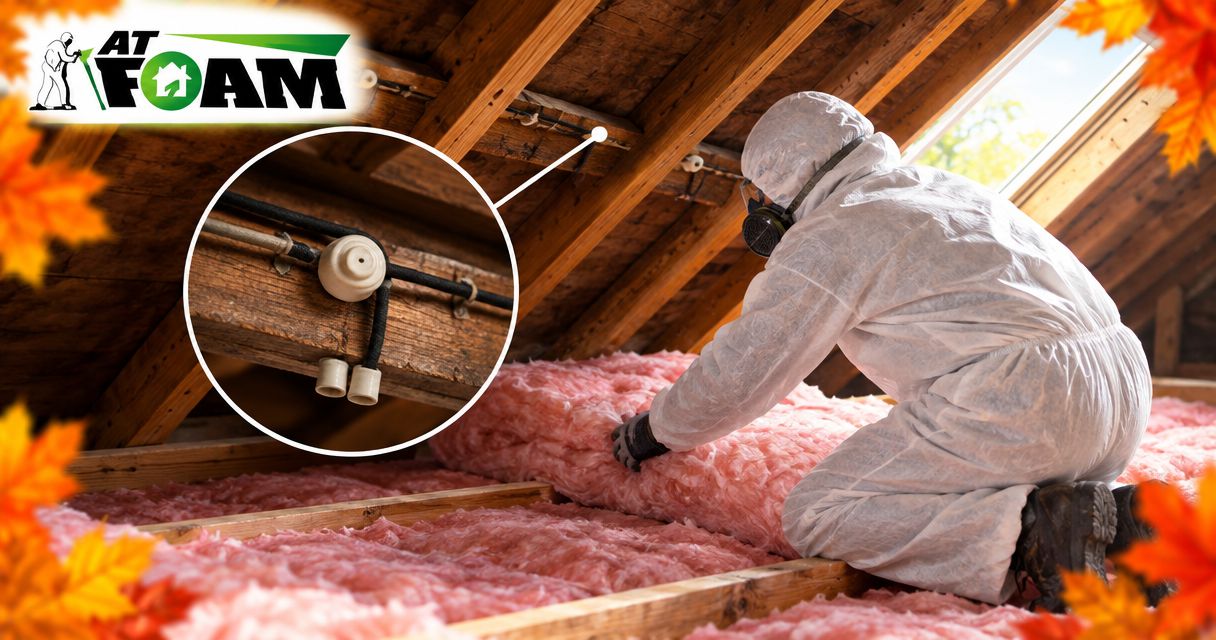
Yes, you can insulate an attic that contains knob-and-tube wiring, but you must resolve the electrical restrictions before covering anything. Do not bury active wiring in spray foam, batts, or loose-fill insulation without an approved plan. Washington has state-specific provisions for insulating around existing knob-and-tube wiring, so a licensed electrical contractor must assess the installation and confirm the requirements with the authority responsible for your job.
- Attic insulation knob and tube wiring projects need an electrical assessment before insulation covers any conductors.
- Washington has state-specific rules; an old installation is not automatic permission to bury active wiring.
- Spray foam is not a repair for damaged wiring or a substitute for electrical approval.
- AT Foam Insulation handles attic insulation; a licensed electrical contractor must resolve the wiring conditions first.
Why this matters
Knob-and-tube wiring uses separate conductors supported by ceramic knobs and protected by ceramic tubes where they pass through framing. Its original installation relies on open space around the conductors. Adding insulation changes those conditions and can hide damaged coverings, altered connections, and unsafe splices.
Electrical clearance comes before insulation coverage. Your first decision is not open-cell versus closed-cell foam. It is whether the wiring can remain, needs repairs, or must be replaced before the attic work starts.
For a 2026 attic project, separate the electrical question from the material question. Understanding whether spray foam insulation can catch fire does not establish that foam is permitted around your wiring.
Can you insulate an attic with knob-and-tube wiring?
You can proceed only after the electrical conditions and the proposed insulation method meet the applicable rules. The National Electrical Code, Section 394.12(5), addresses concealed knob-and-tube wiring in spaces where insulation envelops the conductors. Washington's WAC 296-46B-394 contains state-specific provisions that must also be considered.
That distinction matters. A blanket claim that every Washington attic requires complete rewiring is not a substitute for an electrical assessment. Neither is a claim that existing wiring can simply be covered because it has worked for years.
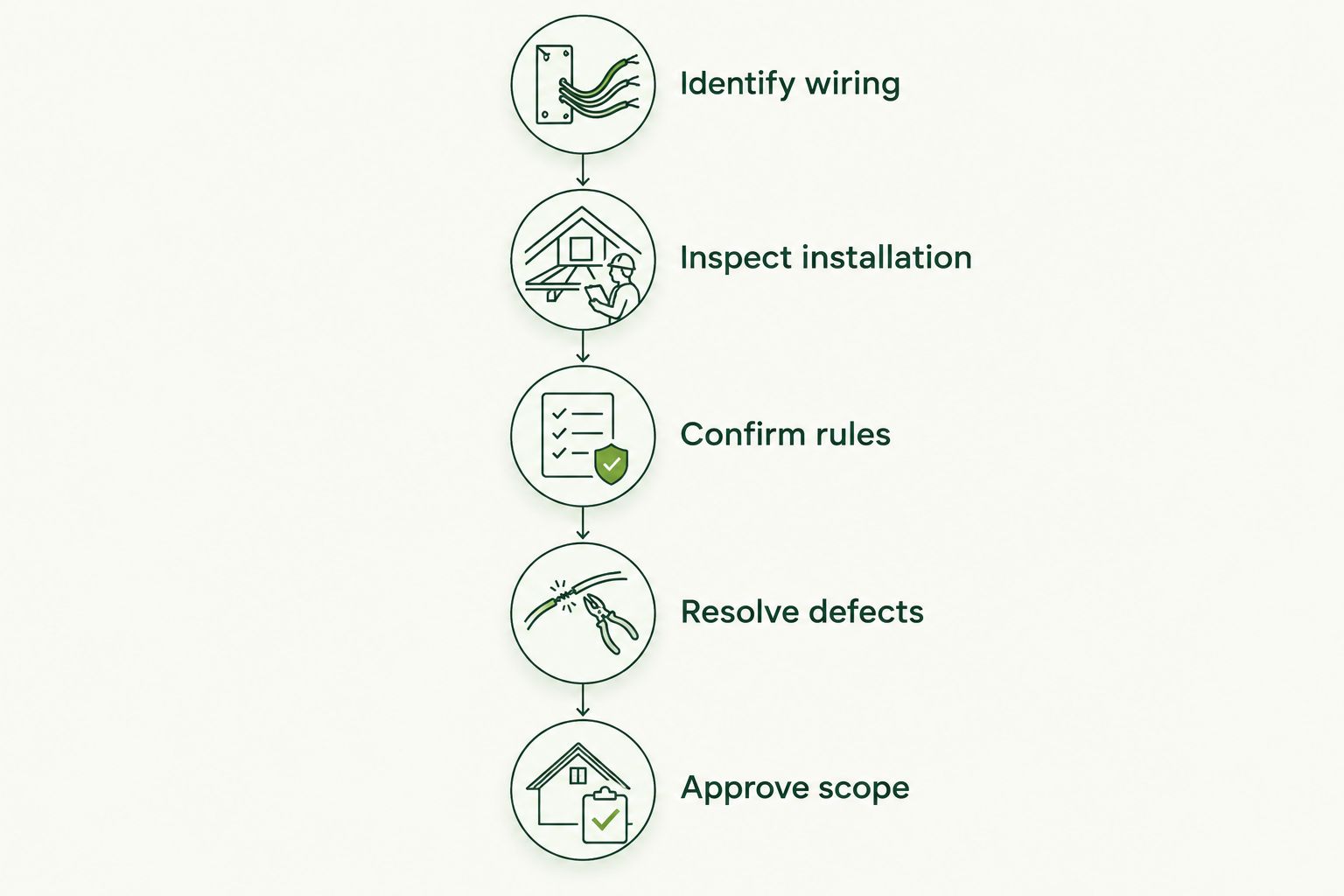
Use this sequence before scheduling installation:
- Identify the wiring. Have a licensed electrical contractor determine which visible conductors are knob-and-tube and whether they remain connected.
- Inspect the installation. The electrician checks its condition, alterations, connections, and relationship to the proposed insulation area.
- Confirm the rules. Establish which state provisions, local requirements, permits, inspections, and documentation apply.
- Resolve the defects. Complete required electrical repairs or replacement before insulation hides the work.
- Approve the insulation scope. Give the insulation crew a clear plan showing where work is permitted and what must remain accessible.
Do not make the insulation installer guess which wires are live. Ceramic hardware left in the attic does not prove that the attached wiring is disconnected.
The sequence is the same whether you are renovating a Seattle bungalow or improving an older Tacoma attic in 2026. The findings determine the work, not the age or appearance of the house alone.
What changes when the wiring is active or disconnected?
The electrical status of the conductors changes your options. Get that status established by an electrician, not by a label on the panel or a seller's recollection.
| Wiring condition | Best next step | Benefit | Limitation |
|---|---|---|---|
| Active knob-and-tube | Electrical assessment before selecting coverage | Establishes whether a compliant insulation plan is possible | Insulation cannot proceed on assumptions about safety or permission |
| Confirmed disconnected remnants | Document disconnection and address remaining hazards | Separates abandoned material from operating circuits | Other active wiring and attic conditions still need review |
| Mixed old and newer wiring | Trace the affected circuits and connections | Identifies what a partial rewire actually changed | New cable nearby does not prove old conductors are disconnected |
| Status unknown | Treat the wiring as energized until professionally verified | Prevents work based on a dangerous guess | The insulation scope remains unresolved |
Best for an attic with unknown wiring: an electrical assessment before any insulation disturbance. Looking at a photograph cannot establish the condition of the full circuit.
A replaced electrical panel is not proof that the house was fully rewired. Likewise, a room with newer outlets can still have older wiring elsewhere along its circuit. Ask what was disconnected and how that conclusion was verified.
Can you use spray foam around knob-and-tube wiring?
Do not spray foam over active knob-and-tube conductors without explicit confirmation that the proposed installation complies with the applicable requirements. Foam surrounds and adheres to surfaces. That makes an incorrect application difficult to undo and can conceal wiring that still needs inspection.
Open-cell foam has a more open internal cell structure. Closed-cell foam has a denser, closed cell structure. Neither description makes the material an electrical repair or grants permission to cover existing conductors.
Compare insulation materials only after the electrical scope is settled:
| Material | Best for | Practical advantage | Limitation around unresolved wiring |
|---|---|---|---|
| Spray foam | Assemblies with an approved foam and moisture-control design | Can provide insulation and air sealing in the specified assembly | Adheres to surfaces and can conceal conductors or connections |
| Loose-fill insulation | Approved attic-floor coverage | Fills irregular spaces across an attic floor | Can bury wiring and make its location difficult to see |
| Batt insulation | Accessible framing bays suited to fitted insulation | Can be cut and fitted around an approved layout | Poor fitting leaves gaps; placing it over wiring still raises electrical concerns |
Changing insulation materials does not remove the wiring question. A material described as noncombustible does not automatically make it acceptable to surround active knob-and-tube conductors.
For your 2026 scope, identify the insulation boundary first: the attic floor or the roofline. Then have the electrical contractor review the wiring affected by that exact boundary. Moving the insulation to the roofline changes the assembly; it is not automatic electrical clearance.
Why the attic insulation plan varies
The same material does not fit every older Pacific Northwest attic. These conditions determine what needs attention before installation:
- Wiring status. Active conductors require a different assessment from remnants confirmed to be disconnected.
- Wiring condition. Damaged coverings, altered connections, and questionable splices need electrical attention before concealment.
- Insulation location. Attic-floor insulation and roofline insulation affect different surfaces, penetrations, and wiring routes.
- Existing coverage. Insulation already covering old wiring does not establish that adding more is acceptable.
- Moisture conditions. Roof leaks, damp wood, and condensation need diagnosis rather than concealment.
- Access and documentation. The crew needs clear instructions about approved work areas and components that must remain accessible.
R-value means resistance to heat flow. It matters when sizing the insulation layer, but a higher R-value does not resolve an electrical defect or a wet roof deck.
Wet winters make moisture planning important in Seattle, Olympia, and Eastside homes. Insulation does not repair a leaking roof. It also does not replace a plan for bathroom exhaust, attic ventilation, or indoor moisture control.
What should you ask before approving the work?
Ask for a written scope that separates electrical work from insulation work. A verbal statement that someone looked at the attic leaves too much unresolved.
Your electrician's findings should answer the practical questions: Which conductors remain active? What defects require correction? What rules apply to covering or working near the wiring? What approvals and records are needed before the insulation crew starts?
Then ask the insulation contractor to identify the proposed coverage area, material, preparation, and access requirements. If the electrical assessment changes the project, update the insulation scope before installation day.
AT Foam Insulation is best for Pacific Northwest homeowners seeking local spray foam installation after the attic's electrical conditions are resolved. The veteran-owned, licensed and insured contractor serves Seattle, Tacoma, Olympia, the Eastside, and the greater Pacific Northwest. Electrical assessment remains a separate requirement; an insulation estimate does not replace it.
Keep photographs and the relevant electrical records with your 2026 project documents. Photos help show what was visible before coverage, but they do not replace testing, inspection, or required approvals.
Do rules for older homes apply across different regions?
No. An insulation method described elsewhere is not permission to use it in your Washington attic. Electrical requirements depend on the governing jurisdiction and the conditions of the installation.
The regional distinction matters when comparing advice written for insulation contractors for older Calgary homes: an older-home discussion from another jurisdiction cannot establish what a Washington inspector will accept. Match the advice to your location before using it to approve construction work.
For a Washington project in 2026, ask the electrical contractor to identify the applicable requirements and the authority responsible for inspection. Do not rely on a forum comment, a neighboring homeowner's project, or a generic clearance distance.
There is no responsible universal gap measurement to give you here. The wiring condition, material, assembly, and applicable requirements determine the approved approach.
Do you have to remove every ceramic knob and tube?
Not necessarily. Ceramic remnants and operating conductors are different things. Have the electrician distinguish abandoned hardware from wiring that remains connected before anyone removes or covers material.
Do not pull old conductors yourself to make the attic look ready. A visible section can lead into walls or connect to portions of a circuit you cannot see. Physical removal and electrical disconnection are not the same task.
Can you air-seal the attic before fixing the wiring?
Only proceed with work that has been reviewed and does not disturb or improperly conceal the wiring. Air sealing means closing gaps that allow air to pass between your living space and the attic; it is not permission to apply foam around every penetration.
Wires, junction boxes, chimneys, and heat-producing equipment create different installation requirements. Identify those conditions in the scope instead of treating every opening alike.
What if insulation already covers the old wiring?
Stop before adding another layer or digging through it yourself. Tell the electrical contractor that the wiring is already covered so the assessment includes a safe plan for access.
Do not assume existing coverage is approved coverage. Avoid moving brittle conductors, opening connections, or disturbing suspect materials while trying to uncover the problem.
FAQ
Can I put blown-in insulation over active knob-and-tube wiring?
Do not cover active knob-and-tube wiring without confirming that the installation meets the applicable electrical requirements. Washington has state-specific provisions, so have a licensed electrical contractor establish the permitted approach before installation.
Is spray foam safer than fiberglass around knob-and-tube wiring?
Neither material removes the need for electrical assessment and approval. Spray foam adheres to surfaces, while fiberglass can also surround and conceal conductors.
Does knob-and-tube wiring always need a complete house rewire?
A complete house rewire is not a conclusion you can reach from visible ceramic hardware alone. A licensed electrical contractor must assess the active wiring, its condition, and the proposed insulation work.
How can I tell whether old attic wiring is disconnected?
Have a licensed electrical contractor verify whether the conductors are disconnected. Appearance, panel labels, and newer wiring nearby are not sufficient proof.
Can I leave a gap around knob-and-tube wiring and insulate the rest?
Do not choose a gap yourself and assume the installation complies. Have the electrical contractor and responsible authority confirm the proposed layout and applicable requirements.
Does a new electrical panel mean the knob-and-tube wiring is gone?
A new panel does not establish that old branch-circuit wiring was removed or disconnected. Ask the electrician to trace the affected circuits before insulation work begins.
Can AT Foam Insulation give me an attic insulation estimate?
AT Foam Insulation offers free estimates for attic spray foam insulation in its Pacific Northwest service area. Resolve the electrical requirements before approving coverage around existing knob-and-tube wiring.
One last thing
A clean-looking attic is not proof of an electrically ready attic. Old ceramic hardware can remain after disconnection, and newer cable can sit beside active older conductors. Get the wiring status documented before you pay to hide it.
Related guides
- Spray foam vs. blown-in insulation for attics
- Does spray foam insulation need extra attic ventilation?
- Best insulation types for older Pacific Northwest homes
Get a FREE Quote from AT Foam Insulation once your electrical requirements are clear.