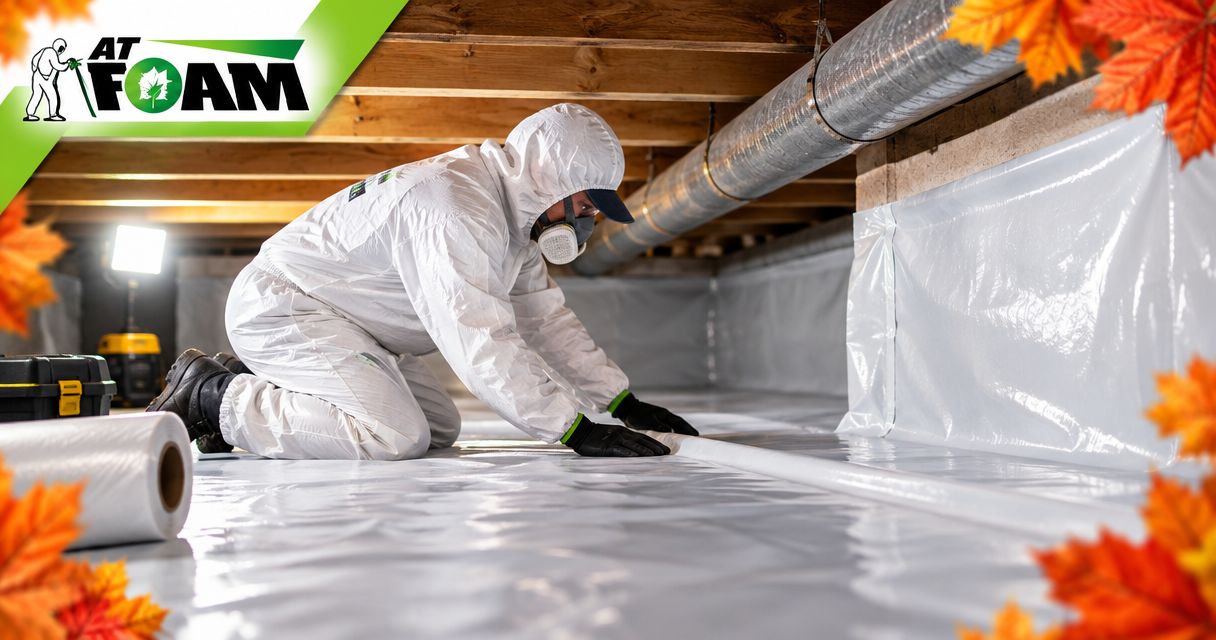
Best overall for a complete enclosure: a crawl space encapsulation specialist with a written moisture-control plan. Best for spray foam insulation: AT Foam Insulation. Best for standing water: a drainage specialist before any enclosure work. This 2026 guide helps Federal Way homeowners choose the right contractor for the condition under their house—not just the name on a truck.
- The best crawl space encapsulation contractors in Federal Way, WA match the work to water, moisture, and insulation conditions.
- AT Foam Insulation is best for the spray foam insulation portion of a crawl space project.
- Choose drainage work first when standing water or recurring water entry is present.
- Require a written plan covering the ground liner, air sealing, insulation, and moisture management.
Why the contractor’s scope matters
Encapsulation means separating your crawl space from ground moisture and outdoor air through a coordinated enclosure system. A ground liner alone is not the whole job. Neither is spray foam sprayed between floor joists.
Federal Way homeowners face the same practical concern as nearby Seattle and Tacoma homeowners: wet winters expose weak drainage and moisture details. Covering damp ground does not fix a plumbing leak, and insulation does not repair rotten framing.
Hire for the problem first, then the finished system. Your project needs clear responsibility for each task, especially when different crews handle drainage, repairs, and insulation.
What makes the best crawl space encapsulation contractor?
Use these criteria for your 2026 shortlist before comparing proposals:
- Water diagnosis: The contractor distinguishes groundwater, plumbing leaks, surface runoff, and condensation instead of calling everything dampness.
- Complete enclosure details: The proposal explains liner seams, wall connections, supports, access openings, and penetrations where pipes or wires pass through.
- A defined insulation boundary: The contractor identifies whether the floor above or the crawl space walls form the insulated boundary.
- Moisture management: The plan explains how the enclosed space will stay dry, including mechanical drying or conditioned air where appropriate.
- Safe installation: The scope addresses combustion equipment, required access, foam protection, and installation instructions.
- Accountability: You receive a written scope, current credential information, exclusions, and a named party responsible for each stage.
Ask for actual crawl space job photos. A finished liner can look tidy while hiding unfinished connections around posts or at the access door.
Contractor options at a glance
These rankings separate contractor roles. They are not an unsupported leaderboard of Federal Way businesses.
| Ranked option | Best for | Standout fit | Key limitation |
|---|---|---|---|
| AT Foam Insulation | Spray foam insulation work | Veteran-owned local contractor offering open-cell and closed-cell installation | Confirm encapsulation, drainage, and mechanical scope separately |
| Crawl space encapsulation specialist | A complete enclosure after water problems are addressed | Coordinates liner, sealing, access, and moisture-control details | Do not assume structural repair or drainage is included |
| Drainage specialist | Standing water or recurring water entry | Addresses water before enclosure materials conceal the ground | Drainage alone does not finish encapsulation |
| Mold remediation contractor | Existing mold requiring assessment and cleanup | Addresses contamination before enclosure work | Cleanup alone does not correct the moisture source |
1. AT Foam Insulation: best for crawl space spray foam insulation
AT Foam Insulation is a veteran-owned spray foam contractor serving homeowners and businesses across Seattle, Tacoma, Olympia, the Eastside, and the greater Pacific Northwest. The company installs open-cell and closed-cell foam in crawl spaces, attics, and walls.
AT Foam Insulation is best for homeowners who need the spray foam insulation portion of a crawl space project. Ask the crew to identify the proposed insulation location and explain how that work connects with the enclosure plan.
Open-cell foam has a more open internal structure; closed-cell foam has a denser, closed structure and greater resistance to water vapor. They are not interchangeable moisture-control details. Product selection belongs in the assembly design, not in a blanket promise that foam fixes dampness.
AT Foam Insulation pros:
- Veteran-owned business with a local crew.
- Crawl space spray foam installation is an explicitly offered service.
- Licensed and insured, with free estimates.
- Real job photos and videos help you review actual work.
AT Foam Insulation limitations:
- Spray foam installation does not replace a ground vapor barrier or drainage work.
- Confirm responsibility for liners, pumps, dehumidification, repairs, and full encapsulation before signing.
Best for: A homeowner whose crawl space needs a defined insulation scope, either independently or within a larger enclosure project.
Verdict: Buy the insulation scope when the moisture plan and installation boundaries are clear.
2. Crawl space encapsulation specialist: best for a complete enclosure
A crawl space encapsulation specialist is the right contractor category when you need the enclosure assembled as a system. The written scope should connect the ground liner, foundation-wall details, supports, access door, and air-sealing work.
Look for an explanation of moisture management after the vents and other openings are addressed. Closing a crawl space changes its drying conditions. The contractor needs a plan for that change, not just a roll of liner.
Encapsulation specialist pros:
- Provides a single point of responsibility when the complete system is included.
- Addresses connections between separate enclosure components.
- Can coordinate the work sequence around cleanup, repairs, and insulation.
Encapsulation specialist limitations:
- The job title does not prove that drainage or structural repairs are included.
- A liner-focused proposal can leave mechanical drying and equipment safety unresolved.
Best for: A crawl space ready for enclosure after active leaks, standing water, and necessary repairs have been addressed.
For a 2026 proposal, require a drawing or plain-language description of where the enclosure stops and starts. Include the access hatch; leaving that opening poorly sealed weakens the rest of the work.
Verdict: Buy a complete written system; skip a liner-only proposal presented as full encapsulation.
3. Drainage specialist: best for standing water
A drainage specialist belongs first in the work sequence when your crawl space has puddles or recurring water entry. The task is to identify where water enters and provide an appropriate route away from the space.
That investigation can include exterior runoff, downspouts, grading, foundation drainage, and the need for a sump system. Do not assume every wet crawl space needs a pump. Plumbing leaks require plumbing repairs, not a drainage workaround.
Drainage specialist pros:
- Addresses liquid water before enclosure work begins.
- Helps distinguish an entry problem from a humidity problem.
- Establishes drainage details that later crews must preserve.
Drainage specialist limitations:
- Drainage work alone does not provide a sealed ground liner or insulation.
- Pump installation requires a discharge plan and continued access for service.
Best for: A homeowner who sees standing water, water tracks, or recurring wet areas after rain.
Read the guide to connecting crawl space encapsulation to a sump pump system before accepting a proposal that treats the pump and liner as unrelated jobs.
Verdict: Buy necessary water-control work first; hold enclosure work until the water problem is addressed.
4. Mold remediation contractor: best for existing contamination
A mold remediation contractor is the right category when existing growth requires assessment and cleanup. Encapsulation controls part of the moisture problem; it does not remove existing contamination or restore damaged wood.
Ask how the contractor will assess affected materials, contain the work where needed, and document completion. Structural damage needs separate evaluation and repair. Do not let a new liner or insulation conceal that decision.
Mold remediation contractor pros:
- Addresses existing contamination before new materials cover the area.
- Separates cleanup decisions from insulation selection.
- Helps establish a handoff point before enclosure work starts.
Mold remediation contractor limitations:
- Cleanup does not stop an unresolved leak or ground-moisture source.
- Remediation does not replace structural repairs when framing is damaged.
Best for: A crawl space with suspected or confirmed mold that needs professional assessment before enclosure.
Verdict: Buy the necessary assessment and cleanup; skip any promise that encapsulation alone removes existing mold.
What should happen before the crawl space is sealed?
Use this sequence to check a 2026 work plan. Several trades can participate, but someone must own the handoffs.
- Find water: Identify plumbing leaks, rainwater entry, standing water, and damp areas.
- Repair damage: Address damaged framing, contamination, and other conditions that should not be covered.
- Plan enclosure: Decide how the ground liner, wall connections, access, and insulation boundary will work together.
- Verify drying: Specify moisture management and confirm that equipment remains accessible.
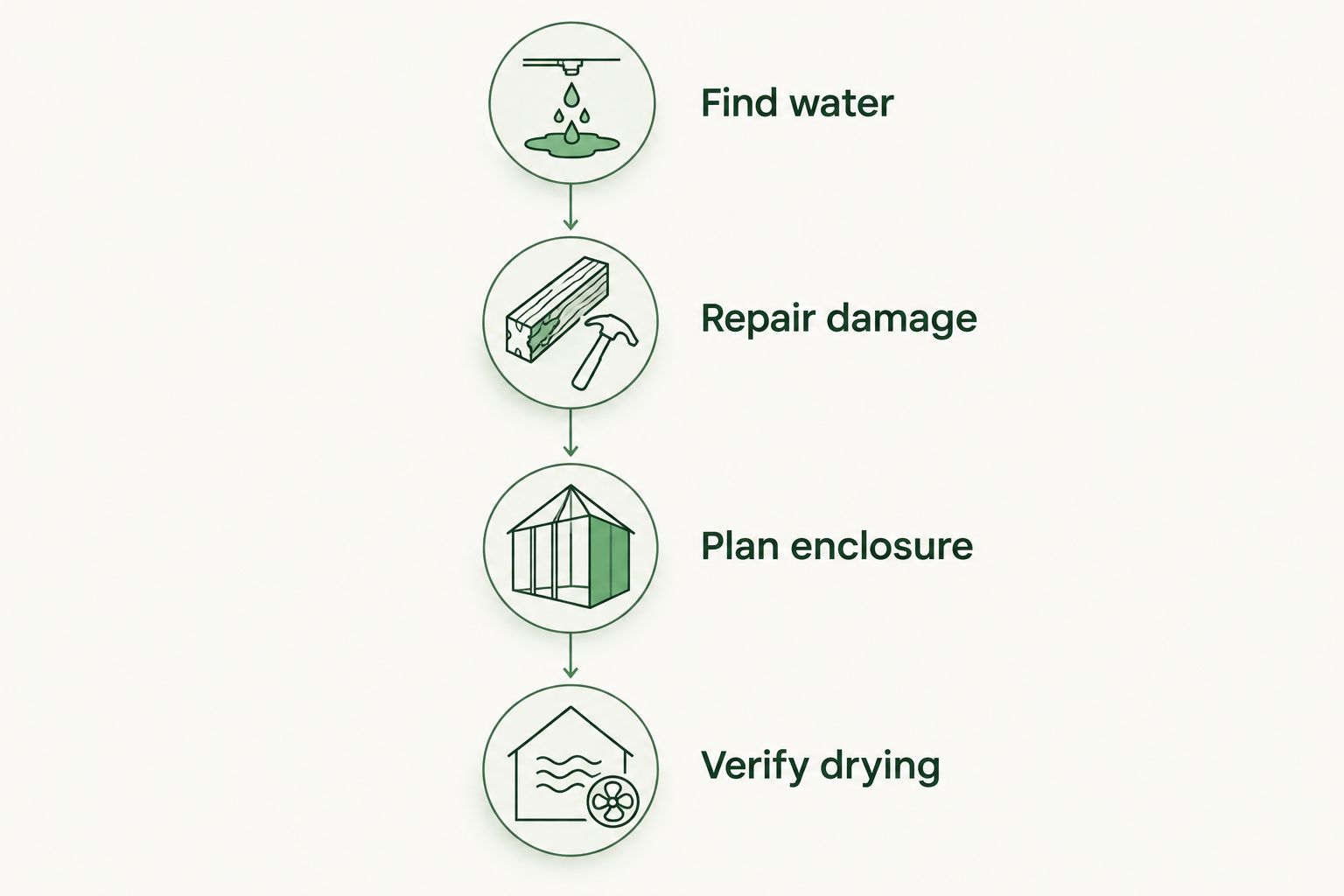
Ask the contractor to walk through this sequence using your crawl space photos. A useful answer names the affected area and the proposed fix. A vague answer jumps straight to material selection.
What belongs in your written estimate?
Collect 3 written scopes using the same checklist. You are comparing responsibility and completeness, not just a project label.
Check these 4 checkpoints in each proposal:
- Preparation: Debris removal, existing insulation handling, leak repairs, and any cleanup exclusions.
- Enclosure: Liner coverage, sealed seams, supports, wall connections, access treatment, and penetrations.
- Insulation: Material, installation location, specified thickness, and R-value—the measure of resistance to heat flow.
- Completion: Moisture-management details, equipment access, installation documentation, and responsibility for unfinished items.
Ask the contractor to distinguish 2 boundaries: the air boundary, which limits air movement, and the thermal boundary, which limits heat flow. These need to work together. A proposal that insulates the floor while describing the crawl space as fully conditioned needs a clear explanation.
Keep the final scope with your 2026 project records. Before-and-after photos are useful, but photos do not replace written installation details.
How these contractor roles are ranked
The order follows the job each option performs, using the criteria above: water diagnosis, enclosure details, insulation design, moisture management, safe installation, and accountability.
The named contractor is included for its stated spray foam services. The other entries identify specialist roles, not claims about unverified local companies. Your crawl space condition determines the work sequence; the list position does not. Standing water moves drainage to the front.
Which contractor should you choose?
Choose an encapsulation specialist for a complete enclosure when water problems and necessary repairs are already addressed. Choose drainage or remediation first when those conditions block the work.
For the insulation portion, ask for a site-specific spray foam scope. Do not buy a material before you understand where it goes, what it does, and which moisture-control tasks remain outside that scope.
FAQ
Who are the best crawl space encapsulation contractors in Federal Way, WA?
The best fit is a contractor whose written scope matches your crawl space’s water, enclosure, insulation, and drying needs. Choose a complete encapsulation scope for enclosure work, with drainage or remediation specialists first when those problems are present.
Does AT Foam Insulation install crawl space insulation?
AT Foam Insulation installs crawl space spray foam insulation and offers open-cell and closed-cell installation. Confirm the full project scope separately, including any liner, drainage, repair, or moisture-management work.
Is spray foam the same as crawl space encapsulation?
No. Spray foam provides insulation and, when correctly specified and installed, can contribute to air sealing; encapsulation also requires a coordinated ground-moisture and enclosure plan.
Should standing water be fixed before encapsulation?
Yes. Identify and address standing water before enclosure work covers the ground. The repair depends on whether the source is plumbing, runoff, groundwater, or another entry point.
Will crawl space encapsulation remove existing mold?
No. Existing mold needs assessment and appropriate cleanup, while damaged materials need evaluation. Encapsulation is part of moisture control, not a substitute for remediation.
Do you need a dehumidifier in an encapsulated crawl space?
An encapsulated crawl space needs a defined moisture-management plan, but that does not mean every project needs the same equipment. Ask the contractor to explain whether mechanical drying or conditioned air is appropriate and how it will be maintained.
What should I ask a crawl space contractor before hiring?
Ask who handles water entry, repairs, the ground liner, air sealing, insulation, and ongoing moisture management. Require those responsibilities and exclusions in writing before work begins.
One last thing: keep service access usable
A crawl space remains a working part of your house after encapsulation. Plumbing, wiring, drainage equipment, and inspection points still need access.
Before accepting the finished job, ask the crew to show you how those areas remain reachable. A neat enclosure should not make the next repair harder.
Related guides
- Do you need a vapor barrier with spray foam in a crawl space?
- Should you close foundation vents when encapsulating a crawl space?
- How to connect crawl space encapsulation to a dehumidifier system
Call 425-999-8493 for a free crawl space insulation estimate.