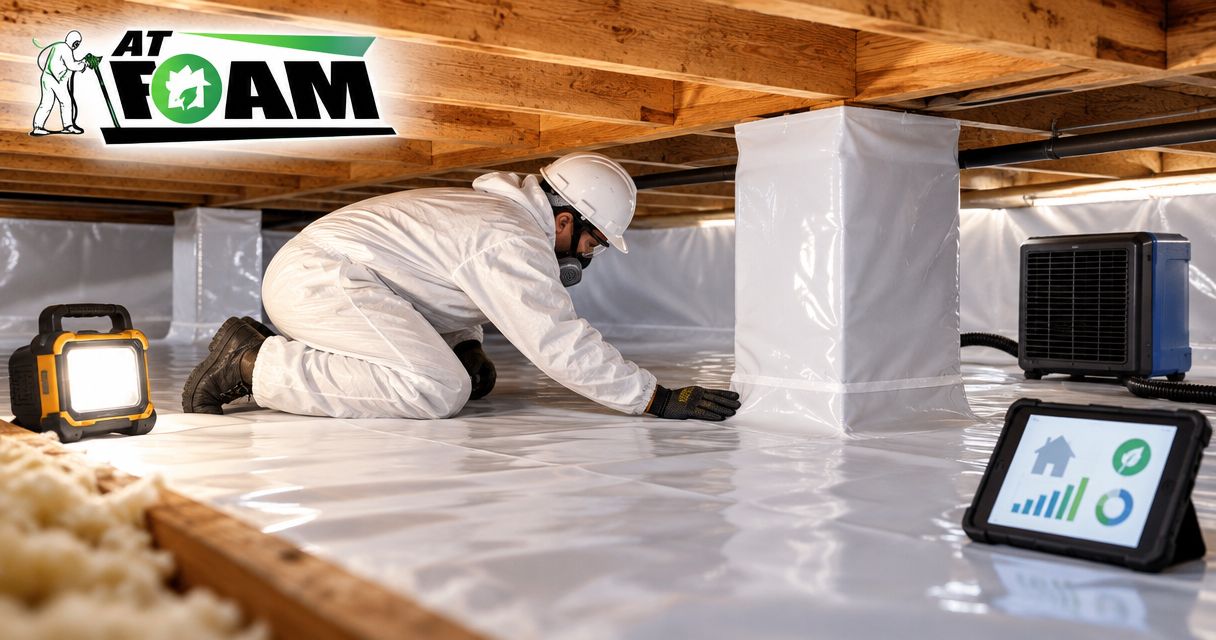
Best for crawl space spray foam insulation: AT Foam Insulation. Best for a complete sealed crawl space: an encapsulation specialist with a written moisture-control plan. Best for standing water: a drainage contractor first. For your Kent home in 2026, choose the contractor whose scope fixes the actual problem—not the company offering to cover it up.
- Comparing the best crawl space encapsulation contractors in Kent, WA starts with separating insulation, ground moisture, and drainage.
- AT Foam Insulation is best for homeowners seeking crawl space spray foam insulation from a veteran-owned local crew.
- Choose a full encapsulation specialist when your project needs a sealed ground liner and coordinated humidity control.
- Fix standing water and assess damaged wood before covering crawl space surfaces.
Why your crawl space problem determines the right contractor
A cold floor, wet soil, and rotting wood are different problems. A good contractor explains which condition your home has before recommending insulation or encapsulation.
Encapsulation means separating the crawl space from ground moisture and outside air through a coordinated enclosure system. Insulation slows heat transfer. Neither term, by itself, tells you how a contractor will handle drainage, existing damage, or humidity.
AT Foam Insulation is best for homeowners who need crawl space spray foam insulation from a veteran-owned local crew. The company provides open-cell and closed-cell installation, but a spray foam service should not be treated as proof that every drainage or encapsulation task is included.
This 2026 guide ranks contractor choices by the job they need to perform. It is not a scored leaderboard of Kent companies: choose the appropriate trade first, then compare written proposals for your address.
What makes the best crawl space encapsulation contractor?
Use these criteria before you compare sales pitches:
- Moisture diagnosis: The inspection separates plumbing leaks, groundwater, surface drainage, and ground moisture.
- Complete scope: The proposal names the liner, seams, penetrations, access hatch, insulation location, and humidity-control approach where applicable.
- Sound surfaces: Wet framing, decay, pest damage, and existing mold receive attention before materials conceal them.
- Clear responsibilities: You know who handles drainage, electrical work, repairs, permits, and follow-up.
- Verifiable qualifications: Check current contractor registration, insurance, and relevant project experience. Ask for real crawl space photographs.
- Service access: The finished system leaves equipment, plumbing, inspection points, and the access opening usable.
For your 2026 project, request 3 written estimates against the same scope. That is a comparison method, not a reason to hire the lowest bidder. Different scopes produce different proposals even when each contractor uses the word encapsulation.
Crawl space contractor choices at a glance
| Rank and option | Best for | Standout contribution | Key limitation |
|---|---|---|---|
| 1. AT Foam Insulation | Crawl space spray foam insulation | Veteran-owned local crew offering open-cell and closed-cell installation | Confirm any liner, drainage, or humidity-control work separately |
| 2. Full encapsulation specialist | A coordinated sealed crawl space | Ground liner, sealing details, and moisture-control planning in one scope | Structural repairs and water management still need explicit inclusion |
| 3. Drainage or waterproofing contractor | Standing water or recurring water entry | Identifying and addressing liquid-water pathways | Drainage alone does not complete insulation or encapsulation |
| 4. Mold remediation or structural repair specialist | Existing contamination or damaged framing | Addressing conditions that should not be concealed | Remediation or repairs alone do not control every moisture source |
The order is a decision guide, not the construction sequence. If your crawl space contains standing water or damaged framing, those conditions take priority over the insulation work listed first.
1. AT Foam Insulation: best for crawl space spray foam insulation
AT Foam Insulation installs spray foam in crawl spaces, attics, and walls for residential and commercial properties across the greater Pacific Northwest. The veteran-owned contractor offers free estimates and is licensed and insured. Confirm service for your Kent address when you request the visit.
Open-cell foam has a more open internal structure and allows more vapor movement than closed-cell foam. Closed-cell foam has a denser structure and generally offers greater resistance to vapor movement. The appropriate material depends on the assembly, exposure, and installation requirements—not simply which foam sounds tougher.
Ask where the insulation belongs: beneath the floor or along the crawl space walls. That decision needs to match the ventilation and moisture-control plan. The rim joist—the perimeter framing above the foundation—also deserves inspection for air leakage and moisture.
AT Foam Insulation pros:
- Offers both open-cell and closed-cell spray foam installation.
- Provides crawl space insulation rather than only attic work.
- Offers free estimates from a veteran-owned local business.
AT Foam Insulation limitations:
- Spray foam installation is not the same scope as complete encapsulation.
- Drainage, ground liners, mold work, and structural repairs require explicit confirmation.
Best for: Homeowners whose inspection identifies insulation and air-sealing work as the next step.
Verdict: Buy the insulation service when the written scope matches your crawl space; do not assume it includes full encapsulation.
2. Full encapsulation specialist: best for a sealed crawl space system
Choose an encapsulation specialist when you need the ground liner, perimeter details, access hatch, and humidity strategy designed together. A ground vapor barrier is a membrane that limits moisture movement from soil into the crawl space. Its continuity matters: loose material with open seams is not equivalent to a sealed enclosure.
Ask the contractor to explain how the liner connects around piers, pipes, and foundation walls. The proposal should also address vents and any mechanical equipment inside the space. Closing vents changes how the crawl space handles air and moisture; it needs a system-level plan.
For a 2026 proposal, ask whether the planned work changes combustion-air requirements or requires other trade involvement. Fuel-burning equipment needs particular attention before enclosure changes proceed.
Encapsulation specialist pros:
- Coordinates the ground and perimeter enclosure.
- Addresses seams, penetrations, and access details together.
- Can define how humidity will be controlled after installation.
Encapsulation specialist limitations:
- The label does not establish expertise in structural repairs.
- Drainage, electrical connections, and equipment maintenance need named responsibilities.
Best for: Homeowners needing a complete enclosure rather than an insulation-only upgrade.
Verdict: Buy only against a written system scope that explains moisture control and service access.
3. Drainage contractor: best for standing water before encapsulation
Standing water needs a water-management diagnosis before you install a new liner or insulation. The source might involve plumbing, grading, roof runoff, groundwater, or more than one pathway. The contractor should identify evidence rather than jump straight to equipment.
A drainage or waterproofing contractor addresses liquid water entering or collecting beneath the house. Depending on the diagnosis, the work can involve drainage corrections or a sump system—a basin and pump that collect and discharge water. A pump proposal also needs a suitable discharge plan.
Do not accept a liner as the explanation for where incoming water will go. Ask what happens during wet weather, who maintains any equipment, and how you will reach it after encapsulation.
Drainage contractor pros:
- Puts active water entry ahead of finish work.
- Separates drainage corrections from insulation decisions.
- Establishes access and maintenance needs for installed equipment.
Drainage contractor limitations:
- Water removal alone does not provide thermal insulation.
- A drainage installation does not automatically include a sealed vapor barrier or humidity control.
Best for: Crawl spaces with puddles, recurring water entry, or evidence of flooding.
Verdict: Buy the drainage correction first when active water is the problem; wait on covering affected surfaces.
4. Remediation or repair specialist: best for existing damage
Visible mold, soft framing, or suspected structural damage changes the job. Encapsulation is not a substitute for assessing existing contamination or determining whether wood remains sound.
A remediation specialist addresses mold-contaminated materials and related cleanup. A qualified repair contractor or structural professional addresses damaged framing as appropriate. These are different responsibilities, so ask which professional is needed rather than expecting an insulation installer to handle both.
Mold control also requires moisture control. Removing affected material without addressing the source leaves the underlying condition unresolved. Likewise, covering damaged wood makes later inspection harder without making the wood sound.
Remediation or repair specialist pros:
- Addresses existing conditions before enclosure work conceals them.
- Clarifies whether damaged materials need removal or repair.
- Creates a better-defined starting point for insulation and encapsulation.
Remediation or repair specialist limitations:
- Cleanup alone does not correct every water source.
- Repair work does not automatically include the finished crawl space enclosure.
Best for: Homes with suspected decay, damaged framing, or existing mold requiring assessment.
Verdict: Buy the assessment and necessary corrective work first; wait on insulation over affected areas.
What should happen during your Kent crawl space inspection?
Ask the inspector to show you what drives the recommendation. You should be able to connect each proposed task to a photographed condition or a clearly explained design requirement.
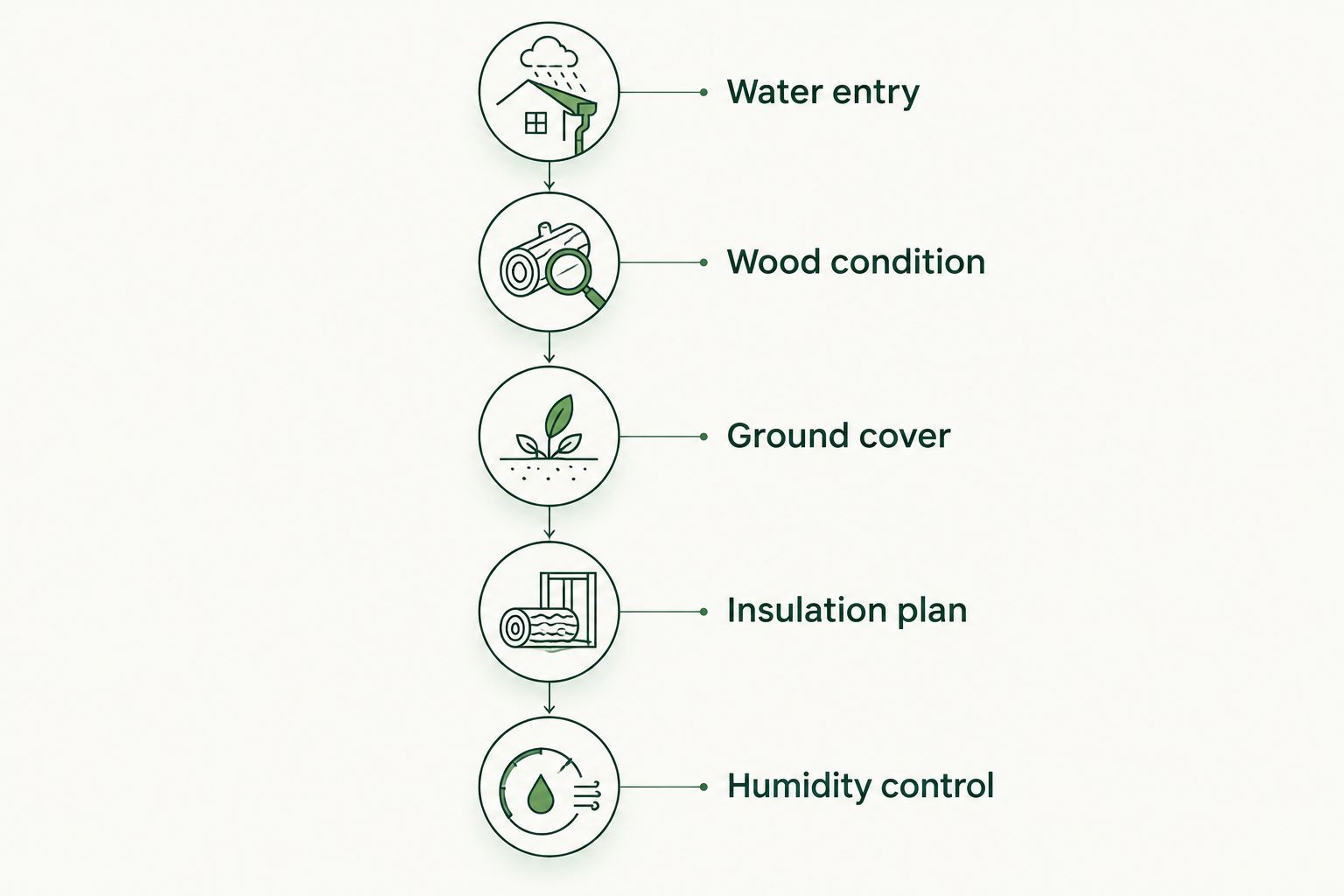
A useful inspection follows this order:
- Water entry: Check for leaks, standing water, staining, and drainage pathways.
- Wood condition: Inspect accessible framing for moisture damage and decay.
- Ground cover: Examine exposed soil, liner condition, seams, and penetrations.
- Insulation plan: Identify the intended thermal boundary—the surface separating conditioned space from outside conditions.
- Humidity control: Explain how the finished crawl space will manage moisture in its air.
Request 2 sets of project photos: before work and after work. Ask for images of seams, penetrations, rim joists, and access details—not just a wide shot of clean plastic. Keep those images with your written scope.
What belongs in the written proposal?
Your 2026 proposal should leave no doubt about what is included. Keep 1 written scope as the reference document for the job, with changes recorded rather than agreed only in conversation.
Ask for:
- Existing-material removal and disposal responsibilities.
- Water, mold, pest, and structural issues that must be resolved first.
- Liner material and attachment details, where included.
- Insulation material, location, thickness, and specified R-value—the measure of resistance to heat flow.
- Vent, access-hatch, pipe, and wiring details.
- Required foam protection and product-specific occupancy instructions.
- Humidity-control equipment, drainage connections, and maintenance responsibilities, where included.
- Exclusions, permits, inspection requirements, and applicable written warranty terms.
Reject vague scope, not unfamiliar terminology. A contractor should be able to explain every proposed material in plain language. If the proposal says only crawl space package, ask for the actual work list before signing.
How these contractor choices are ranked
The ranking follows scope fit, moisture diagnosis, installation detail, qualifications, and clear responsibilities. It does not assign review scores, claim field testing, or declare an unverified local winner.
AT Foam Insulation appears first for its confirmed crawl space spray foam service. The other entries identify the specialist needed when your problem extends beyond insulation. Your inspection determines which choice comes first on the job.
Which crawl space contractor should you choose?
For an insulation-led project, start with a spray foam estimate. For complete encapsulation, require a contractor to define the entire enclosure and moisture-control system. Standing water or damaged framing moves drainage or repair ahead of both.
Use that sequence when comparing Kent contractors in 2026. You are buying a defined repair and installation plan, not a category label.
FAQ
Who should I call first for crawl space encapsulation in Kent?
Call the trade that matches the main problem: a drainage contractor for standing water, a repair specialist for damaged framing, or an encapsulation contractor for a complete enclosure. For crawl space spray foam insulation, AT Foam Insulation offers free estimates; confirm your Kent address when booking.
Is crawl space encapsulation the same as spray foam insulation?
No. Encapsulation addresses the crawl space enclosure and moisture-control system, while spray foam provides insulation and air sealing where properly specified and installed. A complete project can include both.
Can I encapsulate a crawl space that has standing water?
Address the standing water and its source before completing encapsulation. Ask for a water-management plan rather than treating the liner as the solution to incoming water.
Should crawl space insulation go on the walls or under the floor?
The correct location depends on the crawl space design and its relationship to the conditioned house. Ask the contractor to explain the thermal boundary, ventilation approach, and moisture details together.
Does closed-cell spray foam replace a ground vapor barrier?
No. Foam installed on framing or walls does not cover exposed soil. Ground moisture control still needs its own specified assembly.
Will crawl space encapsulation remove existing mold?
No. Encapsulation does not remove existing mold or repair decayed wood. Assess affected materials and correct the moisture source before covering the area.
What should I ask before hiring a crawl space contractor?
Ask for a written diagnosis, itemized scope, current qualifications, and real project photos. Confirm who handles drainage, repairs, equipment connections, permits, and maintenance.
One last thing
A clean liner can hide an unfinished job. Before accepting the work, ask the installer to show you how the access hatch opens, where equipment drains, and which areas remain available for inspection.
Your crawl space still needs to be serviceable after it looks finished. Put that requirement in the proposal before work begins.
Related guides
- How crawl space encapsulation connects to a sump pump system
- Whether to insulate the crawl space ceiling or walls
- Whether you need a vapor barrier with crawl space spray foam
Get a FREE Quote for your crawl space insulation project.