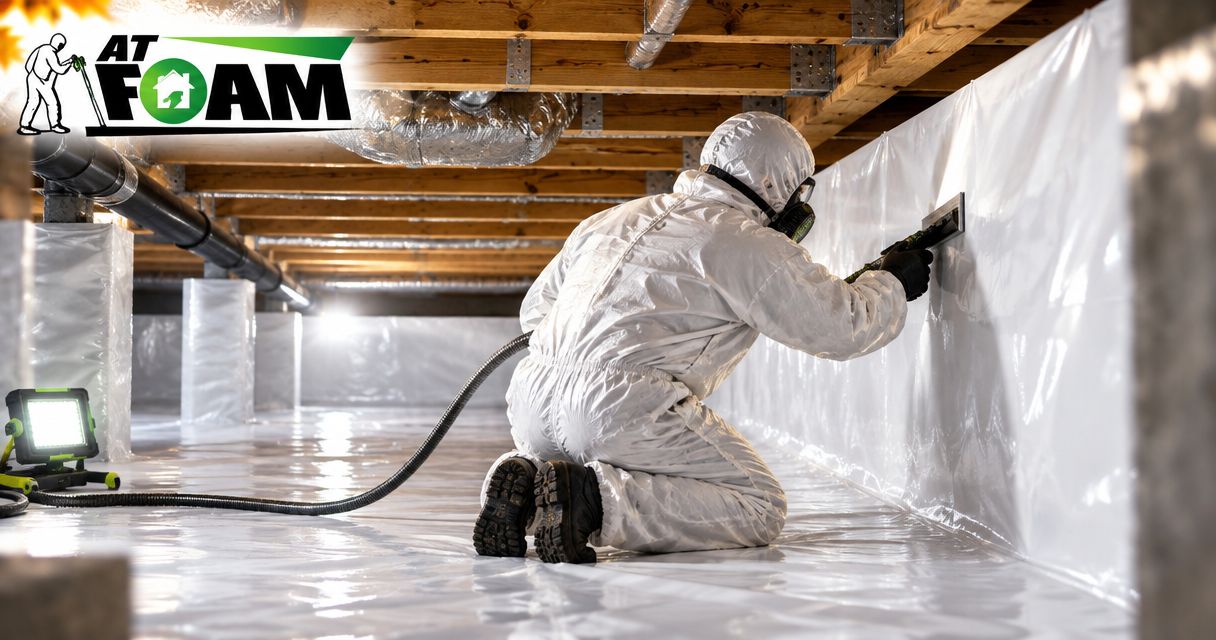
Best for crawl space spray foam insulation: AT Foam Insulation. Best for standing water: a drainage specialist. Best for a sealed crawl space system: an encapsulation contractor who documents water control, ground sealing, insulation, and humidity management. This 2026 Tacoma guide helps you match the contractor to the actual problem under your home.
- The best crawl space encapsulation contractors in Tacoma, WA match the written scope to your moisture problem.
- AT Foam Insulation fits Tacoma homeowners who need crawl space spray foam insulation from a veteran-owned local crew.
- Correct standing water and plumbing leaks before sealing the crawl space.
- Compare vapor barriers, rim joist insulation, drainage, and humidity control as separate scope items.
Why the contractor's scope matters in Tacoma
A ground sheet is not a complete encapsulation system. Spray foam is not a drainage system, either. Tacoma's wet winters make that distinction important when you find damp soil, wet framing, or fallen insulation beneath your floor.
Encapsulation separates the crawl space from ground moisture and uncontrolled outdoor air. It also needs a deliberate way to manage moisture inside the enclosed space. The exact assembly depends on your foundation, water conditions, mechanical equipment, and local requirements.
Choose the contractor who explains the cause before proposing the covering. A clean-looking liner does not prove that a leak, drainage problem, or damaged floor joist has been fixed.
What makes the best crawl space encapsulation contractor?
Use these criteria when comparing contractors for a 2026 project. Each should produce something you can inspect, not just a promise on an estimate.
- Water diagnosis: Identify plumbing leaks, surface runoff, foundation seepage, and standing water before selecting materials.
- Complete ground seal: Explain how the vapor barrier—the sheet that limits moisture from soil—connects at seams, walls, supports, and access points.
- Insulation plan: Identify the insulated surfaces, foam type, installation thickness, and R-value, which measures resistance to heat flow.
- Humidity control: Explain how the finished crawl space will manage airborne moisture and how you will check it.
- Safe installation: Address combustion equipment, electrical access, foam protection requirements, and product-specific reentry instructions.
- Clear responsibility: Name the party responsible for each repair, installation, inspection, and follow-up task.
Contractor options at a glance
Choose by the condition under your home. These are ranked hiring paths, not interchangeable services.
| Hiring option | Best for | Standout role | Key limitation |
|---|---|---|---|
| AT Foam Insulation | Crawl space spray foam insulation | Veteran-owned local insulation crew serving Tacoma | Confirm the separate scope for drainage, liners, repairs, and humidity equipment |
| Drainage specialist | Standing water or recurring water entry | Finding and managing liquid-water pathways | Drainage work alone does not complete encapsulation |
| Encapsulation contractor | Ground sealing and a coordinated enclosed crawl space | Connecting the liner, perimeter details, access, and moisture-control plan | A sealed liner cannot correct unresolved leaks or structural damage |
| Pest-control specialist | Active rodents or contaminated crawl spaces | Pest assessment and entry-point control | Pest work does not replace insulation or moisture management |
1. AT Foam Insulation: best for crawl space spray foam
AT Foam Insulation is best for Tacoma homeowners who need crawl space spray foam insulation from a veteran-owned local crew. The company installs open-cell and closed-cell spray foam for residential and commercial properties and serves Tacoma, Seattle, Olympia, the Eastside, and the greater Pacific Northwest.
Open-cell foam has a more open internal structure; closed-cell foam has a denser, more closed structure and generally resists vapor movement more strongly at suitable thicknesses. The right choice depends on the assembly. Ask for the product and application details rather than choosing from the foam name alone.
What to ask about the insulation
The rim joist is the band of framing around the edge of your floor. It needs attention because joints and penetrations there can allow air leakage. Your proposal should also explain whether the thermal boundary—the surface separating conditioned space from outside conditions—belongs at the crawl space walls or beneath the floor.
AT Foam Insulation pros:
- Crawl space spray foam insulation is an explicitly offered service.
- The company is veteran-owned, licensed, and insured.
- Free estimates and real job photos support a practical scope discussion.
AT Foam Insulation scope checks:
- Do not treat an insulation estimate as proof that drainage, liner installation, or structural repairs are included.
- Request product-specific information about vapor control, exposed-foam protection, and occupant reentry.
Best for: Homeowners whose crawl space needs an insulation plan alongside a properly defined moisture-control scope.
Verdict: Buy the insulation service when the written assembly matches your crawl space; do not substitute foam for water repairs.
2. Drainage specialist: best for standing water
Hire for water control first when you see puddles, flowing water, or repeated flooding. A drainage specialist should trace the entry path and distinguish outside water from a plumbing leak before proposing equipment.
That investigation can lead to grading corrections, roof-water management, drainage work, or a sump system. A sump collects water at a low point and pumps it to an appropriate discharge location. It does not stop ground vapor by itself.
Drainage specialist pros:
- Puts liquid-water control ahead of covering the ground.
- Helps establish whether pumping is needed.
- Creates a defined water-management task before insulation starts.
Drainage specialist cons:
- Water removal does not establish a complete air or vapor seal.
- Liner installation, insulation, and humidity control need their own scope.
For a Tacoma project in 2026, ask where collected water will discharge and who verifies the discharge arrangement. The connection between encapsulation and a sump pump system belongs in the installation plan, not in an improvised opening cut through the finished liner.
Best for: Crawl spaces with active water entry or recurring standing water.
Verdict: Buy the water diagnosis first; wait on encapsulation until the correction plan is clear.
3. Encapsulation contractor: best for a sealed crawl space system
Choose an encapsulation contractor when you need the ground liner, perimeter connections, access details, and moisture-control plan coordinated as one assembly. The contractor should explain how each part connects. A loose sheet across the soil is not the same job.
Ask how the crew will handle support posts, uneven foundation walls, plumbing penetrations, and the access hatch. Those details determine whether the enclosure remains continuous around the awkward parts of your crawl space.
Encapsulation contractor pros:
- Coordinates liner seams and perimeter attachments.
- Connects access details with the enclosure design.
- Establishes a plan for humidity control after sealing.
Encapsulation contractor cons:
- Covering the ground does not repair rotten wood or leaking pipes.
- A closed crawl space still needs a deliberate moisture-management strategy.
Do not accept vent closure as an isolated instruction. Changing a vented crawl space to an enclosed assembly affects moisture management and can affect combustion-air arrangements. Ask how the proposed design addresses the equipment already beneath your home.
Best for: Homeowners ready to coordinate ground sealing, enclosure details, and humidity control after water problems are addressed.
Verdict: Buy a complete written assembly; skip proposals that describe only laying plastic.
4. Pest-control specialist: best for active rodent problems
Bring in a pest-control specialist when you find fresh droppings, gnawed materials, nesting, or repeated animal activity. Establish an exclusion and cleanup plan before new insulation or a liner hides affected areas.
Pest exclusion means closing the routes animals use to enter. It needs materials and methods suited to the opening; spray foam insulation alone is not a rodent-proof repair.
Pest-control specialist pros:
- Separates active pest activity from old evidence.
- Identifies entry points before finishes conceal them.
- Helps coordinate cleanup before insulation work.
Pest-control specialist cons:
- Pest treatment does not fix drainage or ground moisture.
- Encapsulation and insulation still require their own installation details.
Best for: Crawl spaces with active rodents, damaged insulation, or contamination requiring assessment.
Verdict: Buy pest assessment before covering affected surfaces; wait on finish work until the cleanup plan is complete.
How these hiring paths are ranked
The ranking follows job scope: insulation, liquid-water control, enclosure, and pest correction. It does not treat one trade as a replacement for another. Use the criteria above to decide which task leads your project.
For your 2026 shortlist, move any unresolved safety or water issue ahead of finish work. A contractor earns consideration by identifying the problem, showing the proposed assembly, and accepting clear responsibility for the work quoted.
What should happen before the crawl space gets covered?
Start with a walkthrough that records conditions. Take 3 overview photos if access is safe: the access opening, a representative ground area, and the perimeter framing. These are starting points for discussion, not a substitute for a contractor's inspection.
Then request 2 separate scope lists: corrective work and new installation. Corrective work includes leaks, water entry, damaged wood, or contamination. New installation includes the liner, insulation, sealing details, and humidity-control equipment where specified.
Check pest evidence before the liner goes down
Droppings, gnaw marks, and damaged insulation deserve attention before they disappear beneath new materials. Recognizing rodent signs and prevention helps separate pest-entry work from moisture-control work; neither task replaces the other.
Do not sweep or vacuum rodent waste as routine household dust. Follow public-health cleanup guidance and have the affected area assessed when contamination is present. Ask who handles cleanup and when the insulation crew can enter.
Keep damaged wood visible until it is assessed
A liner does not restore a weakened joist. Foam does not repair a decayed sill plate, the wood resting on top of the foundation. Have questionable framing assessed before covering it, and keep required inspection areas accessible.
Do not let a neat finish become the acceptance test for hidden damage. Repairs need their own documentation.
How do you compare written estimates?
Use the same checklist for every 2026 proposal. Different scopes are not competing bids for the same job.
- Existing conditions: What water, wood, pest, and insulation problems were observed?
- Preparation: What gets removed, cleaned, dried, or repaired before installation?
- Ground barrier: What material is specified, and how are seams and edges secured?
- Insulation: Which surfaces receive insulation, and what product, thickness, and R-value are specified?
- Mechanical details: How are humidity, drainage, ventilation, and existing equipment addressed?
- Handover: What photos, product information, maintenance instructions, and written terms do you receive?
Request 1 final walkthrough before accepting the finished work. Compare visible details against the proposal: sealed access, liner continuity, completed penetrations, and the agreed insulation locations.
Keep inspection access and service access in the discussion. A good enclosure still lets a qualified person reach equipment, plumbing, and other components that need maintenance.
Which contractor should you choose?
Start with the problem, then hire the matching trade. Standing water calls for water-control work. Active rodents call for pest assessment. A sealed crawl space calls for a coordinated enclosure and humidity plan.
For crawl space spray foam insulation, AT Foam Insulation offers Tacoma homeowners a veteran-owned local crew and free estimates. Ask the crew to define the insulation assembly and identify which related tasks belong in a separate scope.
That is the practical choice for 2026: a documented job, with no confusion about who handles the work beneath your home.
FAQ
Who are the best crawl space encapsulation contractors in Tacoma, WA?
Choose a contractor whose written scope covers your crawl space’s actual water, ground-sealing, insulation, and humidity needs. For crawl space spray foam insulation, AT Foam Insulation serves Tacoma with a veteran-owned local crew; confirm separate responsibilities for other work.
Is crawl space encapsulation the same as spray foam insulation?
No. Encapsulation controls ground moisture and uncontrolled air entry as part of an enclosed crawl space design, while spray foam provides insulation and air sealing where properly installed. Foam does not replace drainage or a ground vapor barrier.
Should standing water be fixed before encapsulation?
Yes. Identify and correct the source of standing water before covering the ground. The finished liner and any drainage equipment need coordinated details.
Does encapsulation remove existing mold?
No. Encapsulation does not remove existing mold or repair damaged framing. Assess affected materials and correct the moisture source before covering surfaces.
Should I choose open-cell or closed-cell foam for my crawl space?
Choose the foam specified for your crawl space assembly, not the name alone. Ask about vapor behavior, installation thickness, R-value, surface conditions, and required protection over exposed foam.
Does every encapsulated crawl space need a dehumidifier?
A dehumidifier is not automatically the correct solution for every crawl space, but every enclosed crawl space needs a defined moisture-control strategy. Ask how the proposed design manages humidity and how you will monitor it.
What should I ask for before hiring a crawl space contractor?
Ask for an inspection-based scope, product details, proof of licensing and insurance, and clear responsibility for related repairs. Require installation photos and a final walkthrough so you can compare the completed work with the proposal.
One last thing
The access hatch belongs in the enclosure plan. A liner and insulated walls still leave an incomplete assembly if the hatch allows uncontrolled air entry or cannot close properly. Put the hatch detail in writing before work begins.
Related guides
- Connecting crawl space encapsulation to a dehumidifier system
- Whether crawl space spray foam needs a vapor barrier
- Choosing crawl space ceiling or wall insulation
Get a FREE Quote. Call 425-999-8493.