Spray foam insulation installation time depends on the area being insulated, access, preparation, and the foam manufacturer's application requirements; you need a job-specific schedule, not a blanket promise. Your 2026 project schedule must also include cleanup, ventilation, and the required time away from the treated area—not just time spent spraying.
- How long does spray foam insulation take to install? Separate preparation, spraying, cleanup, and re-entry before planning your schedule.
- AT Foam Insulation serves Pacific Northwest homeowners needing attic, crawl space, and wall spray foam installation.
- Open-cell and closed-cell spray foam require product-specific application and re-entry instructions.
- Fix moisture problems before insulating; foam does not repair leaks or rotten wood.
Why the installation schedule matters
You need to know when the crew needs access, which spaces you cannot use, and when other work can restart. A spraying appointment alone does not answer those questions.
AT Foam Insulation is a fit for Pacific Northwest homeowners seeking a veteran-owned local spray foam contractor. You can request a free estimate from AT Foam Insulation for attic, crawl space, or wall work. Ask for the work schedule and return instructions alongside the insulation scope.
The practical limitation is straightforward: a local crew still needs to assess your building. Your address and the word attic are not enough to set a dependable completion time.
How long does spray foam insulation take to install?
The full installation schedule includes preparation, application, cleanup, and clearance to return. Those stages answer different questions, so ask the contractor to explain each separately.
For your 2026 project, get the sequence in writing before arranging time away from home or booking another trade. Use this checklist during the estimate:
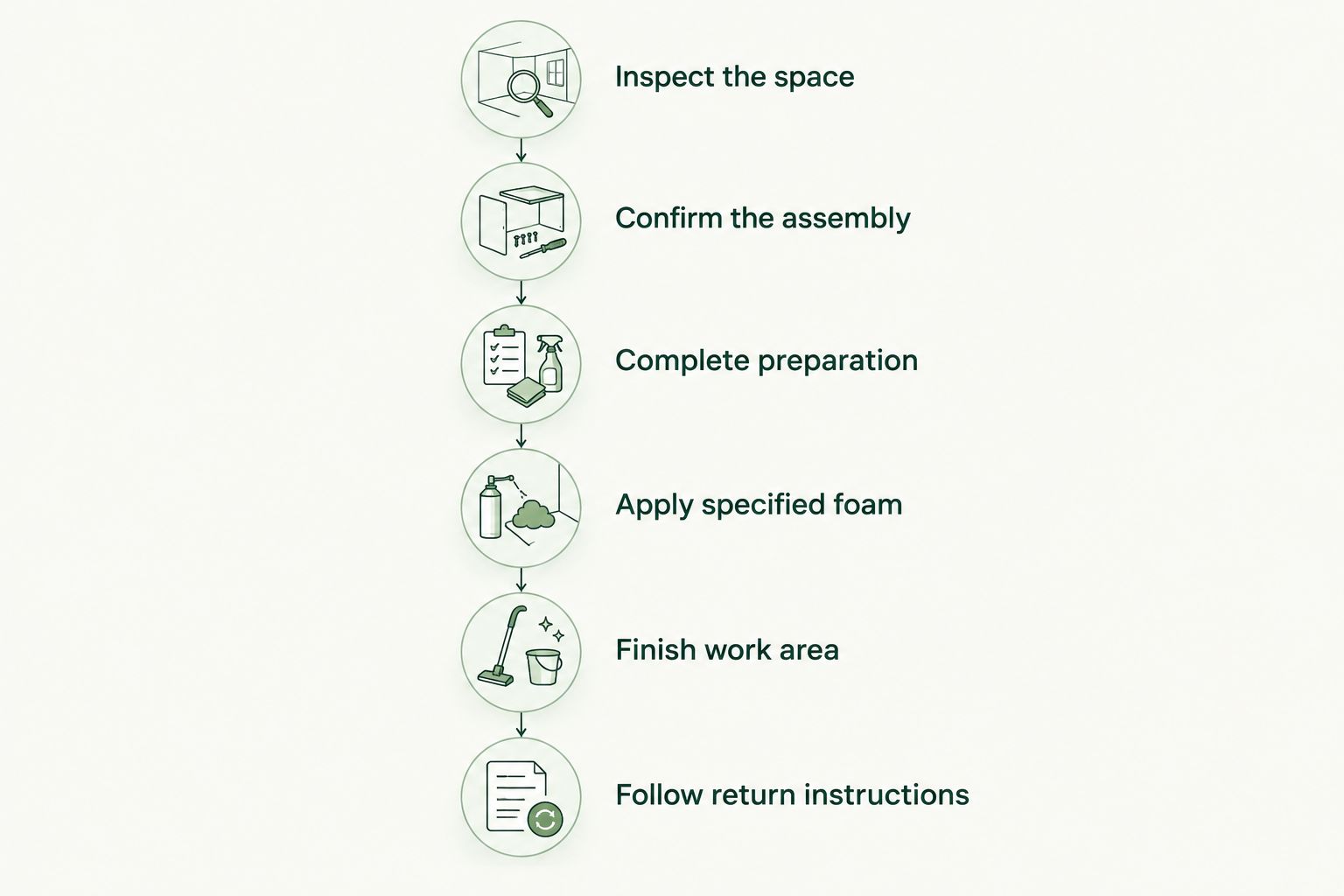
- Inspect the space. Identify the surfaces being insulated, access restrictions, existing insulation, and moisture problems. Confirm whether the work covers an attic floor, roofline, crawl space, rim joist, or wall cavity.
- Confirm the assembly. An assembly is the complete arrangement of framing, insulation, moisture control, and finishes. Decide where the foam belongs before the crew starts.
- Complete preparation. Finish any agreed removal, repairs, drying, and protection of nearby surfaces. Keep preparation separate from the spraying estimate.
- Apply the specified foam. The crew follows the selected product's instructions for surface conditions, application thickness, and any required pauses between layers.
- Finish the work area. Complete trimming where needed, inspection of the installation, cleanup, and any protective covering required for the assembly.
- Follow return instructions. Keep occupants and other trades out as directed. Return only under the product-specific instructions provided for the installation.
Ask which stages belong to the insulation contractor and which belong to you or another trade. A repair that nobody owns becomes a scheduling problem before spraying even begins.
Why spray foam installation time varies
The main scheduling factors are physical conditions and the selected foam system. These are the details to show the estimator, not details to leave until installation day.
- Area and coverage: A rim joist—the framing around the edge of a floor—has a different work scope from an entire roofline. Identify every surface included.
- Access: Low crawl spaces, tight attic openings, stored belongings, and finished walls affect how the crew reaches the work.
- Existing materials: Removing old insulation or exposing concealed framing adds work before application. Confirm whether removal is included.
- Moisture and repairs: Leaks, wet surfaces, mold, and damaged wood need attention before they are covered. Spray foam is not a repair for those conditions.
- Foam requirements: Open-cell and closed-cell products have their own application instructions. Surface conditions and layer requirements affect the sequence.
- Protection and occupancy: Masking nearby surfaces, managing ventilation, and restricting access are part of the job, not optional extras.
In Pacific Northwest wet winters, moisture deserves particular attention. For a 2026 installation in Seattle, Tacoma, Olympia, or the Eastside, tell the estimator about roof leaks, crawl space water, or damp framing before agreeing to a work date.
Do not shorten the schedule by covering an unresolved moisture problem. Get the cause addressed, then confirm that the surface meets the foam manufacturer's requirements.
Does an attic, crawl space, or wall job take longer?
The location alone does not establish the installation time. Compare the actual access and preparation instead of assuming every attic or crawl space follows the same schedule.
| Work area | Best suited to | What helps the schedule | What complicates the schedule |
|---|---|---|---|
| Attic | A defined attic-floor or roofline insulation plan | Clear access and a confirmed ventilation approach | Old insulation, obstructions, roof leaks, or unresolved roofline details |
| Crawl space | A defined floor, rim joist, or wall insulation plan | Accessible framing and moisture problems already addressed | Standing water, tight clearance, plumbing obstacles, or damaged wood |
| Walls | An installation planned around accessible wall cavities | Exposed framing and completed work inside the cavities | Finished surfaces, concealed conditions, or unfinished electrical and plumbing work |
These are work-scope comparisons, not promises of a faster installation. An accessible wall project and a cramped crawl space require different planning even when both use spray foam.
What should you check before attic installation?
Ask whether the insulation goes on the attic floor or along the roofline. Those choices change which surfaces need access and how the attic's ventilation is handled.
Do not let a quick scheduling discussion replace that decision. Stored belongings, existing insulation, roof conditions, and equipment in the attic belong in the estimate conversation.
What should you check before crawl space installation?
Show the estimator where water collects and where pipes or ducts restrict access. Ask whether the scope includes floor framing, rim joists, crawl space walls, or a combination.
Ground moisture control and spray foam are separate parts of the building plan. A damp crawl space needs a moisture assessment, not simply an earlier spraying appointment.
What should you check before wall installation?
Confirm when wall cavities will be open and ready. Electrical, plumbing, inspections, and insulation need an agreed sequence before finishes conceal the work.
Ask whether trimming and required coverings are included. The moment spraying ends is not automatically the moment drywall work can begin.
Does open-cell or closed-cell foam install faster?
Choose the foam for the building assembly, not for an assumed speed advantage. Open-cell foam has an interconnected cell structure; closed-cell foam has a denser structure with enclosed cells. Their moisture behavior differs, and the exact product matters.
R-value measures resistance to heat flow. Ask for the selected product's published R-value and planned thickness rather than treating the foam name as the full specification.
| Foam type | Best for | Practical advantage | Limitation to plan around |
|---|---|---|---|
| Open-cell | Assemblies designed to accommodate its vapor permeability | Allows more water-vapor movement than closed-cell foam | Needs a moisture-control design appropriate to the location |
| Closed-cell | Assemblies requiring the selected product's denser structure and vapor resistance | Provides greater resistance to water-vapor movement at appropriate thickness | Requires careful attention to drying paths and product-specific application limits |
Neither option removes the need for dry, suitable surfaces or correct installation. Both require manufacturer instructions for application, ventilation, and return to the treated space.
Ask AT Foam Insulation to explain the proposed spray foam type in plain language. The answer should connect the product to your attic, crawl space, or walls—not simply call one type better.
Can you stay home during spray foam installation?
Do not plan to remain in an affected occupied area while spray foam is being applied. Spray foam application involves chemical exposure hazards, and the contractor must explain the exclusion and ventilation plan before work starts.
Ask how the plan applies to the whole building, not just the room beside the spray equipment. Air movement, connected spaces, and the ventilation arrangement matter.
Tell the contractor about children, pets, tenants, and anyone with respiratory concerns. Get instructions for occupants rather than relying on a schedule intended for trained workers wearing protective equipment.
For a 2026 booking, confirm these points before arranging accommodation:
- Which parts of the property must remain unoccupied.
- When the exclusion period begins.
- How ventilation will operate during and after application.
- Which product instructions determine return to the building.
- Who will tell you that the agreed return conditions have been met.
Do not judge clearance by touch or smell. Foam that looks finished does not, by itself, establish that the space is ready for occupancy.
When can other contractors work after spray foam?
Other trades need the installation-specific return instructions before entering the treated area. After that, their work depends on whether the insulation scope, trimming, and required coverings are complete.
Give the insulation schedule to your builder, electrician, plumber, or drywall contractor before booking overlapping work. Ask each trade to confirm what must happen first.
A simple handoff prevents confusion: identify the last preparation task, the insulation contractor's completion point, and the condition needed before the next trade starts. Put names against those responsibilities.
For commercial properties, also identify affected employees, customers, and neighboring occupants. A work area inside a larger building needs an occupancy plan; treating it as an isolated appointment is not enough.
What should you ask for in the estimate?
A useful estimate separates the insulation scope from the scheduling assumptions. You should be able to see what the crew will insulate and what needs to be ready first.
Use this list for your 2026 estimate:
- Work area: Identify the attic, crawl space, walls, or rim joists included.
- Selected material: Record the foam product and the planned thickness or performance requirement.
- Preparation responsibility: State who handles removal, repairs, drying, and clearing access.
- Work sequence: Separate preparation, application, cleanup, and any follow-up work.
- Occupancy instructions: Get the exclusion, ventilation, and return requirements.
- Completion details: Confirm trimming, coverings, cleanup, and the handoff to other trades.
Photos help explain access and visible conditions, but they do not reveal every concealed problem. Show the actual entrance and the full work area, not just a close-up of existing insulation.
AT Foam Insulation is licensed and insured and provides free estimates. Use the estimate to settle the scope before you reorganize your household or business around a proposed installation date.
FAQ
How long does spray foam insulation take to install in an attic?
Attic installation time depends on access, existing insulation, the surfaces being treated, and the selected foam’s application requirements. Confirm whether the scope covers the attic floor or roofline, then request a schedule that includes preparation and return instructions.
Can spray foam insulation be installed in a damp crawl space?
Spray foam should not cover an unresolved moisture problem or a surface that fails the product’s application requirements. Address water entry, wet framing, and necessary repairs before scheduling application.
Can I sleep in my house after spray foam is installed?
Return only according to the installation-specific occupant re-entry instructions. Ask the contractor for those instructions before work starts; the end of spraying is not an automatic clearance to sleep in the house.
Does closed-cell spray foam take longer than open-cell?
The foam type alone does not establish the installation time. The product’s layer requirements, work area, surface conditions, and preparation determine the application sequence.
What should I move before the insulation crew arrives?
Clear the access route and work area according to the contractor’s preparation list. Confirm what happens to stored belongings and existing insulation before moving items or removing materials yourself.
Does AT Foam Insulation offer free estimates?
AT Foam Insulation offers free estimates for residential and commercial spray foam work. The veteran-owned contractor serves Seattle, Tacoma, Olympia, the Eastside, and the greater Pacific Northwest.
Can drywall work start as soon as spraying stops?
Drywall work should start only after the applicable return requirements and insulation handoff conditions are satisfied. Confirm trimming, inspections, and required coverings with the contractors before booking the next stage.
One last thing
Ask for two separate milestones: when the crew finishes and when you can return. Those milestones answer different questions, and confusing them is what makes an installation schedule hard to use.
For your 2026 project, save the foam product information and written return instructions with the estimate. You will have the relevant instructions in hand instead of trying to reconstruct them after the crew leaves.
Related guides
- How to connect spray foam insulation to whole-house ventilation
- How to connect crawl space encapsulation to a sump pump system
- How to connect attic insulation to a home energy audit
Get a FREE Quote from AT Foam Insulation. Bring the work area, access details, and your scheduling questions.
Get a FREE Quote
Discuss your attic, crawl space, or wall project with a veteran-owned local crew.
Leave a Reply