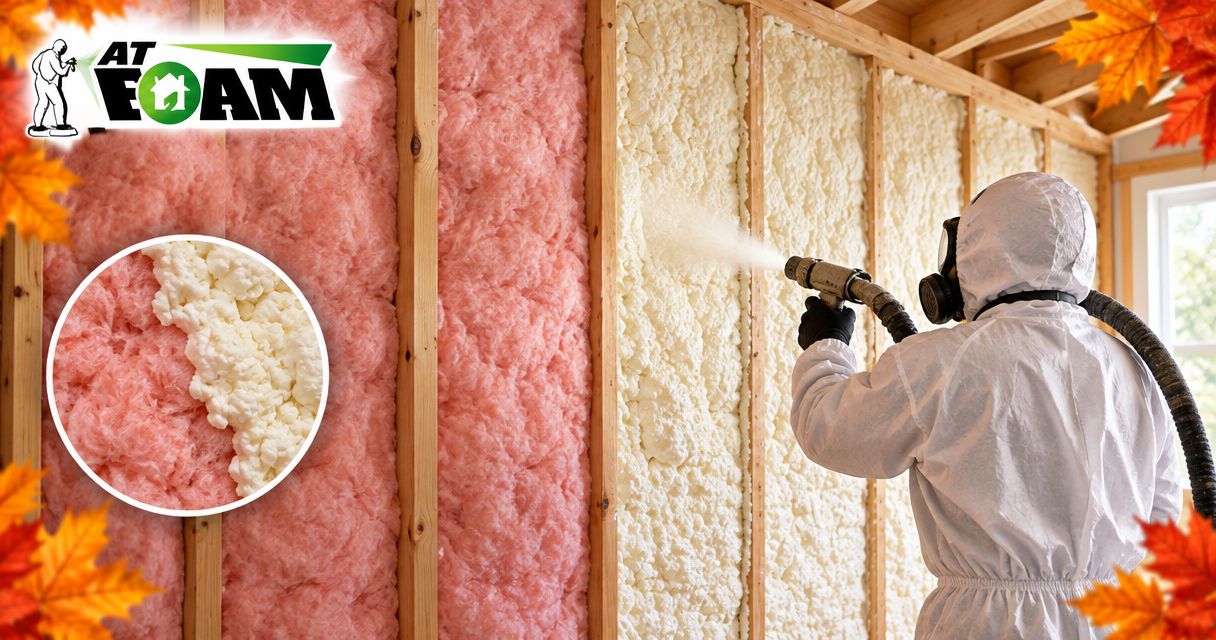
No—do not spray foam directly over existing fiberglass insulation; remove the fiberglass wherever the foam needs to bond to the framing, sheathing, or another approved surface. Sound, dry fiberglass can remain elsewhere, or become part of a properly designed layered assembly, but spraying a foam shell over old batts is not the same thing.
- Can you spray foam over existing fiberglass insulation? No—clear the foam application surface first.
- A foam-and-fiberglass assembly puts foam against the approved surface, not over loose fibers.
- Fix leaks, damp wood, and damaged framing before covering the cavity.
- AT Foam Insulation provides local spray foam installation; get a free estimate for your home’s actual conditions.
Can you spray foam over existing fiberglass insulation?
Remove fiberglass from the surface receiving spray foam. Fiberglass batts are blankets of glass fibers that slow heat movement. They are not a solid backing for an adhered spray foam installation.
Foam needs a suitable surface beneath it. Old fibers, dust, paper facing, and hidden dampness get in the way of inspecting that surface and preparing it correctly. Foam over a batt also leaves the air leaks behind the batt unresolved.
For your 2026 insulation project, separate these choices before you approve the work:
| Approach | Best for | Practical advantage | Limitation | Recommendation |
|---|---|---|---|---|
| Remove fiberglass and install foam against an approved surface | Exposed cavities selected for spray foam | Gives the installer access to inspect, prepare, and seal the cavity | Requires removal and surface preparation | Use where foam is specified |
| Foam first, then fiberglass in a designed assembly | Cavities with a documented layered design | Combines foam's air-control role with fibrous insulation | Moisture control and layer thickness need a proper design | Use only with an assembly-specific plan |
| Keep dry fiberglass away from the foam application area | Separate areas with serviceable insulation | Avoids removing material that does not interfere with the work | Does not correct poor installation or hidden air leaks by itself | Keep only after inspection |
| Spray foam directly over existing batts | Not recommended | Avoids the removal step | Hides the backing and does not establish a dependable bond to it | Skip |
Why this matters in a Pacific Northwest home
Wet winters make moisture control part of the insulation job—not a separate detail to sort out later. In Seattle, Tacoma, Olympia, and Eastside homes, check roof leaks, plumbing leaks, damp crawl spaces, and stained framing before adding insulation.
Insulation slows heat movement. It does not fix a leaking roof, drain standing water, or repair rotten wood. Covering a problem makes the next inspection harder.
AT Foam Insulation is a veteran-owned, licensed and insured local spray foam contractor serving homeowners and businesses across the greater Pacific Northwest. A free estimate lets you discuss the attic, crawl space, or wall conditions before choosing the scope.
The trade-off is straightforward: spray foam requires access, preparation, and a plan for the finished assembly. Keeping existing fiberglass is reasonable only where its condition and location support that plan.
What should happen before the crew sprays foam?
Ask for a preparation plan, not just a foam type. Your 2026 scope should identify what comes out, what stays, and which surface receives the foam.
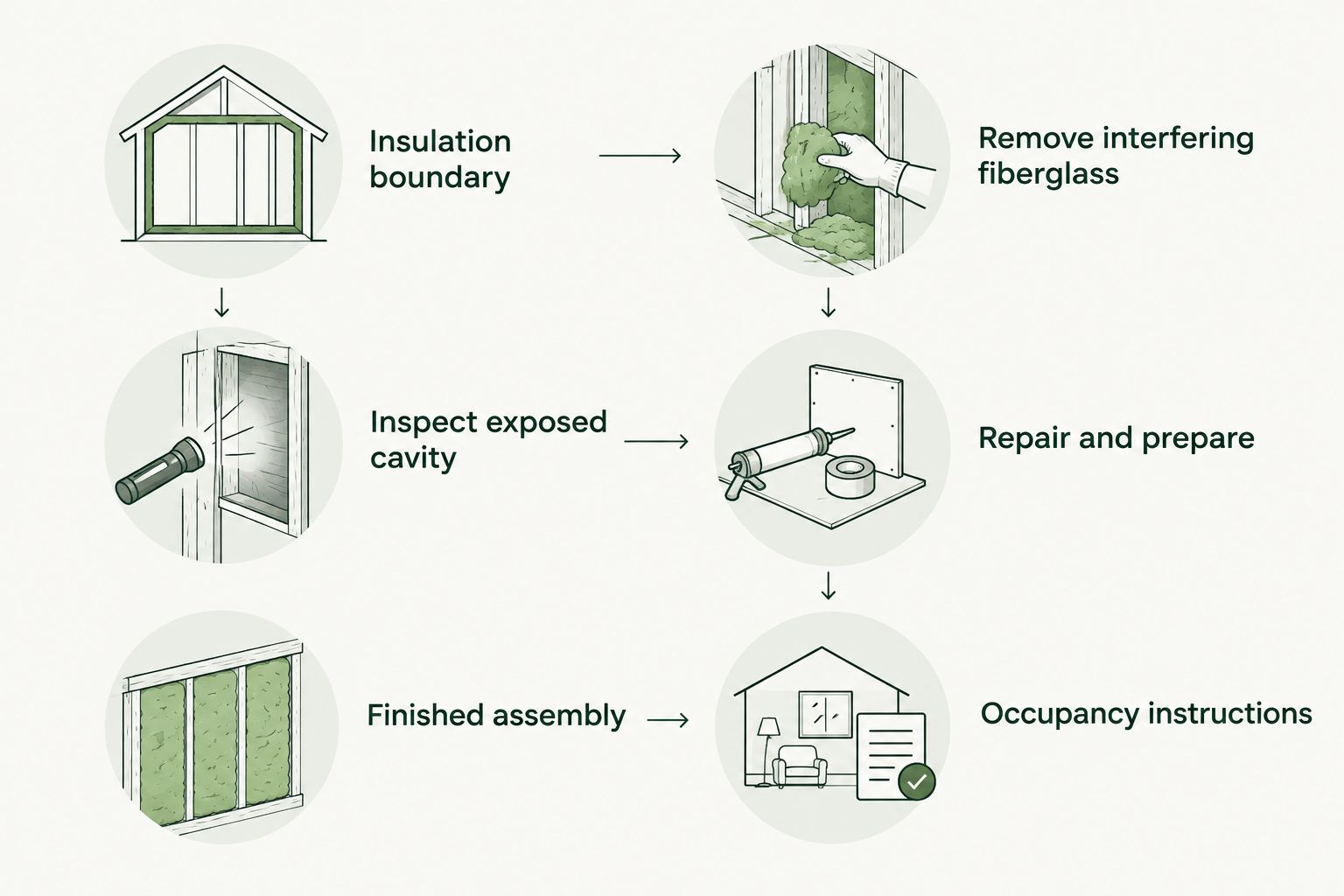
- Choose the insulation boundary. Decide where the insulated enclosure belongs: the attic floor, roofline, crawl space floor assembly, or another specified location. This choice determines which existing materials interfere with the work.
- Remove interfering fiberglass. Pull back or remove the batts and loose fibers from the application area. Clear the backing so the installer can inspect it rather than spray over what is hidden.
- Inspect the exposed cavity. Look for water stains, damaged wood, pest contamination, and openings. A stain needs investigation; it does not tell you by itself whether a leak is still active.
- Repair and prepare. Correct the moisture source and damaged materials. The backing must meet the foam manufacturer's requirements for cleanliness, dryness, temperature, and compatibility.
- Confirm the finished assembly. Establish the foam type, required R-value, ventilation approach, and any required protective covering. R-value means resistance to heat flow; higher values provide more resistance.
- Follow application and occupancy instructions. Confirm how the work area will be isolated and ventilated, and when people and pets can return. Follow the product's instructions rather than a generic waiting period.
You should be able to point to the application surface on the proposal. If the description only says to spray over the existing insulation, ask for the assembly detail before approving it.
Can fiberglass stay on the attic floor?
Sometimes—but first decide whether the attic floor or the roofline is your insulation boundary. Those are different projects, with different ventilation and moisture-control requirements.
In a vented attic, insulation generally sits at the attic floor. The roof space remains outside the conditioned enclosure, and its ventilation paths need to stay functional. If the project replaces floor insulation with foam, the fiberglass in that application area needs removal.
A roofline project moves the boundary to the underside of the roof assembly. That changes how the attic handles air, heat, and moisture. Existing floor insulation needs evaluation as part of that conversion; do not assume it all stays or all comes out.
For a 2026 attic conversion, ask the contractor to explain what happens to the existing vents and attic-floor insulation. Also identify bathroom exhaust ducts, recessed lights, chimneys, and equipment that needs access or clearance. Foam does not belong indiscriminately around those components.
Choose the attic assembly before choosing what to keep. A clean-looking layer of foam is not proof that the attic's ventilation and moisture details are correct.
What changes in a damp crawl space?
A crawl space needs a water assessment before an insulation decision. Check for standing water, plumbing leaks, wet soil, and damp framing. Fixing those sources comes before covering the wood.
Fiberglass under a floor can sag or pull away from the cavity. Removing it exposes the subfloor and joists for inspection. That access matters when the work involves a rim joist—the board closing off the ends of the floor joists at the house perimeter.
Do not spray foam over wet, dirty batts to hold them in place. You would still have the original condition underneath, with less access to inspect it.
Crawl space insulation also needs to fit the larger plan for ground moisture, drainage, and ventilation or conditioning. Spraying the underside of a floor does not automatically make a crawl space dry.
If you see suspicious growth or smell persistent dampness, investigate the cause before installation. The guide to whether spray foam insulation can cause mold covers the moisture questions to discuss with your contractor.
Can you combine spray foam and fiberglass in a wall?
Yes, when the wall is designed for that combination. In a layered assembly, foam goes against the approved backing first. Fiberglass fills the remaining space only when the specified assembly allows it.
This is not permission to spray over an existing batt. The order matters because foam needs direct access to its backing, and each layer affects how the wall handles heat and moisture.
Open-cell foam has an interconnected cell structure and is generally more vapor-permeable than closed-cell foam. Closed-cell foam has a denser structure and can provide greater resistance to vapor movement at specified thicknesses. Neither description tells you which product belongs in your wall without considering the full assembly.
A vapor retarder slows water-vapor movement through a material. Existing paper facing, interior finishes, exterior layers, and foam all affect that movement. Do not keep facing simply because it is already there; confirm its role in the design.
For your 2026 wall project, request the layer order and product-specific requirements in writing. An enclosed wall also raises an access question: cavity-fill methods and materials are not interchangeable with spray-applied foam used in an open cavity.
Why the removal scope varies
The rule stays the same: clear the foam application surface. The amount of fiberglass removal depends on the actual assembly and condition, not a blanket claim that every house needs complete removal.
- Application location. Foam at a rim joist needs access there; it does not automatically require removing insulation from unrelated cavities.
- Insulation condition. Wet, contaminated, badly displaced, or damaged fiberglass needs a different plan from sound, dry material.
- Hidden damage. Stained sheathing or suspect framing requires inspection before the surface gets covered.
- Insulation boundary. A roofline conversion changes the attic's enclosure; a floor-level repair does not make the same change.
- Moisture-control layers. Paper facing, vapor retarders, and exterior materials affect which layered assemblies are suitable.
- Access and clearances. Wiring, plumbing, equipment, and heat-producing components affect preparation and where foam can be installed.
Ask which of these factors applies to your home. A useful explanation names the cavity and the condition—not just the material the crew wants to install.
Does old fiberglass make new spray foam work better?
No—old fiberglass beneath the foam does not replace a suitable application surface. Adding insulation over an unsealed cavity is not the same as sealing that cavity correctly.
Fiberglass and spray foam perform different jobs within an assembly. A designed combination can be appropriate, but compressed batts, gaps, and unknown backing conditions do not become acceptable because foam covers them.
Can you leave dry fiberglass in another part of the house?
Yes—dry, serviceable fiberglass outside the foam application area does not automatically need removal. Check its fit, condition, facing, and relationship to the insulation boundary before deciding to keep it.
A targeted rim-joist project and a full attic conversion have different removal scopes. Ask for a location-by-location answer rather than applying one rule to the whole house.
Is removing fiberglass a do-it-yourself job?
Accessible, uncontaminated fiberglass removal is different from handling suspect materials or working around damaged wiring. Before starting, identify the hazards, disposal requirements, and access limits; use appropriate protective equipment.
Stop when you find wet framing, pest contamination, suspect older materials, or an unsafe walking surface. Let the relevant trade or qualified specialist address those conditions before the insulation work continues.
What should you ask during the estimate?
AT Foam Insulation is best for homeowners seeking local spray foam installation in Seattle, Tacoma, Olympia, and the greater Pacific Northwest. The useful question is not whether foam can cover the old insulation; it is what your home's finished assembly requires.
Bring these questions to your 2026 estimate:
- Which fiberglass areas will you remove, and which will remain?
- What exact surface will receive the foam?
- What happens if removal exposes wet wood or damage?
- Why does this location call for open-cell or closed-cell foam?
- How will you handle ventilation, equipment clearances, and protective coverings?
- What application, ventilation, and re-entry instructions apply to the specified product?
Get those answers before approving the scope. Removal and preparation are part of the installation—not optional cleanup after the main decision.
FAQ
Can you spray foam over existing fiberglass insulation without removing it?
No—remove fiberglass wherever spray foam needs to bond to its approved application surface. Fiberglass elsewhere can remain only when its condition and the assembly support keeping it.
Can I keep fiberglass on the attic floor when insulating the roofline?
Keeping attic-floor fiberglass requires an assembly-specific decision when you move insulation to the roofline. Confirm the ventilation changes, moisture-control plan, and role of the existing floor insulation before work starts.
Can closed-cell spray foam go over wet fiberglass?
No—closed-cell spray foam should not cover wet fiberglass. Remove the affected material, find the moisture source, and prepare the backing according to the foam manufacturer’s requirements.
Is spray foam with fiberglass better than spray foam alone?
A foam-and-fiberglass assembly is not automatically better than foam alone. Compare the specified R-value, air control, moisture behavior, and cavity details rather than judging by the number of materials.
Do I need to remove all the fiberglass in my house?
No—you do not automatically need to remove fiberglass throughout the house. Removal must cover the foam application area and any material whose condition or location conflicts with the planned assembly.
Does spray foam fix mold or rot behind old insulation?
No—spray foam does not fix mold, rot, or the water source behind old insulation. Investigate the condition and complete the necessary repairs before covering the cavity.
Who can assess existing insulation before a spray foam project?
AT Foam Insulation provides free estimates for residential and commercial spray foam projects in its Pacific Northwest service area. Ask for a removal scope and an explanation of the proposed attic, crawl space, or wall assembly.
One last thing
The most useful job photo is often taken before spraying. Ask to see the exposed, prepared backing—not just the finished foam. That view helps you understand what was inspected and what is now covered.
Do not approve foam over a problem you have not identified. Clear the application surface, fix the moisture source, and agree on the assembly first.
Related guides
- Spray foam insulation and whole-house ventilation
- Insulation for rim joists in crawl spaces
- Insulation for vaulted ceilings in Pacific Northwest homes
Get a FREE Quote: call 425-999-8493.
Leave a Reply