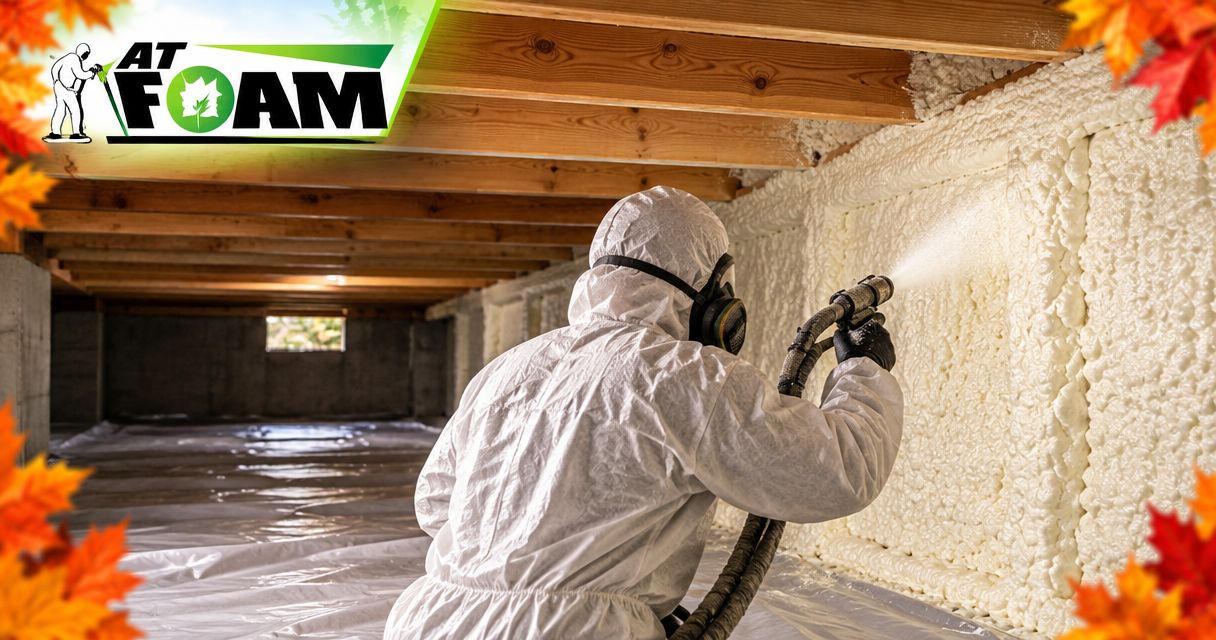
Yes—closed-cell spray foam is a good choice for a crawl space when the surfaces are dry, drainage problems are fixed, and the insulation belongs in the planned location. It can insulate and seal air leaks, but it does not replace a ground vapor barrier, repair rotten wood, or stop water coming through a foundation.
- A closed cell spray foam crawl space project needs drainage, dry surfaces, and a clear insulation plan.
- Closed-cell foam suits rim joists and approved foundation-wall assemblies; it is not a waterproofing repair.
- Keep the ground vapor barrier: foam on walls does not stop moisture rising from exposed soil.
- AT Foam Insulation provides local crawl space insulation estimates for Seattle, Tacoma, Olympia, and the greater Pacific Northwest.
Is closed-cell spray foam a good choice for a crawl space?
Closed-cell foam works well where you need insulation and air sealing together. Its dense structure resists moisture movement better than open-cell foam, but the finished assembly still needs a way to manage water and dry safely.
For your 2026 project, compare the whole installation—not just the material. These options do different jobs, and none repairs an active leak.
| Insulation option | Best for | Main advantage | Main limitation |
|---|---|---|---|
| Closed-cell spray foam | Irregular rim joists and approved crawl space wall assemblies | Insulates and seals irregular gaps when properly installed | Adheres to surfaces, making later inspection and removal harder |
| Open-cell spray foam | Assemblies designed for vapor-open insulation | Fills irregular cavities and provides air sealing at its specified thickness | More vapor-permeable; not interchangeable with closed-cell foam in a damp assembly |
| Rigid foam board | Accessible foundation walls with room for fitted panels | Provides continuous insulation when joints and edges are sealed | Gaps, uneven masonry, and penetrations need separate detailing |
| Fiberglass batts | Dry floor cavities with separate air sealing and proper support | Fits between floor joists without bonding to the wood | Does not stop air leakage and loses effectiveness when wet or poorly fitted |
The right choice starts with understanding why crawl spaces are damp in Washington homes. Insulation selection comes after identifying the moisture source.
Why this matters in a Pacific Northwest crawl space
Wet winters put drainage and ground moisture high on the list in Seattle, Tacoma, Olympia, and Eastside homes. A crawl space can look dry during an estimate and still take on water during sustained rain. Tell your contractor what happens in winter, not just what the space looks like today.
Cold floors do not automatically mean you need foam everywhere. Air leaks at the rim joist—the framing band around the edge of your floor—can contribute to drafts. Wet or fallen insulation is a different problem, and each needs a specific repair.
AT Foam Insulation is a fit for Pacific Northwest homeowners seeking a veteran-owned local crawl space insulation contractor. Installation is only part of the decision: your written scope should also explain existing moisture conditions, preparation, and any separate repairs needed before spraying.
Where should closed-cell foam go?
Rim joists: seal the edge of the floor
Rim joists sit where floor framing meets the outside wall. Plumbing, wiring, and framing joints can leave air paths through this area. Closed-cell foam can follow those irregular surfaces and connect insulation with air sealing.
Best for: dry, accessible rim joists with sound wood and a clear installation detail. The drawback is visibility: once foam covers the wood, inspecting the covered surface becomes harder. Check staining, insect damage, and leaks before installation, not afterward.
Foundation walls: use an enclosed crawl space plan
Insulating foundation walls brings the crawl space inside the home's insulated boundary when the rest of the enclosure is designed accordingly. That boundary is the continuous line separating indoor conditions from outdoor conditions. It must connect through the walls, rim joists, access door, and other transitions.
Best for: crawl spaces being converted to a properly designed, unvented assembly. Wall foam alone does not complete that conversion. Ground vapor control, sealed openings, and an approved moisture-control or air-conditioning approach still matter.
Floor framing: protect the floor without hiding problems
Insulation under the floor keeps the crawl space outside the home's insulated boundary. Closed-cell foam can be used in suitable floor assemblies, but broad coverage under a subfloor deserves careful review. Plumbing leaks and damaged wood become harder to locate when covered.
Best for: a specifically designed floor assembly with dry framing and planned service access. Do not accept “spray everything” as a scope. Ask which surfaces need foam and why those surfaces are the right boundary for your home.
Why the right crawl space insulation plan varies
The same material does not belong in the same place in every house. These conditions determine whether closed-cell foam makes sense:
- Water entry: standing water, plumbing leaks, and foundation seepage need correction before insulation.
- Ground moisture: exposed soil needs its own vapor-control layer; wall foam does not cover that job.
- Existing wood condition: rot, mold, and insect damage need assessment before surfaces become concealed.
- Crawl space design: a vented crawl space and an enclosed crawl space require different insulation and ventilation details.
- Access and equipment: pipes, wiring, ducts, and combustion appliances affect what can be covered and what must remain accessible.
- Product requirements: approved substrates, application conditions, thickness, and protective coverings vary by foam product and assembly.
For a 2026 retrofit, get these decisions written down before approving installation. A material name without an assembly plan leaves too much unresolved.
What needs fixing before the crew sprays?
Start with water, then wood, then insulation. Spraying over a problem does not remove it, and foam should not become the cover that keeps you from seeing it.
- Find water entry. Inspect plumbing, foundation walls, exterior drainage, and signs of seasonal flooding. Correct the source rather than treating dampness as an insulation defect.
- Check the framing. Have suspect wood assessed. Repair structural damage and address mold contamination before covering the affected area.
- Verify surface conditions. The installer should check that wood or masonry meets the selected foam manufacturer's moisture and temperature requirements.
- Set the boundary. Decide whether insulation belongs at the floor or at the foundation walls. Detail the connections around rim joists, access openings, and penetrations.
- Plan protection and access. Identify required fire protection, inspection areas, serviceable equipment, and the installation safety arrangements.
Ask for actual crawl space photos showing the conditions behind the recommendation. A useful photo identifies a leak, an unsealed joint, or damaged insulation. A generic picture of finished foam cannot explain your house.
Do you still need a ground vapor barrier?
Yes—closed-cell foam on crawl space walls or rim joists does not replace a ground vapor barrier. A ground vapor barrier is the sheet material that limits moisture moving from soil into the crawl space. Its seams, edges, and penetrations need detailing appropriate to the design.
Closed-cell foam and ground covering handle different paths. Foam limits heat flow and, when installed to its tested requirements, air leakage through the surfaces it covers. Ground covering limits soil moisture entering the space.
Do not assume closing foundation vents finishes the job. An unvented crawl space needs a code-compliant moisture-control approach, not just blocked openings. For a 2026 enclosure project, ask how the space will stay dry after the vents are sealed.
Can closed-cell foam cause mold or hide rot?
Closed-cell foam does not fix the conditions that caused existing mold or rot. Covering wet or damaged framing can conceal the problem and restrict drying through the covered surface. The important question is whether the wood is sound and the assembly can manage future moisture.
This is especially important below kitchens, bathrooms, and exterior doors. A later leak can still wet the floor assembly even if the crawl space insulation was installed correctly. Keep shutoffs, drains, and likely inspection points accessible where the design allows.
Treat musty odors as a reason to investigate, not proof that one insulation type is at fault. Check water entry, soil coverage, air movement, and existing contamination before choosing the repair.
How thick should closed-cell foam be?
Specify the required R-value and approved assembly before choosing foam thickness. R-value measures resistance to heat flow. The product's published R-value, the installation location, and applicable energy requirements determine the needed thickness.
There is no single thickness that answers every crawl space question. Rim joists, foundation walls, and floors have different details. The thickness required for vapor control can also differ from the thickness required for insulation or air sealing.
Your 2026 proposal should identify the foam product, intended thickness, and target R-value. Ask how the installer checks coverage at corners and transitions, where thin spots are easy to miss. Do not treat a smooth-looking surface as proof of the specified installation.
What should your estimate include?
Compare written scopes, not just the promise of a warmer floor. An estimate should make clear what gets insulated, what gets removed, and what remains outside the job.
Ask for these details:
- Preparation: removal of failed insulation, surface cleaning, and required drying.
- Application area: the specific rim joists, wall sections, or floor cavities receiving foam.
- Material specification: the selected product, target R-value, and planned thickness.
- Moisture responsibilities: who handles leaks, drainage, ground covering, and damaged wood.
- Safety details: occupant and pet separation, ventilation during work, and manufacturer-directed re-entry requirements.
- Finished protection: any required ignition or thermal barrier, plus equipment and inspection access.
AT Foam Insulation offers free crawl space insulation estimates and is licensed and insured. Ask the local crew to explain where closed-cell foam belongs in your house—and where it should stay off. A useful recommendation includes the limits of the proposed work, not just the surfaces the crew can spray.
For your 2026 estimate, also ask what conditions would stop installation that day. Wet substrates, unresolved damage, or unsuitable application conditions should trigger a discussion before work continues.
FAQ
Is closed-cell spray foam good for a damp crawl space?
Closed-cell spray foam can suit a crawl space after the moisture source is corrected and the application surfaces meet the manufacturer’s requirements. It is not a repair for standing water, active leaks, or rotten framing.
Is closed-cell foam better than open-cell foam under a house?
Closed-cell foam is less vapor-permeable than open-cell foam and is often better suited to moisture-sensitive crawl space details. The correct choice still depends on the complete assembly, including drying paths and ground moisture control.
Do I need plastic on the ground if the crawl space walls have spray foam?
Yes, foam on crawl space walls does not replace ground vapor control. The ground covering needs properly detailed seams, edges, and penetrations for the intended crawl space design.
Can spray foam be installed over moldy crawl space wood?
Do not cover moldy or damaged wood as a substitute for fixing it. Identify the moisture source, assess the affected material, and complete necessary cleanup or repairs before insulation.
Should I spray the crawl space walls or the underside of the floor?
Choose the insulation location based on whether the crawl space stays outside or becomes part of the home’s insulated boundary. Foundation-wall insulation requires an enclosure and moisture-control plan; floor insulation requires its own continuous air-sealing details.
Can I stay home while crawl space spray foam is installed?
Occupancy during installation must follow the selected product’s safety instructions and the contractor’s isolation and ventilation plan. Get specific instructions for people and pets before installation, including when re-entry is permitted.
Does exposed crawl space spray foam need a protective covering?
Exposed spray foam requires the protection specified by the applicable code and the product’s approved use. Crawl space access and use affect the requirements, so have the installer identify the accepted detail in writing.
One last thing
Ask what will remain visible after installation. That question can expose a weak plan faster than asking whether closed-cell foam is “good.” You still need to find plumbing leaks, inspect important framing areas, and service equipment after the insulation is finished.
Related guides
- Do you need a vapor barrier with spray foam in a crawl space?
- Do you need to insulate rim joists in a crawl space?
- Should you close foundation vents when encapsulating a crawl space?
Get a FREE Quote from AT Foam Insulation.