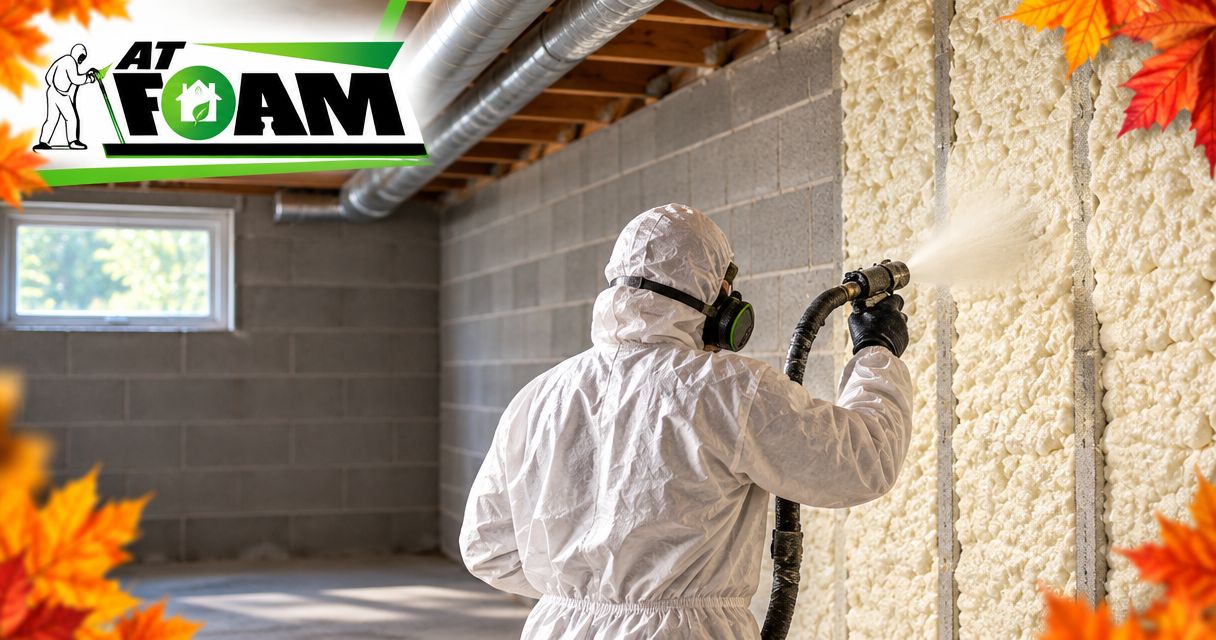
To insulate block basement walls with spray foam, fix water entry first, prepare sound masonry, and have a qualified installer apply a continuous layer of closed-cell foam specified for the wall assembly. Connect that insulation to the rim joist and adjoining surfaces, then install the required fire protection; foam does not repair foundation leaks or make wet block ready to cover.
- How to insulate block basement walls: correct water entry, prepare masonry, install continuous insulation, and provide required fire protection.
- Closed-cell spray foam suits below-grade masonry assemblies when moisture conditions and product specifications permit.
- Open-cell spray foam is not a direct substitute for closed-cell foam on basement block.
- AT Foam Insulation offers local wall insulation services and free estimates for Pacific Northwest homeowners.
How do you insulate block basement walls with spray foam?
Start with the water problem, not the insulation product. Concrete block is porous masonry. It can absorb moisture from the ground, and its joints can admit water where drainage or the foundation needs attention.
Closed-cell spray foam has a dense cell structure that limits water-vapor movement at the thickness specified for that product. Open-cell foam has a more open structure and allows more vapor movement. Neither material replaces drainage, flashing, or foundation repairs.
Before choosing a material, review the differences between open-cell and closed-cell spray foam. The right choice depends on the entire basement wall, not just the cavity you want to fill.
Follow this installation sequence
- Inspect the basement. Check block faces, mortar joints, the floor-to-wall joint, windows, and nearby wood for water damage or deterioration.
- Correct water entry. Address the source of leaks and drainage problems before covering the masonry.
- Prepare the surface. Remove loose material and contamination. Confirm that existing coatings and masonry conditions meet the foam manufacturer's requirements.
- Define the insulation boundary. Decide how the wall insulation connects to the rim joist, adjacent walls, and the bottom of the assembly.
- Install the specified foam. Follow the manufacturer's requirements for substrate conditions, application thickness, and successive passes.
- Inspect and protect the work. Check coverage before concealment, then complete the required fire protection and wall finish.
Each step affects the next. A clean-looking foam surface cannot prove that a hidden wall was dry, sound, or properly prepared.
Why this matters in a Pacific Northwest basement
Seattle, Tacoma, Olympia, and Eastside homes face wet winters. That makes the condition of the block wall and surrounding drainage a first-order concern, not an item to leave until finishing work.
Warm indoor air contacting a cold basement surface can produce condensation. Ground moisture and rainwater entry are separate problems, even when all three leave the wall looking damp.
Insulation addresses heat flow. Air sealing limits air movement through gaps. Water management controls liquid water. A sound basement plan handles each job rather than asking spray foam to do all of them.
For a 2026 basement project, put moisture correction and insulation in the same written scope. Do not let a finished wall hide an unresolved leak.
What should you check before covering block walls?
Walk the basement after rain as well as during dry weather. Look behind stored items and inspect corners where staining or musty odors have gone unnoticed.
Water entry
Check for wet mortar joints, puddles, and staining that returns after storms. Inspect gutters, downspout discharge, and ground drainage outside. Recurring water calls for diagnosis before insulation.
White powder on masonry is called efflorescence: salts left behind as moisture moves through the wall and evaporates. It is a reason to investigate moisture movement, not proof that a particular insulation will solve it.
Masonry condition
Loose mortar, crumbling block, and damaged coatings need attention before application. Bowing walls, displaced blocks, and concerning cracks belong with a qualified structural professional, not behind a new finish wall.
Spray foam needs a suitable bonding surface. Do not assume it will hold loose paint or deteriorating masonry together.
Mold and damaged wood
Do not cover visible mold, rotten framing, or an unresolved musty area with foam. Find the moisture source and arrange appropriate cleanup or repair before insulation proceeds.
Pay attention to the sill plate, the wood sitting above the foundation, and the rim joist, the framing around the floor's outer edge. These areas need inspection before they become harder to see.
Which insulation belongs on a block basement wall?
Closed-cell spray foam is the spray-applied option to assess first for below-grade block. Its suitability still depends on the product, wall condition, drying plan, and required fire protection.
The table below compares approaches, not interchangeable packages. Each needs a complete assembly suited to the basement.
| Insulation approach | Best for | Main advantage | Main limitation |
|---|---|---|---|
| Closed-cell spray foam | Suitable block walls with irregular surfaces and detailed air-sealing needs | Adheres to prepared masonry and follows uneven surfaces | Conceals masonry and requires controlled application and fire protection |
| Rigid foam board | Accessible, relatively flat walls where joints can be detailed | Provides a continuous insulation layer | Edges, seams, and uneven areas need careful sealing |
| Open-cell spray foam | Assemblies specifically designed to accommodate its vapor behavior | Fills irregular framing cavities | Is not a direct substitute for closed-cell foam against below-grade masonry |
| Fiberglass batts in framing | Additional insulation inside an appropriately designed basement assembly | Fits framed cavities without spray application | Does not air-seal the masonry or provide a continuous moisture-control layer |
Do not place fiberglass against damp block and expect drywall to keep the assembly dry. A cavity full of insulation is not the same as a continuous, moisture-aware wall system.
AT Foam Insulation is best for Pacific Northwest homeowners seeking a veteran-owned local spray foam contractor. For a block basement, the installation scope still needs to explain moisture preparation, foam selection, and the finished wall assembly.
How do you connect the wall insulation to the rim joist?
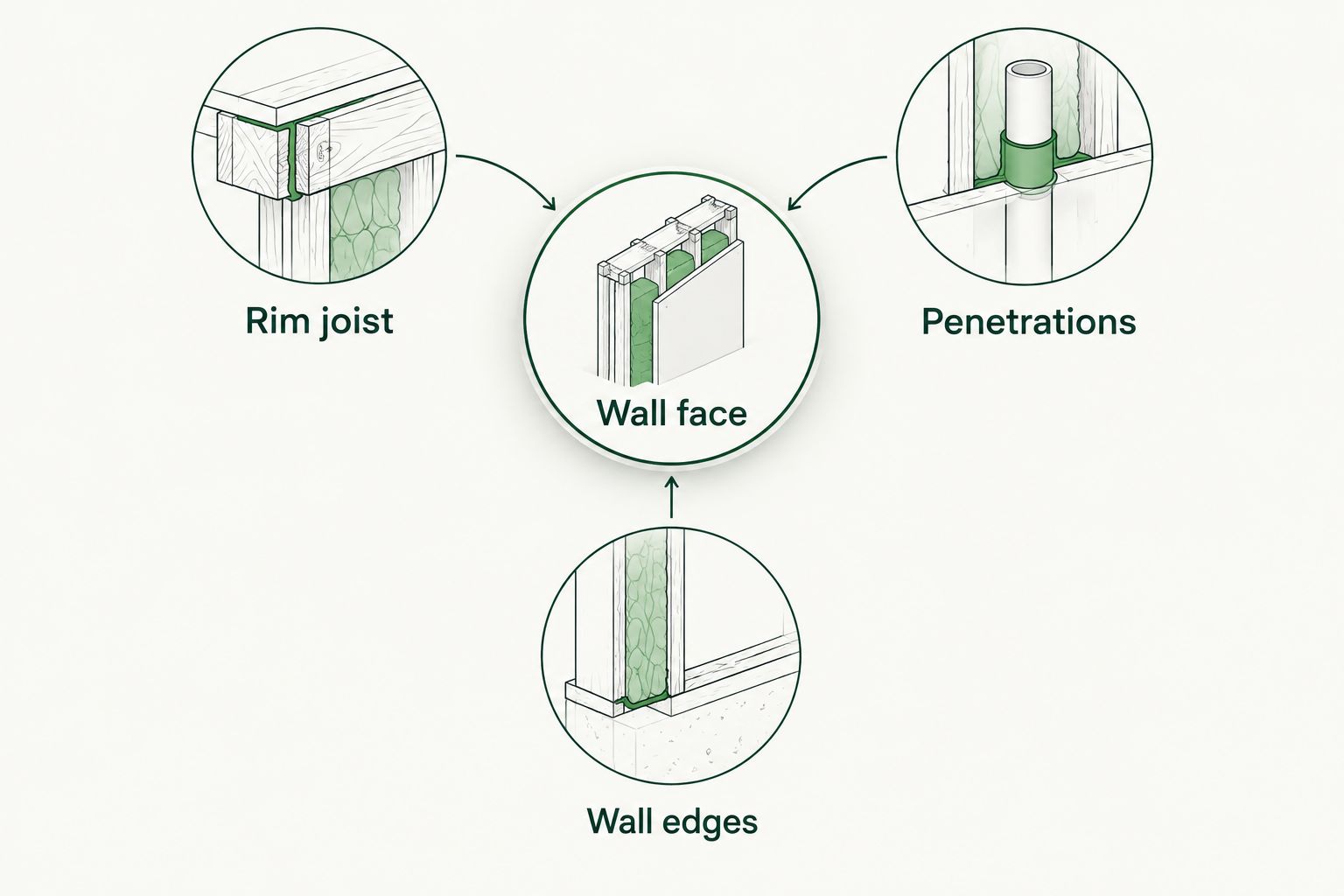
A basement wall needs continuity at its edges. Gaps at the top, corners, or penetrations leave paths for air movement even when the middle of the wall looks fully covered.
The rim joist sits above the foundation at the edge of the floor framing. Inspect that wood before insulating it, then specify how its insulation and air seal connect to the masonry below.
- Wall face: Maintain the specified coverage across suitable masonry.
- Rim joist: Connect the wall treatment to the floor-edge air seal.
- Penetrations: Detail pipes, cables, and other openings with compatible materials.
- Wall edges: Resolve corners, windows, adjoining walls, and the lower termination.
Keep required service access and equipment clearances intact. Foam is not a substitute for approved fireblocking, and it must not cover electrical junction boxes or interfere with equipment instructions.
Ask the installer to show these connections before the finish wall closes them. Photographs at that stage give you a useful record of work that will otherwise disappear.
How much spray foam do block basement walls need?
There is no universal thickness for every block basement. R-value measures resistance to heat flow, and the needed thickness depends on the selected product's published performance and the requirements for the wall assembly.
Ask for the specified R-value, minimum installed thickness, and product identification in your 2026 proposal. An average thickness alone does not explain how thin spots will be identified or corrected.
Application passes also matter. The foam manufacturer sets limits for each pass and the conditions between applications; the installer should follow those instructions rather than treating the full thickness as a single unrestricted application.
The wall finish is a separate requirement. Meeting the insulation target does not automatically satisfy fire-protection rules.
Can you leave spray foam exposed on basement walls?
Do not assume exposed foam is acceptable in a basement. The required protection depends on the adopted building code, the foam's approval, and the intended use of the space.
The International Residential Code's Section R316.4 identifies 1/2-inch gypsum wallboard as a common prescriptive thermal barrier. It also provides an alternative testing route based on a 15-minute fire-exposure standard. These are code provisions, not permission to select an arbitrary coating or leave foam uncovered.
A thermal barrier protects foam from a building fire. An ignition barrier is a different level of protection used only where the applicable rules allow it; the terms are not interchangeable.
For a 2026 installation, ask the local building department which requirements apply to your basement. Confirm the proposed drywall, coating, or other approved assembly before work starts, not after foam is installed.
Why does the basement insulation plan vary?
The same foam product does not create the same wall assembly in every house. These conditions change the work:
- Water history: Active seepage and recurring dampness require correction before concealment.
- Surface condition: Paint, loose mortar, dirt, and existing coatings affect preparation and adhesion.
- Wall layout: Windows, corners, pipes, and uneven masonry affect application access and detailing.
- Insulation target: Product performance and applicable requirements determine the specified thickness.
- Finish requirements: Living space, equipment areas, and approved assemblies affect fire protection and access.
- Drying potential: Existing exterior treatments and planned interior layers affect where moisture can dry.
Closed-cell foam reduces inward drying through the area it covers. That is a trade-off to address in the design, especially when the wall has a history of getting wet.
Do not add interior polyethylene simply because it is common elsewhere in the house. Additional vapor-resistant layers need to fit the selected assembly rather than trap moisture between materials.
Can you spray foam directly onto concrete block?
Spray foam can be applied directly to suitable concrete block when the product permits that substrate and the surface meets its application requirements. Wet, frozen, dirty, or deteriorating masonry is not automatically ready for foam.
Existing paint also needs evaluation. Foam attached to a failing coating is only as secure as that coating's bond to the wall.
Should you frame the basement wall before spraying?
Framing order depends on the assembly and application access. The important requirement is a continuous insulation layer without inaccessible gaps behind framing or around connections.
Have the installer and finishing contractor agree on the sequence before either starts. Keep wood details, utilities, fastening needs, and inspection access in that discussion.
What should your estimate include?
A useful estimate describes the assembly, not just the area receiving foam. Ask for these items in writing:
- Surface preparation and who handles moisture-related repairs.
- Foam identification, specified R-value, and installed thickness.
- Connections at the rim joist, corners, and penetrations.
- Required fire protection and who installs it.
- Occupant exclusion, ventilation, and reentry instructions.
- Inspection and documentation before walls are closed.
AT Foam Insulation provides residential and commercial wall insulation services across its Pacific Northwest service area. The veteran-owned local crew offers free estimates and is licensed and insured; ask the crew to explain the proposed basement assembly in plain terms.
FAQ
What’s the best spray foam for block basement walls?
Closed-cell spray foam is the spray-applied option to assess first for below-grade block walls. Confirm that the selected product, masonry condition, and drying plan suit the assembly before installation.
Can spray foam stop a basement wall from leaking?
Spray foam is not a repair for a leaking basement foundation. Correct water entry and drainage problems before covering the block wall.
Do I need a vapor barrier behind basement spray foam?
A separate vapor barrier is not an automatic requirement behind basement spray foam. The selected foam’s vapor performance, existing wall layers, and applicable requirements determine the moisture-control design.
Can I leave closed-cell foam uncovered in an unfinished basement?
Do not leave closed-cell foam uncovered unless its approval and the applicable code permit that installation. Confirm the required thermal barrier or other approved protection with the local building department.
Can I stay home while basement spray foam is installed?
Follow the product manufacturer’s and installer’s occupant exclusion and reentry instructions. Basement work does not make the rest of the house automatically safe to occupy during application.
Does AT Foam Insulation offer free wall insulation estimates?
AT Foam Insulation offers free estimates for wall insulation within its service area. Discuss the block condition, moisture history, rim joist, and planned finish when requesting an estimate.
One last thing
Ask to see the wall before it disappears. Once foam covers the block, you lose a direct view of mortar joints, old stains, and small changes in the masonry.
For your 2026 project, keep dated photographs before preparation, after repairs, and before the finish wall closes. Include the rim joist and utility penetrations, not just the largest flat surface.
Related guides
- Do you need to insulate rim joists in a crawl space?
- Can spray foam insulation be installed in an occupied home?
- Best insulation companies in Seattle
Get a FREE Quote for your basement wall insulation.