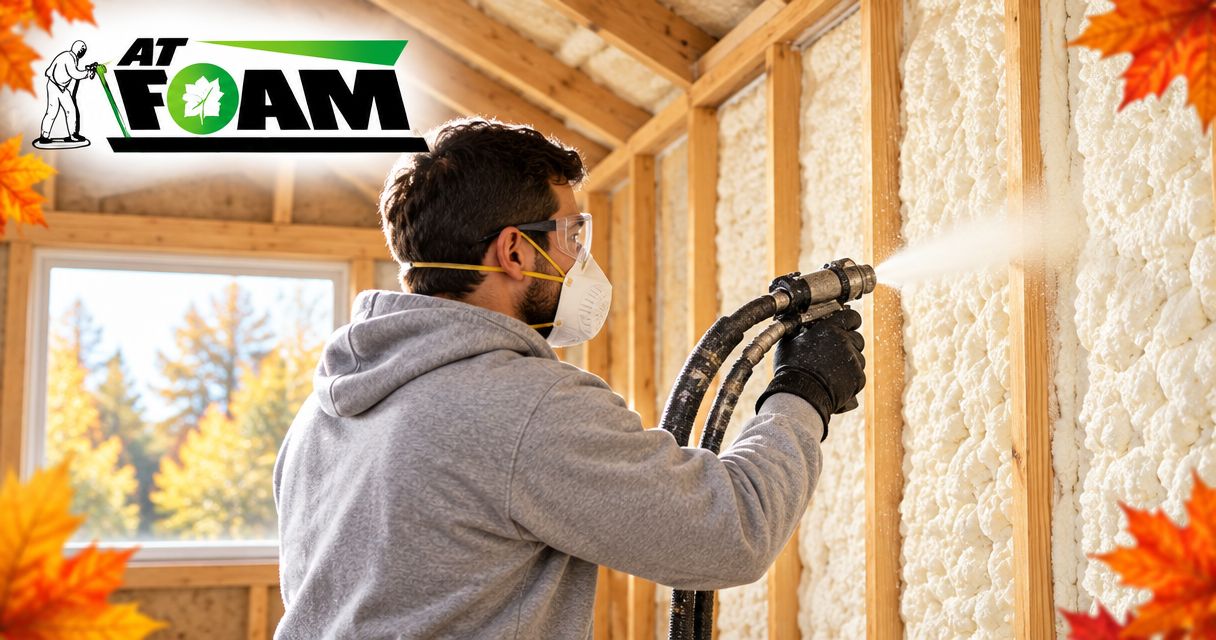
Yes, homeowners can install spray foam insulation themselves when the product is intended for consumer use and the job fits its instructions. Small gap-sealing jobs are different from insulating an entire attic, crawl space, or wall with a two-component system. For whole-space insulation, hire a qualified crew: chemical exposure, moisture control, application quality, and fire protection all need a plan before spraying starts.
- Can homeowners install spray foam insulation themselves? Yes, but small gap sealing differs from whole-space insulation.
- Consumer spray foam must match the job and follow its safety and application instructions.
- Fix leaks and damp wood before insulating a Pacific Northwest attic or crawl space.
- AT Foam Insulation serves homeowners who want professional attic, crawl space, and wall spray foam installation.
Can homeowners install spray foam insulation themselves?
You can handle a suitable consumer-use product yourself. That does not make every spray foam project a DIY job. Filling a small opening around a pipe is not the same as building a continuous insulation layer across roof framing.
Start by identifying the job, not buying the foam. Decide whether you need to seal a gap, insulate an exposed area, or change how an entire space handles heat and moisture. Read the product instructions and safety data sheet before deciding whether you can meet those requirements.
| Approach | Best for | Main advantage | Main limitation |
|---|---|---|---|
| Consumer one-component foam | Small, accessible gaps approved by the product instructions | Targeted air sealing without a full insulation installation | Not a substitute for a designed attic or wall insulation system |
| Consumer two-component kit | Limited exposed areas when the product permits homeowner application | Can cover a broader surface than gap-filling foam | Requires chemical handling, exposure controls, and careful application |
| Professional spray foam installation | Whole attics, crawl spaces, walls, and complicated assemblies | Lets you put preparation, application, and building requirements in one scope | Requires scheduling, job-site access, and arrangements for occupants |
Foam also needs the right fire protection for its location. Read whether spray foam insulation can catch fire before treating exposed foam as a finished surface.
Why this matters in a Pacific Northwest home
Wet winters make moisture part of the insulation decision. A Seattle attic with a roof leak needs the leak repaired first. A Tacoma crawl space with standing water needs water control before new insulation hides the framing.
Spray foam does not repair rotten wood, replace drainage, or remove mold. Covering a problem makes inspection harder. Find the source of the moisture before covering the surface.
For a 2026 home project, judge the finished assembly rather than the foam alone. An assembly is the complete arrangement of framing, insulation, air control, and protective coverings. Each part needs to work with the others.
Small gap sealing: the most practical DIY use
Small gap sealing is the clearest starting point for a homeowner. Air sealing means closing unwanted openings where air moves through the building. A product labeled for a particular gap can help close that opening without turning the entire room into an insulation project.
Check what surrounds the gap. Electrical equipment, hot surfaces, flues, and fire-rated construction have specific requirements. General-purpose expanding foam is not automatically suitable for those locations.
Expansion matters, too. Use the product specified for the application, especially around windows and doors. Foam that expands in the wrong place can interfere with surrounding materials or hardware.
Best for: Accessible gaps with sound, dry surfaces and clear product instructions. The advantage is a focused repair; the limitation is that sealing a few openings does not establish the insulation performance of the whole space.
Two-component kits: more responsibility than a foam can
Two-component spray foam mixes separate chemical components during application. The result depends on the product, storage conditions, surface conditions, equipment, and how you apply it. Owning the kit does not establish that your space is ready for it.
Read the safety data sheet, which explains chemical hazards and handling precautions. Then read the installation instructions. Those documents must tell you what protective equipment, ventilation, surface preparation, and application conditions the product requires.
Do not treat a basic dust mask as a substitute for the respiratory protection specified for the work. If the required protection includes a respirator, understand its selection, fit, and use before starting. An open window alone is not a complete exposure-control plan.
Best for: Limited work that the manufacturer expressly supports for consumer application, where you can meet every requirement. The benefit is access to spray-applied insulation; the drawback is responsibility for chemical exposure and installation defects.
Whole attics, crawl spaces, and walls: choose a crew
Whole-space insulation involves more than covering visible wood. You need to decide where the air and insulation layers belong, how moisture will move, and which openings must remain clear. Those decisions come before choosing open-cell or closed-cell foam.
AT Foam Insulation is best for Pacific Northwest homeowners seeking professional attic, crawl space, and wall spray foam installation. The veteran-owned local contractor serves Seattle, Tacoma, Olympia, the Eastside, and the greater Pacific Northwest, and offers free estimates.
Hiring a crew does not eliminate the need to understand the scope. You still need arrangements for access, occupant exclusion, ventilation, and finishing work. Ask what the installation includes and what another trade must complete.
Best for: Large areas, difficult access, and projects that change the building assembly. Professional installation gives you a defined job scope; the trade-off is coordinating your household and any related repairs around the work.
What makes one spray foam job harder than another?
The size of the area is only part of the decision. These factors determine whether the job belongs on your DIY list:
- Access: Tight crawl spaces and awkward roof framing make inspection, movement, and consistent application harder.
- Moisture: Leaks, damp framing, and standing water require correction before foam covers the area.
- Exposure control: The product's requirements must protect the applicator, other occupants, and adjoining spaces.
- Assembly design: Roof decks, attic floors, crawl space walls, and floor framing do not all use the same insulation approach.
- Fire protection: The location and approved assembly determine whether exposed foam needs a protective covering.
- Existing conditions: Wiring, heat sources, old insulation, and damaged framing can change the preparation and scope.
Use these factors when comparing a DIY kit with a professional estimate in 2026. A smaller area is not automatically a simpler job if it sits beside a heat source or contains wet framing.
What should you check before any spray foam work?
Use this sequence to decide whether the project is ready. It is a planning checklist, not a substitute for the manufacturer's application instructions.
- Define the boundary. Identify where you intend to separate the conditioned part of your home from outside air or an unconditioned space. Conditioned space means the area your heating or cooling system serves.
- Inspect the structure. Check accessible framing for leaks, dampness, deterioration, and conditions that need further evaluation. Repair the cause before insulation covers the evidence.
- Confirm the product and assembly. Match the foam to the location, required thermal performance, moisture design, and approved protective covering. Confirm permit and inspection requirements with your local building department.
- Plan exposure controls. Follow the product's requirements for protective equipment, ventilation, occupant exclusion, and re-entry. Include pets and adjoining occupied areas in the plan.
- Set the acceptance criteria. Establish how the finished work will be checked for coverage, thickness, adhesion, and required protection before it becomes difficult to inspect.
Keep the product documents with your 2026 project records. They are more useful than a general claim that a kit is easy to use. The instructions apply to the exact material going into your home.
Is open-cell or closed-cell foam easier to install yourself?
Neither label establishes that a product is suitable for DIY use. Open-cell foam has a more open internal structure; closed-cell foam has a denser structure with greater resistance to vapor movement. Both require a suitable assembly and correct application.
R-value measures resistance to heat flow. Use the selected product's published R-value at the installed thickness rather than assuming all spray foam performs alike. Do not select material by appearance or by a generic depth recommendation.
Open-cell foam allows more vapor movement, which needs to be accounted for in the moisture design. Closed-cell foam restricts vapor movement more, which can also change a surface's drying path. Choose the assembly first, then the product—not the other way around.
Can you spray foam a damp crawl space yourself?
Do not spray over an unresolved moisture problem. A damp crawl space needs an assessment of where the water comes from and how the framing will dry. Foam is insulation, not a repair for a leaking pipe or a drainage problem.
A rim joist is the perimeter framing at the edge of the floor system. It can be part of an air-sealing and insulation project, but its condition still matters. Inspect accessible wood before covering it, especially where dampness or deterioration is visible.
Crawl space encapsulation is a separate scope that controls ground moisture and unwanted air movement through a planned enclosure. It can involve work beyond insulation. Do not assume spraying the floor framing completes that job.
For an Olympia or Eastside home, ask which surfaces need insulation and which moisture-control repairs come first. You want a sequence that fixes the cause, not a coating that hides it.
Can you stay home while spray foam is being installed?
Do not assume you can occupy the work area during spraying or return as soon as the surface looks firm. Follow the selected product's requirements and the contractor's site-specific exposure-control plan. Curing appearance is not a re-entry test.
There is no universal re-entry time that applies to every spray foam product and every job. Get the requirements before work begins. Arrange where your household and pets will stay, and how adjoining areas will be protected.
Your 2026 plan should also address ventilation after air sealing. A tighter home still needs intentional fresh-air exchange. Read how to connect spray foam insulation to whole-house ventilation before treating reduced drafts as the complete result.
What should a professional estimate explain?
A useful estimate names the work, not just the material. Ask AT Foam Insulation to explain the proposed insulation boundary, foam type, preparation, and areas included. Its licensed and insured local crew provides residential and commercial spray foam installation.
Ask these questions before agreeing to the scope:
- Which surfaces will receive foam, and which will remain clear?
- What repairs or removal must happen before installation?
- What installed performance and inspection requirements apply?
- What protective covering is required, and who installs it?
- What are the occupant exclusion and re-entry instructions?
- What ventilation changes need separate attention?
Keep the answers with your estimate. Clear responsibilities help you compare professional work with the actual tasks you would take on yourself, rather than comparing a kit with an incomplete description of the job.
FAQ
Can homeowners install spray foam insulation themselves in 2026?
Yes, homeowners can install suitable consumer-use spray foam when they follow the product’s instructions and safety requirements. Small gap sealing is different from whole-attic, crawl space, or wall insulation, where professional installation is the better choice.
Is a DIY spray foam kit the same as professional insulation?
No, a DIY kit is a material and application system, not a complete insulation plan. You still need suitable surfaces, exposure controls, correct application, and an assembly that meets building requirements.
Can I spray foam over wet wood?
Do not spray foam over wood with unresolved moisture problems. Repair the water source and confirm that the surface meets the selected product’s preparation requirements before insulating.
Do I need a respirator to install spray foam?
Use the respiratory protection required by the product’s safety data sheet and application instructions. A basic dust mask is not a substitute for specified chemical-exposure protection.
Does spray foam need drywall over it?
Spray foam often needs an approved protective covering, but the requirement depends on its location and approved assembly. Confirm the applicable thermal-barrier or ignition-barrier requirements before leaving foam exposed.
How soon can my family return after spray foam installation?
Your family can return when the selected product’s re-entry requirements and the site’s exposure-control plan allow it. There is no single waiting period that applies to every product and installation.
Does AT Foam Insulation provide free estimates?
Yes, AT Foam Insulation provides free estimates for spray foam insulation work. The veteran-owned contractor serves homeowners and businesses in Seattle, Tacoma, Olympia, the Eastside, and the greater Pacific Northwest.
One last thing
The most useful preparation happens before foam arrives: inspect and document the framing while you can still see it. Keep clear photos of repaired leaks, accessible wiring, and surfaces that will be covered. That gives you a record of conditions before insulation changes access.
For your 2026 project, settle moisture, safety, and the insulation boundary before choosing who sprays. A good application cannot correct the wrong assembly.
Related guides
- Can spray foam insulation cause mold?
- Can spray foam insulation be removed once installed?
- Best insulation for rim joists in crawl spaces
Get a FREE Quote for your attic, crawl space, or wall insulation project.