Yes. Spray foam insulation can reduce your home’s heating and cooling loads, which can change the heat pump capacity you need. It does not automatically mean you need a smaller unit: your HVAC contractor must calculate the load for the finished insulation, air sealing, ventilation and ductwork before selecting equipment.
- For spray foam insulation heat pump projects, size equipment for the finished home—not its old insulation.
- Request an ACCA Manual J load calculation and equipment selection using actual cold-weather performance.
- Open-cell and closed-cell foam affect the calculation through installed R-value, air leakage and assembly design.
- AT Foam Insulation serves Pacific Northwest homeowners planning local spray foam installation before heat pump selection.
Why this matters
A heat pump sized for a drafty house does not necessarily match that same house after insulation work. Less heat escapes through insulated surfaces, and properly completed air sealing reduces uncontrolled outdoor air entering the home.
But tighter does not mean ventilation stops mattering. Your whole-house ventilation plan belongs in the same conversation as insulation and heating equipment.
For a 2026 insulation-and-heat-pump project, settle the building improvements before approving the equipment size. Otherwise, the HVAC proposal can describe the house you are changing rather than the house you will live in.
Does spray foam insulation affect heat pump sizing?
Yes. Spray foam affects the inputs used to calculate heating and cooling loads. The size change depends on the existing house, the areas insulated and the finished installation—not simply whether the contractor uses foam.
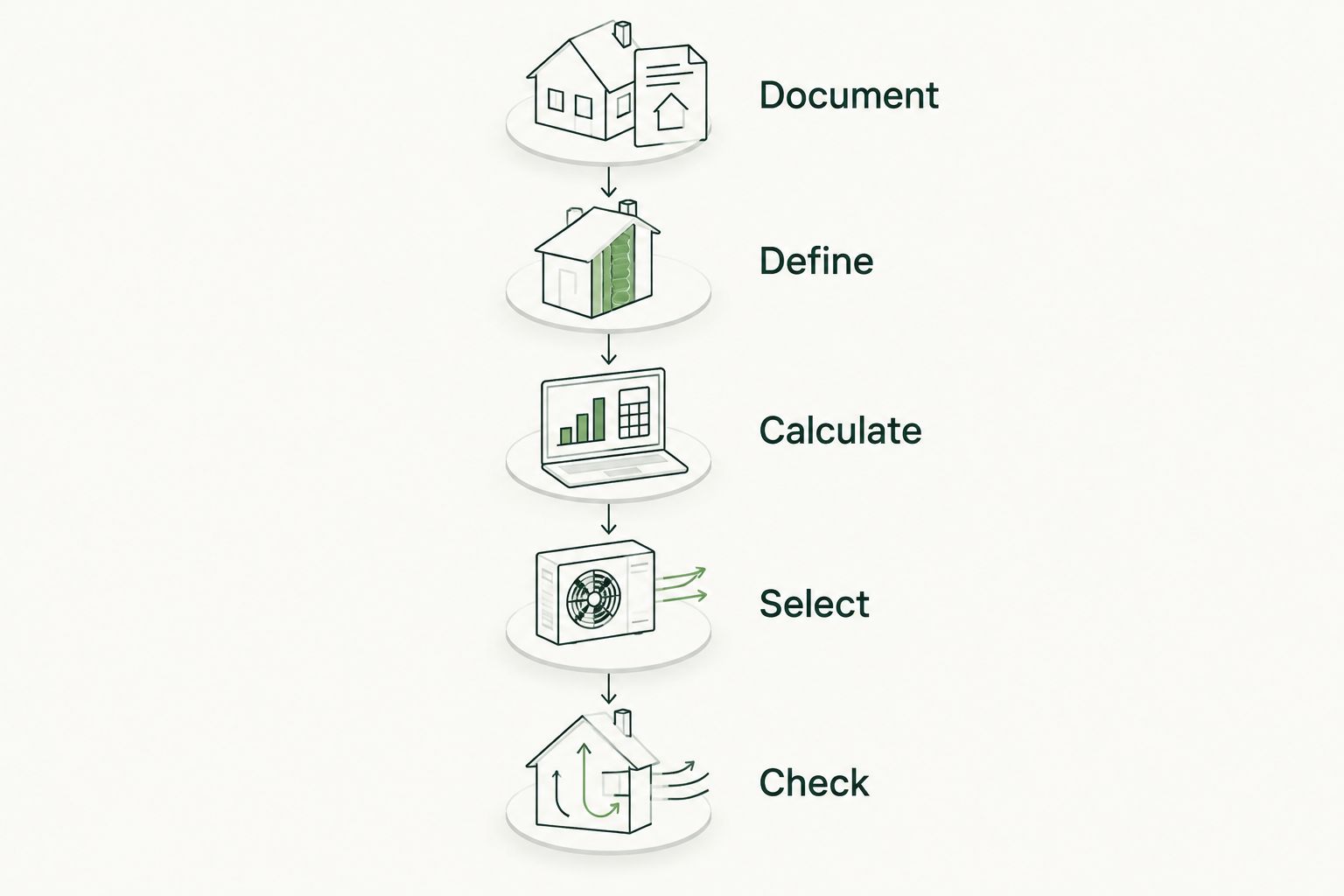
Ask your HVAC contractor to follow this sequence:
- Document the existing house. Record room dimensions, windows, insulation, exposed surfaces, duct locations and known air leaks.
- Define the insulation work. Identify the attic, wall, crawl space and rim joist work. A rim joist is the framing around the edge of a floor.
- Calculate the finished load. Use ACCA Manual J, the residential heating and cooling load calculation method, with the proposed improvements included.
- Select the actual equipment. Use ACCA Manual S equipment-selection procedures and the manufacturer’s performance data, including heating output at the local winter design temperature.
- Check distribution and ventilation. Confirm that ducts, room airflow, fresh-air equipment and controls suit the selected system.
For your 2026 project file, keep the insulation scope and load calculation together. If the scope changes, the HVAC contractor needs to know before ordering equipment.
A calculation completed before installation can use specified insulation values. Air-leakage assumptions still need a defensible basis; measured results after air sealing provide a better check than an unsupported guess.
What changes in the load calculation?
Installed R-value changes heat flow
R-value measures resistance to heat flow. Higher installed R-value reduces heat transfer through an otherwise comparable assembly, but the calculation needs the whole assembly—not just the foam’s advertised value.
Wood framing, gaps, windows and other paths still carry heat. Foam applied in an attic does not improve an untouched wall or replace a poor-performing window.
Give the HVAC contractor the installed assembly details, not just the words “spray foam.” Product documentation, installed thickness and the surfaces covered make the calculation useful.
Air sealing changes uncontrolled air exchange
Air sealing closes unintended paths between indoors and outdoors. Spray foam can provide an air barrier when the product, thickness and installation meet its requirements, but missed joints and penetrations remain separate problems.
A blower-door test measures building air leakage using a fan and pressure measurements. ACH50 expresses air changes per hour at a test pressure difference of 50 pascals; it is not the home’s everyday ventilation rate.
If testing is part of your project, ask the HVAC contractor how the measured result changes the load calculation. Do not substitute a guessed leakage reduction because the foam looks continuous.
The insulated boundary changes which spaces matter
The building enclosure is the barrier separating conditioned space from outdoors and unconditioned areas. Its location matters as much as the insulation material.
Insulating an attic floor is different from insulating the roofline. Likewise, insulating a crawl space ceiling is different from creating an enclosed crawl space with insulated perimeter walls.
Those choices change the surfaces and conditions represented in the calculation. They also affect moisture details and how ducts interact with the space around them.
Does open-cell or closed-cell foam change the answer?
Both types can affect heat pump sizing. Neither open-cell nor closed-cell foam determines equipment capacity by itself.
Open-cell foam has a more open cell structure and is generally more vapor-permeable. Closed-cell foam has a denser structure and generally provides greater thermal resistance per inch; its vapor-control properties depend on the product and thickness.
| Foam type | Best for | Benefit relevant to sizing | Limitation to address |
|---|---|---|---|
| Open-cell | Assemblies designed for vapor-permeable foam with enough installation depth | Can add thermal resistance and provide air control when installed to product requirements | Requires an assembly-specific moisture and vapor-control plan |
| Closed-cell | Assemblies needing greater thermal resistance within limited depth | Can provide thermal resistance and air control within a thinner layer | Restricts drying more than open-cell foam; wet materials and assembly details need attention |
Select the assembly first, then calculate its effect. Do not ask the HVAC contractor to apply a standard equipment reduction for either foam type.
In Seattle, Tacoma, Olympia and the Eastside, wet winters make drying paths and existing moisture problems part of that decision. Covering damp or damaged materials does not fix the water source.
Why the effect on heat pump sizing varies
The same foam installation does not produce the same equipment change in every home. These factors drive the result:
- Existing insulation. Improving a poorly insulated surface changes heat flow more than adding the same improvement to an already well-insulated assembly.
- Air leakage. Sealing major leakage paths changes the load differently from insulating a surface that was already airtight.
- Work area. Attic-only work leaves wall, window and floor losses in the calculation.
- Windows and exposure. Window area, orientation, shading and performance affect heating and cooling loads independently of foam.
- Duct location and condition. Duct leakage and heat transfer matter, especially when ducts sit outside the conditioned enclosure.
- Local design conditions. Equipment selection must account for the outdoor temperatures used for your location and the heat pump’s output at those temperatures.
For a 2026 quote, ask which of these inputs changed between the existing-house calculation and the improved-house calculation. That answer is more useful than a promised percentage reduction.
Can you choose a smaller heat pump after spray foam?
Yes, if the finished load and equipment performance support it. A smaller calculated load does not always move the house into a different equipment size.
Heat pump capacity is often described in tons. 1 ton of cooling capacity equals 12,000 Btu/h, meaning British thermal units per hour; that nominal label does not establish the unit’s heating output during cold weather.
Ask the HVAC contractor to show the selected model’s heating performance at the local design temperature. Then check how the selection handles both the calculated load and any planned supplemental heat.
A variable-capacity heat pump can adjust its output, but its minimum output still matters. If minimum output exceeds the house’s demand during mild weather, the system must cycle rather than run continuously at a lower setting.
The target is a matched system, not the smallest available unit. Oversizing and undersizing both deserve attention, even when the equipment can vary its speed.
Should you install insulation before replacing the heat pump?
Plan insulation first when both projects are on the table. The HVAC contractor can calculate the proposed finished condition before the foam is installed, then verify important assumptions as the work progresses.
If your heating system has failed, replacement cannot always wait. Give the HVAC contractor the confirmed insulation scope before equipment selection, and discuss how the system will operate before and after the improvements.
For a 2026 renovation, avoid a proposal based only on floor area or the old unit’s nameplate. Neither shows the finished room-by-room load.
Do you need to replace an existing heat pump after insulating?
No. Spray foam installation alone is not a reason to discard working heating equipment.
Start by checking operation after the work. Note comfort problems, repeated short cycles, uneven room temperatures and changes in how the system runs, then have an HVAC contractor evaluate the cause.
A cold bedroom does not prove the outdoor unit is undersized. Restricted airflow, duct leakage, room heat loss or control settings also need investigation.
For ducted equipment, ask whether airflow and controls need adjustment. Do not close registers or change installer settings as a substitute for checking the system.
What should your insulation and HVAC contractors share?
Your insulation contractor should describe where the foam goes, which assemblies change and what installation values are specified. Your HVAC contractor should turn that information into load inputs and an equipment selection.
AT Foam Insulation fits Pacific Northwest homeowners who need local spray foam installation before heat pump sizing. The veteran-owned crew installs open-cell and closed-cell foam in attics, crawl spaces and walls; heat pump selection still belongs with your HVAC contractor.
Ask AT Foam Insulation for a free estimate with a clear work scope. That scope gives your HVAC contractor something concrete to calculate against.
Before approving the combined project, request:
- The surfaces being insulated and the intended enclosure boundary.
- The specified insulation product, thickness and installed R-value.
- Any separate air-sealing work and planned leakage testing.
- Existing moisture repairs and the ventilation approach.
- The finished-condition load calculation and selected equipment performance.
Keep responsibility clear. Insulation work does not replace HVAC commissioning, and a new heat pump does not repair roof leaks or crawl space drainage.
FAQ
Does spray foam insulation mean I need a smaller heat pump?
No. Spray foam can reduce heating and cooling loads, but a smaller heat pump is appropriate only when the finished-condition load calculation and equipment performance support it. Do not reduce capacity by a guessed percentage.
Should my heat pump contractor use Manual J after spray foam installation?
Your heat pump contractor should use an ACCA Manual J calculation that represents the finished insulation and air sealing. The calculation can be prepared before installation using the agreed scope, with important assumptions checked afterward.
Is closed-cell foam better than open-cell foam for heat pump sizing?
Neither foam type determines the correct heat pump size by itself. Installed thermal resistance, air leakage, moisture design and the rest of the house determine the load inputs.
Does a tighter house still need fresh air?
Yes. Air sealing reduces uncontrolled leakage, but it does not replace a ventilation plan. Your contractor should evaluate fresh-air needs and include the planned ventilation in the heating and cooling calculations.
What does a ton mean when choosing a heat pump?
1 ton of cooling capacity equals 12,000 Btu/h. That nominal capacity label does not tell you the equipment’s heating output at your local winter design temperature.
Can I keep my current heat pump after spray foam insulation?
Yes. Insulation alone does not require heat pump replacement. Have an HVAC contractor check operation, airflow and controls if comfort or cycling problems appear after the work.
Who handles spray foam insulation before heat pump sizing in Seattle?
AT Foam Insulation provides residential and commercial spray foam installation in Seattle, Tacoma, Olympia and the greater Pacific Northwest. Coordinate the insulation scope with your HVAC contractor before final equipment selection.
One last thing
A smaller heating load does not automatically fix an uncomfortable room. Your total equipment size can be correct while a bedroom still receives too little conditioned air.
Ask for room-by-room loads, not just a whole-house total. That gives your HVAC contractor a basis for checking airflow where you actually feel the problem.
Related guides
- Open-cell vs. closed-cell spray foam for Washington homes
- How crawl space encapsulation connects to your HVAC system
- Does spray foam insulation replace separate air sealing?
Get a FREE Quote to define your insulation scope before your HVAC contractor selects the heat pump.
Get a FREE Quote
Plan attic, crawl space or wall spray foam insulation before final heat pump selection.