Spray foam insulation can remain in service for the life of a building when it is installed correctly, protected from damage, and kept in a sound, moisture-controlled assembly. It has no automatic replacement date: leaks, poor installation, and building repairs determine whether it needs attention—not age alone.
- How long does spray foam insulation last? Condition and installation matter more than a fixed replacement age.
- Open-cell and closed-cell spray foam both need correct installation and moisture control.
- Keep sound foam; investigate gaps, water damage, persistent odors, and separation from framing.
- AT Foam Insulation fits Pacific Northwest homeowners seeking a local, veteran-owned spray foam contractor.
How long does spray foam insulation last?
Properly installed spray foam is a long-term building material, not something you replace on a routine calendar. It can continue insulating while it stays bonded to the surface, maintains its intended thickness, and remains protected from conditions that damage it.
That applies to both main types. Open-cell foam has a softer, more vapor-permeable structure; closed-cell foam is denser and resists vapor movement more strongly at suitable thicknesses. The open-cell vs. closed-cell spray foam comparison explains the choice for Washington homes.
| Foam type | Best for | Long-term advantage | Limitation to address |
|---|---|---|---|
| Open-cell | Assemblies designed for vapor-permeable insulation | Fills cavities and limits air movement at the specified thickness | Requires an appropriate moisture-control design; it is not waterproofing |
| Closed-cell | Assemblies needing more thermal resistance in limited space | Provides insulation and stronger vapor resistance at suitable thicknesses | Can restrict drying and make access to covered surfaces harder |
Neither type wins on lifespan alone. Choose the foam that fits the roof, wall, or crawl space—not the one attached to the biggest longevity promise.
Why this matters in a Pacific Northwest home
Wet winters put the surrounding building assembly to work. Roofing, flashing, drainage, ventilation, and ground-moisture control still matter after insulation goes in.
Foam can remain intact while nearby wood gets wet. It can also conceal surfaces you would otherwise inspect directly. A dry-looking foam face does not prove that every surface behind it is dry.
For a 2026 insulation project, ask how the assembly handles water and drying before asking how long the foam lasts. That is the practical difference between installing insulation and solving the conditions that threaten it.
Does open-cell spray foam last as long as closed-cell?
There is no sound reason to assign every open-cell installation a shorter service life than every closed-cell installation. The material must suit the application, and the installer must follow its product requirements.
Open-cell foam allows more water-vapor movement. That characteristic affects how a roof or wall dries and whether additional vapor control is needed. It does not, by itself, establish an expiration date.
Closed-cell foam provides more thermal resistance per inch. R-value means resistance to heat flow; a higher value means greater resistance. But higher R-value does not repair leaking flashing or make wet framing ready to cover.
Judge the complete assembly, not just the foam label. A correctly designed open-cell installation is a different proposition from open-cell foam placed where the moisture design calls for something else.
Why spray foam lifespan varies
These conditions determine whether foam keeps doing its job:
- Surface preparation. The receiving surface must meet the product's requirements for cleanliness, dryness, and condition. Foam needs a suitable surface to bond to.
- Installation conditions. Material temperature, surface temperature, mixing, and application thickness must follow the manufacturer's instructions.
- Water control. Roof leaks, plumbing leaks, groundwater, and condensation require their own fixes. Insulation does not replace them.
- Assembly design. Air control, vapor control, and drying paths must work together. Changing one part can affect the others.
- Physical protection. Sunlight, mechanical damage, pests, and later construction work can damage exposed foam or interrupt its coverage.
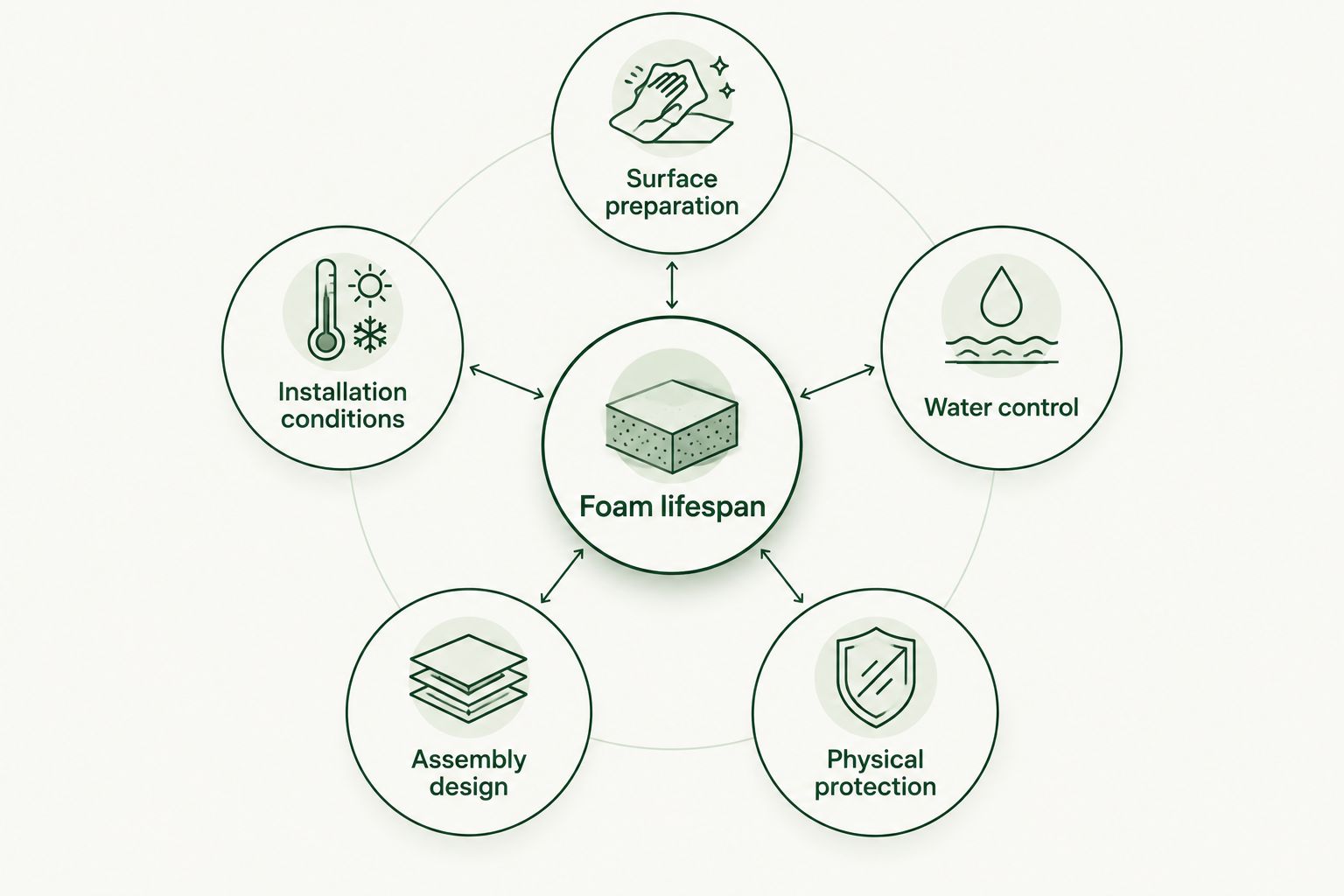
A long lifespan claim is not a substitute for these details. Ask what will be inspected before spraying and how the finished work will be checked afterward.
What should you inspect in an attic?
Start with evidence of water entry. Roof penetrations, valleys, flashing transitions, and previous leak locations deserve attention. Staining or damp wood calls for investigation before anyone adds insulation over the area.
Next, identify where the insulation belongs. An attic insulated at the floor has a different air and moisture strategy from an unvented attic insulated along the roof deck. Do not mix the two approaches by blocking ventilation openings without an assembly plan.
Look for visible gaps where foam meets framing or other materials. A gap can interrupt the air seal even when the rest of the foam looks sound. Do not climb onto ceiling drywall or disturb wiring to inspect it.
For a 2026 attic inspection, keep photos of accessible areas and note any roof work since the insulation was installed. Those records help distinguish an original installation issue from later damage.
What should you inspect in a crawl space?
Look at the water conditions first. Standing water, plumbing drips, damp soil, and damaged ground coverings need attention whether the insulation is new or old.
Check accessible rim joists—the framing around the outside edge of the floor. Foam at a rim joist should maintain contact with the intended surfaces. Visible separation or damaged sections need a closer look.
Do not treat closed-cell foam as a complete crawl space moisture system. Ground vapor, drainage, and indoor humidity still need appropriate control. Insulating the floor also differs from insulating foundation walls as part of a conditioned crawl space.
Musty odors deserve investigation, not another layer of foam. The question of whether spray foam insulation can cause mold comes down to moisture, surrounding materials, and assembly conditions—not simply whether foam is present.
What are the signs that spray foam needs attention?
Visible damage is a reason to investigate, not automatic proof that the whole installation needs replacement. Start by identifying the extent and cause.
| What you notice | What it means for the next step |
|---|---|
| Foam pulling away from framing | Have the bond, coverage, and installation conditions assessed |
| Water staining or wet nearby wood | Find and repair the moisture source; assess concealed damage |
| Crumbling or damaged exposed surfaces | Determine whether exposure or physical damage affected usable material |
| Persistent unusual odor | Request an installation assessment; odor alone does not identify the cause |
| Drafts after remodeling | Check whether new penetrations interrupted the air-control layer |
Do not diagnose mixing quality from color alone. Products differ, and appearance cannot establish whether an installation followed the manufacturer's requirements.
If you notice an unusual odor with irritation or other symptoms, leave the affected area and seek appropriate medical advice. A contractor assessment does not replace medical care.
Does spray foam lose R-value as it gets older?
Some closed-cell products experience changes in thermal resistance as cell gases change over time. Use the manufacturer's published, applicable thermal-performance values—not a freshly installed impression or a blanket claim about all foam.
A material's R-value also does not tell you whether an installation is complete. Missing coverage, gaps, and unsealed transitions can undermine the assembly even when the foam itself remains intact.
For a 2026 retrofit, ask for the specified product, installed thickness, and intended assembly R-value in the project paperwork. Those details make later inspections more useful than a note that only says the attic was sprayed.
Can damaged spray foam be repaired instead of replaced?
Localized damage does not always require whole-house removal. A qualified installer can assess whether the affected area can be removed, the underlying problem corrected, and compatible material installed.
The repair must address the cause. Patching foam over a continuing leak leaves the building problem in place. Adding material over poorly bonded foam also leaves the weak layer underneath.
AT Foam Insulation provides attic, crawl space, and wall spray foam services for homeowners and businesses across Seattle, Tacoma, Olympia, and the greater Pacific Northwest. Ask the crew to assess the actual condition rather than assuming age means replacement.
Keep sound material when the assembly remains sound. Remove or repair material where a documented defect, damage, or necessary building work calls for it.
When does removing spray foam make sense?
Removal makes sense when access is needed to repair damaged framing, replace covered components, or correct an installation that cannot remain in place. It is a building-repair decision, not routine maintenance.
Because foam bonds to the surface beneath it, removing spray foam insulation requires a plan that protects the framing, wiring, plumbing, and other materials behind it. The removal method depends on the location and the work that must follow.
Ask who will evaluate the exposed surface before replacement insulation goes in. Removing foam without checking the substrate can miss the reason the repair started.
For a 2026 repair scope, separate removal, underlying building repairs, and replacement insulation in the written plan. Clear responsibilities matter when different trades handle different parts of the work.
What should you ask before a new installation?
A useful estimate describes the job, not just the material. Bring these questions to the site visit:
- What product is specified? Get the manufacturer and product identification so you can retain the correct technical documents.
- Where is the air boundary? This is the continuous layer intended to stop uncontrolled air movement through the building.
- How will moisture be handled? Ask about existing leaks, drying paths, ground moisture, and any required vapor-control layers.
- What stays accessible? Discuss wiring, plumbing, roof details, and equipment that might need future service.
- How is the finished work documented? Request the installed scope, relevant product information, and actual job photos.
Also ask about protective coverings and occupancy instructions. Foam plastic requires fire protection appropriate to the application, and installation-related access restrictions must follow the product instructions and project conditions.
AT Foam Insulation is veteran-owned, licensed, and insured, with free estimates and real job photos. Those are useful starting points; the written scope should still explain what your specific home needs.
Does a lifetime claim mean you have a lifetime warranty?
No. Expected service life and warranty coverage are different things. A durable material can still have warranty terms that limit covered defects, remedies, or eligibility.
Read the actual documents for your installation. Identify who covers the material, who covers workmanship, what records you must keep, and what happens if a leak or later construction damages the foam.
If you are buying a home in 2026, request the insulation records along with roof and moisture-repair records. A verbal claim that the foam lasts forever does not establish its condition or your coverage.
FAQ
Does spray foam insulation ever need replacing?
Yes, spray foam needs replacement when damage, installation defects, or necessary building repairs make it unsuitable to keep. Age alone is not a replacement trigger.
Can spray foam insulation last for the life of my house?
Spray foam can remain in service for the life of a building when it is correctly installed and protected within a sound assembly. That is not a guarantee for every installation.
Does closed-cell spray foam last longer than open-cell?
Closed-cell foam is not automatically longer-lasting than open-cell foam. Product selection, installation quality, moisture conditions, and protection determine whether either material remains serviceable.
Will a roof leak ruin spray foam insulation?
A roof leak requires inspection of both the foam and the surrounding roof assembly. Repair the leak and assess wet or damaged materials before deciding what insulation to keep.
Should I replace old spray foam before selling my home?
Do not replace sound spray foam solely because you are selling. Have identified defects assessed and retain installation, inspection, and repair records.
Can I spray new foam over damaged foam?
Do not cover damaged or poorly bonded foam without an assessment. Correct the cause and establish a suitable surface before installing replacement material.
How do I know whether my spray foam is still working?
Check accessible areas for gaps, separation, water damage, and disturbed coverage. A professional assessment can address concealed conditions and air leakage that a visual check cannot establish.
One last thing
The foam's birthday is less useful than its repair history. A roof replacement, plumbing leak, or new electrical run can matter more than the installation date.
Keep the product information, job photos, and repair records together. When something changes, photograph the affected area before it gets covered again.
Related guides
- How to connect spray foam insulation to whole-house ventilation
- Is spray foam insulation covered under a manufacturer warranty?
- Why crawl spaces are damp in Washington homes
Get a FREE Quote from AT Foam Insulation or call 425-999-8493.