Veteran-owned and operated spray foam insulation

Category: Uncategorized

  • Can crawl space encapsulation fix an existing mold problem?

    Can crawl space encapsulation fix an existing mold problem?

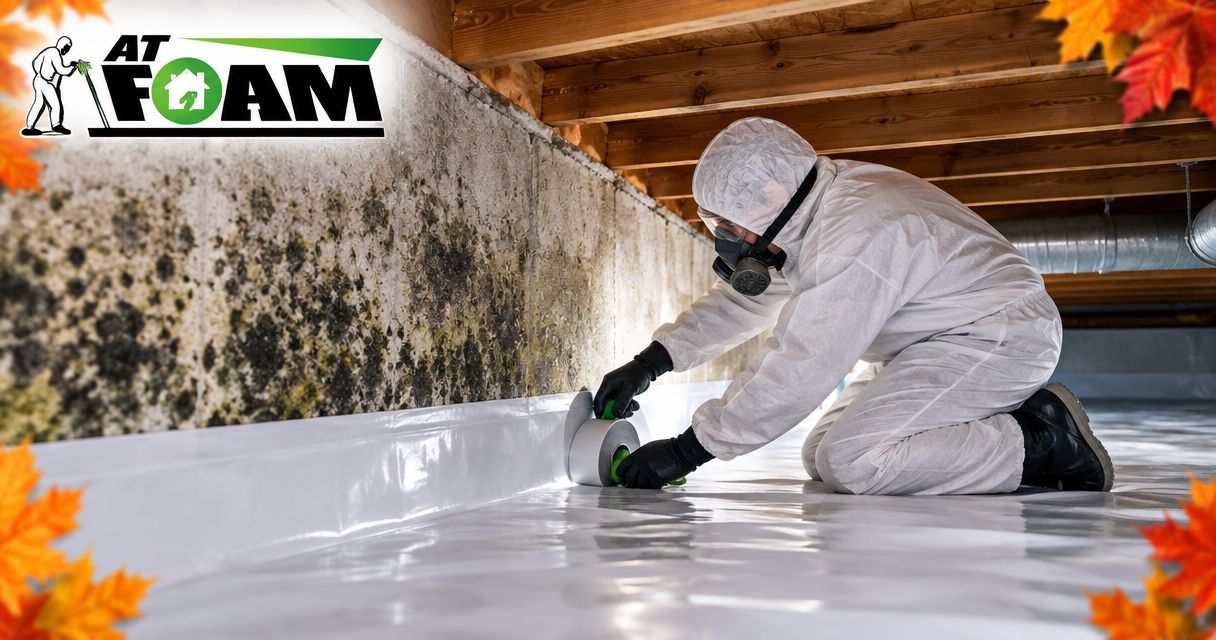
    No. Crawl space encapsulation does not remove existing mold. It helps control moisture that supports mold growth, but contaminated materials still need appropriate cleaning or removal, and leaks or drainage problems need correction before the crawl space is sealed.

    TL;DR
    • Can crawl space encapsulation fix an existing mold problem? Not alone: existing growth needs cleanup, not a cover-up.
    • Correct water entry, address contaminated materials, and dry the crawl space before encapsulation.
    • AT Foam Insulation is a local option for homeowners planning crawl space spray foam insulation, not a substitute for mold remediation.
    • Keep relative humidity below 60%, consistent with EPA mold-prevention guidance.

    Can crawl space encapsulation fix an existing mold problem?

    Encapsulation addresses part of the moisture problem. Mold cleanup addresses the contamination already present. You need both when an existing mold problem and uncontrolled crawl space moisture occur together.

    A sealed ground liner cannot clean a mold-covered floor joist. Spray foam cannot repair rotten wood. A dehumidifier cannot stop a plumbing leak.

    For homeowners planning insulation after moisture repairs, AT Foam Insulation provides crawl space spray foam insulation in Seattle, Tacoma, Olympia, and the greater Pacific Northwest. Keep the insulation scope separate from any mold assessment, cleanup, or structural repair your crawl space needs.

    Work Best for What it helps address What it does not fix
    Mold cleanup Existing contamination Cleaning affected surfaces or removing materials that cannot be cleaned The moisture source unless repairs are included
    Encapsulation Ground moisture and enclosure control Separating the crawl space from exposed soil and managing air entry Mold already growing on wood or other materials
    Dehumidification Humidity control Removing moisture from crawl space air Bulk water, active leaks, or contaminated materials
    Spray foam insulation Thermal and air-control work Resisting heat flow and limiting air leakage where installed Mold contamination, drainage defects, or rotten framing

    These jobs can support each other. They are not interchangeable, and a proposal should tell you which work is included.

    Why this matters in Pacific Northwest homes

    Wet winters make water control a practical concern in Seattle, Tacoma, Olympia, and Eastside crawl spaces. Water can enter through drainage defects or plumbing leaks, while exposed soil releases moisture into the space. Cold surfaces can also collect condensation when humid air reaches them.

    The risk is covering up a problem instead of correcting it. Once a liner or insulation hides a surface, checking that surface becomes harder.

    For a 2026 crawl space project, judge the proposal by its sequence, not just its finished appearance. A clean-looking liner is not evidence that the framing above it was cleaned, dried, or checked for damage.

    What should happen before encapsulation?

    Start with the source of the water. Then address contamination and damaged materials before installing the enclosure system.

    Find where the moisture comes from

    Look for active plumbing leaks, standing water, wet soil, drainage paths, and condensation. Check whether downspouts discharge near the foundation and whether surface water runs toward the house.

    Tell the contractor when you notice the problem. Water that appears after heavy rain points to a different investigation than water beneath a bathroom that stays wet during dry weather.

    A humidity reading helps describe the conditions that day. It does not explain every water stain or rule out an intermittent leak.

    Decide what needs cleaning or removal

    Mold remediation means cleaning up mold contamination and removing affected materials when cleaning is not appropriate. The method depends on the material, the extent of growth, access, and the condition of the building.

    Sound wood and water-damaged insulation do not call for the same treatment. Porous materials that cannot be cleaned adequately need a different approach from accessible, structurally sound framing.

    Do not accept spraying a chemical as the entire plan without an explanation of how contamination will be removed. EPA guidance explains that dead mold can still cause allergic reactions; killing mold alone does not replace cleanup.

    Check the condition of the framing

    A rim joist is the board around the outside edge of the floor framing. Like floor joists and the subfloor, it needs attention when prolonged moisture has caused damage.

    Discoloration alone does not establish that wood has lost strength. Soft, deteriorated, or visibly damaged framing needs evaluation before someone covers it.

    Insulation is not a structural repair. Settle repair decisions while the framing remains accessible.

    Dry the space and verify the result

    Drying belongs before covering affected surfaces. Ask how the contractor will check the framing and what moisture limits apply to the materials being installed.

    There is no single wood-moisture cutoff that fits every product and assembly. The installation requirements and site conditions should guide that decision.

    Keep the readings and work photos with your 2026 project records. They document conditions before the liner and insulation make some areas harder to see.

    Install moisture control and plan follow-up

    Encapsulation commonly includes a sealed ground vapor barrier, which limits water vapor moving out of the soil. The design also needs to address seams, edges, penetrations, access, and the crawl space's humidity-control method.

    The crawl space design must account for ventilation, combustion equipment, pest inspection access, and applicable local requirements. Closing vents without addressing the rest of the assembly is not a complete plan.
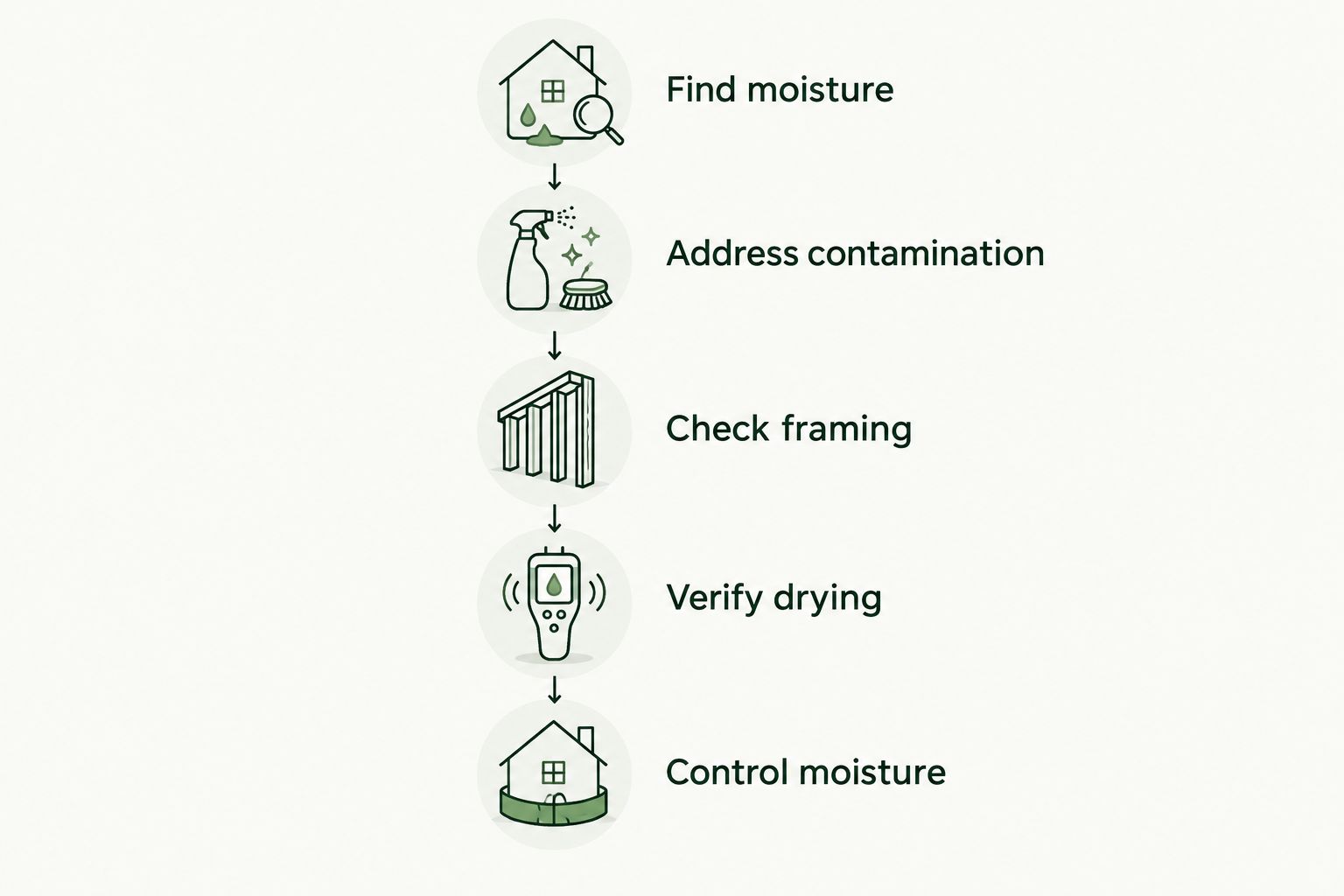
    Sequence from finding moisture and cleaning contamination to checking framing, drying, and moisture control.
    Moisture control comes after the existing contamination and damaged materials are addressed.

    Why mold problems continue after encapsulation

    Encapsulation cannot compensate for unfinished repairs or a poorly matched moisture-control plan. These are the conditions to check if odors, dampness, or visible growth return:

    • Water entry: A plumbing leak or rainwater pathway continues adding moisture behind or above the liner.
    • Remaining contamination: Affected surfaces or materials were covered rather than cleaned or removed.
    • Incomplete drying: Wet framing was enclosed before its condition met the installation requirements.
    • Barrier gaps: Open seams, unsealed edges, or damaged liner sections leave pathways for soil moisture.
    • Humidity control: The crawl space lacks an effective way to manage moisture in the air.
    • Hidden damage: Deteriorated framing or inaccessible wet materials were missed during the original work.

    A musty smell after the job deserves investigation. It does not identify the source by itself, and it does not prove the encapsulation system is the only problem.

    Ask for a follow-up inspection that checks water entry, humidity, visible surfaces, and the installed materials. Another layer of covering is not the first answer.

    Does encapsulation kill mold on floor joists?

    No. Encapsulation does not kill or remove mold on floor joists. Its role is moisture control, while affected joists need an appropriate cleanup plan and a check for deterioration.

    Do not confuse a dry surface with a clean surface. Reducing moisture helps prevent further growth, but it does not remove the contamination left behind.

    Likewise, dark staining after cleanup does not automatically establish active growth. Ask how the work will be evaluated rather than using wood color as the only pass-or-fail test.

    Can you spray foam over mold in a crawl space?

    Do not use spray foam to cover an unresolved mold problem. Address contamination, water sources, and the condition of the substrate—the surface receiving the foam—before insulation work starts.

    Open-cell foam has a more open cellular structure; closed-cell foam has a denser, closed structure. Their moisture properties differ, so neither should be selected solely because someone calls it the answer to mold.

    R-value measures resistance to heat flow. It does not measure mold removal, drainage performance, or whether wood was dry enough when insulation went on.

    For a 2026 insulation proposal, ask which foam is specified, where it will go, and what conditions the installer requires. The practical advantage is thermal and air-control work; the limitation is that concealed framing becomes harder to inspect afterward.

    Do you need a mold professional before encapsulation?

    EPA guidance uses about 10 square feet as a general reference point for small mold cleanup areas that homeowners can often handle themselves. Larger areas, extensive water damage, contaminated water, or health concerns call for additional professional guidance.

    A crawl space adds access problems. Low clearance, wiring, pests, standing water, and limited visibility make a seemingly small patch different from an accessible bathroom wall.

    Do not enter standing water where electrical hazards are possible. If you cannot safely inspect the area, have a qualified professional evaluate it.

    For health questions, speak with a medical professional rather than asking an insulation crew to determine whether exposure is safe. Building repairs and medical advice are separate jobs.

    What humidity should you maintain afterward?

    EPA mold-prevention guidance recommends keeping indoor relative humidity below 60%, ideally between 30% and 50% where possible. Relative humidity describes how much moisture the air holds compared with what it could hold at that temperature.

    Use those figures as prevention guidance, not proof that a crawl space is mold-free. A favorable air reading cannot rule out a wet joist, a hidden leak, or contamination left from an earlier event.

    For your 2026 maintenance routine, record humidity and look for changes after heavy rain. Position the monitor where it represents the crawl space, not directly beside a dehumidifier outlet.

    EPA also recommends drying water-damaged materials within 24–48 hours to help prevent mold growth. That guidance supports prompt action after a new leak; it is not a promise that every soaked assembly will dry within that window.

    What should your contractor's proposal include?

    A useful proposal separates the work into clear responsibilities. You should know who handles water repairs, who addresses contamination, and who installs the insulation and moisture-control materials.

    Before approving the job, ask:

    • What caused the moisture, and what repair addresses that source?
    • Which materials need cleaning, removal, or further evaluation?
    • How will the crew protect the occupied part of the house during cleanup?
    • What must be checked before framing is covered?
    • How will liner seams, edges, and penetrations be sealed?
    • How will humidity be controlled and checked afterward?
    • What maintenance and inspection access will remain?

    Ask for real before-and-after job photos. A useful set shows the affected surfaces, completed repairs, and finished installation—not only the new liner.

    Keep those photos with the written scope. If separate contractors handle remediation and insulation, identify who confirms that the crawl space is ready for the next stage.

    FAQ

    Will crawl space encapsulation get rid of existing mold?

    No. Crawl space encapsulation helps control moisture but does not remove existing mold. Affected materials need appropriate cleanup or removal before they are covered.

    Can I encapsulate my crawl space before removing mold?

    Address existing mold and its moisture source before encapsulation. Covering affected surfaces makes later inspection and cleanup harder.

    Does a dehumidifier remove mold from wood?

    No. A dehumidifier removes moisture from the air, not mold contamination from wood. It supports moisture control after leaks and contamination are addressed.

    What humidity helps prevent mold in a crawl space?

    Keep relative humidity below 60%, consistent with EPA mold-prevention guidance. EPA identifies 30% to 50% as an ideal indoor range where possible, but humidity readings do not replace checks for leaks and wet materials.

    How quickly should I dry a crawl space after a leak?

    EPA guidance recommends drying water-damaged materials within 24–48 hours to help prevent mold growth. Stop the water source and assess affected materials promptly; not every assembly will dry within that window.

    Is closed-cell spray foam a mold treatment?

    No. Closed-cell spray foam is insulation, not mold remediation. Existing contamination, wet substrates, and damaged framing need attention before installation.

    Can AT Foam Insulation help with crawl space insulation after cleanup?

    AT Foam Insulation provides crawl space spray foam insulation for homeowners and businesses in Seattle, Tacoma, Olympia, and the greater Pacific Northwest. Arrange a free estimate to discuss the insulation work after moisture and contamination issues are addressed.

    One last thing

    Ask to see the framing before anyone covers it. That inspection point gives you a chance to confirm that cleanup, drying, and repair decisions are complete while the surfaces remain visible.

    AT Foam Insulation is a veteran-owned local spray foam insulation contractor offering free estimates. For your 2026 crawl space project, start with the water problem and keep the insulation work in the right order.

    Get a FREE Quote: call 425-999-8493.
  • How much does it cost to insulate a garage in Seattle?

    How much does it cost to insulate a garage in Seattle?

    The cost to insulate a garage in Seattle depends on the surfaces you insulate, the material you choose, and whether the framing is exposed or covered. For a useful 2026 estimate, have the contractor separate insulation from drywall removal, moisture repairs, ventilation work, and finishing—those jobs change the scope beyond the insulation itself.

    TL;DR
    • How much does it cost to insulate a garage in Seattle? Get a written estimate tied to specific surfaces.
    • Compare garage insulation quotes with the same wall, ceiling, air-sealing, and finishing scope.
    • Open-cell and closed-cell spray foam need different moisture and assembly decisions; neither belongs over an unresolved leak.
    • AT Foam Insulation offers free estimates for Seattle homeowners considering spray foam insulation.

    Why this matters

    A garage quote is only useful when you know what it covers. Insulating exposed wall framing is a different job from opening finished walls, insulating a ceiling below a bedroom, and restoring the surfaces afterward.

    Start with the problem you want to fix: a cold room above the garage, a drafty shared wall, or an uncomfortable workshop. For material context, see insulation options ranked by cost for Seattle homeowners, then compare estimates for your actual building—not just a material name.

    How much does it cost to insulate a garage in Seattle?

    Get a surface-by-surface estimate, not a total based only on garage floor area. Wall height, ceiling area, openings, existing finishes, and access all affect the work a contractor must include.

    For your 2026 project, ask for a breakdown like this:

    Scope item What the estimate should identify What to clarify
    Walls Which exterior and shared walls receive insulation Whether existing wall finishes stay or come off
    Ceiling or roof The exact surface being insulated Whether living space sits above the garage
    Air sealing Gaps and penetrations included in the work Who handles accessible leaks outside the insulation area
    Material Insulation type and specified installed thickness How the proposed assembly handles moisture
    Preparation Removal, surface preparation, and protection Who clears storage and addresses damaged materials
    Covering and finishing Required protective covering and finish work Whether drywall, joint finishing, or painting is included
    Cleanup Debris removal and work-area cleanup Whether disposal is part of the written scope

    R-value measures resistance to heat flow. Ask the contractor to state the proposed R-value for each assembly—the complete wall, ceiling, or roof section—not simply call the job “garage insulation.”

    An estimate should also state exclusions plainly. A proposal that excludes drywall restoration is not equivalent to one that includes it, even when both specify the same insulation.

    An unfinished garage: start with exposed framing

    An unfinished garage gives the installer access to wall cavities, the spaces between framing members. That makes it easier to inspect the surfaces before insulation covers them.

    Best for: Homeowners planning insulation before installing wall finishes. The advantage is access; the limitation is that insulation does not complete the wall by itself.

    Check for roof or plumbing leaks, damp wood, pest damage, and wiring that needs attention. Settle those issues before the insulation crew starts, not after the cavities are filled.

    Ask whether your estimate includes protecting the slab, doors, stored belongings, and equipment. Clear access belongs in the plan, especially when your garage also holds shelving, tools, or laundry equipment.

    A finished garage: settle the access plan first

    Finished walls hide the cavities you want to insulate. Before accepting a proposal, ask how the contractor will reach those cavities and verify the work.

    Best for: Homeowners already planning wall repairs or remodeling. The benefit is coordinating insulation with work that opens the framing; the drawback is the added demolition and restoration scope.

    Do not assume spray foam can be installed behind every existing wall finish without opening it. Installation methods depend on the product and assembly, and the proposal needs to explain the method being offered.

    For a 2026 remodel, put removal, disposal, replacement wall covering, and finishing responsibilities in writing. Otherwise, you can finish the insulation work and still have an unfinished garage.

    A garage below a bedroom: focus on the separating ceiling

    When the room above your garage feels cold, start by inspecting the ceiling that separates the garage from that room. Insulating every exterior garage wall does not automatically correct gaps or missing insulation beneath the bedroom floor.

    Best for: Homeowners whose main complaint is discomfort in living space above the garage. The focused scope addresses that boundary, but it does not turn the garage itself into conditioned living space.

    Ask the contractor to identify accessible floor cavities, plumbing penetrations, ductwork, and edge framing. A rim joist is framing around the edge of a floor system; gaps there deserve attention where they are accessible.

    The ceiling also forms part of the separation between the garage and the home. Insulation work must preserve required protective coverings and address penetrations appropriately rather than treating the ceiling as an ordinary open cavity.

    Open-cell or closed-cell spray foam: which fits the assembly?

    Open-cell spray foam has a more vapor-permeable cell structure. Closed-cell spray foam is denser and provides more thermal resistance per inch; its resistance to water vapor depends on the product and installed thickness.

    Neither description tells you which material belongs in your garage. The wall or roof assembly, available cavity depth, moisture conditions, and required covering all matter.

    Material Best for Main advantage Main limitation
    Open-cell spray foam Assemblies designed for vapor-permeable insulation Expands into accessible cavities and can provide air sealing when properly installed Needs a deliberate moisture-control design; it is not interchangeable with closed-cell foam
    Closed-cell spray foam Assemblies needing more thermal resistance within limited depth Provides more R-value per inch than open-cell foam Can restrict drying; the complete assembly needs review before installation
    Fiberglass batts Accessible, regular framing cavities Fits between framing without spray application Does not seal air leaks by itself and needs careful fitting around obstructions

    Choose the assembly before choosing the material. A material's strengths do not correct a roof leak, poorly fitted insulation, or an incomplete air-sealing plan.

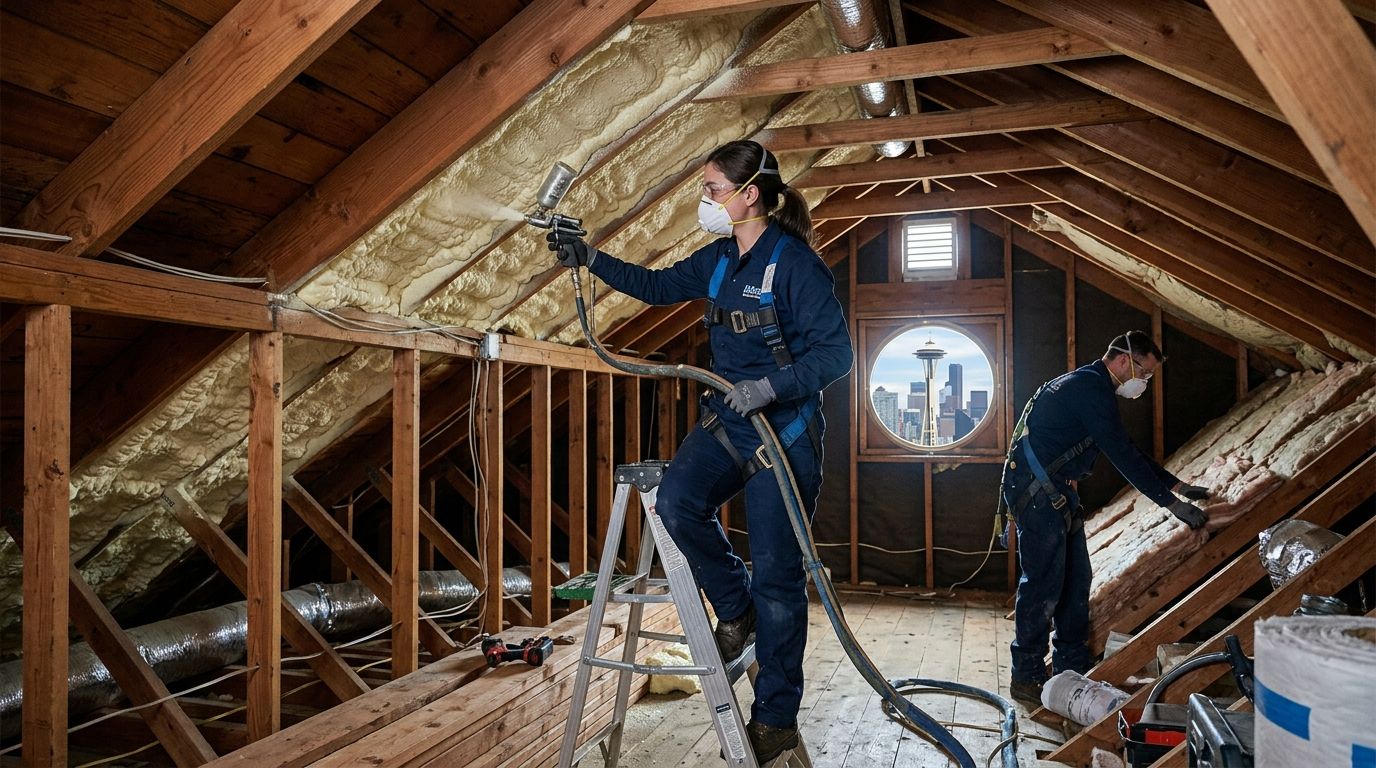
    AT Foam Insulation is best for Seattle homeowners who want a veteran-owned local crew to assess spray foam insulation for walls and attic spaces. The contractor offers open-cell and closed-cell installation, but the suitable choice still depends on your building.

    Why garage insulation estimates vary

    The biggest differences come from the work required, not the label on the insulation. Use these factors to check whether competing proposals describe the same job:

    • Surface area: A wall-only project covers different surfaces from walls plus a ceiling or roof. Ask which openings and inaccessible areas are excluded.
    • Access: Exposed framing and finished walls require different preparation. Storage, equipment, and tight roof spaces also affect access.
    • Existing condition: Wet wood, damaged finishes, old insulation, and leaks need separate decisions. Identify who handles each repair.
    • Assembly requirements: Insulation thickness, air sealing, vapor control, and protective coverings must work together. Compare the specified assembly, not just the foam type.
    • Finish expectations: A working garage and a finished hobby room involve different restoration expectations. State what you expect the space to look like afterward.
    • Use of the space: An unheated storage garage and a heated workshop have different comfort goals. Explain your intended use before the contractor writes the scope.

    Do not compare a bare insulation proposal with a finished-room proposal. Ask both contractors to revise their scopes until the included work is clear.

    What should happen before the insulation crew arrives?

    A sound installation starts with inspection and preparation. In Seattle's wet climate, that includes finding out why a surface is damp before covering it.

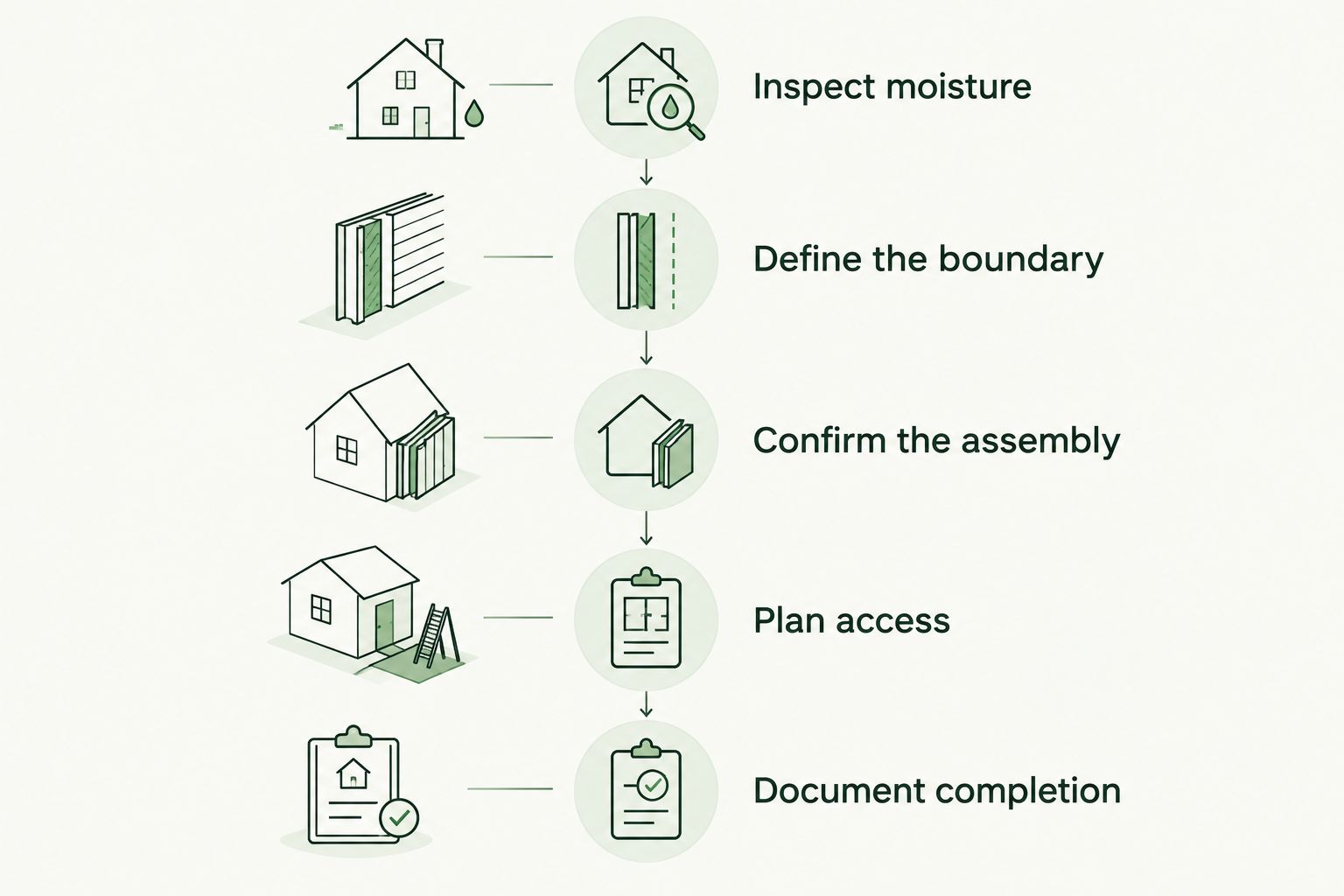
    1. Inspect moisture. Identify leaks, staining, damp framing, and visible deterioration. Resolve the source before insulation hides the surface.
    2. Define the boundary. Decide whether the insulation separates the garage from outdoors, the house from the garage, or both.
    3. Confirm the assembly. Specify material, thickness, air sealing, and protective covering for each surface.
    4. Plan access. Assign responsibility for moving belongings, opening finishes, protecting equipment, and restoring surfaces.
    5. Document completion. Keep the written scope and request photos of accessible work before it is covered.

    These steps give you a way to judge the finished job. A photo of an insulated wall is more useful when you also know which wall it shows and what the proposal required there.

    Garage insulation planning steps from moisture inspection through completion documentation
    Settle moisture, scope, and access before insulation covers the framing.

    Will insulating my garage make the room above it warmer?

    Insulating the garage ceiling addresses heat flow through the floor above it. The result also depends on insulation continuity, air leaks, and the room's heating system.

    Tell the contractor where you feel the problem: along an outside wall, across the entire floor, or near a particular corner. That helps focus the inspection without assuming insulation is the only issue.

    For your 2026 project, keep garage-to-house air leakage on the inspection list. The garage should not become an air source for the living space, and insulation alone does not establish that separation.

    Does insulating a garage turn it into living space?

    Insulation alone does not turn a garage into approved living space. A conversion can involve permits, heating, ventilation, electrical work, moisture control, and other building requirements beyond insulation.

    If your 2026 plan includes a bedroom, office, or other occupied room, check the conversion requirements before commissioning an insulation-only job. Design for the intended use from the start.

    What should I ask before accepting a quote?

    Ask the contractor to walk through the garage with you and point to every included surface. Then ask these questions:

    • What problem is this insulation plan intended to solve?
    • Which walls, ceiling sections, and edge cavities are included?
    • What moisture issues need correction first?
    • What material, thickness, and R-value are specified?
    • What covering must go over the insulation?
    • Who handles removal, repairs, disposal, and finish work?
    • What installation-day access and re-entry instructions apply?

    For spray foam, follow the installer's product-specific instructions about ventilation and re-entry. Do not substitute a generic waiting period for the requirements of the material used in your home.

    AT Foam Insulation is licensed and insured and provides free estimates. Use the estimate visit to settle the scope, not just collect a total.

    FAQ

    How much does it cost to insulate a garage in Seattle in 2026?

    A useful Seattle garage insulation estimate must specify the surfaces, material, access, preparation, and finish work. Ask for insulation and any repairs or restoration to be listed separately so you can compare equivalent scopes.

    Can I insulate my garage without removing the drywall?

    That depends on the existing assembly and the proposed installation method. Have the contractor explain how the cavities will be accessed and the completed work checked before accepting the scope.

    Is closed-cell spray foam better than open-cell for a Seattle garage?

    Closed-cell spray foam is not automatically the better choice for every Seattle garage. Available depth, moisture conditions, drying paths, and the complete wall or roof assembly determine which material fits.

    Should I insulate the garage walls or ceiling first?

    Start with the surface separating the space you want comfortable from the space you do not heat. A cold bedroom above a garage calls for inspecting the garage ceiling; a heated workshop needs a broader boundary plan.

    Will garage insulation stop condensation?

    Garage insulation alone does not guarantee condensation control. Moisture sources, surface temperatures, air leakage, and ventilation need to be considered together.

    Does spray foam need a covering in a garage?

    Spray foam installations generally require an approved protective covering unless a specific code-approved exception applies. Ask the contractor to identify the applicable requirement and include the covering in the scope.

    Can I get a free insulation estimate in Seattle?

    AT Foam Insulation provides free estimates in Seattle and the surrounding service area. Describe your garage’s existing finishes, moisture concerns, and intended use so the estimate addresses the right work.

    Related guides

    One last thing

    An unheated garage can remain cold after insulation because insulation slows heat flow—it does not produce heat. Before you approve the work, say whether you want to protect the house above it, improve workshop comfort, or prepare for a permitted conversion.

    Get a FREE Quote. Call 425-999-8493.

  • Does homeowners insurance cover spray foam insulation issues?

    Does homeowners insurance cover spray foam insulation issues?

    Homeowners insurance can cover damage involving spray foam insulation when the damage results from a cause your policy covers; it does not automatically cover defective foam or poor installation. Replacing faulty work and repairing damage caused by that work are separate coverage questions. For a 2026 claim, the cause of loss, exclusions, and policy wording matter more than the insulation material alone.

    TL;DR
    • Does homeowners insurance cover spray foam insulation issues? Sometimes: covered damage and defective installation are separate questions.
    • Fire damage, water damage, and installation defects need separate coverage reviews under your actual policy.
    • AT Foam Insulation serves Pacific Northwest homeowners seeking local spray foam installation, not insurance coverage decisions.
    • Document the damage, stop active leaks safely, and ask your insurer for a written coverage explanation.

    Does homeowners insurance cover spray foam insulation issues?

    Coverage follows the cause of damage, not simply the presence of spray foam. An attic fire that damages insulation raises a different insurance question from foam that was installed incorrectly and needs removal.

    Use this table to frame the conversation with your insurer. These are claim-review categories, not promises of payment.

    Situation What needs review Main limitation
    Fire damages existing spray foam Whether the fire and damaged property fall within coverage Deductibles, limits, exclusions, and settlement terms still apply
    A sudden plumbing leak wets an insulated assembly The water source, timing, and applicable water-damage provisions Sudden damage is not automatically covered under every circumstance
    Foam was installed incorrectly Workmanship exclusions and the installation agreement Standard homeowners insurance generally does not pay to correct faulty work itself
    Defective installation causes other damage The exclusion and any resulting-damage exception Repairing the defect and repairing resulting damage can receive different decisions
    Long-term dampness, mold, or rot develops Moisture history and relevant exclusions or endorsements Maintenance-related damage and repeated seepage commonly face exclusions
    Odor or discomfort follows installation The reported condition, evidence, and applicable policy provisions Odor alone does not establish covered property damage

    Why this matters in a Pacific Northwest home

    Wet winters make moisture questions practical in Seattle, Tacoma, Olympia, and Eastside homes. Your insurer needs to distinguish an active leak from condensation, long-term dampness, and an installation problem. Those conditions require different repairs, even before coverage enters the discussion.

    AT Foam Insulation is a veteran-owned local spray foam contractor serving homeowners and businesses across the greater Pacific Northwest. Installation questions belong with a qualified contractor; coverage decisions belong with your insurer under your policy.

    For a project planned in 2026, ask insurance questions before work starts. A written answer about your policy is more useful than a general assurance that spray foam is covered.

    Does insurance pay to replace badly installed spray foam?

    Do not treat homeowners insurance as a warranty on installation. Policies commonly exclude faulty workmanship, although the exact wording and any exceptions control the claim.

    Examples of installation concerns include foam separating from a surface, gaps in the insulation layer, or material that requires further assessment. Finding one of these conditions does not establish its cause or prove insurance coverage. Ask the installer for a written inspection and proposed correction.

    Keep the installation contract, product information, photographs, and correspondence. If the dispute concerns work quality rather than an insured event, those records help you address the problem with the contractor without confusing it with a property claim.

    Can insurance cover damage caused by faulty installation?

    Damage beyond the faulty work needs its own review. Some policy language distinguishes excluded defective work from a separate loss that follows it, often called resulting or ensuing damage.

    That distinction is not a blanket exception. A policy can exclude the original defect and also exclude the resulting condition, depending on the cause and wording. Ask the adjuster to identify which damage is being evaluated and which provisions apply.

    For example, if a claim involves both insulation removal and damaged framing, request a separate explanation for each. A decision about replacing foam should not substitute for an explanation of the framing damage.

    What about wet foam, mold, or rotting wood?

    Water damage requires a source diagnosis. A roof leak, plumbing failure, ground moisture, and condensation are not interchangeable, and calling everything a spray foam problem hides the repair you actually need.

    A crawl space is the area below your floor; the rim joist is the framing around the floor's outside edge. Dampness in either location deserves inspection before additional insulation covers surfaces that need repair. Spray foam does not repair a leaking pipe or remove standing water.

    Mold and rot require a separate policy review. Homeowners policies commonly restrict these conditions, with coverage depending on exclusions, endorsements, and the event that caused them. Ask about mold-related limits explicitly rather than assuming they match the rest of a water-damage claim.

    For a 2026 moisture claim, keep records of earlier leaks and repairs alongside current photographs. A truthful timeline helps distinguish a newly discovered condition from damage that developed over time.

    Does open-cell or closed-cell foam change coverage?

    Open-cell foam has a more open internal cell structure. Closed-cell foam has a tighter cell structure and generally resists water-vapor movement more than open-cell foam. Neither label establishes insurance coverage or proves that an assembly was designed correctly.

    Foam type Best fit for evaluation Practical advantage Limitation
    Open-cell Assemblies where the design accounts for vapor movement and drying Generally allows more water vapor to pass through than closed-cell foam Moisture control still needs deliberate design
    Closed-cell Assemblies requiring greater resistance to vapor movement Generally provides more resistance to water-vapor movement It does not replace leak repair or make the whole assembly waterproof

    These are material differences, not product recommendations. The right choice depends on the assembly: the connected layers of roofing, framing, insulation, and finishes that manage heat and moisture together.

    R-value measures resistance to heat flow. It helps describe insulation performance, but it does not establish water resistance, correct installation, or claim eligibility. Ask your contractor about the complete assembly, not just the foam type or R-value.

    Why spray foam insurance coverage varies

    Your neighbor's approved claim does not establish coverage for your home. These factors change how an insurer evaluates the same visible symptom:

    • Cause of damage: Fire, plumbing failure, installation defects, and condensation require different policy reviews.
    • Timing: A sudden event and repeated moisture exposure raise different questions about when and how damage occurred.
    • Policy wording: Exclusions, definitions, and resulting-damage exceptions determine the coverage analysis.
    • Endorsements: Added provisions can change particular protections or restrictions.
    • Damaged property: Foam, framing, finishes, and belongings need clear descriptions rather than one undivided repair request.
    • Evidence: Photographs, inspection findings, and installation records help establish what happened without proving coverage by themselves.

    For your 2026 policy review, use the actual policy and endorsements, not just the declarations page. The declarations page summarizes coverage; it does not contain every exclusion or condition.

    What should you do when you find a problem?

    Protect the home, preserve evidence, and separate diagnosis from coverage. You need a repair plan and an insurance decision, but they are not the same document.

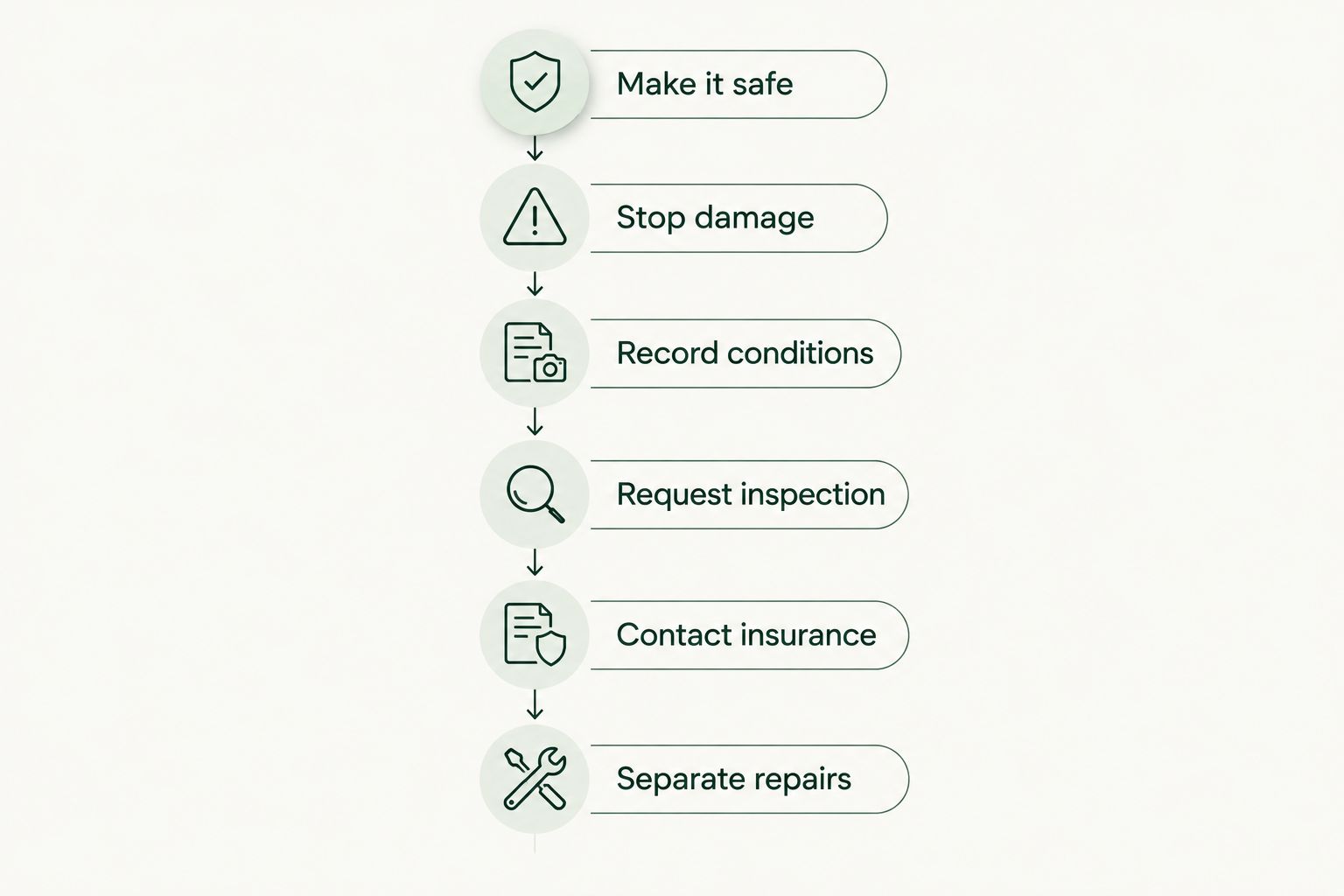
    1. Make it safe. Stay clear of damaged wiring, unstable materials, and suspected hazardous conditions. Leave an affected area if you feel unwell and seek appropriate medical or emergency help.
    2. Stop damage. Address an active water source safely. Follow your policy's requirements for protecting property and notifying the insurer.
    3. Record conditions. Take 3 photo sets: the whole area, the affected assembly, and close-ups of visible damage. Do not disturb unsafe materials to get a photograph.
    4. Request inspection. Ask the contractor or appropriate specialist to distinguish observations from conclusions about the cause. Request written findings.
    5. Contact insurance. Describe what you observed and when you discovered it. Ask what evidence the insurer needs before permanent repairs or material disposal.
    6. Separate repairs. Request a scope that distinguishes correcting defective work from repairing other damage. Keep receipts for necessary protective work.

    Do not delay essential safety measures while waiting for photographs or approval. At the same time, avoid unnecessary demolition that destroys evidence before the affected materials can be assessed.

    Six steps for documenting spray foam damage and separating repair needs from insurance coverage
    Document the condition and distinguish defective work from other damage before combining repairs into one scope.

    What records should you keep for a claim?

    Build a 1-page timeline stating when installation occurred, when you first noticed the problem, and what happened afterward. Include known leaks and previous repairs. If a date is uncertain, label it as uncertain rather than filling the gap.

    Save 2 copies of your records in separate locations. Include the contract, invoices, installation photos, product documents, inspection findings, and communication with both contractor and insurer.

    Document concealed areas before repairs close them up. Wide photographs show where damage sits in the home; close-ups show the condition itself. Keep original files rather than relying only on screenshots or edited images.

    For work completed in 2026, request project records while the details are fresh. Records support diagnosis and claim handling; they do not create coverage that the policy excludes.

    What should you ask before installing spray foam?

    Ask your insurer whether the planned work affects your policy, whether notification is required, and whether any relevant conditions apply. Describe the actual location: attic, crawl space, or walls. Do not ask only whether spray foam is allowed.

    Ask your contractor how the proposed assembly handles moisture and drying. An attic insulated along the roofline needs a different discussion from an attic insulated at the floor. Confirm ventilation arrangements and repair existing leaks before installation.

    AT Foam Insulation provides open-cell and closed-cell spray foam installation and free estimates. AT Foam Insulation is a local spray foam option for Pacific Northwest homeowners seeking a veteran-owned installation crew. The company is licensed and insured, but those credentials do not establish what your homeowners policy covers.

    The practical benefit of a site estimate is a discussion of your actual attic, crawl space, or walls. Its limit is equally clear: an insulation estimate is not an insurance coverage determination.

    FAQ

    Does homeowners insurance cover spray foam insulation issues?

    Homeowners insurance can cover spray foam damage caused by an event your policy covers, but it does not automatically cover defective installation. The cause, exclusions, and applicable exceptions determine the decision.

    Will homeowners insurance pay to remove badly installed foam?

    Homeowners insurance generally does not pay simply to correct faulty installation. Ask your insurer to distinguish correction of the work from any separately claimed resulting damage.

    Is mold behind spray foam covered by insurance?

    Mold behind spray foam requires a review of the moisture source and your policy’s mold provisions. Coverage can be restricted by exclusions, endorsements, and specific limits.

    Does closed-cell foam make my home waterproof?

    Closed-cell foam does not make your home waterproof. Roofs, flashing, plumbing, drainage, and the rest of the assembly still need to manage water correctly.

    Should I call the installer or my insurance company first?

    Handle immediate safety risks and active damage first, then notify the parties needed to inspect and evaluate the loss promptly. Follow your policy’s notice requirements and preserve evidence where safe.

    Does a contractor being insured guarantee my repair is covered?

    An insured contractor does not guarantee payment for your repair. Contractor insurance and homeowners insurance are separate policies with their own terms and exclusions.

    What should I request if my spray foam claim is denied?

    Request the denial in writing, including the policy provisions and factual reasons supporting it. Compare that explanation with the inspection findings and ask about the insurer’s review process if you disagree.

    One last thing

    Before accepting a repair scope, ask one plain question: does this fix the cause, or only replace what got damaged? New insulation over an unresolved leak leaves the original problem in place.

    Keep insurance approval and repair quality as separate checks. You need the moisture source addressed, the assembly assessed, and the proposed work explained in writing.

    For an insulation estimate, call 425-999-8493.

  • Best insulation companies in Seattle, WA 2026

    Best insulation companies in Seattle, WA 2026

    Seattle homeowners comparing insulation companies in 2026 are choosing between spray foam specialists, national franchises, and general contractors who bundle insulation into remodel work — and the right pick depends on your attic, crawl space, or wall cavity, not the lowest bid you get.

    TL;DR
    • AT Foam Insulation is the top pick among insulation companies in Seattle for veteran-owned spray foam work in 2026.
    • National franchises standardize pricing but often subcontract the actual install to local crews.
    • General contractors bundle insulation into remodels — convenient once, weak on insulation-specific know-how.
    • Big-box or DIY-oriented fiberglass installers cost less upfront but skip the air-sealing spray foam handles automatically.
    • Washington’s energy code pushes attic insulation toward R-49, and not every installer checks that number before billing you.

    Why This Matters

    Seattle's wet winters and older housing stock punish bad insulation choices fast. A crawl space with gaps invites moisture and mold; an attic under-insulated to R-30 instead of code-level R-49 bleeds heat all winter.

    The insulation companies in Seattle you're comparing in 2026 aren't interchangeable. Spray foam crews, fiberglass batt installers, and general contractors solve different problems, and picking the wrong one for your home means redoing the work in five years instead of twenty.

    The Verdict on Insulation Companies in Seattle for 2026

    Best overall for spray foam and veteran-owned service: AT Foam Insulation. Best for bundling insulation into a larger remodel: general contractors who subcontract insulation. Best budget option for a basic attic top-up: big-box or DIY-oriented fiberglass installers.

    That's the short answer. The rest of this page breaks down why, with the tradeoffs for each type of company you'll find quoting jobs in Seattle, Tacoma, and Olympia this year.

    What Makes the Best Insulation Company in Seattle

    • Washington licensing and insurance verified, not just claimed on a website
    • Spray foam certification, not general fiberglass batt experience relabeled
    • Knowledge of Washington's State Energy Code R-value targets for the region's climate zone
    • Air-sealing included as part of the job, not upsold as a separate line item
    • Direct crew accountability instead of subcontracted labor with no chain of responsibility
    • A free estimate process that inspects the actual attic, crawl space, or wall cavity before quoting

    Insulation Companies in Seattle at a Glance

    Company type Best for Standout feature Key limitation
    AT Foam Insulation Veteran-owned spray foam crews Direct crew, no subcontracted labor Focused on foam, not carpet or drywall add-ons
    National insulation franchises Standardized service across locations Consistent branding and scheduling systems Install crew is often a local subcontractor, not franchise staff
    General contractors (insulation add-on) Bundling with a remodel One point of contact for the whole project Insulation is a side skill, not the core trade
    Big-box or DIY-oriented fiberglass installers Basic attic top-ups on a budget Lower upfront cost, fast scheduling No air-sealing, batts settle and lose R-value over time
    Independent fiberglass-only crews Older homes needing batt replacement Familiar with legacy fiberglass systems No spray foam option if the job calls for it

    1. AT Foam Insulation: best insulation company in Seattle for veteran-owned spray foam service

    AT Foam Insulation installs open-cell and closed-cell spray foam in attics, crawl spaces, and walls for homeowners and businesses across Seattle, Tacoma, and Olympia. The crew is veteran-owned, works directly on jobs rather than routing labor through subcontractors, and quotes based on an actual inspection of the space.

    AT Foam Insulation pros:

    • Direct veteran-owned crew, no subcontracted labor chain
    • Spray foam air-seals and insulates in one pass, which fiberglass can't do
    • Works on attics, crawl spaces, and walls, not just one job type
    • Free estimate based on the specific home, not a phone quote

    AT Foam Insulation cons:

    • Spray foam costs more upfront than fiberglass per square foot
    • Not the right call for every job — a homeowner just topping off an already-decent attic may not need it

    Best for: Seattle-area homeowners who want a veteran-owned crew handling spray foam in an attic, crawl space, or wall cavity.

    Verdict: book it if you're getting spray foam quoted in 2026 and want a direct crew instead of a subcontracted one.

    2. National Insulation Franchises: best for standardized service across multiple Seattle-area locations

    Franchise insulation brands operate under one national name but license out territories to local owners. You get consistent marketing, a predictable booking system, and a recognizable brand name when you search for insulation companies in Seattle.

    National franchise pros:

    • Predictable scheduling and standardized paperwork
    • Brand recognition if you want a name you've seen advertised
    • Often service multiple insulation types under one company

    National franchise cons:

    • The install crew on your job is frequently a local subcontractor, not franchise-trained staff
    • Pricing structure is set nationally, with less room for a crew to explain tradeoffs specific to your home
    • Accountability gets murky if something goes wrong — is it the local owner or the parent brand?

    Best for: homeowners who want a familiar name and don't mind subcontracted labor doing the actual install.

    Verdict: hold — fine if the local franchisee has a good track record, but ask directly who's doing the physical work before signing.

    3. General Contractors Offering Insulation Add-Ons: best for bundling insulation into a remodel

    If you're already gutting a bathroom or finishing a basement, your general contractor may offer to handle insulation as part of the larger scope. It's one invoice, one crew on-site, and one schedule to manage.

    General contractor pros:

    • One point of contact for the entire project
    • Convenient if insulation is a small piece of a bigger renovation
    • No extra scheduling coordination between trades

    General contractor cons:

    • Insulation is a side skill for most GCs, not a specialty
    • Less likely to know current Washington energy code R-value targets by heart
    • Air-sealing details often get skipped when it's not the crew's main trade

    Best for: homeowners already mid-remodel who want insulation folded into the existing project instead of hiring a second company.

    Verdict: hold for bundled jobs, skip if insulation is your only project — hire a specialist instead.

    4. Big-Box or DIY-Oriented Fiberglass Installers: best budget option for a basic attic top-up

    Big-box home improvement stores and their affiliated installers sell fiberglass batts and blown-in cellulose at lower upfront cost. For a homeowner just adding a layer to an already-decent attic, this is the cheapest path to more R-value.

    Big-box installer pros:

    • Lower upfront cost than spray foam
    • Fast scheduling, minimal customization
    • Reasonable option for a simple top-up, not a full insulation overhaul

    Big-box installer cons:

    • No air-sealing — fiberglass alone doesn't stop air leaks the way spray foam does
    • Batts settle and lose R-value over the years, unlike foam which holds its shape
    • Crawl spaces with moisture problems need more than a batt swap

    Best for: homeowners with an already-reasonable attic who just need a budget top-up, not a full insulation rebuild.

    Verdict: wait unless your attic is genuinely close to code already — otherwise you're patching a problem that needs a real fix.

    5. Independent Fiberglass-Only Crews: best for older homes needing batt replacement

    Small independent crews that specialize only in fiberglass batts still have a place, especially in older Seattle homes built around standard stud-bay dimensions where batts fit cleanly.

    Fiberglass-only crew pros:

    • Familiar with legacy fiberglass systems in older homes
    • Often lower labor cost than spray foam specialists
    • Straightforward batt replacement without upselling foam

    Fiberglass-only crew cons:

    • No spray foam option if your crawl space or attic actually needs it
    • Can't air-seal the way a foam crew can
    • Limited to one insulation type, so you may need a second quote elsewhere anyway

    Best for: straightforward batt replacement jobs in older homes where fiberglass is already the system in place.

    Verdict: hold for simple batt swaps, skip if moisture or air leakage is part of the problem.

    How This List Was Ranked

    Each company type gets measured against the same six criteria: licensing, spray foam certification, code knowledge, air-sealing inclusion, crew accountability, and inspection-based estimates. AT Foam Insulation ranks first because it's the only option here combining direct crew labor with spray foam certification and an inspection-based quote. Franchises and general contractors trade some of that specialization for convenience or brand familiarity.

    Get a Free Spray Foam Estimate

    Free quotes for attics, crawl spaces, and walls across Seattle and Tacoma.

    Which Insulation Company Should You Choose in Seattle?

    If your project is spray foam in an attic, crawl space, or wall — hire a certified spray foam specialist with a direct crew, not a subcontracted one. If you're mid-remodel and insulation is a small piece of it, a general contractor bundling the work is reasonable. If your attic just needs a modest top-up and moisture isn't a factor, a big-box fiberglass installer covers it.

    For most homeowners comparing insulation companies in Seattle in 2026 who actually need the job done right the first time, AT Foam Insulation is the default pick — veteran-owned, direct crew, and built around spray foam rather than treating it as a side offering.

    FAQ

    What’s the best insulation company in Seattle for spray foam in 2026?

    AT Foam Insulation is the top pick for spray foam work in Seattle, Tacoma, and Olympia in 2026 because it’s veteran-owned and uses a direct crew instead of subcontracted labor. Look for spray foam certification specifically, not general contracting experience.

    Is spray foam insulation better than fiberglass for Seattle’s climate?

    Spray foam air-seals and insulates in one step, which matters in Seattle’s wet climate where air leaks bring moisture into attics and crawl spaces. Fiberglass insulates but doesn’t seal air gaps, so it’s often paired with separate air-sealing work.

    How much does insulation cost in Seattle in 2026?

    Cost depends on square footage, insulation type, and whether air-sealing is included, so there isn’t one flat number that applies to every home. Get a quote based on an inspection of your specific attic, crawl space, or wall cavity rather than a phone estimate.

    Are national insulation franchises better than local companies?

    Not necessarily — national franchises offer standardized scheduling, but the actual install crew is often a local subcontractor rather than franchise-trained staff. A local veteran-owned crew handling the work directly gives you clearer accountability.

    Does Washington require a specific attic R-value?

    Washington’s State Energy Code targets R-49 for attics in the state’s dominant climate zone, higher than the R-38 many older homes were built to under earlier code versions. A qualified installer should check this before quoting your job.

    How long does spray foam insulation last compared to fiberglass?

    Spray foam holds its shape and doesn’t sag or settle the way fiberglass batts do over the decades, so it typically maintains its R-value longer. Fiberglass can compress and lose effectiveness well before a home needs a full insulation replacement.

    Is AT Foam Insulation veteran-owned?

    Yes, AT Foam Insulation is a veteran-owned spray foam contractor serving Seattle, Tacoma, Olympia, and the greater Pacific Northwest. The crew handles residential and commercial attic, crawl space, and wall insulation directly.

    Do I need to remove old fiberglass insulation before adding spray foam?

    It depends on the condition and location of the existing fiberglass — sometimes it needs to come out first, sometimes spray foam can be added around it. An inspection-based estimate from a spray foam specialist will tell you which applies to your attic or crawl space.

    One Last Thing

    Most homeowners comparing insulation companies in Seattle in 2026 focus on price per square foot and skip the R-value question entirely. Washington's energy code has pushed attic targets to R-49 in the state's dominant climate zone — if your current insulation sits at R-30 or R-38 from an older build, you're already behind code, and no amount of shopping around on price fixes that until the actual insulation level goes up.

  • Best Spray Foam Contractors, Seattle/Tacoma

    AT Foam. Veteran-owned spray foam insulation serving Seattle, Tacoma & Western Washington. Free estimates. Call 425-999-8493.

    Related: Spray foam insulation in Seattle · Spray foam insulation in Tacoma · Best spray foam insulation contractors in Seattle & Tacoma

  • Welcome to the AT Foam Blog

    Welcome to the AT Foam Blog

    Insulation guides, energy-saving tips, and project walk-throughs from Washington’s veteran-owned spray foam team.